Last Friday, SpaceX tested the third version of its Starship rocket. It was the twelfth Starship flight overall and the first launch of this rocket in the V3 configuration, a substantially new design. It went like a lot of Starship test flights have gone—well enough to build hopes, but not quite well enough to declare success and start colonizing the Galaxy.
Opinion around Starship has a tendency to polarize. On one end is an extreme enthusiasm and a conviction that Starship will revolutionize space flight by bringing launch costs down by orders of magnitude. The rocket’s fans point to SpaceX’s immense success in operating the Falcon 9, the world’s first reusable commercial rocket, along with the rapid progress Starship showed during early flight tests in 2023. Launches in that ‘V1’ configuration showed that Starship could reach orbit1 and successfully re-enter the atmosphere. Both stages of the spacecraft (the Super Heavy first stage and the Starship upper stage) demonstrated precision controlled landings, and in 2024 SpaceX was able to catch and re-fly a Super Heavy first stage. From the optimists’ perspective, the Starship concept has been proven; what remains is a series of iterative improvements to make it operational, followed by scaling.
The opposing tendency is a skepticism that can shade into derision. Starship dislikers point out that the vehicle has yet to reach orbit, and that Elon Musk’s promises about its payload capacity keep getting pushed to future versions of the rocket. No Starship upper stage has made it through re-entry in anything like a condition to fly again, even though rapid reusability is essential to the economics of the program. And the lunar variant of Starship, paid for with taxpayer money, is years overdue. Moreover, there has been a tendency for the whole rocket to get redesigned just as things start to stabilize. The criticism is that SpaceX is not doing iterative flight testing so much as YOLO flight testing, and that it can’t get its ambitious design to close.
I have a similar struggle evaluating Starship that I do with AI. The core technology is undeniably real and transformative, but it comes welded to a preposterous vision of the future. In the case of Starship, that means hundreds of launches a day, vast orbiting data centers, and kilometer-length mass drivers on the Moon built to sub-micron tolerance. And the whole thing depends on the emergence of an orbital economy that, for several decades now, has resisted boosters’ efforts to will it into being.
It doesn’t help matters that people talking about Starship are often talking about different things. Starship is simultaneously a very big rocket, the second stage of that rocket, an operational concept, an enabling technology for colonizing Mars, and a deus ex machina for solving all practical questions of human space flight.
But between the reality and the woo there is a gray area that is hard to evaluate. So I’m writing this post to try to clarify my thinking, and in particular to try to figure out at which station I want to get off the hype train. I always welcome comments on my posts, but I would particularly welcome them on this topic, since there are so many different ways to think about Starship.
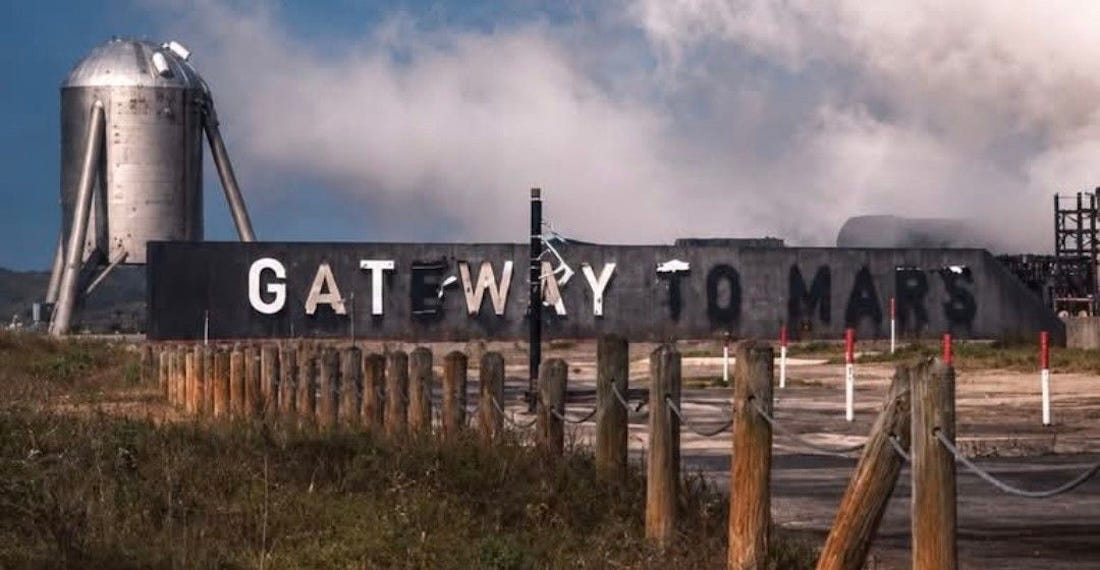
Starship was born as a Mars-going rocket, and the argument for it then was simple. Launch costs were the biggest barrier to settling Mars. The only way to make rockets cheap was to mass-produce them and stop throwing them away after each launch. So SpaceX set out to build a very big rocket that was rapidly re-usable and could ferry heavy payloads to the Martian surface.
SpaceX was serious both about the ‘rapid’ and ‘big’ parts of this vision for Starship. Their targeted payload to low Earth orbit was 100 metric tons, or about the mass of a fully-loaded Space Shuttle orbiter with a satellite stuffed inside.2 This capacity would make Starship more capable than NASA’s budget-obliterating Space Launch System, and nearly as capable as the 1960’s vintage Saturn V. A Starship that refueled in orbit (another part of the vision) could then go on to land that 100 ton payload on the Moon or Mars. When you consider that the heaviest object ever landed on the Moon weighed 8 tons (Apollo 17), and the heaviest payload to reach Mars weighs one ton (the Perseverance rover), you see the transformative potential of the technology.
Operationally, the giant rocket was supposed to behave more like an airplane, able to launch again within minutes after landing, and to fly many times before requiring a major overhaul. This capability would be a step change from the Falcon 9, whose reusable first stage has to be overhauled for days or weeks between launches, not to mention a dinosaur like the Space Shuttle orbiter, which needed a full rebuild between launches.
As a final touch, Starship would use methane and liquid oxygen as rocket fuel, opening the possibility of refueling the rocket from (hands begin waving) autonomous solar-powered propellant factories on Mars.
So the original Starship vision consisted of four elements:
A huge, cheap rocket
That is rapidly reusable
And can refuel in orbit
Or on the surface of Mars.
Let me go through what’s left of this vision in descending order of plausibility.
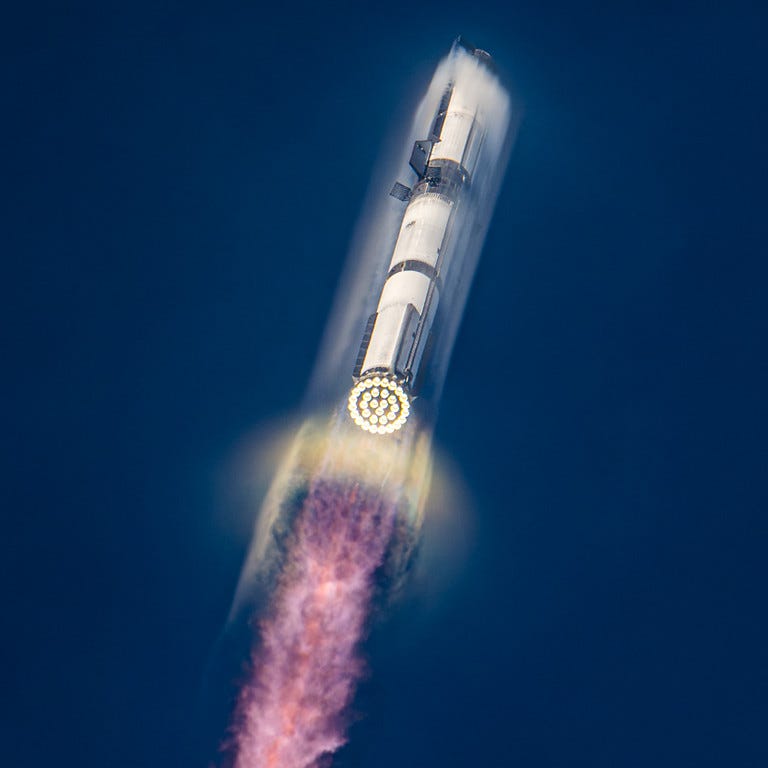
Super Heavy, the enormous first stage powered by 33 Raptor engines, has somehow become the least contentious part of the Starship design, despite looking like a mad rocketeer’s fever dream, a cluster of giant engines tucked under a skyscraper of rocket fuel. The only point of reference for Super Heavy before it was built was the Soviet N1 rocket, a mighty vehicle that blew up on all four of its launch attempts and discredited the idea of ‘just add engines’ for a generation. But SpaceX made it work, almost from the first launch.
Today Super Heavy is a piece of pure electric-guitars-and-screaming-eagles space awesomeness, from the gorgeous purple exhaust plume full of shock diamonds, to the grace with which it descends on a single swiveling column of flame until the rocket comes to rest on the chopsticks that catch it.
The fact that SpaceX seems to have had less trouble with this vast booster than the simpler upper stage was one of the big surprises of the flight test campaign. While Super Heavy had some early engine failures on the first two flights, these were ironed out quickly. The fifth and seventh test flights demonstrated a successful return of Super Heavy to the launch pad, and the booster from that second catch was then re-flown two flights later.
If SpaceX was using Super Heavy as the first stage in a more traditional rocket stack, there would be no reason to write this post. Both the booster and the Raptor engines that power it are a giant leap forward and the main reason it’s so hard to dismiss ambitious promises from SpaceX about the rest of the system.
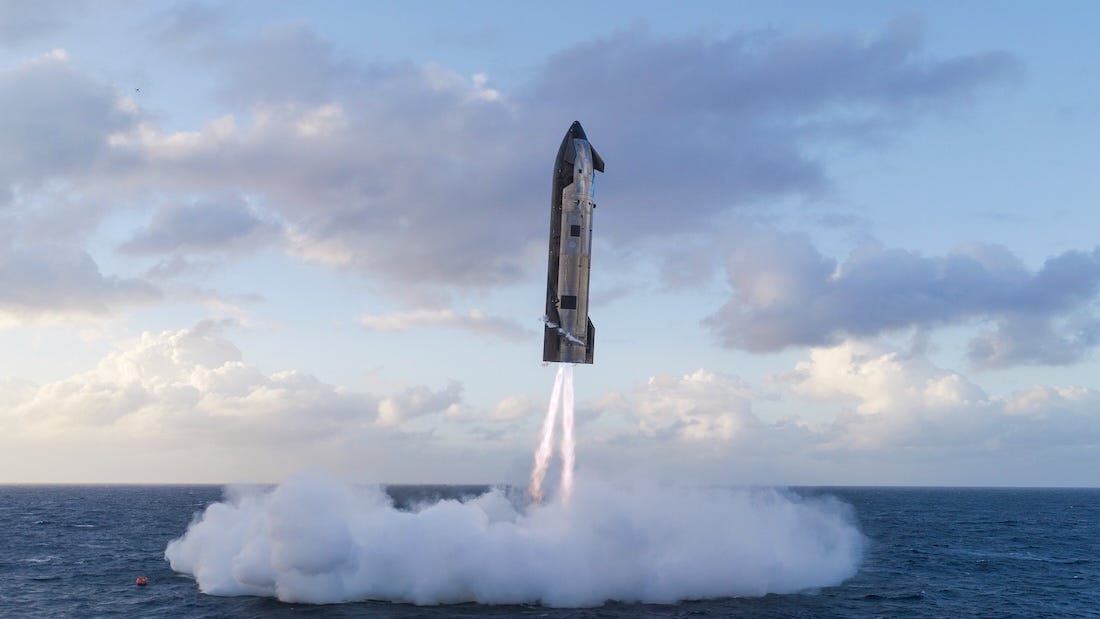
The second stage of Starship, confusingly also called Starship, is where SpaceX has struggled. The problem is mostly one of size. In order for Super Heavy to fly back to its launch site, Starship-the-rocket has to stage very early, which pushes a lot of mass and propellant into the second stage. That stage is about as tall as the Space Shuttle and its attached fuel tank put together, and when fully fueled, nearly as heavy as the entire Space Shuttle stack was when it sat on the launch pad.
Keeping this hunk of spacecraft intact and controllable during re-entry requires large control surfaces and a capable heat shield. But for these elements to be re-usable, they have to be sturdy, and ‘sturdy’ in an aerospace context usually means so heavy that it eats through all your available payload.
The early Starship flight tests drove home the difference between a rocket that can re-enter once, and one that can survive re-entry dozens of times. On several of those flights, viewers could watch hot gas slicing through the steering flaps in real time, even as the hardy rocket shrugged it off and came to a successful water landing. Some landings left visible damage on the engines, and all of them left the vehicle covered in spectacular burn scars. To what extent the damage is structural, and to what extent it is cosmetic, only SpaceX knows. But it shows the magnitude of the forces at play.
The nightmare scenario for SpaceX is one where making Starship robust enough to survive repeated atmospheric entries leaves it too heavy to carry useful payload. This seems to be what happened with V1. That first iteration of Starship was supposed to deliver 100 tons to low earth orbit, a claim Musk later walked back to 45 tons, then ultimately 15 tons, less than the payload of the Falcon 9. The V2 version of the rocket (a horrible version number to use in rocketry, just saying) managed to lift 35 tons to near orbit, but was also prone to explode, accelerating the shift to the new design that launched on Friday. Starship V3 has incredible new engines and looked peppy on its maiden flight, but it’s not clear how much mass will have to be added back to the rocket before the latest design either stabilizes or gets ditched for an even more ambitious V4.
Put simply, SpaceX is in a race to see whether it can improve performance in the Raptor engines faster than the upper stage of Starship gains weight. The real test for the program will be the first capture and re-flight of an upper stage, because the economics of launch cost are sensitive to just how many times that upper stage can fly. If it turns out a Starship upper stage is only good for a flight or two, the rocket will remain groundbreaking, but cannot meet its more transformative goals.
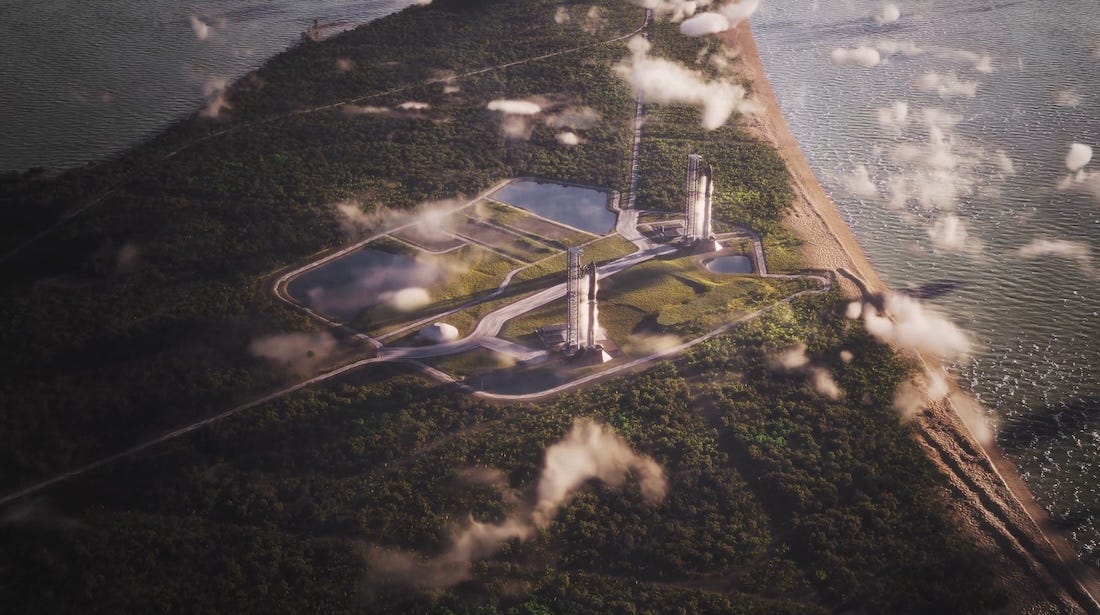
How often will Starship launch? Getting a credible answer is hard because the SpaceX IPO hinges on preposterous numbers that the company can’t disavow yet.
The lower limit to launch cadence is set by SpaceX’s contract with NASA for a lunar lander, which the agency calls the ‘Human Landing System’. HLS has to be refueled from an orbiting depot Starship to get to the Moon, and filling that depot will involve launching a large number of tanker Starships over the span of a few months. How many launches that will take is unknown; I think people would be surprised to see it happen with fewer than ten launches, or more than thirty. Assuming that a fuel depot can hang around in orbit for six months, that implies an operational tempo of about one launch per week, from at least two different launch sites (so that a pad explosion at one won’t ruin the whole campaign).
This would be an ambitious but achievable cadence for Starship, particularly if the tanker Starships didn’t have to be reusable, and could be made without a heat shield or control surfaces. Just how much time SpaceX has to reach this cadence is an interesting question, since right now NASA and SpaceX are locked in a game of chicken around who can commit to the least realistic timeline. But it probably has to get in gear by early 2027.
A more ambitious goal would be to match Falcon 9’s cadence of one launch every two days. At that high a launch rate, Starship would also need to match Falcon 9’s high level of reliability (about 1 failure in 200), and expand launch operations across several more sites. SpaceX would also need to find payloads to put on all those rockets, unless you accept their pre-IPO claim that the appetite for Starlink and AI launches will be insatiable for decades to come.
Finally, there is the launch cadence SpaceX actually targets in their S-1, a million metric tons a year to Earth orbit. That frankly preposterous figure implies 25-30 Starship launches a day, with the exact number contingent on how much payload the final version of the rocket can carry. This would be the flight rate of a small regional American airport like Chattanooga or Sioux Falls, except that instead of turbojets SpaceX would be launching skyscrapers full of liquid oxygen and methane from a constellation of launch pads, each one handling multiple launches, catches, and re-stackings in every 24 hour period.
Launching Starship on the hour would also mean permanent no-fly zones for aircraft and a likely environmental backlash against SpaceX, who would be putting significant amounts of water vapor in the stratosphere. Overnight the company would become one of the country’s biggest consumers of methane, electric power, and liquid oxygen. And since a failure rate of 1/200 at this cadence would have Starships falling out of the sky every week, the rocket would have to improve in reliability by at least two orders of magnitude.
In other words, SpaceX’s IPO promise implies a Starship program that looks like airline travel in the early thirties, dozens of flights a day with an accident rate of a few flights per hundred thousand, or about a thousand times more reliable than any modern rocket.
However much you may love SpaceX, there is no number of bong rips that makes this scenario feel real. It’s in the S-1 is to try to prop up the company’s astronomical valuation, but the sooner we can all move past it, the better.
At this point we leave the realm of existing hardware and get speculative.
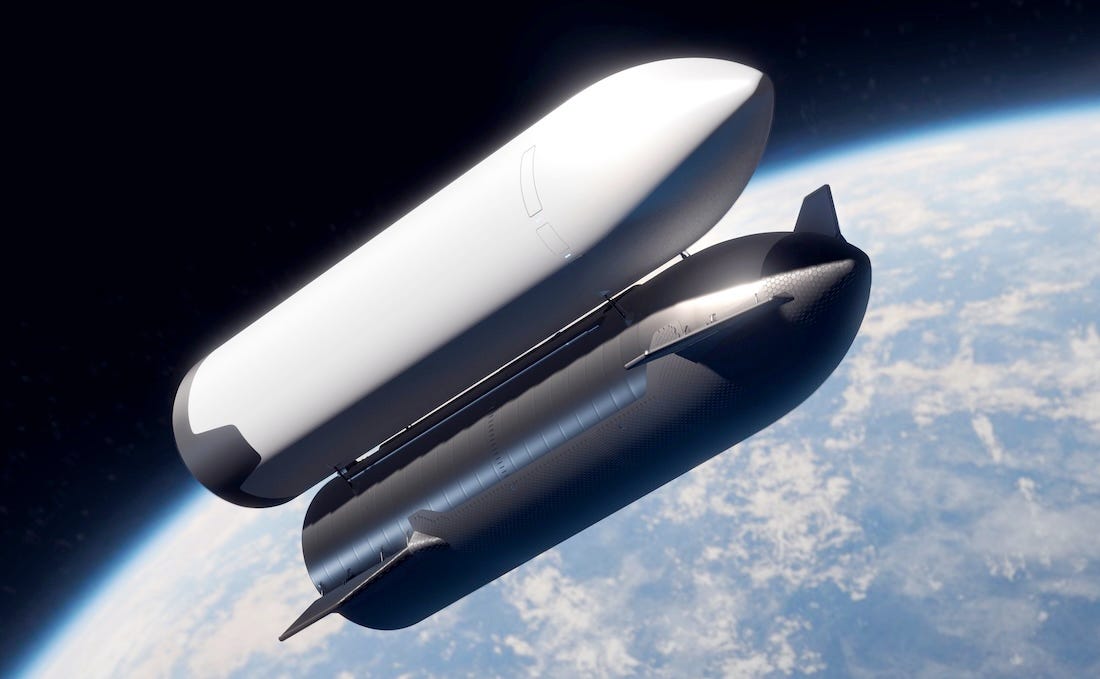
Back when going to Mars was the goal, orbital refueling was a key part of the Starship concept. The heavy Starship second stage arrives in orbit with its propellant tanks almost depleted, and to travel to a destination beyond Earth orbit, it needs to top up. This procedure—pumping cryogenic propellants between two rockets in orbit—has never been attempted.
Now that SpaceX is an AI company, refueling has become something of an awkward side quest. SpaceX can launch as many Starlink and AI satellites it wants on Starship without having to touch refueling with a barge pole. But it is still on the hook to develop the technology for its NASA contract, since the lunar lander version of Starship can’t get to the Moon without it. And turning refueling from an idea to an operational capability has the potential to get expensive, especially if the company is not yet able to re-use Super Heavy and second stages while launching all those tankers.
Multiple factors conspire to make the refueling problem hard:
Historically, valves and seals are two components that love to act up in space. But for refueling to work, two rockets have to come together, form a leakproof seal, and move hundreds of tons of propellant through some elaborate plumbing.
Propellants in zero g exist as a three-dimensional jumble of liquid mingled with gas. Moving them between rockets requires either developing special wicking techniques for use in zero g, or accelerating the docked rockets enough that the propellants inside settle to the bottom of the tank.
Liquid methane and oxygen are both very cold, and the plumbing connecting the two rockets has to be chilled down by spraying it with propellant that flashes into gas. Doing this with minimal propellant loss needs careful geometry and is difficult to model with computers.
When Starship and the fuel depot dock together, the propellant inside will constitute a significant portion of the two vehicles’ mass. As that propellant moves from Starship A to Starship B, it will shift the center of gravity of the combined assembly. This creates challenges if the rockets are being accelerated in tandem to settle propellant in the back of the tank for pumping. It also creates the potential for slosh as moving fluid bounces off the interior of the propellant tanks.
Once propellant has been transferred to an orbital depot, it has to stay there for a long time (weeks or months) without boiling away. Keeping cryogenic gases liquid while a warm planet fills a third of the sky requires active cooling and careful pointing.3
Just like with the Starship heat shield, no one doubts that orbital refueling is possible. The question is one of efficiency: how many Starships have to launch from Earth to fully fuel a Starship that wants to leave orbit? At what point does the sheer number of launches required make the whole idea uneconomical?
NASA’s official schedule for the Artemis missions anticipates landing a crew using HLS in late 2028. Working back from that date, SpaceX would need to have orbital refueling operational by the end of next year, giving the company 18 months to complete a sequence of increasingly demanding test objectives:
Complete an orbital test flight of Starship.
Launch two Starships at once and demonstrate that they can rendezvous in orbit and dock together.
Transfer some quantity of propellant between two docked Starships in orbit as a proof of concept.
Transfer a full load (about 100 tons) of propellant from a freshly-launched Starship to an orbiting Starship configured as a fuel depot.
Keep the fuel depot in orbit for several weeks to test station-keeping and determine the boil-off rate of stored propellant.
Demonstrate a full orbital transfer of propellant (~1200 tons) from the orbiting depot to an empty HLS Starship.
Fortunately for SpaceX, NASA’s timeline for landing on the Moon is even less realistic than these development milestones. But it does set up an interesting dynamic of who will blink first, and who will bear official blame for the inevitable delay of the first Artemis landing into the 2030’s.
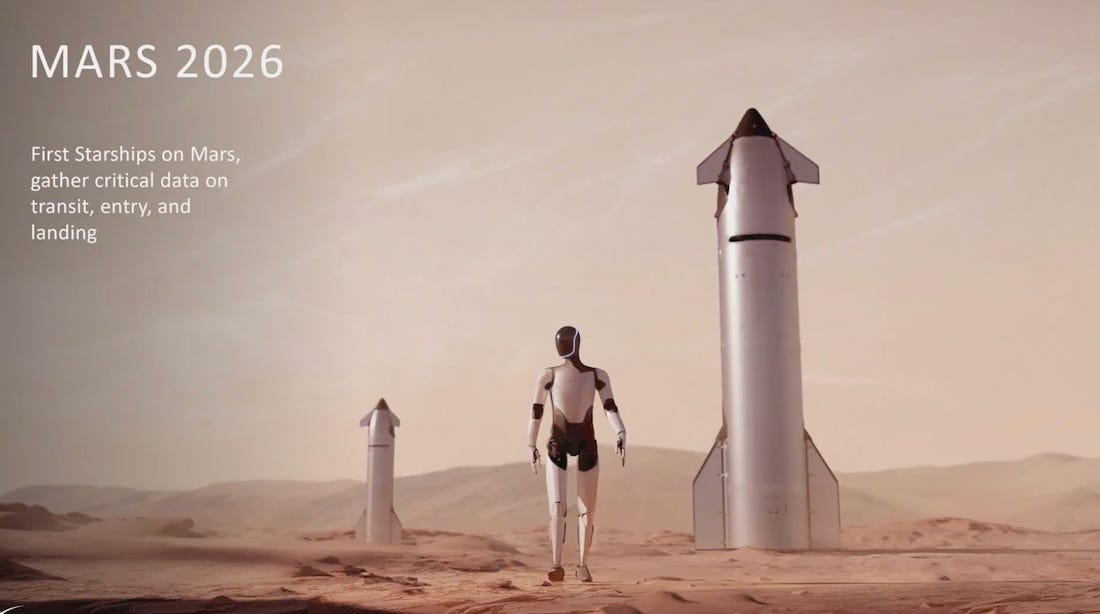
The final and most ambitious part of the Starship vision is landing on Mars. Back in the innocent days of 2025, Elon Musk promised that flights would start this year, with serious tonnage starting to arrive on the planet in 2029.
But it’s hard to read SpaceX’s S-1 filing and estimate the chances of a Starship landing on Mars as anything higher than zero. The company’s core business is no longer space flight, but data center rentals and B2B enterprise sales in low Earth orbit. Not a penny of the company’s claimed total addressable market of $26 trillion(!!) comes from sending space nerds to Mars.
This is bittersweet news. The bitter part is that before the xAI merger, SpaceX seemed legitimately committed to trying to land Starship on Mars. In an earlier post, I wrote about how every lander since Viking has been trapped in the same basic aeroshell design, making it hard to put more than two tons of equipment on the Martian surface at a time. Starship was our best chance at breaking that barrier, and it looked like SpaceX was even going to develop the capability on its own dime. NASA faced the real possibility of being able to land a hundred tons of stuff on Mars for about what it costs to send a single rover there now.
Unfortunately, every Starship that launches into space is also a big piece of machinery that stands out in the Texas sun. Bugs crawl on it, water collects in it, and bacteria, mold and fungi cover it from tip to stern. Like any large spacecraft, Starship is much too big to sterilize. And some of the creatures that might take up residence on it are unfortunately durable enough that they would survive a six-month trip through space, making every Starship that landed on Mars a severe contamination risk.
As a practical barrier, this meant nothing to SpaceX. Musk has been clear that he has no interest in the contamination problem, and it’s hard to imagine a Trump-led FAA withholding a launch license from him to protect the sanctity of the 1967 Outer Space Treaty. But for people who dislike contaminating Mars on the merits, sending Starships to land there was a Faustian choice. On the one hand, it would enable large-scale robotic exploration, but on the other hand, it might vitiate the whole purpose of sending all those robots in the first place.
But now—bittersweet! There is no more Mars plan. We’re back to the pre-Starship struggle of trying to figure out how to land heavy stuff on the planet, but at least nobody is trying to bury giant septic rocket hulls there to live in.
Six months ago, the SpaceX story was clear. The company’s long-range goal was to colonize Mars, and its lucrative launch business and Starlink internet service existed to subsidize the development of Starship, a rocket that would transform the economics of heavy launch and make the Mars plan real.
Today, the story is confusing. SpaceX is suddenly an AI company with a small sideline in rockets, claiming a $2 trillion valuation on mostly vibes. Starship is no longer a rocket for colonizing Mars, but has turned into what the Space Shuttle was trying to be early in its design—a cheap, reusable two-stage space truck.
I can’t imagine Starship failing in this diminished role, even if making the upper stages fully reusable turns out to be too expensive. SpaceX is bound to get some variant of ‘Space Shuttle’ Starship working, lowering its launch costs substantially, and fulfilling its dream of data centers in spaaaaace.
The interesting question is what happens with orbital refueling. Over the last half decade, NASA had engineered an enviable situation where Elon Musk and Jeff Bezos were both willing to go out of pocket to develop a transformative technology, just to stick it to the other guy. The nation’s space agency had finally found a way to harness the power of our space billionaires. But with SpaceX pivoting from Mars to AI, orbital refueling is no longer on the critical path for the company’s goals. And Blue Origin, the other player in the refueling game, might also decide to abandon those efforts in favor of launching technically simpler transfer stages.
If SpaceX decides to follow through on its HLS commitment, and finds a way to make refueling routine and economical, then that really will open up the Solar System to exploration. We will be able to cheaply send probes and rovers to the outer planets, darken the sky with space telescopes, and build significant infrastructure on the Moon and Mars. But if refueling turns out to be impractical, or too expensive for commercial applications, then Starship will end up a less transformative technology than some of us space nerds had hoped.
Either way, though, what an impressive piece of hardware! If SpaceX hadn’t built it, people would call it impossible, and that’s the highest form of praise for the engineers who have beavered away on this rocket for so many years now.
Scott Manley always has nice Starship recaps, and his video going over the latest test flight is no exception.
The SpaceX S-1 makes for some amazing reading, even if you normally don’t curl up at night with SEC filings.
This 2024 paper is probably the most detailed attempt to model a Starship Mars mission from the outside. About feasibility of SpaceX’s human exploration Mars mission scenario with Starship (2024). DOI 10.1038/s41598-024-54012-0