On Tuesday, December 9th, Anthropic announced that they were donating the Model Context Protocol open source project to the Linux Foundation, under a new umbrella called the Agentic AI Foundation.
There were two main reactions to this news.
Most (80-90%) people across platforms like Reddit and X expressed support and enthusiasm. MCP is an open standard for connecting data to AI, and is intended to be universal. That type of infrastructure makes sense to be owned and managed by a neutral third party. The Linux Foundation is well-respected and already is home to a number of critical open source infrastructure projects.
A smaller subset (10-20%) of the reactions, particularly those on HackerNews, interpreted the announcement as Anthropic ‘giving up’ on MCP, and questioned what this means for the protocol’s future significance.
I think those reactions, in that proportion, are probably about right.
To break it down, I’ll discuss:
Some (ok, a lot of) history and background on open source
Why I think this choice is mostly a win for MCP and for the ecosystem
Why Anthropic is willing to let go
How this compares to A2A’s similar announcement earlier this year
Open-source software (OSS) is software where the source code is public, so anyone can freely use, modify, or share it. An HBS study estimated that the value of OSS to the firms who use it is $8.8 trillion, which I find mind-boggling.
Many iconic OSS projects started as personal side projects that later became essential to broader infrastructure. Linux, created by Linus Torvalds, is the canonical example.
I’m now required to share the iconic XKCD meme on this topic:
Somewhere along the way, people started to realize that depending on unpaid individual maintainers for critical infrastructure wasn’t a very good idea for business continuity or security.
So, in 2000, the Linux Foundation was created to help shepherd the growth of Linux with more structure and a mechanism to attract funding.
Organizations like Google, Hitachi, and Oracle could pay for Linux Foundation memberships, currently ranging from $5K - $500K/year, and those funds would go towards continued development, education, training, security, and more, for the open source projects.
In addition to greater stability, this is also better for optics. If you’re a company CFO, it also makes you feel much better to donate $500K to the Linux Foundation and get a shiny membership than it does to wire $500K directly to the random person in Nebraska, even if the outcomes are similar.
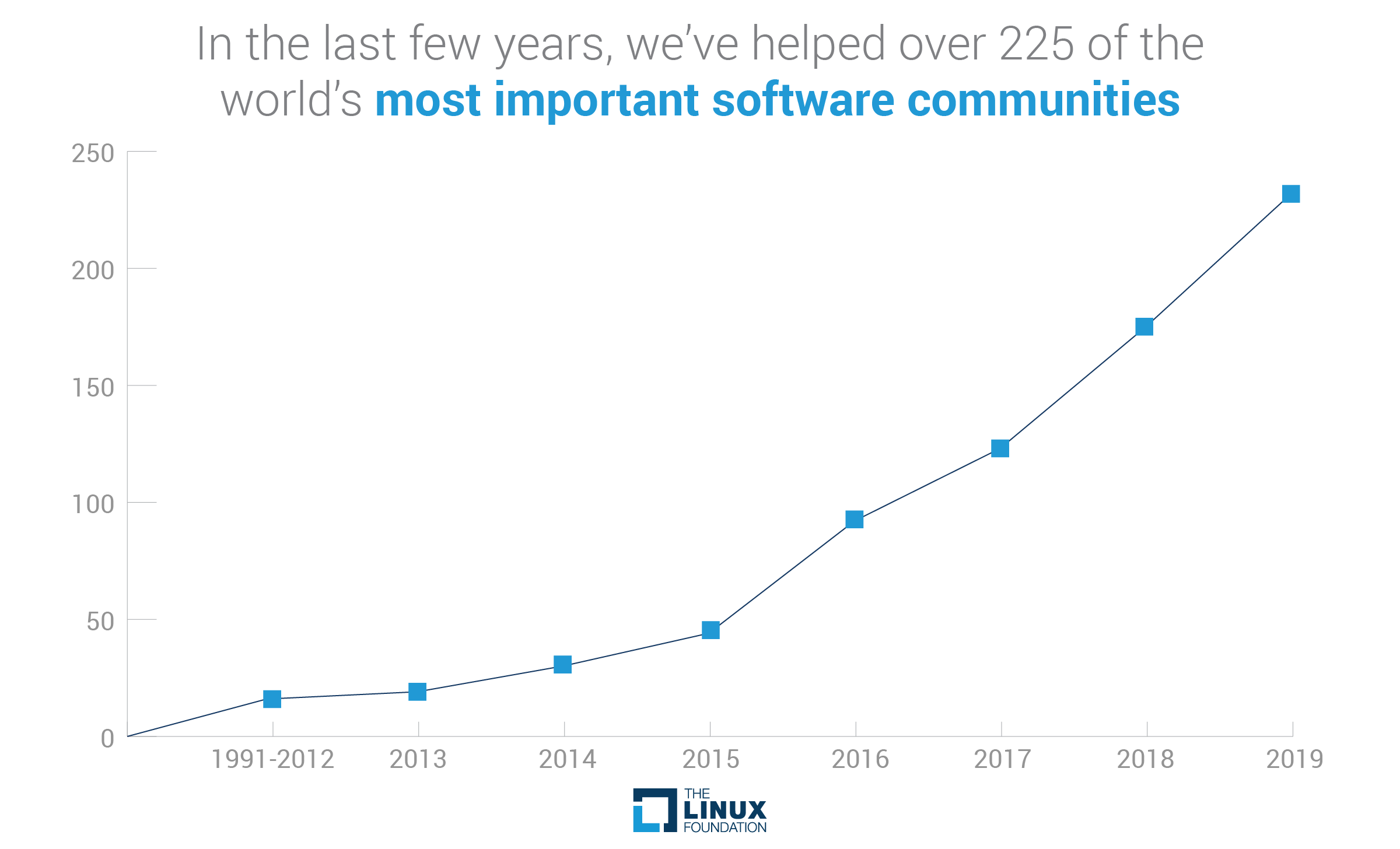
Soon, the Linux Foundation expanded to support more, and more, and more OSS projects, and now includes more than 800 projects:
In parallel, we also saw the rise of commercial open source software (COSS).
As it turns out, it can be really hard to take free software from the internet and deploy that securely, and reliably, at scale, within your enterprise.
So, shortly after Linux was created in 1991 and started to gain popularity, Red Hat was founded in 1993 to provide a ‘stable, accessible distribution’ of Linux. Companies who wanted to DIY could still use the free open-source version and build on it themselves; companies that wanted more support could buy the commercial version from Red Hat. This turned out to be a successful business model; Red Hat hit $1B in revenue in 2021, and inspired many other products.
While Red Hat focused mainly on offering support and services around a fully open-source offering, it’s more common now to see an ‘open-core’ model. This means that the ‘core’ software is free and open-source, but the commercial company provides additional features and managed hosting for paid users.
MongoDB is a great example: they have a limited open-source ‘community edition’, an ‘Enterprise edition’ that offers more features but requires self-hosting, and a hosted SaaS service called MongoDB Atlas.
Commercial OSS is a great thing. Open-source software is more transparent and often more secure, develops and improves quickly with community involvement, and provides a clear way for users to get started for free, or pay if they need more support. Commercialization creates a sustainable funding mechanism that allows that to continue and ensure that the creators and maintainers benefit from their work - above and beyond what we see from non-profit stewards like the Linux Foundation.
However, this does create complex incentives. Commercial stewards and community contributors don’t always share the same priorities.
A recent example has been the relationship between Next.js, an open-source web framework, and Vercel, a company that provides paid hosting services around Next. Vercel has repeatedly come under fire for using their control over the open-source project to evolve Next.js in ways that benefit their commercial entity, at the cost of open-source flexibility and interoperability.
Here’s an example gripe that racked up hundreds of likes on HN:
Vercel has been similarly criticized for their steering of React, a web framework that pairs tightly with Next.js.
React was created by Facebook/Meta in the early 2010s and open sourced in early 2013. For the next 12 years, React remained under the control and stewardship of Meta, becoming increasingly popular and influential.
Interestingly, in October 2025, Meta announced that React would be moving under a newly created foundation, the React Foundation, within the Linux Foundation. Much like the MCP transition, this move was broadly cheered by the community, as it would more actively separate technical governance from any one company’s business goals.
This is just one of many examples of how commercialization can create tension or tricky incentives at times. To be clear: I think Vercel is an extraordinary company, but I also think it’s hard to be a truly neutral technical steward of an open-source project that you make money from.
MCP has followed a similar arc. It started as an internal Anthropic hackathon project, then grew rapidly as an open standard. OpenAI, Google, Microsoft, and others adopted it quickly.
Over time, MCP formalized its governance, with maintainers that spanned a number of major companies:
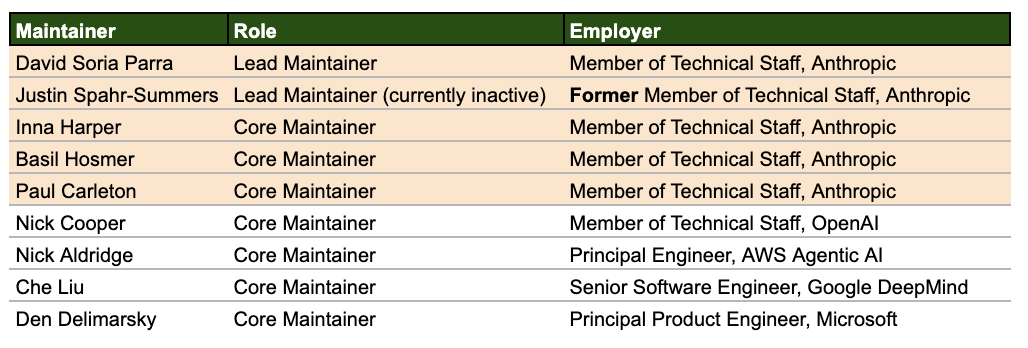
However, ultimately, MCP’s governance wasn’t neutral, it was Anthropic-led. The two MCP creators from within Anthropic were the lead maintainers, acting as ‘Benevolent Dictators for Life’ (a common governance model in open source, but where the leaders have full veto power and can’t be unseated).
Moving MCP to the Agentic AI Foundation gives the Technical Steering Committee true authority. The TSC can now oust the lead maintainers if they so choose, and the project’s neutrality and separation from Anthropic’s business goals increases. This, in turns, makes other companies more excited to continue investing and supporting MCP as an open, neutral standard.
It’s also nice that MCP will be under a new umbrella focused on Agentic AI, and accompanied by both Goose, an MCP host/client from Block, and agents.md, a standard format for providing info to AI agents, from OpenAI. In an evolving space, where new competing standards are regularly emerging, AAIF is well-positioned for leadership and to help drive convergence over time.
The negative view is that Anthropic wouldn’t give MCP away unless its strategic value had fallen.
Realistically, ‘owning’ an open-source standard wouldn’t provide Anthropic with a meaningful competitive advantage without risking Vercel-esque criticism at some point down the line.
Second, MCP has come under scrutiny in recent weeks, as companies (led by Anthropic!) have looked for more token- and context-efficient ways to get similar results. Anthropic has been a leader here, proposing new strategies like advanced tool use. This move frees Anthropic to let the Linux Foundation carry on core development, while they innovate on top of and around MCP.
Finally, team stability is also a challenge in a fast-moving (and profit oriented) tech company. Two early MCP team members have already moved on. The foundation structure may be better for building long-term continuity.
If MCP had been uniquely strategic for Anthropic, they probably would have kept it. But, given the context, donating it buys goodwill, reduces the risk of governance friction, and (I think) strengthens the protocol’s long-term prospects.
Donating MCP was not a novel idea. In addition to the precedent set by the React Foundation, MCP now also follows in the footsteps of its competing(ish) protocol counterpart from Google, the Agent-2-Agent (A2A) protocol, which Google donated to the Linux Foundation in June.
Unfortunately for Google, who tries really hard on these things, with big press releases and lots of partner quotes, no one really cared.
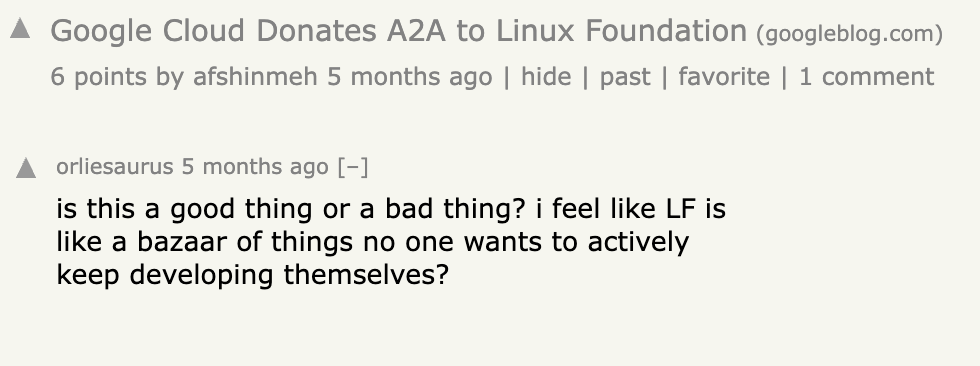
Compare these 6 upvotes to the 286 that the comparable announcement about MCP received.
Although A2A has a lot of benefits and great features, it never successfully built an engaged developer community, and was quickly eclipsed by MCP as the primary standard.
I find this interesting because even though the motion is identical (donating an open source AI protocol to the LF), these two occurences feel very different to me. Google’s choice to donate A2A feels more like giving up, while Anthropic’s choice to donate MCP felt like an effort to ensure long-term neutrality.
I also think it’s a bit odd that A2A lives outside the newly created Agentic AI Foundation (AAIF) that houses MCP, even though the two protocols are functionally quite similar. How this happened (namely, how A2A wasn’t also pulled in to join the AAIF upon creation) goes beyond my understanding of big tech company politics. ¯\_(ツ)_/¯
To summarize, MCP is moving from Anthropic to the Linux Foundation, under the new Agentic AI Foundation.
While some detractors think this means Anthropic no longer wants to invest in MCP, I think this is broadly a good thing for the protocol. It ensures neutral technical stewardship and funding for the open-source project going forward. I also hope it will encourage companies who compete with Anthropic, like OpenAI and Google, to continue using and investing in MCP.
Open source software creates enormous value, so I’m optimistic that the Linux Foundation and its many projects, now including MCP, will continue to grow and thrive!
Thanks for reading! This post is public so feel free to share it.