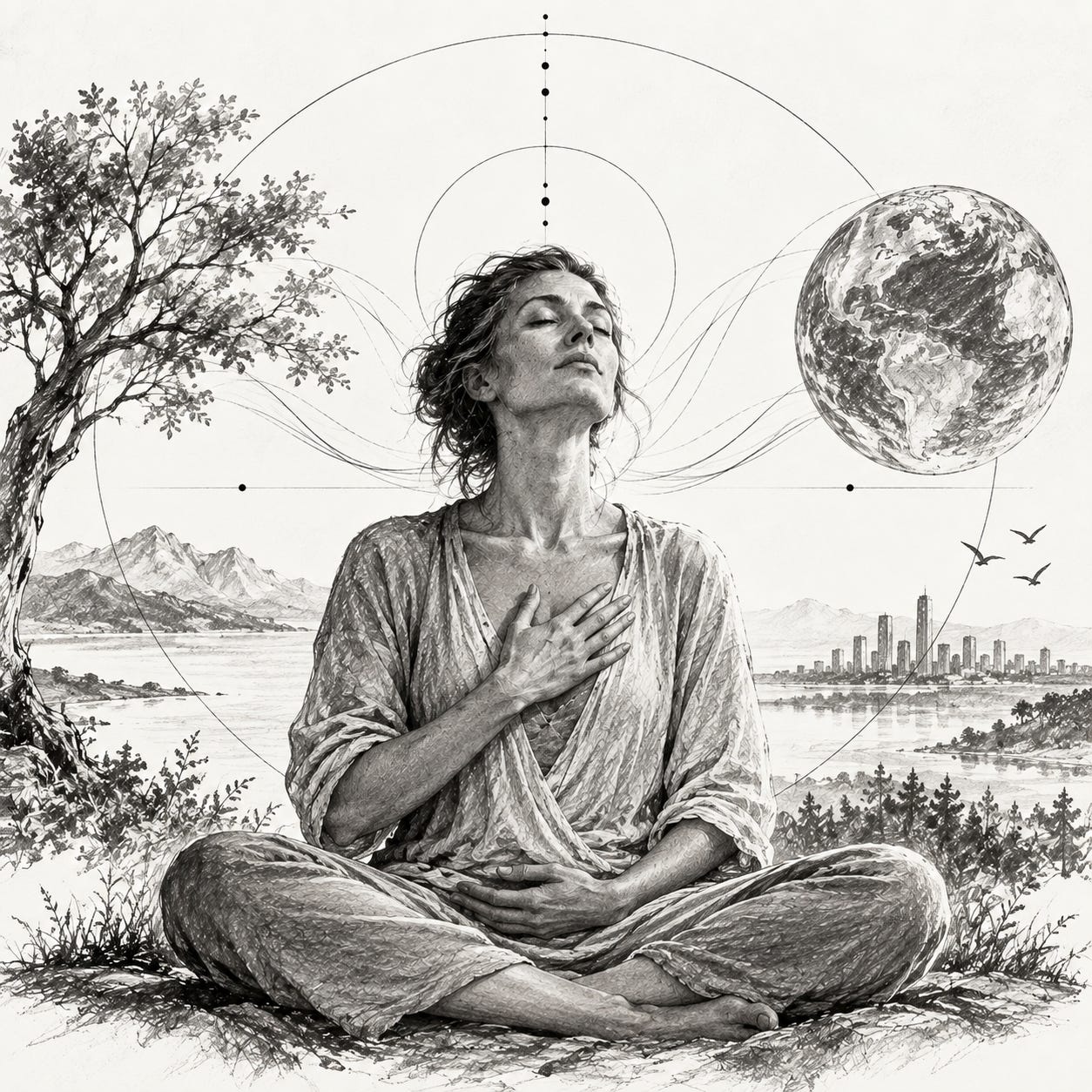
We are building intelligence faster than we are developing the consciousness to live with it.
Essay by Maya Christobel
As I look at the extraordinary possibilities opening around artificial intelligence, I keep coming back to a more fundamental question. We speak about AI freeing human beings from repetitive work, democratizing intelligence, accelerating medicine and science, personalizing education, and giving us time and capacity to become more fully human. But who, exactly, is the human being who will receive this freedom?
We are not entering the AI age as a mature civilization. We are entering it carrying enormous technological sophistication alongside profound emotional, relational and spiritual underdevelopment. We have spent centuries elevating intellect, rationality, competition, productivity and optimization while treating the intelligence of the heart, the body, relationship and consciousness as secondary. We know how to split atoms, sequence genomes, place telescopes in space and create machines that converse with us. Yet we remain remarkably poor at regulating fear, repairing relationship, tolerating difference, sharing power and loving without possession.
So my question is not simply whether AI can free us to become better humans. My question is whether we are developmentally prepared to use that freedom.
If AI gives us more time but we fill it with distraction, have we evolved? If AI gives us abundance but we become more acquisitive, have we advanced? If AI gives us extraordinary intelligence while our relationships continue to fracture, our loneliness deepens and our institutions remain organized around domination, have we created a more intelligent civilization, or simply a more powerful adolescent one?
One of the deepest errors of modern civilization may be that we have confused intellectual capability with human development. They are not the same thing.
A person can be intellectually brilliant and emotionally primitive. A corporation can be technologically sophisticated and relationally destructive. A nation can possess astonishing scientific capability while remaining governed by fear, tribalism and domination. Humanity has repeatedly demonstrated that knowledge does not automatically produce wisdom.
Our technologies have evolved exponentially. Human nervous systems have not. Beneath our smartphones, satellites and artificial intelligence are organisms still deeply organized around ancient imperatives: survival, status, attachment, sexuality, belonging, territoriality and threat.
This is why I would describe humanity as developmentally asynchronous. We are not simply immature. Human beings are capable of extraordinary compassion, creativity, sacrifice, insight and higher states of consciousness. But those capacities coexist with primitive responses that can be activated astonishingly quickly. Our technological power and our collective emotional development are moving at radically different speeds.
And now AI enters the gap.
E. O. Wilson, “We have Paleolithic emotions, medieval institutions, and godlike technology.”
Much of the public conversation about AI risk asks whether artificial intelligence will become too powerful, autonomous or uncontrollable. Those questions matter. But there is another risk underneath them: What happens when extraordinarily powerful intelligence is placed in the hands of a species that has not yet learned how to wield power consciously?
The danger is not intelligence alone. We are fearing the wrong species: Ai is not the threat, human unconsciousness is.
The danger is intelligence amplified through unresolved human fear, greed, narcissism, tribalism, trauma and the desire for control.
AI is an amplifier. It can amplify scientific discovery, education, creativity and cooperation. It can also amplify surveillance, manipulation, warfare, extraction, polarization and concentration of power. The technology does not arrive outside human consciousness. It enters directly into it and reflects the developmental stage present.
The developmental gap is therefore the distance between what we are technologically capable of doing and what we are emotionally, relationally and morally capable of holding.
That gap may become one of the defining dangers of this century. I believe this is where I want to stand, in the gap, to close it in whatever way I can within myself and assisting others in deepening their personal awareness of themselves, others and the cosmos.
There is an intoxicating story about the AI future: machines will perform increasing amounts of human labor and we will finally be free to create, love, learn, raise our children, care for one another and explore consciousness.
I want that future. I believe it is possible. But there is an assumption hidden inside it that deserves examination: that when human beings are liberated from labor, they naturally use that freedom for development.
History does not give us reason to assume this.
Free time does not create wisdom. Abundance does not create generosity. Intelligence does not create love. Technology does not automatically liberate consciousness.
Without an intentional developmental culture, AI could free us from work only to deliver us more completely into entertainment, consumption, compulsive stimulation and algorithmically engineered distraction. It could create extraordinary convenience while weakening the very capacities required for meaningful life: patience, frustration tolerance, embodied presence, sustained attention, reciprocity, deeper intimacy with all of life and the ability to be with another human being who does not instantly accommodate us.
So the real opportunity is not merely freedom from labor. It is freedom for development.
And those are profoundly different things.
After 40 years and two degrees from Harvard in Developmental Psychology this questions if formost on my mind and the impetus for me as a teacher. Imagine if we invested even a fraction of the resources now pouring into machine intelligence into developing human intelligence, human consciousness, in its fullest sense.
Not simply IQ. Not more information. Not greater productivity.
I mean emotional literacy. As a civilization we are sorely illiterate. Nervous system regulation. Secure attachment. Relational intelligence. Embodied awareness. Conflict transformation. Conscious sexuality. Parenting. Empathy. Discernment. Contemplative capacity. The ability to tolerate ambiguity. The ability to recognize projection. The ability to hold power without domination. The ability to remain present when another person is different from us.
These are not secondary skills in an AI civilization. They must become primary ones.
If machines become better at calculation, memory, pattern recognition and information retrieval, then the qualities we have historically dismissed as ‘soft skills’ may become some of the hardest and most valuable capacities human beings possess.
Who can listen without preparing a defense? Who can recognize fear before turning it into aggression? Who can remain curious in conflict? Who can repair after rupture? Who can hold complexity without immediately dividing the world into allies and enemies? Who can experience power without needing domination? Who can love another without converting love into possession?
Who of us is developmentally evolved enough to observe ourselves, pause and take personal responsibility in every circumstance, discern what is happening from the inside out and then course correct our response instead of living in a continual state of reactivity to what is coming at us, expected of us, or continually being subservient to our fears.
These questions sound personal. In the AI age they become civilizational.
Martin Luther King Jr., “We have guided missiles and misguided men.”
This is where I see one of AI’s most extraordinary possibilities. The same technology that threatens to magnify human immaturity could also help us develop capacities we have never successfully taught at scale.
Imagine a child having an AI tutor not only for mathematics and history but for emotional vocabulary, perspective-taking, and conflict repair. Imagine young people learning how their nervous systems respond to threat, how attachment patterns form, how advertising manipulates desire, how algorithms compete for attention and how to recognize when fear is making decisions for them.
Imagine couples having access to relational reflection before years of resentment become rupture. Imagine parents receiving support in understanding what lies beneath a child’s behavior rather than merely controlling it. Imagine leaders having systems that continuously expose blind spots, unintended consequences and perspectives absent from the room.
Imagine education teaching not merely what to think but how consciousness itself works: how beliefs form, how projection operates, how trauma shapes perception, how bodies communicate information, how desire differs from compulsion, how intimacy requires both connection and sovereignty, and how disagreement can occur without dehumanization.
AI could help democratize access to forms of developmental knowledge that have historically been confined to therapy rooms, monasteries, universities, leadership programs and privileged communities.
Used this way, AI does not replace the human relationship. It can help prepare us for it.
We have spent much of human history living under conditions of scarcity: scarcity of food, information, education, medicine, labor and expertise. AI may make at least some forms of intelligence astonishingly abundant.
When something becomes abundant, value migrates.
If answers are abundant, the quality of our questions becomes more important. If content is abundant, discernment becomes more important. If synthetic interaction is abundant, authentic presence becomes more important. If productivity is abundant, meaning becomes more important.
And if intelligence becomes abundant, love may become one of the great scarcities.
Not because human beings lose the capacity to love, but because love requires capacities that an optimization culture continually erodes: attention, time, vulnerability, patience, embodiment and the willingness to encounter another being who cannot be completely controlled.
The paradox is breathtaking. At precisely the moment technology becomes capable of giving us more time for relationship, the same technology may become capable of occupying every available moment of attention, and our current state as a species is a profound brain addiction to the dopamine produced on all our technological devices.
The numbers tell the story. In the United States, roughly 15.5 million adults now carry an ADHD diagnosis, more than half of them diagnosed only in adulthood, and among adults aged 18 to 24 the figure has reached 21.7%. Some 7 million American children, 11% of those aged 3 to 17, have a current diagnosis, a million more than in 2016. In Britain, NHS prescriptions for ADHD medication rose 31% in a single year, with the steepest climb among middle-aged women, and among young men diagnoses have risen twentyfold since 2000. Globally, more than 400 million adults are now estimated to live with symptomatic ADHD.
Whether these figures reflect a true erosion of attention, a long-underdiagnosed condition finally being named, or both, the conclusion is the same: we have become a civilization in which the capacity for sustained attention is now being medicalized at scale.
The battle for the future may therefore be a battle for human attention. And attention is one of the fundamental currencies of love.
Simone Weil, letter to Joë Bousquet, 1942: “Attention is the rarest and purest form of generosity.”
When I use the word Love here, I do not mean sentimentality, romantic love, or the myriad of ways we love our children, parents or animals. I am interested in Love as Source: love as an organizing field through which we recognize relationship, interdependence and intrinsic worth.
Love at this level is not merely an emotion. It is a developmental capacity.
It is the capacity to encounter another person as a subject rather than an object. To remain connected without erasing difference. To hold one’s own sovereignty while honoring another’s. To experience intimacy without possession. To care about consequences beyond one’s immediate self. To recognize that intelligence, power and freedom acquire meaning through relationship.
This kind of love requires development. Infants cannot do it. Adolescents struggle with it. Adults do not automatically acquire it simply because they age.
Civilizations do not automatically acquire it either.
Perhaps this is why the AI moment is so consequential. It is confronting humanity with powers that demand capacities we have treated as optional.
For centuries we have privileged exactly the capacities machines are now becoming extraordinarily good at: memory, calculation, analysis, prediction, categorization and optimization.
And suddenly the mirror speaks back.
If intelligence is no longer uniquely yours, what is?
Our answer cannot simply be that humans are better workers. Machines may eventually outperform us across enormous domains of work. Nor can our answer be that humans alone create art, language or ideas. Those boundaries are already becoming porous.
The more interesting answer may be that human beings possess the capacity to become conscious participants in relationship.
We can become beings who consciously love.
Love as the capacity to experience interconnection without losing individuality. Love as stewardship rather than domination. Love as the ability to remain present to suffering rather than dissociate from it. Love as responsibility to generations we will never meet. Love as an organizing principle through which intelligence becomes accountable to life.
AI cannot answer for us whether we choose to become that civilization.
That question cannot be outsourced.
We hear constantly about the AI race: which company will build the most capable model, which nation will control the chips, who will achieve artificial general intelligence first, who will own the infrastructure of intelligence.
Those races are real. But there is another race underway that may matter even more.
Can human consciousness develop quickly enough to become a responsible steward of the intelligence we are creating? From my vantage point this essential-to-our-survival outcome is a big question mark.
If the answer is no, AI may magnify the adolescence of our civilization. Our unresolved patterns will acquire unprecedented computational power.
If the answer is yes, AI could become something very different: a catalyst that helps humanity move beyond the civilization of extraction and optimization toward a civilization organized increasingly around relationship, stewardship, consciousness and life.
This does not require every human being to become enlightened. Human evolution has never worked that way. Cultural change occurs when enough people, institutions and systems begin operating from a different developmental logic that new possibilities become normal.
We do not need a perfect humanity before using AI. But we do need to make human development an explicit part of the project.
I increasingly wonder whether AI represents something larger than another technological revolution. Perhaps it is an evolutionary confrontation.
Humanity has externalized intelligence. We have built a mirror capable of speaking back to us, learning from us, amplifying us and increasingly acting in the world.
And that mirror exposes an uncomfortable truth: greater intelligence alone does not solve the human condition.
We already know enough to feed the world. We already know enough to understand much of what damages ecosystems, relationships and human health. Our failures are not solely failures of information. They are failures of coordination, consciousness, incentive, courage, relationship and care.
AI can increase what we know. It cannot, by itself, determine what or how we should love.
That is the threshold we are standing at.
The next stage of civilization cannot simply be more intelligent. AI can give us that. The next stage has to be more conscious.
A mature AI civilization would not measure progress solely by the power of its models, the speed of its economy or the amount of labor it automates. It would ask whether human beings are becoming more capable of relationship. Whether children are more securely held. Whether communities have greater trust. Whether people experience greater agency and meaning. Whether power is exercised with greater accountability. Whether technology strengthens or fragments our capacity to be present to one another.
It would understand that consciousness and relationship are infrastructure.
It would recognize that the purpose of intelligence is not intelligence itself.
Intelligence must ultimately be in service to life.
Carl Jung, “Who looks outside, dreams; who looks inside, awakes.”
This is why I do not see AI only as a threat, nor do I see it as an inevitable salvation. I see it as an amplifier and an invitation.
AI can amplify what humanity already is. And it can help create conditions through which humanity becomes something more.
The difference will not be determined by technology alone.
It will depend upon what we choose to educate for, what we reward, what we measure, what we protect, what we refuse to optimize, and what we decide human life is ultimately for.
We may be creating the technology that finally makes our old definition of human advancement obsolete.
If we fail to develop ourselves, AI may give unprecedented power to a civilization still governed by adolescent impulses.
If we accept the invitation, AI may paradoxically become one of the catalysts that helps humanity grow beyond them.
That is the dilemma I see at the center of this moment.
And it is also why I remain hopeful.
Because for perhaps the first time, the inadequacy of intelligence without wisdom is becoming impossible to ignore.
The future will not be secured simply by building better artificial intelligence.
We must also build a civilization capable of receiving it.
And perhaps the deepest work of that civilization will be learning that our greatest evolutionary achievement is not how much intelligence we can create, but how consciously we can love.
“The next stage of civilization cannot simply be more intelligent. AI can give us that. The next stage has to be more conscious.”