A Six-Part Series on What Consciousness Knows About Sex, Love, Death, and Wholeness
* * *
What the separation from our body has done to love, to sex, to dying, and to the human experience of being alive.
* * *
I am resuming this six-part series after a four-day road trip through Scotland, which was not only breathtaking but also revitalizing to my spirit, my love for the life I live, my body, whom I encouraged to hike near Ben Nevis, and my continued sharing about all things to do with Love.
In Part Three, we named the wound that is of epic proportions and has crippled our civilization, erasing our own knowing, our relationship to the sacred body, and to love itself. We traced how a civilization, through layers of philosophy, theology, and deliberate social control, amputated itself from the sacred body. We saw how shame was installed as the most efficient instrument of control ever devised, how the burning of healers was the burning of embodied feminine wisdom, how the suppression of bodily love produces rage, and how the erotic wound and the ecological wound are the same wound at different scales. We ended with the understanding that this is not history. It is living in your body right now, as structure, as nervous system, as the daily experience of a door sealed before you were old enough to ask whether you wanted it there.
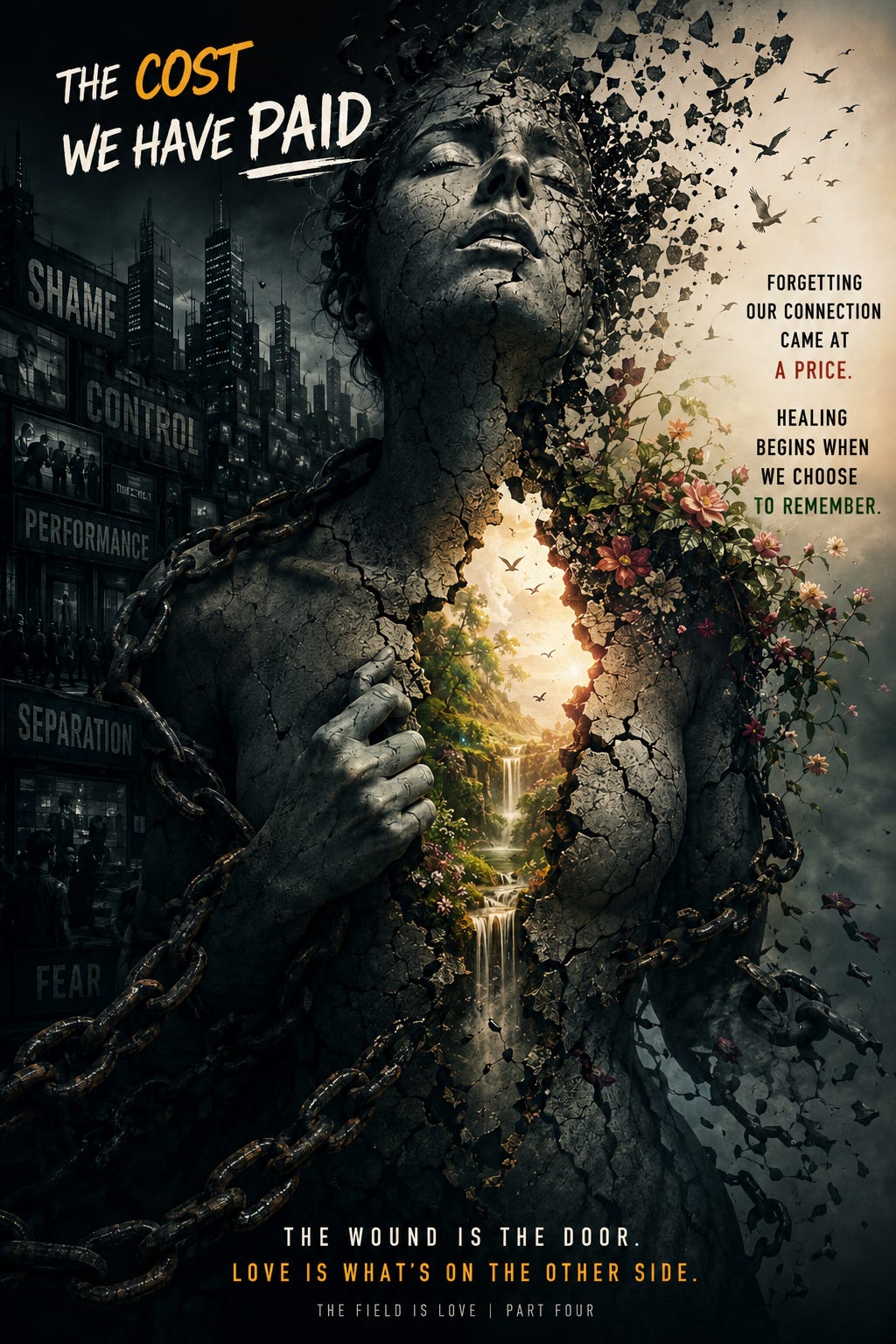
Part Four is where we stop being academic about it. Part Four is where we look, without flinching and without the comfort of historical distance, at what the amputation has actually done. To the way we love. To the way we die. To the way we experience being alive in a body on an ordinary day in a civilization that is, by every serious measure, in the process of destroying itself. Not despite the amputation. Because of it.
These are not gentle statistics. They are not causes for despair. They are the cost, itemized and made visible, so that the choice to begin healing becomes not a spiritual luxury but the most urgent and practical decision a human being can make right now. Look at what we have paid. And then decide whether we are willing to keep paying it.
* * *
Before the statistics arrive, before the research confirms what we are about to name, let us do something more intimate than cite a study. Let us look at a single ordinary day in the life of an ordinary person living inside the wound. And then let us look at what that same day was designed to be. The distance between the two is the cost. Feel it before you measure it.
You wake before you are ready, pulled by an alarm rather than by the body’s own completion of its rest. Your first act is to reach for the phone. Before you have spoken a word, before you have noticed how you feel, before you have made contact with the person beside you or with the quality of the light coming through the window, you are already processing information from the outside world. Already managing. Already performing the self that the day requires. And most of the time, you are not inspired to even get out of bed. You are not lit up from the inside with excitement for your life.
If there is a partner in the bed, you may touch them briefly, out of habit or affection, but rarely with full presence. The body, designed to be the primary instrument of connection, has already been bypassed in favor of the screen. Sex, if it happens at all, happens on a schedule, in a window between competing obligations, oriented toward a conclusion, an orgasm for tension release, rather than an opening of the sacred, to the merging of soul with soul, and then followed by the particular deflation and disconnect after the mere seconds of release. This is the disconnect that no one quite has language for, but almost everyone recognizes: the sense that something almost happened and then did not. That touching love itself was a miss. Then you shower, dress, feed yourself something, and begin the performance of the day.
You move through your hours in a body you are largely unaware of except when it signals pain or hunger or fatigue. Or you are hyper-focused on hair, makeup, workout, clothes, and presentation. Your heart, that first intelligence, that organ that was beating before your brain existed, sends you signals continuously: tightening, opening, the faint, persistent ache of something unfinished, the flicker of joy at something beautiful, the grief that arrives without announcement. You process most of these signals without feeling them.
You have learned, over decades, to convert emotion into thought almost instantly, to take what the body offers as raw feeling and package it immediately into something manageable. Something that does not require you to stop running toward a day filled with what you think is essential and away from love and presence. Something that does not make you vulnerable in a world that has taught you that vulnerability is danger.
You may interact with dozens of people across the day. Colleagues, strangers, the person at the counter, the face on the screen. You are pleasant, functional, sometimes genuinely warm. But genuine contact, the kind where another person’s reality actually lands in you and changes something, is rare. You are good at the performance of connection. You have been practicing it your entire life. What you are less practiced at, what you may have almost no practice at, is the thing underneath the performance: the willingness to let another person see you as you actually are, right now, without the editing, without the competence, without the version of yourself that you have determined is safe to show.
The day ends the way it began: managing. You are tired in a way that sleep does not fully resolve, because it is not physical exhaustion but the exhaustion of continuous self-monitoring, of being perpetually slightly elsewhere than where you are. That lack of flame, lack of inner vitality, will be the number one reason you do not reach for your partner and come together at the end of the day. You reach again for the phone, or the drink, or the screen, or whatever it is that provides the brief relief of not having to be fully present for a few moments.
And somewhere, very quietly, beneath all of it, there is a hunger you cannot name. An unnamed agitation. A sense that the day, which was full of activity and contact and forward motion, somehow did not quite touch the thing that most needed touching. You go to sleep without knowing what that thing is. And tomorrow begins the same way. And more often than not, you do nothing to change it.
Most people reading this will recognize that day. Some will recognize it as their own. All will recognize it as the water they swim in, the cultural norm so thoroughly established that it no longer reads as diminishment but simply as life.
You wake when the body is ready. The first awareness is not external but internal: the quality of your own aliveness in this moment, the weight and warmth of the body you are in, the presence of the person beside you energetically registered, not as a fact but as a felt reality. Something warm in your heart, something soft in your breathing. You breathe in the gratitude to be alive. The presence of skin next to you. The heat beneath the covers. Touch is not a courtesy. It is the body’s first language, the oldest intelligence available to a mammalian nervous system, and you speak it before words, before the day’s obligations arrive, as a genuine act of communion rather than a gesture of routine.
Hands and eyes meet and linger. A smile of recognition. The love in you is fully available for expression. Instantly. No foreplay needed, just presence. No mind distractions, in fact, no mind at all. There is no hurry; there is pressing a kiss into the moment with your lover with such tenderness and power that you both feel fueled for the day. Whether sex happens for an hour or more, there is no clock to watch. It is a sacred, non-negotiable moment that you know in all certainty will make your day stronger, better, more successful, and perpetually fueled by love. It is how your day starts; in your body, your heart, and the field of love. And it does not disappear but is banked throughout the day to fuel more love, more connection to self and others, and keeps the flame of your soul at the center of everything you do.
And the sex you have, when it happens, is not a transaction between two people managing their needs. It is what the Tantric traditions always understood it to be: an act of genuine meeting, entered without destination, without performance, without the monitoring self checking whether it is going well. Two bodies in full presence with each other, following the intelligence of sensation rather than the script of expectation, allowing the boundary between self and other to become genuinely permeable, and resting in that permeability not as a means to an end but as the experience itself. What follows is not deflation but expansion: the particular quality of aliveness, of genuine contact, that the body was designed to carry into the rest of the day, informing everything it touches with the resonance of having been fully arrived. Fully alive.
The body is not bypassed throughout the day. It is consulted. Recognized. Listened to with reverence. Fully felt. Its signals, the tightenings and openings, the grief and the joy and the inexplicable longing, are not immediately converted into thought and managed away. They are felt. Not indulged, not dramatized, but genuinely felt, because the body that is allowed to feel its own experience is the body that can be genuinely present with the experience of others. Empathy is not a moral achievement. It is a physiological capacity. And it is available only to the person who is present enough in their own body to feel what another body is broadcasting.
Contact with other people across this day is genuine contact: moments of actual meeting, of seeing and being seen, of allowing the reality of another consciousness to land rather than to be processed and filed. Where being seen and heard is a covenant not a skill you cultivate. This does not require extraordinary circumstances or spiritual achievement. It requires only the willingness to be actually present, which is to say the willingness to bring the whole self, body, and feeling and attention and genuine curiosity, into contact with the whole reality of the moment. In a body and a culture organized around this willingness, love is not a feeling that visits occasionally. It is the medium through which ordinary life is conducted. The resting state of a human being who has not been severed from their own nature.
The day ends not in exhaustion but in completion. There is tiredness, the honest tiredness of a body that has been genuinely used, genuinely present, genuinely in contact with the life it was living. But not the grey depletion of continuous self-monitoring. Not the unnamed hunger. Not the sense of a day that moved through you without quite touching you. The body knows, at the end of such a day, that it has been here. That it has met the day as it actually was rather than as it needed to be managed. That the love it is capable of has been exercised rather than withheld. That it is, in the most precise sense of the word, alive. And no one in literature could write about this more powerfully but Anais Nin
“Only the united beat of sex and the heart together can create ecstasy.” Anais Nin
This is what the Tantric texts were describing. Not technique. This.
“She does not reach for him. She arrives at him. There is a difference that the body knows even when the mind has no language for it. She is here, fully, without the part of her that is always already somewhere else, planning, monitoring, managing the distance between what is happening and what she needs it to be. He feels that. The body always feels that. And in feeling it, something in him that has been guarded since before he knew he was guarding it, releases. Not because she has done something. Because she has stopped managing what she is. They breathe. Time does not stop. It simply becomes irrelevant. The energy that was moving toward its familiar conclusion turns instead and moves deeper, the way water, meeting no obstacle, simply continues to fill the space it is given. There is no performance here. There is no goal. There is only this: two forms of the field, meeting in the oldest recognition available to a human body, knowing each other as what they both came from, and what they will both return to.”
This is not a fantasy. This is not a description of enlightenment or of a life available only to the spiritually advanced. This is the description of a human life lived in the body it was given, with the heart it was given, in genuine contact with the people it loves and the world it inhabits. This is what ordinary human life was designed to feel like. The distance between that description and the first one is not the distance between the exceptional and the ordinary. It is the distance between the healed and the wounded. And the wound, as this series has been showing from the beginning, is not yours. You inherited it. You did not choose it. And you are not required to keep it.
Read those two versions of the day again. Not with your mind. With your body. Notice where in you the first version produces a faint recognition, the slight deflation of someone reading a description of their own life. And notice where the second version produces something else entirely: a longing, a faint ache, the particular feeling of something remembered that you were not sure you had ever actually experienced. That longing is not romantic projection. That is your body recognizing what it was built for. Trust that recognition. It is the most honest thing you will feel today.
* * *
In 2023 the United States Surgeon General Vivek Murthy issued an official advisory declaring loneliness a public health epidemic. Not a social trend. Not a cultural mood. An epidemic, with measurable physiological consequences equivalent to smoking fifteen cigarettes a day. The research behind that declaration showed that more than half of American adults report measurable levels of loneliness. Similar figures appear across the United Kingdom, Australia, Japan, and every other industrialized nation that has measured it. We are not talking about people who are isolated in the obvious sense. We are talking about people with families, with jobs, with phones full of contacts, with social media accounts that perform connection sixteen hours a day, who nonetheless report, in the privacy of an anonymous survey, that no one truly knows them. That they have no one they can call at three in the morning. That they move through their days in a crowd of near-misses, close enough to other people to feel the warmth but never quite close enough to actually be touched by it.
The neuroscientist John Cacioppo, who spent his career studying loneliness before his death in 2018, demonstrated in his landmark research that chronic loneliness is not merely an unpleasant feeling. It is a physiological state that dysregulates the immune system, elevates cortisol, disrupts sleep architecture, accelerates cognitive decline, and increases the risk of early death by 26 percent. Loneliness, Cacioppo showed, activates in the brain the same neural pathways as physical pain. The body does not distinguish between the pain of a broken bone and the pain of genuine isolation. Both register as threat. Both trigger the same survival responses. And when those survival responses become chronic, when the nervous system lives in a permanent low-grade state of social threat, the body begins to break down in ways that no amount of medication or therapy or productivity optimization can address, because the root cause is not biochemical. It is relational. We were designed for genuine connection and we are living without it.
This is not a coincidence. This is the cost of the amputation. A civilization that sealed the door to genuine physical and emotional presence, that taught its people that the body is suspect and vulnerability is weakness and real intimacy is dangerous, has produced exactly what you would predict it would produce: a species that is in the same room with each other and profoundly, structurally, physiologically alone. We built the most sophisticated communication technologies in human history and we are using them to perform connection rather than experience it. We have a thousand ways to be seen and almost no practice in being known.
The philosopher Albert Camus wrote that the absurd is born of the confrontation between the human need for clarity and the world’s unreasonable silence. But the silence Camus was describing is not the world’s silence. It is ours. We stopped hearing the world speak because we stopped inhabiting the body designed to listen to it. And in that silence, we built civilization after civilization of people who are technically alive and genuinely, in some fundamental sense, the walking dead.
When did you last feel genuinely known by another human being? Not liked. Not admired. Not needed. Known. If you have to think about it for more than a few seconds, you are living the cost this section is describing. And you are not alone in that. Which is, in its own devastating way, the most important thing to understand.
* * *
The Collapse of Genuine Intimacy
The divorce rate in Western nations has hovered between 40 and 50 percent for decades. That figure is cited so often it has lost its power to shock. But stop and feel what it actually means. One in two people who stand before their community and make the deepest commitment available in human social life will not be able to sustain it. Not because they are weak or selfish or morally deficient. Because no one taught them what love actually is. They were taught what love feels like at the beginning: the excitement, the chemistry, the sense of completion, the relief of not being alone. They were not taught what love requires when the chemistry normalizes: presence, genuine seeing, the willingness to be changed by another person, the practice of choosing, daily and without the support of neurochemical novelty, to remain genuinely open to someone whose reality is not always convenient.
The psychologist and researcher John Gottman, who has spent four decades studying couples in his laboratory at the University of Washington, can predict with 91 percent accuracy whether a couple will divorce, based on observation alone. What he looks for is not the presence of conflict. Conflict is not the problem. What he looks for is the presence of what he calls the Four Horsemen: contempt, criticism, defensiveness, and stonewalling. And beneath all four of these, without exception, he finds the same root: two people who have stopped being genuinely curious about each other. Who have replaced the living reality of their partner with a fixed image, a story, a projection, and who are relating to the projection rather than the person. The relationship did not die from too much conflict. It died from too little genuine presence.
The psychiatrist and author Scott Peck, in his landmark work The Road Less Traveled, made a distinction that most people find uncomfortable the first time they encounter it: falling in love, he wrote, is not love. It is a temporary regression, a collapse of ego boundaries that feels like union but is actually projection. Genuine love, Peck argued, is the will to extend oneself for the purpose of nurturing one’s own or another’s spiritual growth. It is not a feeling. It is a discipline. It is a daily, demanding, frequently uncomfortable practice of choosing to see the other person as they actually are, rather than as we need them to be, and choosing to stay present to that reality even when it inconveniences us. This practice requires a body that knows how to be present, a nervous system that has not been organized around perpetual self-protection, a heart that has been given permission to feel without immediately managing what it feels. And these are precisely the capacities that the amputation systematically destroyed.
The result is that most people in the modern world are attempting the most demanding relational practice in human existence, sustained conscious love, with none of the preparation, none of the somatic capacity, and none of the cultural support that would make it remotely possible. We are sending people into the most complex interior territory imaginable with no map, no training, and a nervous system organized around the conviction that genuine openness is a threat. And then we call it a personal failure when they cannot navigate it.
How much of your experience of love has been the genuine article, two people fully present to each other’s actual reality, willing to be changed by what they find? And how much has been two people managing each other from a safe distance, performing intimacy, negotiating needs, conducting the careful diplomacy of two protected selves who want connection but cannot afford the full cost of it? The answer to that question is not a judgment. It is a measurement of what the wound has cost you personally.
* * *
The Industrialization of Desire
In the future, I will focus more on this section, “The Industrialization of Desire” as one of the single greatest destructions on our planet today. Tantamount to deforestation of our rainforests and the ravaging of our planet for profit, Pornography has almost single-handedly killed the spirit, made love unreachable, and fractured relationships, all the while cultivating an endless supply of shame. The poison of generations.
The global pornography industry generates more revenue annually than the NFL, NBA, and MLB combined. Its largest websites receive more monthly traffic than Netflix, Amazon, and Twitter combined. The average age of first exposure to internet pornography is now eleven years old. By the time most young people have their first real sexual encounter with another human being, they have already been educated, comprehensively and without their consent, in a model of sexuality built entirely on performance, objectification, and the systematic removal of everything that makes sex sacred: presence, mutuality, genuine arousal, the slow dissolution of the boundary between self and other.
Having been a sex therapist for nearly 30 years, I refer to Emily Nagoski, in her extensively researched work Come As You Are, which documents what she calls the dual control model of sexual response: the accelerator and the brake. Every human being has both. The accelerator responds to sexually relevant stimuli. The brake responds to anything the nervous system perceives as threatening, including performance pressure, body shame, fear of judgment, and the chronic low-grade anxiety of a person who has learned that their body is not safe to fully inhabit. The research shows unambiguously that the epidemic of sexual dysfunction in the modern world, rising rates of erectile dysfunction in men under 40, women reporting inability to experience orgasm with a partner, and an entire generation reporting less sex than any generation since records were kept, is not a hormonal problem. It is a nervous system problem. The brake is permanently engaged.
The psychiatrist Norman Doidge, in his work The Brain That Changes Itself, documents the neurological consequences of pornography consumption with uncomfortable precision. The brain’s reward circuitry rewires itself around whatever provides repeated stimulation. Regular pornography consumption rewires the sexual brain away from response to real human presence and toward response to the screen, the novelty, the escalating stimulation that only a curated feed can provide. The result is a generation of people whose sexual brains have been calibrated to a stimulus that no living human being can match, and who find, to their bewilderment and shame, that they are more aroused by a screen than by a person. This is not moral failure. It is neuroscience.
And beneath all of this, beneath the statistics and the neurological rewiring and the epidemic of dysfunction, is the original wound. A civilization that told its children, before they could think, that the body’s desire is shameful, that sex is dangerous, that genuine physical presence with another person is something to be managed rather than inhabited, has produced exactly what you would predict: people who cannot be present in their own bodies, who use sex to perform rather than to connect, who experience the most potentially sacred encounter available to a human being as a transaction, an achievement, a source of anxiety, or an addiction, but almost never as what it actually is: a doorway into the deepest experience of love that embodied consciousness can reach.
When did you last experience sex as something that genuinely opened you rather than something you performed, achieved, or got through? If the question produces more discomfort than memory, you are feeling the cost of the wound in its most intimate form. And you are in the company of the majority of the human beings alive on this planet right now.
* * *
The Wound Transferred
One in five children in the United States will be diagnosed with a mental health disorder before they reach adulthood. Rates of anxiety and depression among adolescents have more than doubled in the last decade. Suicide is now the second leading cause of death among people aged 10 to 34 in the United States. Self-harm among teenage girls has increased by 189 percent since 2010. These are not numbers produced by a generation of weak or damaged individuals. These are numbers produced by a civilization that is transferring its unhealed wound directly into the bodies of its youngest members, and then expressing bafflement at the result.
Gabor Mate, in his book The Myth of Normal, is unequivocal: what we call mental illness in children and adolescents is not, in the overwhelming majority of cases, a disease of individual brains. It is a predictable response to an environment that does not meet the fundamental developmental needs of human beings: genuine attunement, physical safety, emotional honesty, and the consistent experience of being genuinely seen and loved by the adults responsible for their care. Children do not become anxious and depressed in a vacuum. They become anxious and depressed in families, in schools, in cultures, that are themselves anxious and depressed.
The attachment researcher Dan Siegel demonstrates with precision what happens to a developing brain when its primary caregivers are not fully present. A parent who is physically present but emotionally unavailable, who is going through the motions of care without genuine contact, produces in their child a nervous system organized around the expectation of emotional unavailability. The child learns, pre-verbally, in the deepest layers of their developing neurology, that genuine connection is not reliably available. And they spend the rest of their lives either searching for it compulsively or protecting themselves from the pain of its absence.
The parents producing these children are not bad parents. They are wounded ones. They are people who were themselves raised by wounded parents, who were raised by wounded parents, in an unbroken chain that runs back through the generations to the original sealing of the door. The wound does not require malice to propagate. It requires only the normalization of its own presence: the shared cultural agreement that this is simply how human beings are.
Think of the child you once were. Think of what that child needed most, not materially but actually: to be genuinely seen, to be touched with real tenderness, to be in the presence of adults who were fully present in their own bodies and therefore able to be genuinely present with you. Did you have that? And if you did not, do you understand now that what was missing was not love, but the capacity for presence that the wound had already taken from the people who loved you? That is the cost passed to children. It is the most unbearable item on the list.
* * *
The Final Abandonment
Seventy percent of Americans say they want to die at home. Seventy percent of Americans die in hospitals or institutional care facilities. That gap between what people want and what actually happens is not a logistical failure. It is a cultural one. We have handed the most profound transition available to a human being to institutions whose primary mandate is to prevent it, and we have called this progress.
Love and Death is Woody Allen’s 1975 comedy in which he plays Boris Grushenko, a neurotic, cowardly Russian living during the Napoleonic era who is obsessed, in equal and unresolvable measure, with sex and death. Boris is hopelessly in love with his cousin Sonja, played by Diane Keaton, who prefers one of his more athletic brothers, while Boris himself spends the film oscillating between philosophical despair about mortality and frantic, unsuccessful attempts at seduction, peppering every conversation with lines like “to love is to suffer” and “life is unbearable” delivered with the complete deadpan of a man who finds both propositions simultaneously hilarious and genuinely terrifying. The film is Allen’s most direct comedic confrontation with the two forces this series has been examining: sex and death arriving together in the same anxious, bespectacled body, unable to be resolved, unable to be separated, and ultimately, in Allen’s hands, unable to be taken entirely seriously or entirely lightly, which may be the most honest thing anyone in Western culture has ever said about either subject.
The philosopher and cultural historian Philippe Aries, in his monumental study The Hour of Our Death, traces across a thousand years of Western history the gradual transformation of death from tamed death, the accepted, communal, ritually supported transition that was a normal part of ordinary life, into forbidden death, the medicalized, institutionalized, socially invisible event that death has become in the modern world. In the medieval period, people died at home, in the presence of their community, with explicit awareness of their own dying. They were the directors of their own death rituals. They completed. The community witnessed and was changed by the witnessing. Death was not the end of relationship. It was its final, most concentrated expression.
The palliative care physician Atul Gawande, in Being Mortal, documents the extraordinary mismatch between what dying people say they want and what the medical system delivers. What dying people want is not more treatment. They want to be at home. They want to be free of pain. They want to be in the presence of the people they love. They want to complete their stories. What they get, in the majority of cases, is aggressive treatment that extends biological existence while destroying quality of life, dying surrounded by strangers and machines, departing without the completions that would have given their dying its full meaning.
The psychologist Irvin Yalom writes in Staring at the Sun that the awareness of death is not the enemy of life. It is its most powerful teacher. A civilization organized around the denial of death is a civilization organized around the denial of life. The two cannot be separated. The avoidance of one is always the diminishment of the other. And of course, the denial of death started with the denial of the body. Once we left that sacred connection, then death became a specter, a thing to be feared, a darkly cloaked man coming for us like the bogeyman we made it.
Have you ever sat with a dying person and been genuinely present, not managing, not fixing, not filling the silence, but simply present to the reality of what was happening? If you have, you know that death, met directly, is not what the culture taught you it would be. And if you have not, ask yourself what it would mean to live your entire life without ever genuinely reckoning with the one thing that is most certainly and most imminently true about it.
Book to read: Briefly, Perfectly Human, by Alua Authur
* * *
The Epidemic of Numbness
In 2022, for the first time in recorded history, antidepressants became the most prescribed class of medication in the United States, surpassing cardiovascular drugs. One in five American adults is currently taking a psychiatric medication. In the 12 to 25 age group, the numbers are rising faster than in any other demographic. We are medicating ourselves at a scale and a speed that has no precedent in human history, and we are calling it treatment.
The psychiatrist and researcher Joanna Moncrieff, in her meticulously researched work The Myth of the Chemical Cure, presents the scientific evidence that the serotonin theory of depression has never been established. The largest review of existing research on the serotonin hypothesis, published in Molecular Psychiatry in 2022, found no consistent evidence that depression is caused by low serotonin levels. This does not mean that antidepressants do not provide relief to some people. It means that the story we have been told about why they work locates the problem in the individual brain rather than in the civilization that produced the conditions in which that brain is trying to survive.
Gabor Mate is direct on this point. Depression, anxiety, addiction, attention disorders, the full spectrum of what we call mental illness, are responses to environments. They are the intelligible attempts of a human nervous system to cope with conditions that are genuinely coping-worthy: chronic disconnection, the absence of genuine community, the suppression of authentic feeling, the impossibility of being truly known, the requirement to perform rather than be. We have pathologized the response and left the conditions entirely intact.
The philosopher Herbert Marcuse, writing in 1964 in One-Dimensional Man, argued that advanced industrial civilization produces a comfortable, smooth, reasonable, democratic unfreedom. We are given enough to keep us from revolt and not enough to actually heal. The numbness is not incidental to the system. The numbness is the system working as designed.
Are you numb? Not completely, not dramatically, but in the particular low-grade way that has become so normal you barely notice it anymore: the way your feelings arrive already slightly muffled, the way strong emotion feels faintly dangerous, the way you reach for your phone or your drink or your next task in the precise moment when something real is trying to happen inside you? That numbness is not a personal quirk. It is a civilizational adaptation. And it is costing you your life.
* * *
The Cost Paid by the Earth Itself
We are in the sixth mass extinction event in the history of life on Earth. The first five were caused by asteroid impacts, volcanic eruptions, and catastrophic climate shifts. This one is caused by us. Species are currently disappearing at a rate between 1,000 and 10,000 times the natural background extinction rate. The world’s wildlife populations have declined by an average of 69 percent since 1970. The oceans are acidifying. The ice caps are melting. The Amazon is burning. These are not projections. They are measurements. They are happening now, in real time, in the world that your body is part of whether your culture has taught you to feel that or not.
The ecopsychologist Theodore Roszak argues that the ecological crisis and the psychological crisis of the modern world are not two separate problems requiring two separate solutions. They are one problem: the estrangement of the human being from the living systems of which it is an inseparable part. The body is nature. The suppression of bodily intelligence is the suppression of ecological intelligence. They are the same act of severance, applied at different scales.
Robin Wall Kimmerer, in Braiding Sweetgrass, describes what she calls the grammar of animacy: the understanding, embedded in many indigenous languages and entirely absent from the dominant Western worldview, that the living world is not an it but a thou. Not a resource but a relative. When you can only speak of a river as an it, you can only relate to a river as an it. And when you can only relate to a river as an it, you can dam it, poison it, drain it, and sell its water without the cognitive dissonance that would stop you.
This is the final and largest cost of the amputation. A civilization that severed its people from their own bodies severed them from the intelligence that would have told them, viscerally and unmistakably, that what they were doing to the living world was also what they were doing to themselves. You cannot feel the wrongness of poisoning a river if you have been taught not to feel your own body.
When did you last let the state of the living world actually land in you? Not as information. Not as a news story that you processed and filed and moved past. But as a felt reality in your body, the way the loss of someone you loved landed? Feeling is not the opposite of action. It is action’s only reliable source.
* * *
A Civilization on the Brink of Itself
Let us be entirely clear about what we are trying to say in this series, because the stakes are too high for the kind of careful hedging that academic and spiritual writing typically employs. This civilization is on the brink of destroying itself. Not as a metaphor. Not as a rhetorical flourish. As a measurable, documented, accelerating reality that the best minds of our time, across disciplines that do not ordinarily speak to each other, are all describing from their different vantage points. The loneliness. The collapse of genuine intimacy. The epidemic of mental illness in the young. The industrialization of desire. The medicalization of dying. The numbing of consciousness. The burning of the living world. These are not separate crises requiring separate solutions. They are one crisis, seen from different angles. They are the cost, finally coming due, of a decision made two thousand years ago to sever the human being from the sacred intelligence of their own body.
Charles Eisenstein, in The More Beautiful World Our Hearts Know Is Possible, argues that the defining crisis of our time is not political or economic or ecological, though it expresses itself through all three. It is a crisis of story. We are living inside a story about what human beings are that is not true, and that is killing us. The story says: you are a separate self in a world of separate objects, competing for scarce resources in a universe that is fundamentally indifferent to your existence. This story is not a description of reality. It is the civilizational consequence of the amputation. It is what the world looks like to a species that has forgotten it is part of something.
The poet David Whyte writes that the antidote to exhaustion is not rest. It is wholeheartedness.
And whole-heartedness is precisely what the wound took from us. The capacity to bring the whole of ourselves, body and mind and heart and desire and grief and longing and love and mortality, fully and without management, into contact with the full reality of our lives. What we have instead is partial-heartedness: a civilization of people who are doing their best with what they have been given, which is a body they were taught not to trust, a desire they were taught to be ashamed of, a love they were never shown how to sustain, and a death they have never been given permission to reckon with.
This is why Part Five needs to be written next. Not as comfort. But as the serious, practical, embodied proposition that the door is still there. That the warmth behind it is still there. That the intelligence that was severed is not gone but dormant, waiting in the body of every human being alive today, including yours, including the most defended and the most wounded and the most convinced that this is simply how things are.
The field of love does not despair at what it sees in this accounting. What it has not seen, what has never happened in the history of human consciousness, is a species that became simultaneously aware of its own wound and in possession of the tools required to begin healing it. That is what is new. That is what this particular moment in history is. Not the end but the most dangerous and the most extraordinary beginning.
* * *
The Door Has Always Been Waiting
We have spent four essays in the difficult territory. The arc of the wound. The mechanics of its installation. The full, unflinching accounting of what it has cost us in the most intimate and the most planetary dimensions of our lives. We have not done this to produce despair. We have done it because the field knows something that despair does not: that the clearest possible sight of what is actually true is always, in the end, the most compassionate gift you can offer another human being. You cannot find the door if you do not know it was sealed. You cannot reach for the key if you have been told there is no lock.
Part Five is where everything we have built across four essays arrives at its purpose. Why the wound is not the final word. Why the door, which has never been destroyed, has been held from the other side across every century of forgetting. And what it actually looks like, in a body, in a life, in an ordinary day, to begin to turn the key. Part Five is the beginning of the reason the series was written in the first place.
* * *
Authors and Works Cited in This Essay
Vivek Murthy, Our Epidemic of Loneliness and Isolation: The U.S. Surgeon General’s Advisory (2023)
John Cacioppo and William Patrick, Loneliness: Human Nature and the Need for Social Connection (2008)
John Gottman, The Seven Principles for Making Marriage Work (1999)
M. Scott Peck, The Road Less Traveled (1978)
Emily Nagoski, Come As You Are (2015)
Norman Doidge, The Brain That Changes Itself (2007)
Gabor Mate, The Myth of Normal (2022)
Dan Siegel, The Developing Mind (1999)
Philippe Aries, The Hour of Our Death (1981)
Atul Gawande, Being Mortal (2014)
Irvin Yalom, Staring at the Sun: Overcoming the Terror of Death (2008)
Joanna Moncrieff, The Myth of the Chemical Cure (2008)
Herbert Marcuse, One-Dimensional Man (1964)
Theodore Roszak, The Voice of the Earth (1992)
Robin Wall Kimmerer, Braiding Sweetgrass (2013)
Charles Eisenstein, The More Beautiful World Our Hearts Know Is Possible (2013)
David Whyte, Crossing the Unknown Sea (2001)
Albert Camus, The Myth of Sisyphus (1942)
IPBES Global Assessment Report on Biodiversity and Ecosystem Services (2019)
From the field of love,
the intelligence that moves through all living things,
through every threshold, and through every human heart
willing to sense what it has always already known.