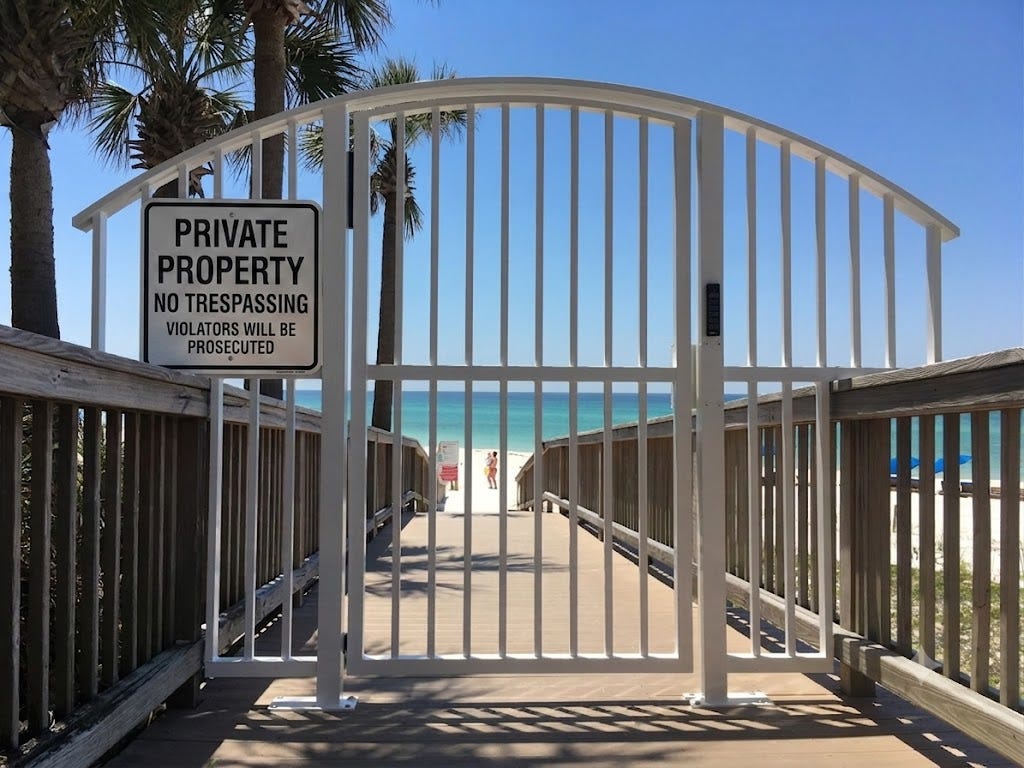
Private Property - No Trespassing
On June 12, 2026, SpaceX went public on the Nasdaq. The stock opened at $150, eleven percent above its IPO price, which put the company past $2 trillion and made the offering the largest in history. It raised $75 billion, more than double the Saudi Aramco listing that had held the record since 2019. By the close, Elon Musk was the world’s first trillionaire. His SpaceX stake by itself was worth about $866 billion, and his total fortune had grown larger than Bezos and Arnault put together.
The reaction was the obvious one: anger. One man should not have a trillion dollars, while half the country can’t cover a surprise car repair - and it sounds reasonable. But I think it is also aimed at the wrong target, and that matters, because a wrong diagnosis here leads straight to a cure that does nothing about the disease and a fair amount of damage to everything around it.
Start with the word “rich,” which we apply to at least three different situations as though they were one.
Wealth held in zero-sum assets: Sometimes a fortune sits in assets that come in fixed supply, where one person holding more means everyone else holds less. Land is the clean case. If I buy the only well in the valley I have not made a well. I have taken the one that was already there, and now you pay me for water.
Wealth from value creation: Sometimes a fortune exists because its owner caused something new to show up in the world. Most of the SpaceX number works this way. Reusable rockets were not a fee bolted onto a market that already existed. They cut the cost of reaching orbit by something close to a factor of ten, and nobody could do that before SpaceX did it. You can find the size of one person’s slice obscene and still see that there is a real thing sitting underneath it.
Rent-seeking: And sometimes a fortune comes from owning a chokepoint. A license, a patent thicket, a regulation cut to your measurements, a strip of ground everyone has to cross. Money flows toward it the same way it flows toward a factory, so from across the room the two look identical. But nothing got produced. A toll was installed.
This is the flaw in “abolish billionaires.” If you Cap fortunes as a category, then yes, you claw back the well-owner and the toll-collector, but you also delete the reason a person pours two decades of their life into forcing reusable rockets to exist. The drive to build and the urge to extract run through one bank balance, and a blunt ceiling on the balance cuts both at once. There is a second problem, quieter and worse. A wealth cap limits how much your holdings can be worth. It never touches what you are allowed to own. The chokepoints stay exactly where they are.
So the people calling to tax extreme wealth have found a real wound and grabbed the wrong knife.
By the third quarter of 2025 the top one percent of American households held 31.7 percent of all wealth, the highest share since the Federal Reserve began keeping the series in 1989. That is roughly $55 trillion, about what the entire bottom ninety percent owns combined. And the gap is opening, not holding steady. Oxfam found billionaire wealth in 2025 growing three times faster than its average over the previous five years, and the ten richest Americans alone picked up something like $698 billion in one year. The line about the rich getting richer stopped being a complaint a while ago. It is now just a reading of the data.
Most people feel it through housing, where one statistic lays the whole thing open. The National Association of Realtors put the median age of a first-time homebuyer at 40 in 2025, an all-time high, with first-time buyers down to 21 percent of the market, the smallest share they have on record. Forty years old. A generation back that number sat around 28.
The people building AI keep saying human labor is on the way out. This is not a critic’s extrapolation. It is the sales pitch. Musk has said outright that there will come a point when no job is needed, and puts the odds of a future where “probably none of us will have a job” at roughly eighty percent. Dario Amodei, who runs Anthropic, calls the technology a general labor substitute for humans rather than a tool that helps workers, and has warned it could wipe out half of entry-level white-collar jobs and push unemployment toward twenty percent.
Take them at their word and finish the sentence they leave dangling. If labor stops being the scarce input, where does the income that used to pay for labor go?
The first answer is easy, and it is already sitting in the charts above. It goes to whoever owns the machines. The returns that flowed to workers flow instead to the shareholders and founders of the companies doing the automating, and they pile up more steeply than before, because the slice of output that used to pay wages is the exact slice being rerouted. The owners get richer, and they get richer faster than everyone else, as a matter of arithmetic.
That much is survivable on its own. Money on a balance sheet is money on a balance sheet. The trouble starts when you ask what the money goes out and buys, which is the part the conversation keeps skating past.
Suppose you are so rich that you have effectively unlimited money. What do you buy? You buy the good places. The coast, the valley, the island. With enough money you could buy the entire California shoreline and run it as a private resort for yourself and the few dozen people who you enjoy having around - friends, family, etc.
Why hasn’t this happened already? Not for lack of appetite among the very rich. It hasn’t happened because hoarding prime land has always carried a built-in brake, and the brake is labor. A large estate has to be kept up, and fifty of them have to be kept up fifty times over. Keeping a place up means people: someone on the grounds, someone to fix what breaks, the quiet workforce that stops a beautiful house from sliding into ruin. People cost money, people are a headache to manage, and the bill rises in step with how much you are trying to hold. Past a certain point the next mansion is more trouble than it is worth. So even the wealthiest pull back into a handful of homes and leave the rest of the world’s nice places nominally open to the rest of us.
Now take the labor out. Removing labor is the entire promise of robotics. Once a crew of machines can maintain a property indefinitely at almost no running cost, and a million humanoid robots is a literal target in Musk’s own Tesla pay plan, the brake that has rationed prime land for the whole of human history is just gone. There is no longer any reason not to own all of it.
But wait, people like people, so they’ll share the beautiful real estate with everyone…
Well - Would you? Do you hand your car to strangers when nothing makes you, when you aren’t using it? I don’t think so - and not out of meanness. You simply don’t want strangers in your car. The instinct scales without losing anything. If you could keep spotless, perfectly maintained estates on every coast worth having, an hour away by jet whenever the mood struck, filled only with people you love, and robots to do the chores, would you also be listing them on a booking site for the public? Of course not. A place that is yours and used by no one else, where no stranger has ever sat on the couch or used the bathroom, is plainly nicer to its owner than the same place shared. Having it to yourself is the whole point. So having it to yourself is what the money buys.
Run that forward across a class that gets richer every year, in a world where the cost of holding land has fallen to nothing, and the ending writes itself. The good parts of the world get fenced off, quietly, one parcel at a time, and they do not come back. No law has to change for this. The incentives all lean one way, and the weight that used to lean against them has been lifted off.
People are right to be scared. They have been scared of the wrong noun. The danger was never that a man is a trillionaire. The danger is what a trillionaire can now pull out of circulation permanently.
That flips the useful question around. Not “should anyone be allowed this much money,” but “how do we keep the things we care about from being cornered.”
Those are separate problems with separate answers. If the problem were money as such, you would cap money, and pay for it by killing off the reason to make the next useful thing anyone bothers to build. The actual problem is narrower. Some assets are rivalrous and fixed. There is one California coast and there will not be a second. Stockpiling that kind of asset takes directly from everyone else. Stockpiling shares in a company that builds rockets does not. The remedy should bite on the rivalry, not on the wealth.
Which points, fairly naturally, at one family of tools.
The cleanest is a land value tax, an old Georgist idea with a property close to magic for this particular problem. You tax the unimproved value of the land, not the building sitting on it. You cannot duck it, because land cannot be moved or tucked into a shell company in the Caymans. It does not punish building things; if anything it punishes leaving land idle. And it makes sitting on land expensive again. It puts back, on purpose, the carrying cost that robotics is about to erase by physics. The drag that maintenance labor used to supply for free, a land tax supplies by design.
There are other levers worth a look. Taxes that fall on consumption and accumulation instead of on production. Hard limits on how much rivalrous land any one entity can hold. Public ownership of certain commons that were never really anyone’s to sell in the first place. I don’t have the full answer, and I would be wary of anyone who said they did. The piece I am confident about is the diagnosis. We are about to pull out the last natural limit on monopolizing the irreplaceable parts of the world, and there is still time to write a new limit into law before the old one finishes wearing through.
The trillionaire is not the asteroid. The coast going dark, parcel by parcel, with nobody quite noticing until it is done, is the asteroid.
Worth aiming at the right one.