Updated July 28, 2026: Kimi K3 replaces Kimi K2.6 and takes the open lead
If closed models like Claude and GPT are more performant, why should you use open models at all? The first reason is cost: leading open models now deliver near-frontier intelligence at a fraction of the cost of closed-API models. For everyday, high-volume work, they offer a better tradeoff between price and intelligence.
The second reason is control. Two recent decisions show the risk of relying on a closed model: Anthropic restricted Mythos to trusted partners, and the US government pulled Fable 5 from the market. An API model can be deprecated, rerouted, or pulled away from you. One that you host yourself is stable, can be fine-tuned, and doesn’t leak your data.
This article analyzes the seven strongest open models and tracks how far they trail the closed frontier.
Summary
• Six of the seven best open models are Chinese, and the US entry trails the leaders by a large gap.
• Everyone converged on sparse MoE, while attention went the other way: no two models share a design.
• On-policy distillation is the new standard for post-training, either replacing or complementing reinforcement learning.
Across 2026, open models nearly caught up to the closed frontier, then fell behind as the closed labs released stronger models. GLM-5.2 has now closed most of that gap again. Kimi K3 has now pulled them back to within three points.
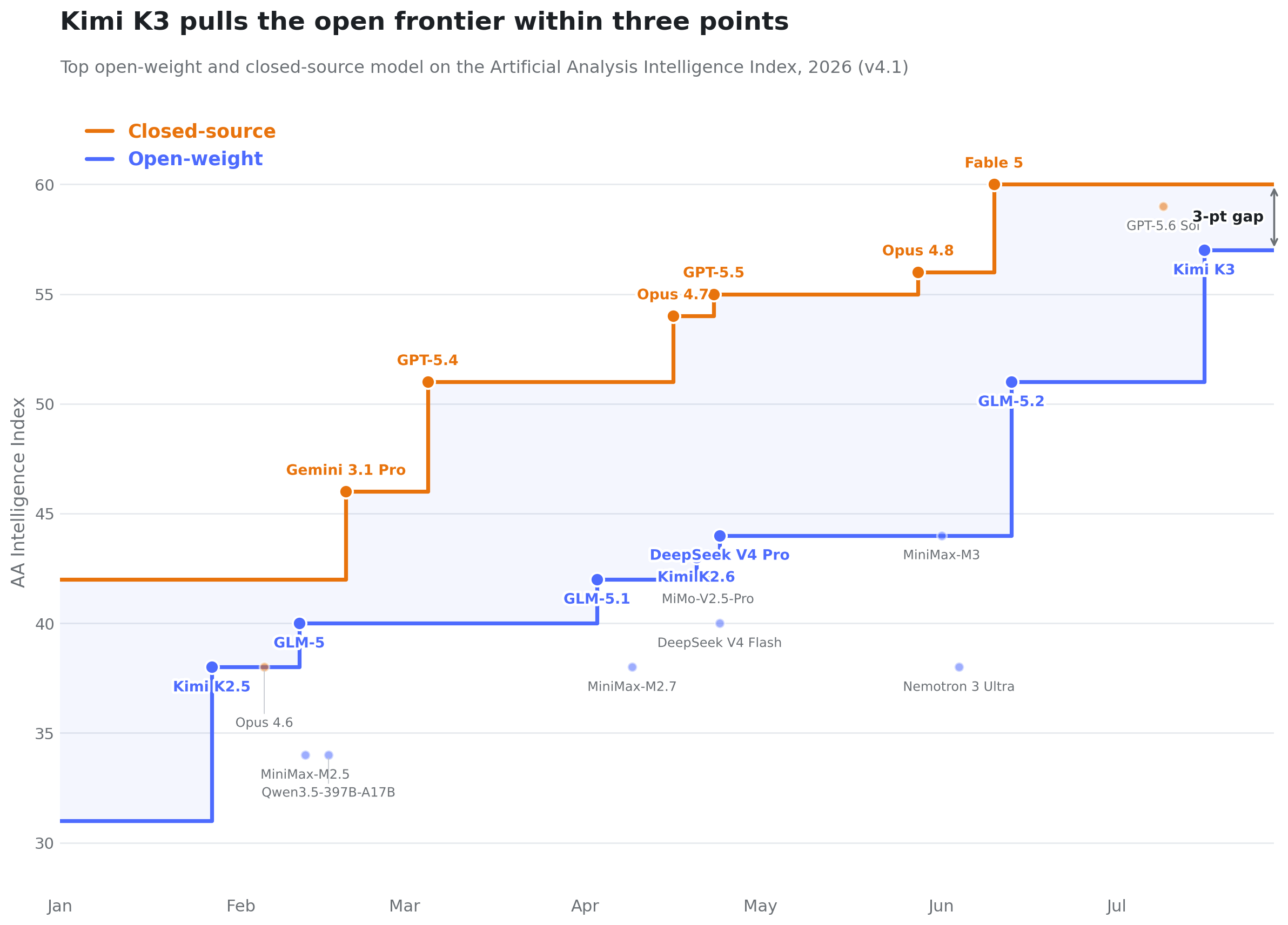
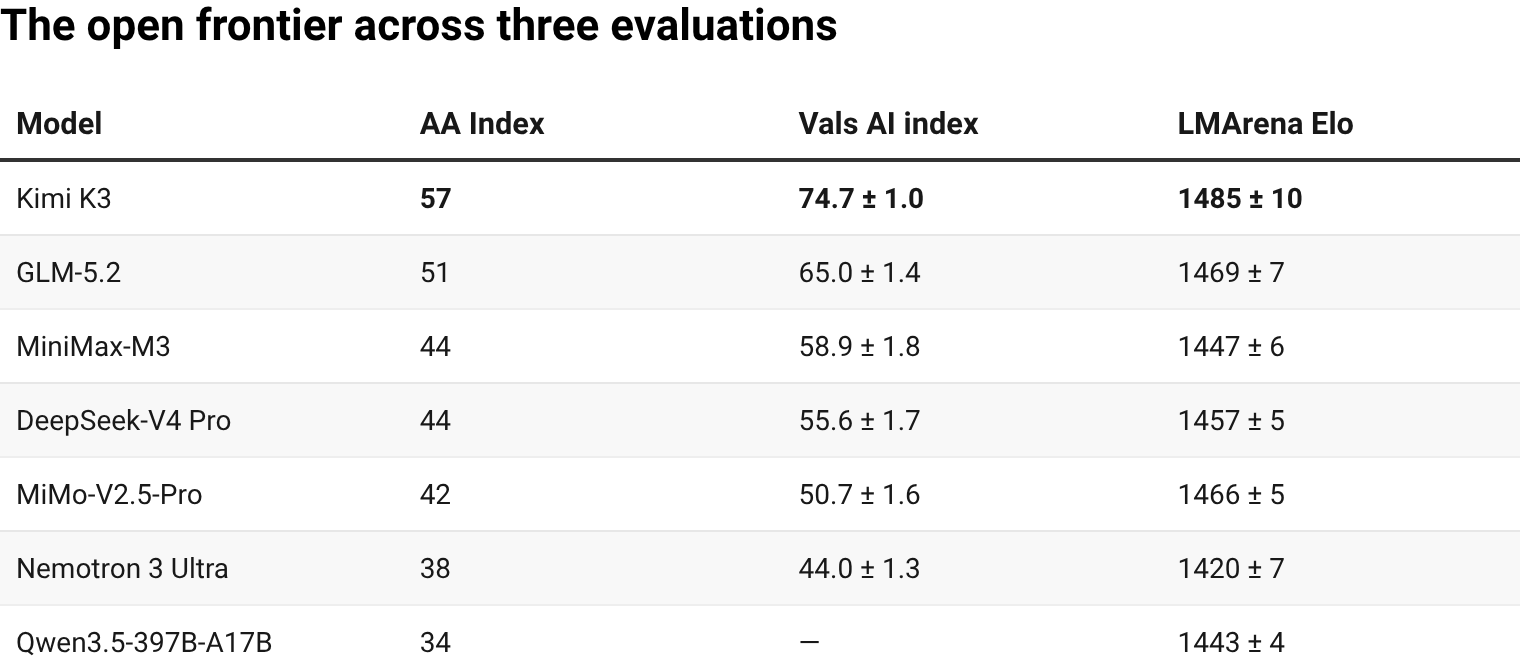
On the Artificial Analysis Intelligence Index, Kimi K3 leads all open models at 57, six points above GLM-5.2 (51) and 19 above the best US open model, Nemotron 3 Ultra (38). Only Anthropic’s Fable 5 (60) and OpenAI’s GPT-5.6 Sol (59) score higher, and both are closed.
Other evaluations point in the same direction. Vals AI scores domain-specific work (legal, finance, tax) on private test sets, and LMArena ranks models by human preference in head-to-head chat. Kimi K3 leads all three, but each ranks the models below it differently.
However, closed models still keep a clear edge on real-world agentic coding tasks. On benchmarks like SWE-Bench Pro and long, real-world agentic coding tasks that Claude Code and Codex run, closed models are still ahead.
Every model here is a sparse Mixture of Experts (MoE). Six of the seven come from Chinese labs.
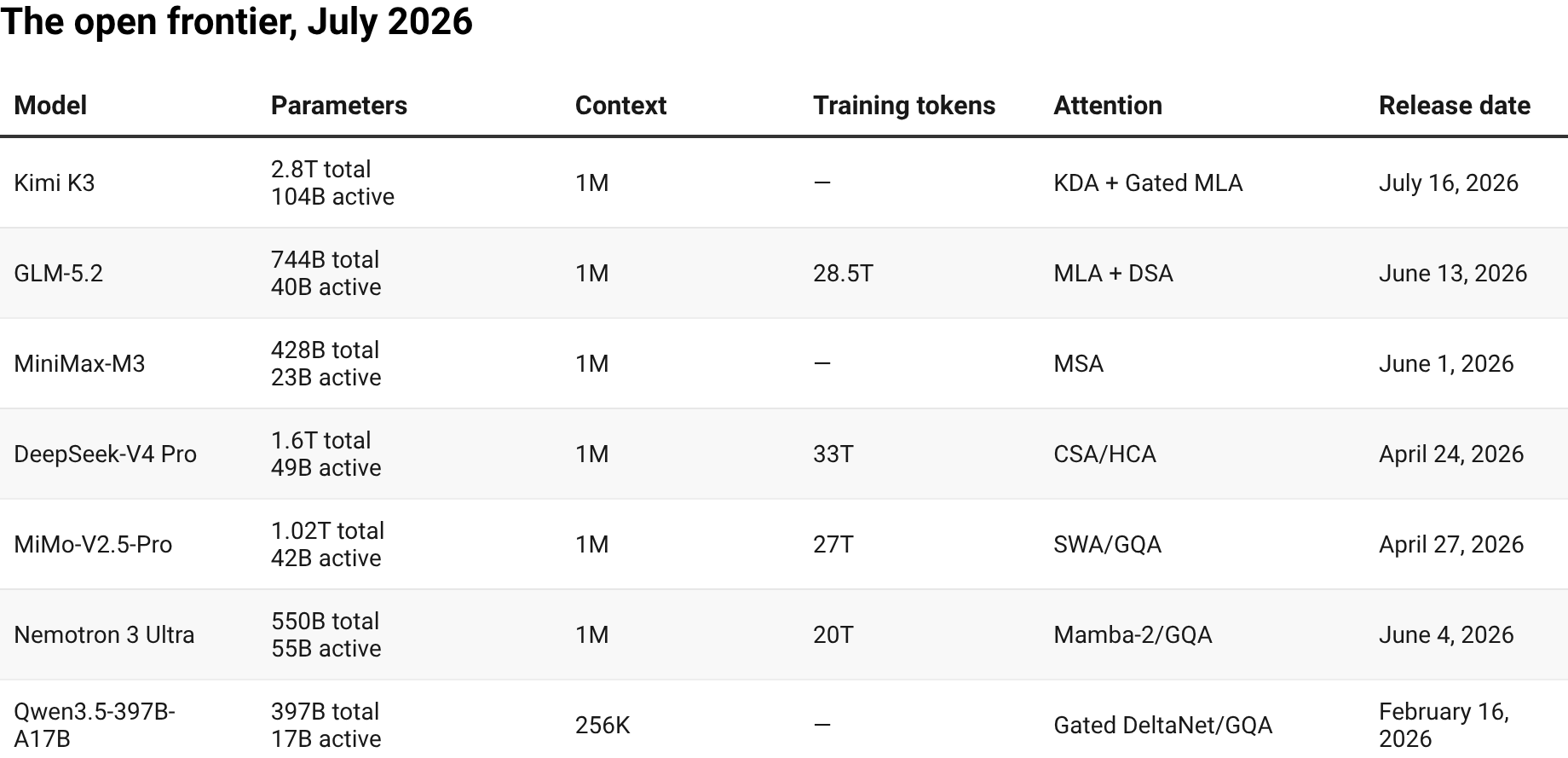
Every family here shipped its current generation within the last six months.
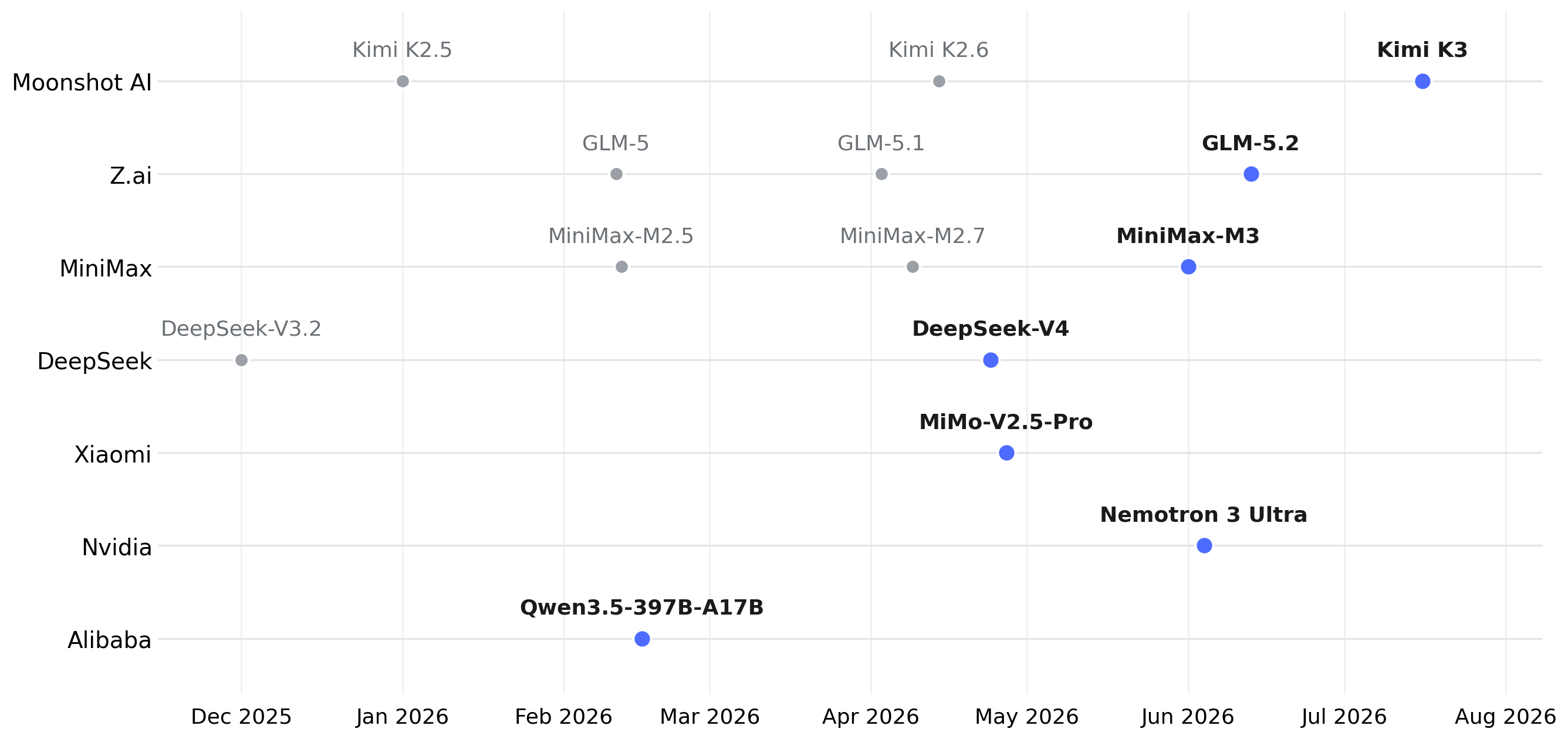
Kimi K3 (Moonshot AI, 2.8T total, 104B active; technical report) is the strongest open alternative to Claude and GPT today, and the first open model at 3T scale, nearly double the next largest here (DeepSeek-V4 Pro, 1.6T). It also reverses Moonshot’s own design philosophy: K2.6 ran the most conservative attention stack of the seven, and K3 runs the most aggressive. Two costs come with it. Its API price is five times K2.6’s, and its calibration got worse: Artificial Analysis measures its hallucination rate rising from 39% to 51% while its accuracy climbed from 33% to 46%, so K3 buys correct answers by guessing more often.
GLM-5.2 (Z.ai, 744B total, 40B active; my GLM-5 article) held the open lead for five weeks and remains the better buy for most work. It tops SWE-Bench Pro, has a usable 1M-token context, and costs less than a quarter of what K3 does for six index points less.
MiniMax-M3 (MiniMax, 428B total, 23B active, 1M context; my M2.5 article) replaced M2.7 just eight weeks after it shipped. It swapped M2.7’s full attention for MSA, a new sparse attention mechanism, and added native image and video input. Its real edge is price: M3 runs at some of the lowest costs on the frontier.
DeepSeek-V4 Pro (DeepSeek, 1.6T total, 49B active; my DeepSeek-V4 article) is architected around million-token serving and consolidates its post-training via distillation alone. It is the cheapest model here, at roughly 4% of K3’s blended price. Its clearest weakness is calibration: on hallucination tests, it guesses on questions it cannot answer instead of declining them.
MiMo-V2.5-Pro (Xiaomi, 1.02T total, 42B active) is the fastest climb on this list. Xiaomi launched its Core AI group in April 2025 and hired Luo Fuli, a core DeepSeek-V2 developer, to lead MiMo. They went from a small first model to a frontier-scale one in about a year. It is assembled largely from published components, and a June paper documents Xiaomi’s multi-teacher on-policy distillation.
Nemotron 3 Ultra (Nvidia, 550B total, 55B active; my Nemotron 3 Ultra article) is the best US open model, co-designed with the hardware its maker sells. It serves several times faster than its Chinese peers but trails them in quality by the widest gap on this list, due to its design tuned for throughput.
Qwen3.5-397B-A17B (Alibaba, 397B total, 17B active; my Qwen3.5 article) was the first production test of linear attention at frontier scale, a bet K3 has since made seven times larger, and it is the only model here under a plain Apache-2.0 license. It is Alibaba’s strongest open model, but not its strongest model: the more capable Qwen Max line stays closed.
Everyone agrees on the MoE backbone, but nobody agrees on attention. Which design wins for long context processing is still a different answer per lab.
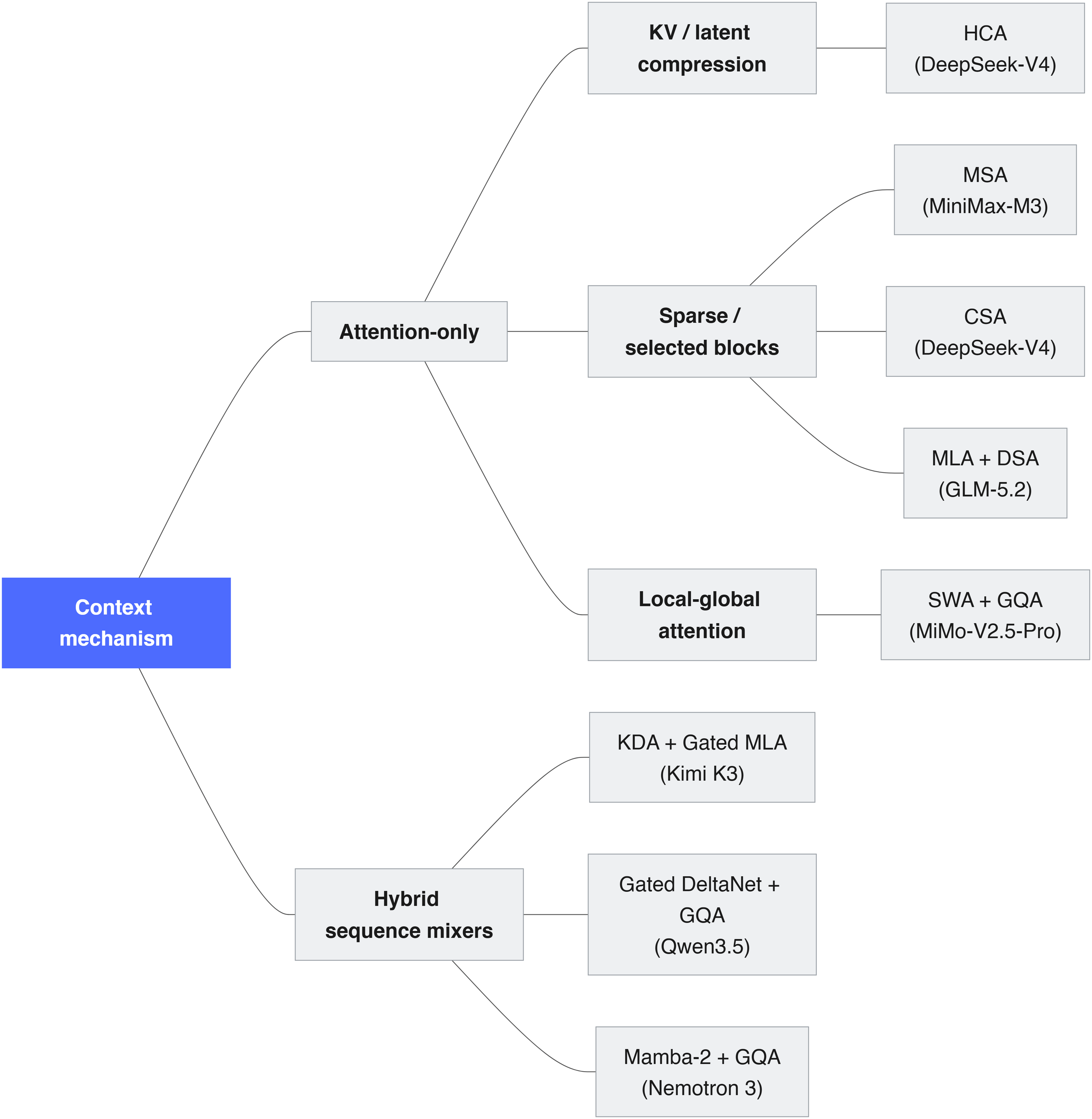
One camp stays entirely on attention and shrinks the cache rather than replacing it, which it does three ways:
The first compresses the cache. DeepSeek-V4 moved to compressed hybrids (CSA and HCA) built for very long context, with the most aggressive cache reduction in the field.
The second keeps only selected blocks of the cache per token. GLM-5 stacked DeepSeek Sparse Attention on MLA, and GLM-5.2 added IndexShare to reuse the sparse-attention indexer every fourth layer. After M1’s Lightning Attention and M2’s full attention, M3 landed on Minimax Sparse Attention. It scores the cache in blocks with a cheap index branch and lets each query read only its top-ranked ones.
The third route is local-global attention. MiMo runs sliding-window attention over GQA at a 6:1 ratio, so most layers attend only to a nearby window.
The other camp replaces most attention layers with a cheaper sequence mixer, whose cost grows only weakly with sequence length:
Kimi K3 is the newest and largest defector to it, and it went further than anyone: 69 of its 93 layers are linear, with a Gated MLA layer closing every block of four to restore global attention. Its mixer is Kimi Delta Attention, a channel-wise-gated refinement of the delta rule that Moonshot introduced in Kimi Linear in October 2025, which itself refines Gated DeltaNet.
Qwen interleaves Gated DeltaNet with full attention at the same 3:1 ratio.
Nemotron pairs Mamba-2 with thin GQA layers.
Sparsity varies just as much. The number to compare is active parameters, i.e., how many of a model’s parameters actually run on each token. That now ranges from Qwen3.5’s 17B to K3’s 104B, a 6x spread among models within 23 index points. Most use the DeepSeekMoE layout. The structural departure is LatentMoE, which Nvidia published in January, compressing each expert into a narrow latent space so a model can hold many more of them at the same active-parameter cost. K3 is its first adoption outside Nvidia.
No design has won, and they are all making the same bet: trade some recall for cheaper long-context capacity. A sequence mixer is the cheapest, with a constant-size state per layer, but it recalls earlier tokens poorly. This is why Kimi, Qwen, and Nemotron all pair it with periodic full-attention layers to compensate, which makes them hybrids. The compression and selection designs (MLA, DSA, MSA) give up less recall, but their cache still grows with the input, while sliding-window attention caps it at a fixed window.
Few labs document pre-training in depth, and the choices they do disclose already diverge.
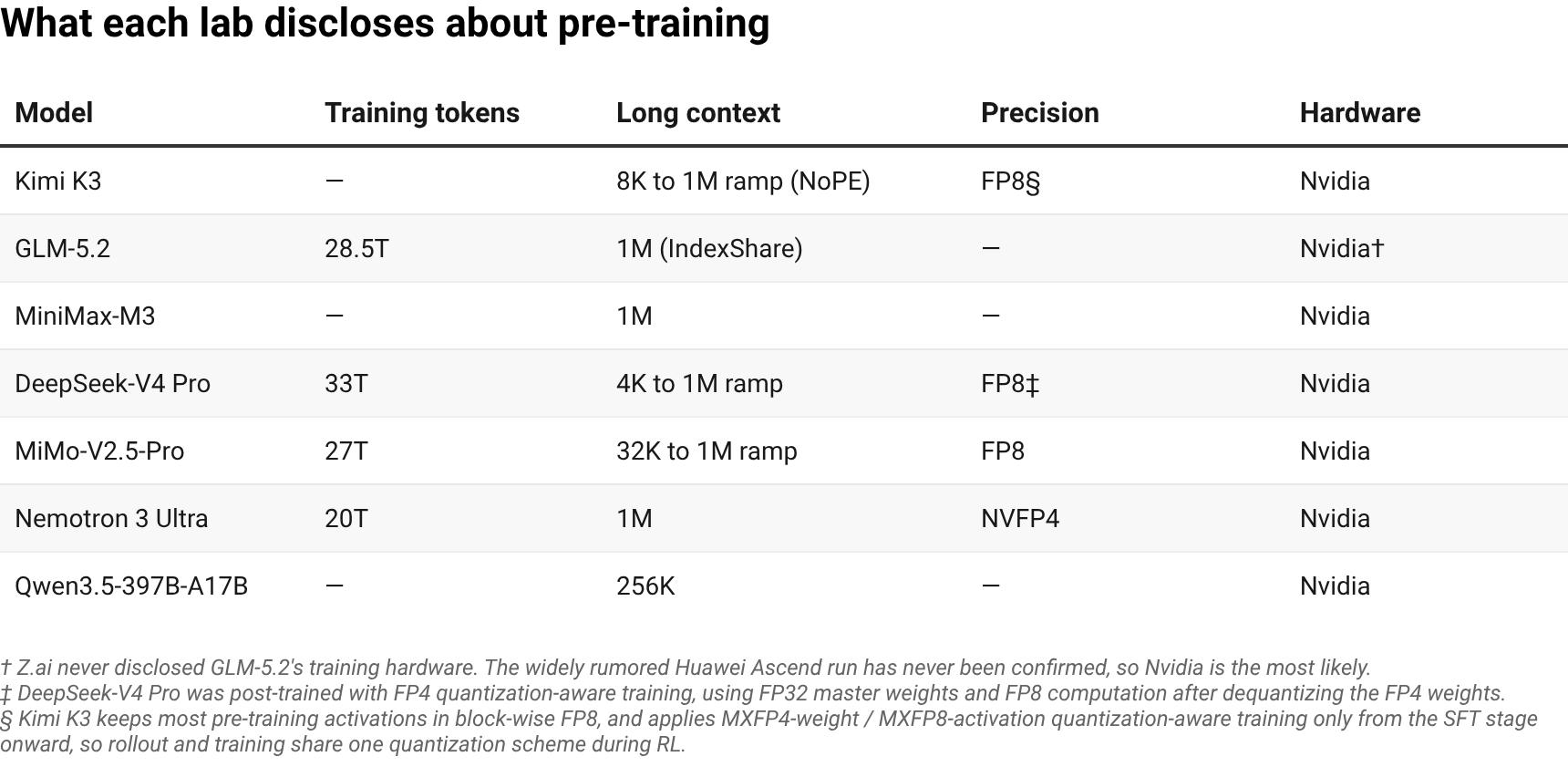
Of the four labs that disclose a token budget, Ultra is the low outlier at 20T, five trillion short of plan, after its run diverged twice. Long context now splits on method rather than reach, since six of the seven ship 1M. V4 ramped its sequence length from 4K to 1M during the run and MiMo trained natively to 1M, while K3 grew its window in four stages, 8K to 64K during pre-training and 256K to 1M during cooldown.
Precision is where the labs are still experimenting. Ultra is the largest model pre-trained in NVFP4 (4-bit), and it paid for it: two runs diverged, one traced to FP4 interacting with the MTP heads, and one never explained. Both DeepSeek-V4 and K3 took the conservative route instead, training in FP8 and reaching 4-bit only through quantization-aware training afterwards. The optimizer has converged on Muon: Moonshot proved it at a trillion parameters on K2, adding a stabilizer called QK-Clip, and K3 now orthogonalizes each attention head’s momentum separately so a few large heads stop dominating the shared update. DeepSeek-V4 adopted Muon but dropped QK-Clip because its RMSNorm placement already keeps training stable.
Hardware is the murkiest of these choices. Every model here most likely trained on Nvidia. DeepSeek’s attempt to migrate to Huawei Ascend failed in mid-2025 and cost months, per ChinaTalk, which shows how hard a full Ascend pre-training run still is. Z.ai is the only lab here on the US Entity List (added January 2025), which cut it off from advanced Nvidia chips, so GLM-5.2 was widely rumored to have trained on Huawei Ascend. Z.ai never confirmed that, so Nvidia stays the most likely. The one confirmed frontier-scale run off Nvidia is Meituan’s LongCat-2.0, trained on roughly 50,000 domestic ASICs. It shows the Nvidia dependency is only starting to loosen.
Post-training is where the training pipelines diverge the most. The main trend is the wide adoption of multi-domain on-policy distillation (MOPD). It consists of training a set of domain specialists, then distilling them into a single student on the student’s own outputs. It is doing work the reinforcement learning stage used to do, either replacing that stage or adding to it. Four of the seven now run it, and Kimi K3 is the newest convert: Moonshot’s last generation ran a conventional RL pipeline.
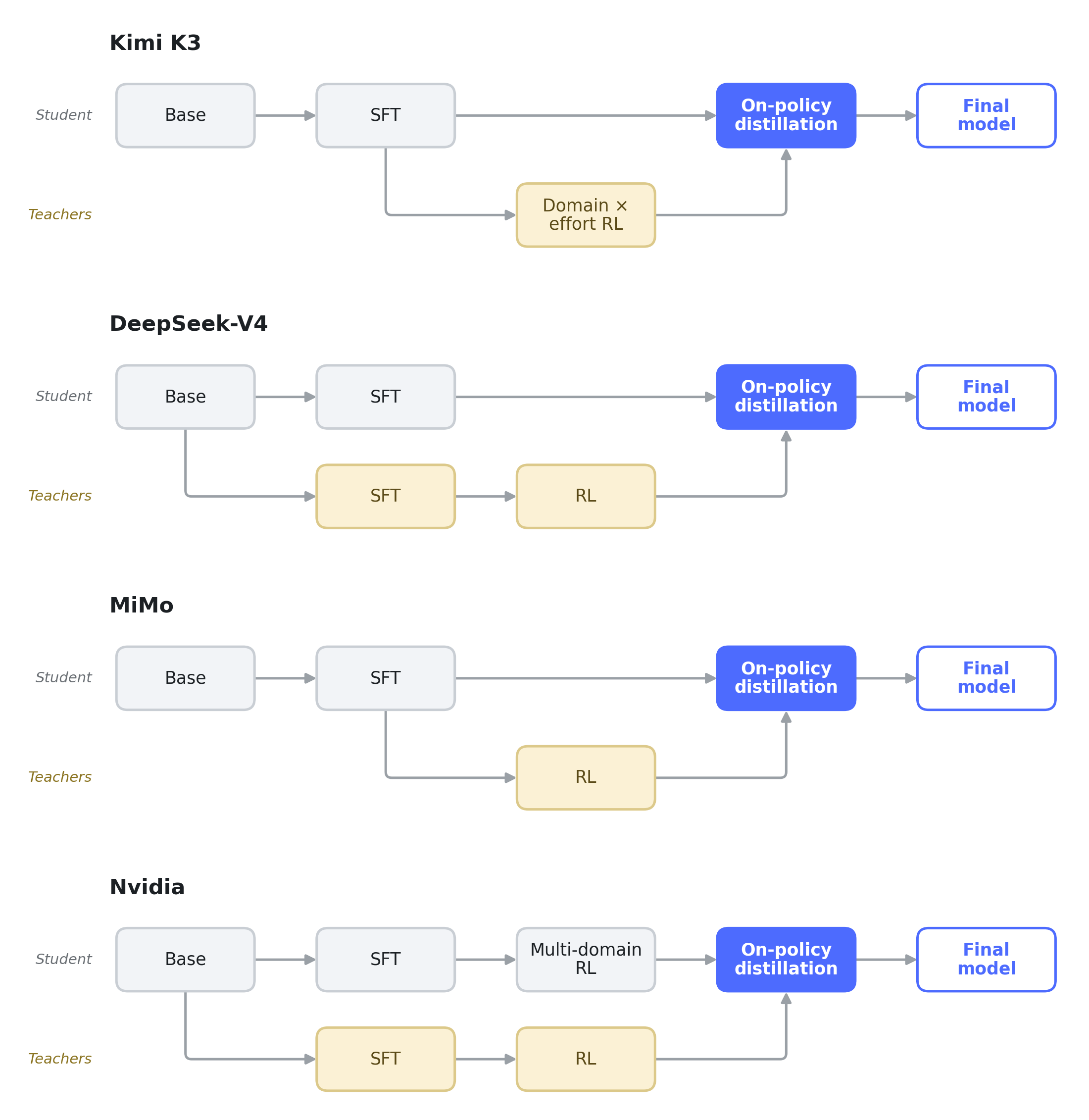
Kimi K3, DeepSeek-V4, and Xiaomi’s MiMo use it in place of the student’s RL: they train domain specialists, then distill those teachers into an SFT student, with no RL on the student itself. The way they build these specialists differs, though. DeepSeek trains each specialist from the base model with both SFT and RL. Xiaomi initializes its specialists from the SFT checkpoint and only uses RL, keeping teachers and student close in policy. Nvidia adds distillation on top of RL: it trains the student with SFT and RL first, then distills the specialists to push past the plateau RL hit on its own. Distillation only amplifies what the base can already do, and it is not cheap, since it requires training a stack of specialist teachers.
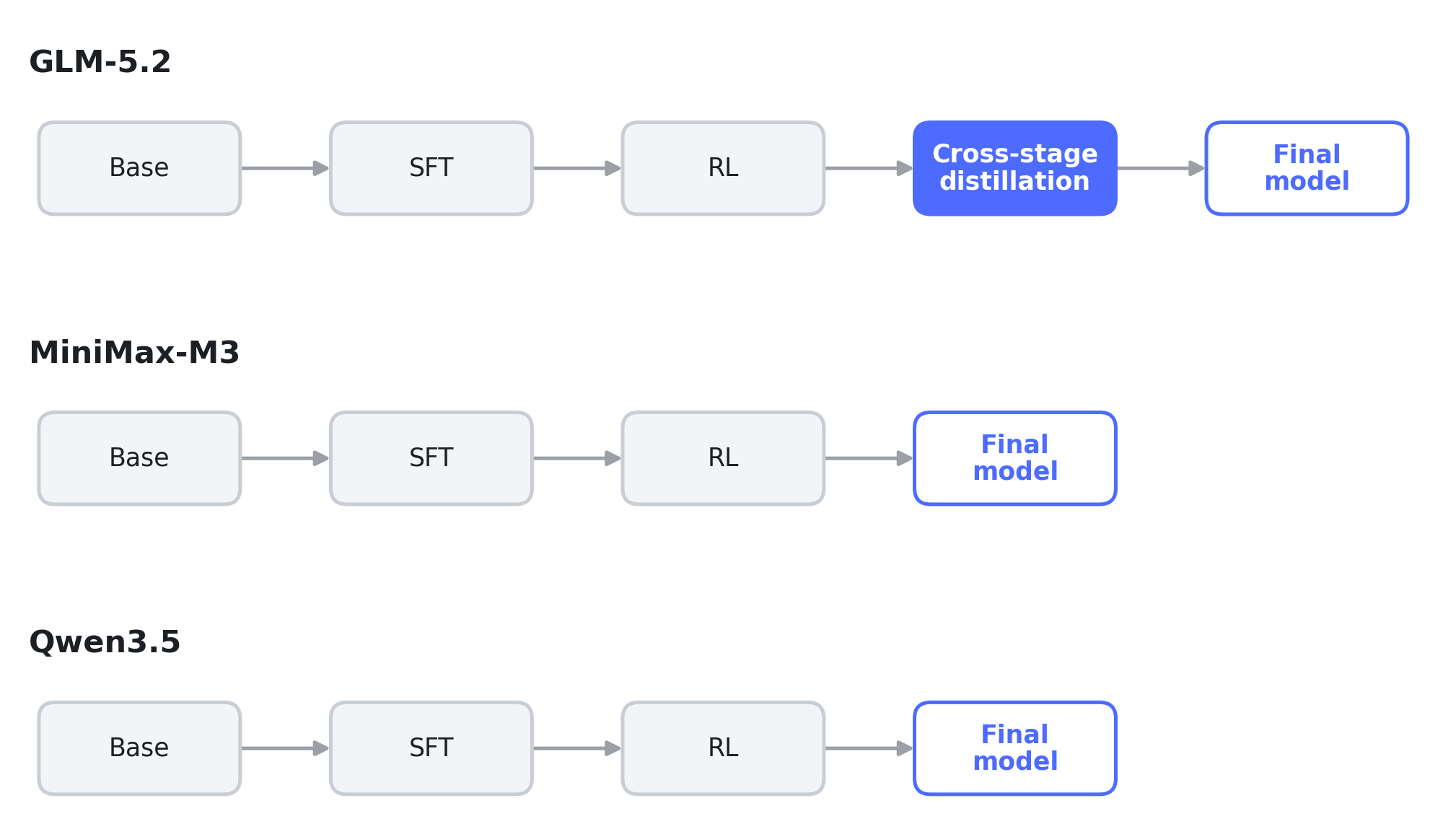
The labs that skip distillation run a long, multi-stage RL pipeline instead: SFT, RL with verifiable rewards, agentic RL against live software repos, terminals, and browsers, then preference tuning on top. This is the path GLM-5.2, MiniMax, and Qwen take. With agentic RL, the bottleneck is generation, not the gradient step, since a few very long rollouts stall the whole batch. That is why these labs build asynchronous RL systems, like MiniMax’s Forge, that decouple rollout generation from training so the accelerators never idle on the slowest trajectory. GLM is the partial exception: it runs the same RL pipeline, then adds a final distillation step that uses each earlier stage’s own checkpoint as the teacher, so the last stage does not overwrite the skills the earlier ones learned.
Open frontier models are much cheaper than closed-source ones, but it also means the labs that make them profit little from inference alone.
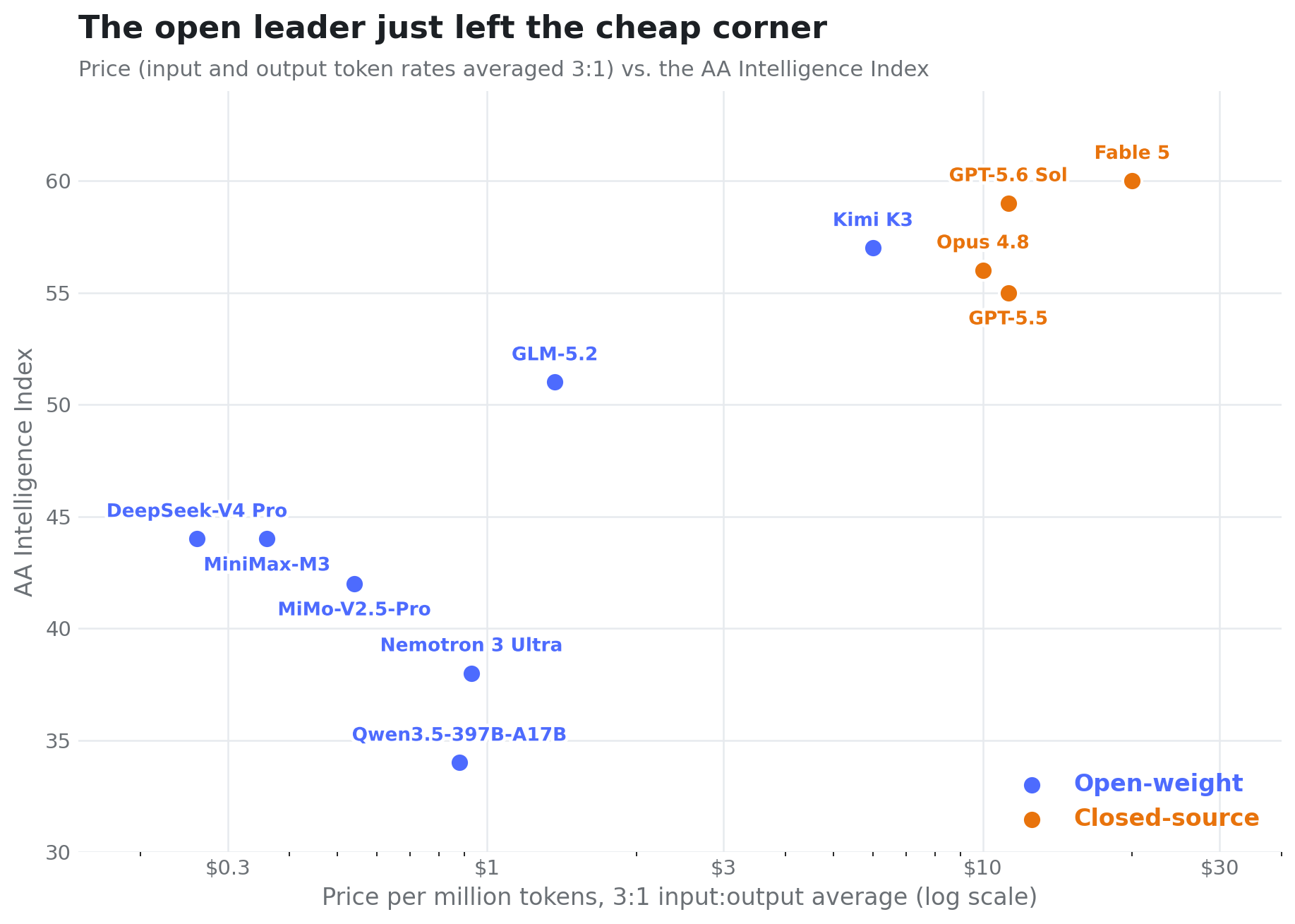
The rule holds because of competition, not efficiency. Anyone can serve open weights, so dozens of providers drive the price of these models down to roughly the cost of the GPUs and electricity. A closed model has one seller, who charges for the value it delivers instead.
The catch for the lab is that it is just another provider, with limited cost advantage over Together or Fireworks when serving the same checkpoint. Open-sourcing a frontier model means giving up exclusive inference revenue, so the question is what each lab sells instead.
Two sell the complement. Nvidia sells GPUs, and Alibaba sells cloud services, so a cheap, ubiquitous model only drives demand for what they charge for. Three sell a differentiated service based on a hosted API tuned for reliability and support: MiniMax, Moonshot, and Z.ai. Alibaba also keeps a stronger model closed, the Qwen Max line above open Qwen3.5. And two sell only (publicly) sell model inference: DeepSeek and Xiaomi open-source it as a strategic bet.
A frontier run can cost over a hundred million dollars, and open weights let anyone serve them at commodity margins. The labs that can keep going are the ones with a business the model feeds (Nvidia, Alibaba) or a backer that does not need it to earn (DeepSeek's High-Flyer fund, Xiaomi's phone business). The pure plays take the real risk: MiniMax, Moonshot, and Z.ai are betting that giving the weights away buys enough API and enterprise business to fund the next model.
To conclude, here is a list of open questions worth watching:
Silicon: LongCat-2.0 was trained on domestic Chinese hardware. Are other Chinese labs going to make the switch this year?
Attention: the field keeps splitting on this. Will one design become the standard, or does the split hold?
FP4 training: despite its theoretical advantages, stability and performance issues make FP4 difficult to justify. Is it going to become a new standard for large runs?
Open publishing: competitors now adopt a new technique within a single release cycle. Are we going to see less and less open research and detailed reports?
DeepSeek V4: ten teachers, one student: the consolidation recipe in full.
Nemotron 3 Ultra: what distillation can't fix: the recovery ceiling, measured.
Qwen3.5: nobody agrees on attention: the architecture split this post extends.
GLM-5: China's first public AI company: the lab behind the Ascend run.
Kimi K2.5: still worth it after two: the Moonshot lineage behind K2.6.