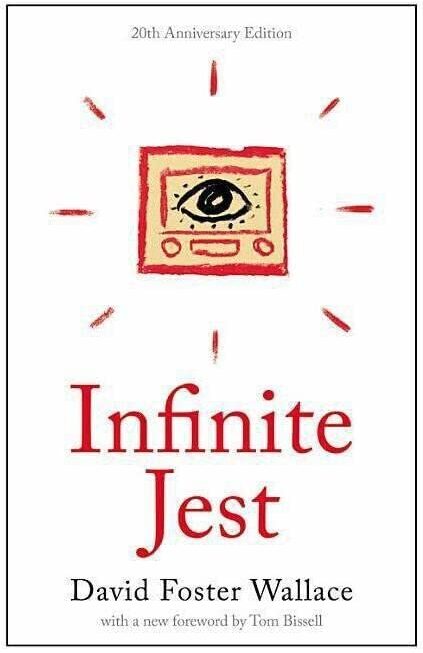
I read David Foster Wallace’s Infinite Jest via audiobook, which at the default speed, takes over 52.5 hours. On paper, the book is usually over 1,100 pages, including its 388 endnotes.
I’ve written about books before, but these essays are so long and so much of them are devoted to summarizing the texts that I don’t really consider them reviews. I think of them more as extractions, as attempts to capture the value of the books in the most dense and entertaining way possible. Writing is a method of processing information, and I feel like I have a better grasp of the life of Napoleon and the Incan conquests because I wrote about them.
I’m not sure there has ever been a book written anywhere in the world at any point in human history that is better suited to an extraction essay than Infinite Jest. It is a vast, opaque, and impenetrable work from the outside, and actually sitting down to read it doesn’t clarify its meaning so much as bury you in it. It’s a true classic novel in the sense that it’s a book that everyone wants to have read but nobody wants to read.
What is Infinite Jest about? The setting is an alternate history America that is wacky and largely established for comedic and thematic purposes, the plot matters even less and barely exists across 52.5 hours/1,100 pages but consists mostly of groups of people living their lives at an elite tennis academy and a drug/alcohol rehab facility, the characters matter a lot and many are very deep but there are a billion of them and their stories are told temporally out of order in a way that leaves you (the reader) often not understanding them until, like, 45 hours/800 pages into the book. The vast majority of chapters are devoted to describing characters in little snippets of their lives in ways that have some thematic relevance but usually no story relevance.
But Infinite Jest is also about is the rot of cynicism and the painful catharsis of earnestness and the trap of excessive entertainment potency and figuring out how to find meaning in giving your life to something.
It’s a lot, it’s confusing, sometimes it’s dumb, sometimes it doesn’t always work, but it’s impossible to read Infinite Jest and not recognize the late David Foster Wallace as some kind of genius. A sub-genius couldn’t write this. And although I was bored throughout significant chunks of the book, and although I think there is a half-way decent case that Infinite Jest would be better if you cut down 30-60% of it, I also found it brilliantly insightful, and it ended up resonating with me in a way books rarely do.
Like a lot of great writing, Infinite Jest repeatedly did that thing where it described something I already knew, but had never fully, consciously conceptualized, but reading it packaged in this manner brought it into reality in my mind. It reminded me that the best self-help writing doesn’t tell you anything new, it just tells you obvious good advice in a way that makes you actually follow it. I’m not sure I’d say that reading Infinite Jest changed me as a person, but I think it made me slightly happier by getting me to focus on the good in my life.
So I’m going to try to extract the value I got from Infinite Jest by going over my understanding of its setting, plot, and themes to present them in the most condensed form possible to readers so they can hopefully get a significant portion of the value to be gleaned from the book without necessarily spending 52.5+ hours reading it.
Needless to say, FULL SPOILERS FOR Infinite Jest AHEAD, but I’ll also note the caveat that this is a book where the plot doesn’t really matter.
The World of Infinite Jest
Most of Infinite Jest (IJ) takes place over the course of one year, with the narrative bouncing seemingly arbitrarily forward and backward between different points in that year. Other significant events take place over a seven-ish (?) year span, but there are also plenty of flashbacks to 30+ or 50+ years ago.
The year in which most of the story takes place is called the Year of the Depend Adult Undergarment. There is also the Year of the Whopper; the Year of the Tucks Medicated Pad; the Year of the Trial-Size Dove Bar; the Year of the Perdue Wonderchicken; the Year of the Whisper-Quiet Maytag Dishmaster; the Year of the Yushityu 2007 Mimetic-Resolution-Cartridge-View-Motherboard-Easy-To-Install-Upgrade For Infernatron/InterLace TP Systems For Home, Office Or Mobile; the Year of Dairy Products from the American Heartland; and the Year of Glad.
IJ has a lot of elements that are extremely confusing at first, but you eventually sort of get used to them until they become slightly less confusing, and time is one of them. The nature of the IJ calendar only begins to be explained around 25% of the way into the novel, but even then, the order and relationships between the years is purposefully vague, seemingly to create a floaty, disorienting narrative. True IJ nerds have created an approximation of a consolidated story timeline by poring over book details and cross-referencing them with real-life timelines, like on what real-life years November 20 occurs on a Friday. For what it’s worth, the nerds have deduced that the crucial Year of the Depend Adult Undergarment is probably 2009, but that’s not important to understanding the novel.
What is important is that the IJ calendar is called “subsidized time,” as in corporate subsidized. At some point, likely in the late 1990s or early 2000s, the government began auctioning off naming rights of years to corporations. This is one of many, many, many elements of IJ’s obsession with corporate dominance in its society. It is impossible to exaggerate how much of this book consists of listing off corporate names of corporate products with corporate trademarks. The story’s tennis players don’t just use sunscreen, they use Coppertone SPF 45. Characters don’t watch tv, they use InterLace TelEntertainment Teleputers (TPs) with InterLace Entertainment Cartridges. Almost every time a drug is mentioned for the first time, Wallace states the trademarked name of the drug, its pure chemical name, its various street names, its manufacturer, and maybe gives a short history of its discovery and proliferation.
The subsidized time scheme and most of the rest of IJ’s background worldbuilding is the product of the character Johnny Gentle, a germophobic lounge singer/tv personality who, by the judgment of the audiobook reader, talks like Elvis. In what would become the Year of the Whopper (the first year of subsidized time), Gentle was elected president of the United States as a member of the Clean U.S. Party with the vague platform of cleaning up America environmentally, corruption-wise, and otherwise. Once in power, Gentle seemingly consolidated the government into a more authoritarian state based around vapid pandering and entertainment to placate the masses, though it’s implied that he is mentally unstable and likely being manipulated by crafty advisors.
As part of Gentle’s cleaning-up efforts, he has to deal with a new massive toxic waste pollution problem caused by the invention and use of cold fusion energy generation. If you’re wondering how cold fusion produces pollution, let alone a lot of it, don’t worry, this is explained in a chapter by one teenaged prodigy tennis player to another, wherein the latter is wearing a blindfold to improve his other senses but can’t find a bathroom, so he asks the other player for help, but instead, the other player explains cold fusion in exhaustive detail over such a long period of time that the blindfolded player is nearly peeing in his pants, and it all turns out to be a ploy by the explainer to pressure the blindfolded player (who is a Muslim and drug-free) to give away his urine so the other player and his friends can pass a drug test. Stuff like this happens a lot in IJ.
Gentle’s solution to the new massive toxic waste problem is to dump it all in one out-of-sight-and-out-of-mind place, but he knows that doing so will destroy a sizeable portion of the country and upset voters. So Gentle conceives and executes his most important reform: the United States, Mexico, and Canada merge into a single country called the Organization of North American Nations (commonly known as ONAN, which IJ nerds recognize as a reference to masturbation, which is thematically relevant). Though the three countries are now one country, they also all operate semi-autonomously, though under the leadership of the US.
The merger into ONAN allows Gentle to shuffle around North American territories. He assigns a portion of the northeastern United States/southeastern Canada to serve as a giant dumping ground for the fusion waste; the precise boundaries of this area aren’t laid out in the book, but it seems to cover the northern half of New York, a decent chunk of New England, and a substantial portion of Quebec. Throughout the duration of Gentle’s regime and the subsidized time era, convoys of vehicles are constantly driving to this area and dumping toxic waste, often by launching it from catapults. What precisely happens in the region is partially a matter of science and partially a matter of rumor and speculation, but it allegedly goes through rapid cycles of tremendous natural growth (in terms of flora and fauna) and then complete eco-collapse, both fueled by rogue radioactivity, which may also produce mutant creatures, including hordes of feral hamsters.
This region, which becomes known as the Great Concavity (to Americans) or the Great Convexity (to Canadians), is completely evacuated of human life, and more-or-less coercively given to Canada, though Canada disputes the gift and tries to give it back to the United States, leading to an ongoing territorial dispute where both sides are trying not to claim a territory.
All of this stuff is a pretty good encapsulation of the difficulty of processing Infinite Jest. It all happens in the background of the book, and though characters sometimes talk about the Great Concavity or Johnny Gentle or speculate on political matters or deal with the new bureaucracy of ONAN, none of it is actually very important to the story of the novel. No one ever meets the president or goes to the Great Concavity. The most plot/character-relevant aspect of the worldbuilding is that the ONAN merger spawns numerous separatist groups, mostly in Canada, and particularly in Quebec, which has always wanted independence from Canada, but which has radicalized due to the ascendant dominance of the US and the loss of Québécoise territory into the so-called Convexity. Many of the key characters in IJ are Québécoise and are either members of a Québécoise terrorist separatist organization or are at least sympathetic to the movement.
But beyond that, it’s difficult to parse the point of all this world building, especially when it’s all rather loose and doesn’t make much sense. Why would the governments and people of Canada+Mexico agree to form ONAN? What are they getting out of it? Wouldn’t successful cold fusion power completely transform the American and global economy? If so, why don’t we see any evidence of that in the book (aside from a few semi-futuristic technologies, everyone seems to be in late-1990s/early 2000s tech levels and economic conditions)? If not, then what’s the point of using cold fusion, especially since it has these massive negative externalities? How does corporate subsidized time fit into any of this?
Ultimately, I think Wallace does all this world building in this style for the same reason IJ has a billion bizarre characters acting in only semi-coherent ways. I think the idea is for the reader to immerse himself in a time/place/setting with lots of strangeness, complexity, and incomprehensibility to simultaneously grasp a sense of thematic resonance without having a firm grasp of the story’s reality. It’s not all supposed to make sense, but it is supposed to produce some sort of meaning.
I think this can be seen better in the worldbuilding that goes beyond the politics; Wallace devotes entire chapters to explaining the techno-social developments of the world of IJ, some of which, I have to admit in that pretentious literary way, are quite prophetic, especially for a book written in the early 1990s.
For instance, there is no internet in IJ, but there is an approximation of modern tv/movie streaming services (like Netflix). At some point early in subsidized time or just before it (which is called pre-subsidized time), the major traditional television broadcast companies were all thoroughly outcompeted and bankrupted by InterLace TelEntertainment’s Teleputers (TPs) system. TPs are machines people buy and keep at home; customers can order individual cartridges containing programs (tv series, documentaries, news, etc.) that are rapidly produced and delivered. Consumers no longer need to watch whatever comes on tv, but rather select what they want to watch from a rapidly growing TP cartridge catalog. IJ implies that TPs have significantly raised the quality and potency of television as a source of entertainment to the detriment of the ONAN population.
There is also an entire (really good) chapter devoted to the rise and fall of video calls, which is called videophony in the world of IJ. At first, videophony was a major tech breakthrough and became extremely popular, but people soon discovered two major problems with it:
- The person on the other end of the line knows how much you are or aren’t paying attention. They can see if you’re answering the call while on the toilet or if you’re only half listening while the TP plays in the background. People find that talking to someone on the phone is a lot less enjoyable when they have to pay full attention the entire time.
- Callers can see themselves in the video screens, so they become hyper-aware of their physical selves and what the other caller sees and thinks of them. They not only notice skin blemishes, posture, uneven smiles, etc., but, since they are seeing themselves in extended speech for likely the first times in their lives, they become aware of how their faces contort, where their eyes look, and every other minor oddity in their conversational appearances.
These factors made videophony users highly self-conscious and stressed. To at least ameliorate the second issue, videophony companies began developing digital face masks that smoothed out bad skin, bad hair, and other appearance imperfections. But this triggered an arms race, and soon everyone was using face masks, and then the masks moved beyond fixing imperfections to more dramatic appearance alterations to make people look better than they could ever possibly look in real life, like idealizations. Some people even started wearing face masks of celebrities or beautiful strangers to take on entirely new personas while on videophone. All this led to an uncanny valley effect in videophony calls where people felt like they weren’t really talking to each other, thus making the entire videophony technology pointless, and so within a matter of years, videophony almost entirely died out, and everyone returned to old telephones.
That sounds a little bit like what happened in real life during COVID-19 when everyone went on Zoom, but it sounds a hell of a lot like what happened in the early days of the internet as users transitioned from real names to screen names to avatars and entire pseudonymous personas meant to project an idealized image of a person instead of the craggy complexities of the real person.
More importantly to IJ, the videophony, TPs, and even a lot of the political stuff circle around one of the thematic cores of the book. Wallace was fixated on entertainment – its nature, its uses, and especially its dangers. I’m lukewarm on a lot of the political wackiness in IJ, but I loved the techno-worldbuilding because it crisply plays with a psychological phenomenon that is near and dear to my heart – what if technology keeps making entertainment more potent? What if average, everyday entertainment crosses a threshold into hyper-stimuli? What does that do to human brains that are still biologically at caveman levels? Does it drive them into self-conscious identity spirals like videophony? Does it drive them into dopamine-induced stupors like ONAN citizens who spend their days in front of their TPs? Could we end up amusing ourselves to death, or at least living wasted lives?
Basically, IJ depicts entertainment as a seductive force that potentially parasitically lodges itself into a person’s psyche, where something like passion or ambition or purpose should be. This is a sub-category of what is, IMO, the central thematic core of the book – how to effectively devote your life to something.
What Happens in Infinite Jest?
Another good microcosm of Infinite Jest is that you can read all of the above and more about the history, politics, time, and technology of the world of IJ and still not have a clue about what actually happens in the book.
The short answer to ‘what happens in Infinite Jest’ is that it follows the lives of a few dozen characters in two main locations and a dozen secondary locations, mostly over the course of the Year of the Depend Adult Undergarment, without much of a unifying plot or even subplots. Some of the characters across the location are tenuously connected by the extended Incandenza family.
The patriarch of the Incandenza family is, or was, James Incandenza, who killed himself in the Year of the Trial-Size Dove Bar, which is five years before the Year of the Dependent Adult Undergarment. James was a 6 foot, 5 inches-tall, socially awkward genius who had many passions throughout his life, the first of which was physics, specifically optics. He helped invent the cold fusion process that was crucial to the rise of ONAN and the Great Concavity, and which also made him very rich. James used his money to retire from science and start the Enfield Tennis Academy, a hyper-competitive, elite high school/tennis training school, which uses a hybrid Trivium (grammar, logic, rhetoric) and Quadrivium (arithmetic, geometry, music, astronomy) curriculum to cultivate geniuses of both the mind and body.
After a time, James moved on from the Academy (leaving its management to his wife, an almost equally tall Québécoise beauty) and became a filmmaker, who, like all other filmmakers in the subsidized time, made movies on InterLace TelEntertainment Teleputer cartridges. His films tended to be postmodern and avant-garde, and focused more on the technical aspects of filmmaking (particularly optics) rather than the plot or characters. In very IJ fashion, many of these (fictitious) films are described in the book in their entireties, from plot beginning to end, with ample coverage of the actors, filming style, critical analyses of themes, etc. In even more IJ fashion, there is an endnote that lists all 60 James Incandenza films, which on audiobook, the reader reads out in exhaustive detail, including every title, publisher, date of publishing, etc. It was the only part in the entire audiobook that I skipped.
One of James’ films is the titular “Infinite Jest.” Its plot is only hinted at, something to do with a woman explaining “mother-death-cosmology,” but “Infinite Jest” is somehow the most entertaining film in history. It is so entertaining that once an individual starts watching it, he becomes so hyper-fixated on it that he never wants to do anything else besides rewatch it over-and-over until he dies (presumably of thirst). If a viewer is yanked away from “Infinite Jest,” he enters a permanent sort of stupefied catatonic state and dies without external care. There’s a cool sequence early in the book where an Infinite Jest film cartridge gets mailed to a guy’s apartment, he watches it, and then dozens of people (his wife, neighbor, police, etc.) get locked into the film and end up dead/catatonic until someone figures out to unplug the TP before laying his eyes upon its screen. It should go without saying at this point that the “Infinite Jest” film is very important thematically to the book, Infinite Jest.
James Incandenza bounced between numerous passions in his life, seemingly getting bored with one when he neared mastery, and then moving onto the next. But throughout it all, he maintained a passion for alcohol, namely Wild Turkey bourbon, a habit picked up from an equally severely alcoholic father. After decades of heavy drinking, which exacerbated substantial emotional/social problems and difficulties with his family, James killed himself by sticking his head in a microwave (which his son recognizes as an impressive feat of engineering). It also can’t be ignored that David Foster Wallace was a genius life-long alcoholic who eventually killed himself, albeit by hanging.
IMO, one of the key story beats to understanding all of IJ thematically is that – contrary to what many characters think – James didn’t kill himself because of his alcoholism. In fact, he got sober a few years before his suicide. Rather, he killed himself because he got sober and didn’t find something new with which to replace the alcohol in his life. In the logic of IJ, addicts permanently warp some part of their psyche or soul with their addictions, and so removing the addiction leaves a gaping maw that has to be filled with something else, or else the addict becomes a sort of emotional zombie with no purpose in life. James failed in this process and decided to have one final Wild Turkey before killing himself.
To move on to what seems like an entirely unrelated section of the novel, but which will soon become apparently connected… Les Assassins des Fauteuils Roulants (AFR) is a Québécoise separatist terrorist organization consisting entirely of wheel-chair bound people, all of whom became so due to a fictitious Québécoise coming-of-age tradition in rural Quebec that consists of standing jumping in front of a train and getting out of the way at the last second, or not. The closest thing to a central plot in IJ, which concerns maybe 15% of the novel, consists of the AFR trying to find a master copy cartridge of “Infinite Jest,” which, unlike standard copies, allows the movie to be replicated. The AFR wants to make a bunch of copies of the film and flood the United States with them as a terrorist attack to weaken the country to trigger a geopolitical crisis that will result in the independence of Quebec. To find the master copy, the AFR surveil and covertly contact various family members and associates of James Incandenza, who constitute most of the important characters in the novel.
A side note on IJ’s humor… there’s a lot of it, and I rarely found it funny.
Do you find the concept of a wheelchair-bound terrorist group to be funny? What if that joke concept is repeated over-and-over again across 52+ hours? How about multiple scenes describing the wheelchair-bound terrorists sneaking up on targets with the use of wheelchair ramps, or when they say a target can’t be reached because he’s on a grassy hill? If you think that’s funny, then you’ll find a lot of IJ funny that I didn’t. There’s a scene where a drug-addled trans woman steals an old lady’s purse, and it turns out to contain her artificial heart, so she dies. There’s a character who refers to marijuana as “Bob Hope” throughout the novel, and then when he tries to quit weed near the end, he describes himself as “giving up all Hope.” There are a billion parts where characters discuss the literary/grammatical/etymological subtleties of words or phrases in ways that I’m pretty sure are meant to be humorous.
And I just don’t find it funny. I can’t blame Wallace too much for this; humor is more ephemeral and contextual than most other emotions provoked by art, like romance or thrills. For instance, I find very few movies from the 1980s funny, but I find plenty of 1980s sci-fi films or adventure movies to be good by modern standards.
One final cluster of humor examples – there’s a lengthy subsection of the novel devoted to a conversation between AFR member Rémy Marathe and ONAN government agent Hugh Steeply. In one way, this is actually one of the most straightforwardly serious parts of the whole book, as Marathe and Steeply have genuinely insightful conversations about IJ’s themes, mostly by comparing the national identities/moral systems of the United States and Quebec. Marathe argues that the individualism of the US has left its citizens without deeper purpose or drive in their lives, which makes them susceptible to the parasitic effects of entertainment, which is why the US has such a massive entertainment industry pumping out garbage, and why Americans are so lonely and neurotic and bored, and which is why spreading “Infinite Jest” in the US is a perfect symbolic way to destroy the country. Steeply counters that the Québécoise insistence on pride in the nation’s greatness and collective focus on national goals is just another form of the 19th century totalitarianism that has led generations to their deaths, and is a product of weak minds that can’t imagine true individuals finding their own passions with their own wills to which to dedicate their lives, but he also acknowledges that such pursuits require moral responsibility and strength that many people inherently lack, and dealing with this is one of the greatest struggles that all individualistic people face in life.
While discussing all that, Steeply, who is basically a CIA agent, is pretending to be a woman, complete with a dress and comically bad fake breasts, and she obsesses over the intricacies of how to act like a woman, such as how to hold a cigarette or look at the dirt in one’s finger nails (men hold up their hands with their palms facing them, women hold their hands with their palms out). Steeply isn’t trans; for some completely unexplained reason, the United States Office of Unspecified Services (USOUS) demands these arbitrary and bad disguises of its agents, and so throughout the rest of the book, other characters who don’t know Steeply is really a man keep commenting on how gigantic and ugly he is as a woman. Meanwhile, there are numerous references to Steeply’s amazement that the wheelchair-bound Maranthe managed to get to the location of their conversation (the top of a dirt hill) and questions how he will get down.
My point is that there is a lot of comedic wackiness in Infinite Jest. Some people find it funny, others like me occasionally find it assuming, but more often feel like it has to be tolerated to get to the book’s good stuff.
Speaking of which, I really liked the chapters focused on Orin Incandenza, James’ oldest son, who is in his early 20s during the Year of the Depend Adult Undergarment. As a kid, Orin was an elite contender at his father’s Enfield Tennis Academy, but he got burned out, left tennis, and then accidentally stumbled into becoming a star NFL punter with the Phoenix Cardinals (no, I have no idea why Wallace puts him on the fictitious Phoenix Cardinals instead of the Arizona Cardinals, a real-life NFL team the Phoenix Cardinals became the Arizona Cardinals in 1988).
Orin is handsome, smooth-talking, and cool, but also a repressed emotional wreck, not too unlike his father. He dabbled in drugs when he was younger, but found his addiction of choice in the form of sex and romance, particularly targeted at mothers as part of a weird psycho-sexual/intimacy processing mechanism regarding his own mother. He also has a love/hate inferiority complex toward his father, whose brilliance he could never live up to. The end result is that despite being a handsome, cool, affluent, professional athlete who constantly bangs hot chicks, he is completely miserable. To give a sense of the odd brilliance of IJ, one of my favorite chapters in the entire book is one early on that describes Orin’s troubles with bringing girls back to his house while contending with a massive and undefeatable cockroach problem in his home, wherein the bugs keep coming up from his shower drain and he keeps trapping them in cups in his bathroom until they suffocate, thereby leaving an eerie cockroach cemetery for the girls to see. I’m sure that’s a metaphor for something.
In college, Orin fell head-over-heels in love with Joelle Van Dyne, but so did everyone else. She is described as literally the prettiest girl on earth, maybe in history. She is so beautiful that men in her presence often become mentally dysfunctional and have trouble looking at her. She is so beautiful that her own father fell romantically in love with her. She is so beautiful that she understandably has massive issues with intimacy because everyone around her essentially becomes addicted to her on sight, and so she can never have genuine relationships.
That is until she and Orin got together, and for a time, they seemed to fulfill the voids left in each other – Joelle’s need for intimacy and Orin’s need for validation. This went on happily for years, despite an emerging cocaine addiction for Joelle, and a developing strange relationship between Joelle and James Incandenza, the latter of whom used Joelle as an actress in his movies, including “Infinite Jest.” Orin is disturbed by the relationship, even jealous, despite assurances from both parties that it was never sexual.
Most characters in IJ think Joelle and Orin broke up because of James, but according to Orin, that’s not true. At a family dinner party, the secret of Joelle’s father’s romantic love for Joelle came out, which prompted Joelle’s mother to throw a jar of acid at the father, which missed the father, and was going to hit Orin, but he dodged it due to his superior athletic ability, and thus the acid hit Joelle in the face. This permanently disfigured Joelle, thereby destroying her supernatural beauty and prompting her to wear a veil in public for the rest of her life. Orin couldn’t handle this and promptly dumped her, which exacerbated Joelle’s coke problem and sent her tumbling to rock-bottom addiction.
All of that happens before the Year of the Depend Adult Undergarment, and I’ll circle back to Joelle’s present-day story later, but it’s worth noting that there is debate among IJ nerds whether Joelle actually is disfigured. Some people think she wasn’t permanently scarred by the acid but chose to don the veil to shut down the overwhelming power of her beauty so that she could find more genuine relationships. If she is faking the disfigurement, it doesn’t seem to work, since male characters are still utterly bewitched by mere glances at her bare skin even when she’s a coke addict weirdo who always covers her face with a veil and attends meetings of the Union of the Hideously and Improbably Deformed (UHID) in the Boston metro area.
Believe it or not, James Incandenza, Orin Incandenza, Joelle Van Dyne, Hugh Steeply, and Rémy Marathe are all relatively peripheral characters in Infinite Jest at the edges of the main narratives in the book. Most of the book takes place at the Enfield Tennis Academy and the Ennet Drug and Alcohol Recovery House, which are geographically right next to each other in Enfield, Massachusetts, but represent polar opposites on multiple thematic spectrums within the story of IJ.
As mentioned, the Enfield Tennis Academy (usually called ETA) was founded by James Incandenza to cultivate elite young tennis talent. The boys and girls who attend ETA are not just tennis phenoms whose food intake is carefully monitored and controlled to achieve caloric and nutritional optimization, they are also all literal geniuses. In between Olympic-level obsessive technical and physical tennis training sessions (that run six days per week and start at 6 AM), they recite off-hand Ph.D.-level mastery of English, physics, biology, history, and every other relevant academic subject. They are peak humans by nature – ranging from the rich children of other geniuses to hyper-ambitious immigrants – and are even more finely crafted by the nurture provided by ETA’s domineering staff, which has been molding kids into super stars for years. There isn’t really bullying at ETA, but a 14 year old non-native English speaker is mocked for struggling to wrap his mind around Latin, and another is ridiculed for failing to ace supposedly easy optics classes.
The brilliance of the ETA kids pervades every aspect of their lives, down to their entertainment. In one of the most (in)famous chapters of IJ, which is well over an hour long on the audiobook, the ETA kids play “Eschaton,” a fictitious game consisting of simulating global warfare on tennis courts. I tried to write up a comprehensive explanation for the game, but I gave up and prompted ChatGPT:
“In Infinite Jest, Eschaton is played across several adjacent tennis courts that have been overlaid with a chalked geopolitical map of the world. Each player stands in the territory of the nation he represents, and tennis balls function as nuclear warheads. Before any strike, a player must declare the target, yield (in megatons), delivery system, and relevant state variables from the game’s ever-evolving ledger: remaining arsenal, prior damage, alliance obligations, and civil defense levels. Wind speed and direction—measured in real time—are factored into calculations, because the physical flight of the ball must correspond to the abstract map beneath it. The adjudicator (often Michael Pemulis) consults dense rule sheets and conversion formulas to determine projected casualties, infrastructure loss, and retaliatory capacity, translating a ball’s landing zone into modeled devastation through layered modifiers and probabilistic adjustments.
What makes Eschaton vertiginously complex is its insistence on preserving the distinction between symbol and reality: the tennis court is not the world, and a ball striking a body is irrelevant unless it corresponds to mapped territory. Every move requires simultaneous attention to geometry (angles, vectors, court coordinates), arithmetic (yield scaling, defense reductions, alliance cascades), and doctrine (mutually assured destruction thresholds, escalation triggers, retaliatory sequencing). Players must track not just their own strategic position but a shifting web of conditional commitments, all while executing accurate tennis shots under wind constraints. The game only functions if everyone maintains the abstraction; once emotion intrudes and the map collapses into the territory, the system’s baroque logic disintegrates into chaos.”
(It should be noted that David Foster Wallace was a genius junior tennis champion who achieved impressive, though not astounding regional rankings.)
Anyway, the geniusest kid of all the geniuses is Hal Incandenza, who is 17 in the Year of the Depend Adult Undergarment, and is the youngest son of James Incandenza. Hal has a literally photographic memory and can recall any words on any page in any book he has ever read, which includes entire dictionaries. His intellectual interests spin off into esoterica that only handfuls of people on earth know or care about, like Byzantine Empire-era erotica or longstanding etymological debates. He is also the second-best tennis player at ETA and a top-5 young tennis player in the world, with his game being known for its mastery of tempo and control rather than raw physicality. I’d guess that more time is spent with Hal than any other character in IJ, though it’s still only maybe 15-20% of the book.
Hal is also a severe marijuana addict. He gets high at every chance he gets despite the extreme mental and physical demands of ETA, and it being obviously prohibited by the school. Hal becomes increasingly paranoid about smoking his pot, and nearly always does so in creepy underground ETA tunnels, less so out of a desire to avoid being caught by staff and more out of an unexplained compulsion to not be seen smoking pot by his friends even though they all know he’s a pothead. As the novel goes on, Hal finds that he doesn’t even enjoy the pot anymore, just the temporary escape from his mind and life, a pattern of which he is paradoxically aware, yet continues to indulge.
Both Hal and the reader come to understand Hal’s character arc as sliding into severe depression as he becomes more and more isolated from people around him. There’s a motif in his scenes where Hal has a conversation with someone else, but Hal only talks to the other person half the time, and with the other half he opines about a random topic that the other person doesn’t care about, seemingly as a misguided means of having his inner thoughts reflected in another person. This gulf widens later in the novel as Hal recognizes that he consistently fails to translate his impeccable intellect into comprehendible communication with other people.
The first chapter of IJ is the last chapter of the book chronologically, taking place in the Year of Glad, which is the year following the Year of the Depend Adult Undergarment. In it, Hal is at a meeting with college admissions officers to discuss a recent drop in his grades, and when Hal tries to explain himself, he horrifies everyone in the room by uttering bizarre animal noises and disgustingly contorting his face, until he is wrestled to the ground and brought to a hospital by concerned caretakers. The implication is that Hal’s addiction spiraled downward to the point of having some sort of mental breakdown, possibly as a result of taking DMZ, a hyper-potent mind-altering drug that may-or-may not melt people’s brains.
My reading on (most of) the rest of the ETA attendees is that they are more moderate versions of Hal. They are all brilliant students and elite tennis players who are thrust into a hyper-competitive life that they don’t entirely comprehend. In fact, a significant portion of their chapters consists of them explicitly trying to comprehend what it means to be a genius and tennis phenom, how to avoid burn out, how to measure self-worth against other geniuses, how to prepare oneself for the equally daunting challenges of potential phenomenal success (becoming a rich/famous tennis star) and catastrophic failure (becoming a poor/unknown tennis pro). There’s a good sub-chapter about a tennis kid from another academy who rises to the top of the world rankings and then immediately commits suicide because he has no idea what else to do with his life.
Another one of my favorite chapters in IJ describes how tennis players improve by leaping up a series of skill “plateaus,” with some players failing in the process due to inbuilt pitfall tendencies. For instance, some players hit the ball a new way and they are amazing at it and their skills rise to a new plateau, but then they become so addicted and reliant on this new way of hitting and the accompanying satisfaction that comes with it that they struggle to adapt their games to even newer ways of hitting which would induce more temporary failure and pain but might also diversify and overall strengthen their game, so they stay on the plateau forever and never improve. This is an absurdly accurate portrayal of my Brazilian Jiu-Jitsu career once I learned ankle locks.
Also of note – when the ETA kids aren’t obsessing over their futures, they are doing everything they can to not think about their futures. They do lots of drugs, they watch lots of films on TPs, they play lots of (non-tennis) games, they make fun of each other, they challenge each other, they engage in aggressive banter, and they generally maintain a sense of ironic detachment that gets them through exhausting days that end late and start early.
Relatedly, one more individual of note at ETA is Mario Incandenza, the 18 year old middle son of James Incandenza. Though, like Hal and formerly Orin, Mario spends a lot of time at ETA, unlike them, he doesn’t attend classes or play tennis because he has been severely deformed since birth. Mario is macrocephalic (he has an abnormally large head), homodontic (all of his teeth are the same), bradykinetic (he moves slowly), he can’t feel physical pain, and he has such a bent spinal cord that he is doubled over most of the time. However, he is mentally normal, albeit far closer to average intelligence than his genius brother Orin, uber-genius father James, or mega-super-uber-genius brother Hal. It’s another one of those arguably intriguing, arguably really annoying quirks of IJ that Mario’s deformities aren’t really described until later in the book, so for much of the novel, his character is especially confusing to the reader (or at least to me).
The most remarkable thing about Mario isn’t his physique but that he’s seemingly the only happy person at ETA. He loves his brother Hal and likes most of the other ETA boys who all treat him kindly and with respect despite his apparent physical and mental inferiority. When James was alive, Mario assisted his father with his films, and he continued to cultivate that passion after James’ death, which he seemingly does in a healthy and joyful manner compared to the ETA tennis players gambling their sanities on tennis. Perhaps most importantly to IJ, Mario is uniquely earnest among the ETA crowd, including the slave-driving adult staff members, and he is often confused by the joking gallows humor of Hal and his friends. This contrast between earnestness and irony is another one of the core themes of the book.
Ok, one final location and group of characters to go…
Though the Ennet Drug and Alcohol Recovery House is right next door to ETA, the attendees of the two institutions never interact, aside from Ennet House residents doing some menial work in the ETA kitchens. Ennet House residents are all addicts in the process of recovery; residence in the house is highly coveted more for its value in the judicial system than for its admirable effectiveness, but in practice, it simply provides a rigid life structure for addicts to follow while they get through withdrawal and start to try to rebuild their lives. The structure involves mandatory attendance at Alcoholics Anonymous or Narcotics Anonymous (AA/NA) meetings, curfews, being set up with and having to attend menial jobs, being given chore assignments in the house, and being kicked out over slight infractions at the discretion of the staff.
The likely second most-followed character in IJ is Don Gately, who, during the Year of the Depend Adult Undergarment, is 29 and holds a temporary staff position at Ennet House after going through its recovery program. At first, I thought I’d find the Ennet House stuff less interesting than ETA, but the opposite turned out to be true. Gately corralling and protecting the latest batch of addict losers trying to get their lives straight is the emotional heart of Infinite Jest.
It’s safe to say that Gately is a dumb character in a literal low-IQ sense. He is a giant, hulking man with a laughably square-shaped head whose potential football career was derailed by failing high school English despite ample support from teachers and coaches. He is said to oversee much of Ennet House’s operations despite having “limited administrative capabilities.” Another one of the best chapters in IJ describes Gately’s childhood in a broken home where he tried to hinder his mother’s alcoholism by drinking her vodka, thereby inadvertently turning himself into a hardcore alcoholic, an affliction that followed him through his teens and into his 20s until he mostly converted to Demerol (an opioid) along with epic amounts of pot smoking, habits that were supported by an unsuccessful burglary career which concluded with a manslaughter charge that sent him to prison and recovery at Ennet House.
I know I keep saying this, but another one of my favorite chapters in IJ, and maybe my favorite in the whole book, describes Gately’s experience as a resident of Ennet House and frequent attendee of AA+NA meetings. Gately initially attempts to use his limited intellect to parse the structure and meaning of these programs – the million rules dictating what addicts can and can’t eat, where they can go, how they have to work, when to go to bed, when they can have sex (no sooner than one year into the program), etc. Gately, an atheist, especially struggles with the AA/NA demand that he find a “Higher Power” to serve, and that he has to get on his knees every morning and night for 15 minutes to pray to that Higher Power to help him get through the day without relapsing. Gately explicitly compares Ennet House and AA/NA to a “cult” and worries that he is subjecting his individualism and humanity to a malign, totalitarian force.
And yet, after a few months, Gately finds that, to his complete bafflement, it was all working. His cravings were fading, his completely bombed-out drug/alcohol-addled brain was healing, he was making friends, and for the first time since he was a young child, he was beginning to feel like a human being, and sometimes a happy one at that. But he still couldn’t figure out how all the stupid, random bullshit they made him do and the Higher Power nonsense was actually making him better off. There’s a great part where Gately compares himself to a superstitious baseball pitcher on a hot streak who starts repeating random bullshit every day – like what cereal he eats in the morning or what socks he wears – because he doesn’t know what is and isn’t causing his hot streak, so he just repeats everything in the hopes of keeping the streak going.
This becomes the basis of Gately’s life – he doesn’t know what exactly is working, but he knows that it is, so he keeps doing it. He decides that yes, Ennet House and AA/NA are literal cults, but addicts are already in their own form of cults where they worship their addictions, and the only way for them to get out of those cults is to join other, more benign cults. He knows that he is being brainwashed, but he figures that his brain is so dirty that it could use some washing. By the Year of the Depend Adult Undergarment, Gately has been clean for over a year, a feat he previously thought impossible, and begins working at the Ennet House so he can brainwash other addicts and bring them into this good cult. It must be noted that David Foster Wallace was a genius atheist who spent quite a bit of time in drug and alcohol recovery programs throughout his life.
Some of the Ennet House members that Gately looks after are well-meaning and on a similar path to him, others are weird, scary, annoying, malicious, dangerous, or hopeless. Honestly, their stories tend to blur together in my reading and recollection, with the exception of Joelle Van Dyne, the ex-girlfriend of Orin Incandenza and actress for James Incandenza, who hit rock bottom on her cocaine habit and used her connections to get into Ennet House where she strikes up a surprising friendship and possible budding romance with Gately.
Later in the book, Gately confronts a group of AFR (the Québécoise separatist terrorists) members unrelated by typically violent Canadians attacking an Ennet House member. Invigorated by the excitement and drive to protect his residents, Gately beats the shit out of the Canadians and gets shot in the process, which lands him in the hospital. For the rest of the book, he draws support from Joelle and the other addicts as he contends with excruciating pain and the potential impending threat of law enforcement action against him while incompetent doctors try to get him to take painkillers. Gately’s story ends with him going in and out of delusional consciousness while promising himself and his Higher Power that he will bear the pain and not relapse.
That’s my coverage of eight out of Infinite Jest’s “119 notable characters” (according to Google AI, compare to 30+ characters in the similarly massive Atlas Shrugged), and while there is plenty of value to mine from the other IJ characters, I think these eight get the core themes of the book across. But if you’re curious how the sort of central plot – the AFR trying to find the Infinite Jest master copy – resolves…
In very IJ fashion, it doesn’t. Not really. At the end of the Year of the Depend Adult Undergarment, AFR agents are tracking Orrin, Joelle Van Dyne, and Hal, but none of them know where the master copy is. Orrin continues to sleep with a “Swiss hand model” who is actually an AFR agent, Joelle Van Dyne gets closer to Gately, who is laid up in the hospital, and Hal sinks deeper into depression, and presumably at some point takes DMZ.
Then the book jumps forward almost an entire year into the Year of the Glad where Hal has his meltdown. What happens in the greater plot between those two points is actively debated among IJ nerds based on a bunch of subtle clues and inferences. I didn’t pick up on this stuff while reading the book, but the consensus is that neither the AFR nor ONAN succeed in finding the master copy; rather, somehow Hal and Gately team up and exhume James Incandenza’s head (this comes from a hallucination Gately has in the hospital), which may or may not contain the master copy of “Infinite Jest.” Also, another player at ETA (John Wayne, of no relation to the actor) was likely a secret AFR agent and may have died trying to get the master copy. Also, he was banging Hal’s mom because they were both really hot and secret Québécoise agents, or at least Québécoise separatist sympathizers.
It’s a weird book.
What’s The Point of Infinite Jest?
I mentioned Atlas Shrugged above as a comparison for the vastness of Infinite Jest and its number of characters, but it reminds me of another comparison between David Foster Wallace and Ayn Rand. The latter starts her understanding of morality with the observation that conscious beings have no choice but to make choices. Like, at literally any given moment, you, a conscious human being, have to choose to do something. Even if you say, “I’m not going to do anything, I’m just going to sit here indefinitely until I die,” that’s still a choice being made. So Rand conceived of morality as essentially an algorithm that people must design to guide their choices as conscious beings. And further, she believed that if an algorithmic moral system wasn’t purposefully aligned with the right standard (life), it would flail about and fall into arbitrary and unhealthy patterns that would ultimately lead to a subpar life (or death).
I think that Wallace’s ethical point in IJ sort of abstracts Rand’s argument to a psychological level. Through IJ’s characters, Wallace argues that you, a conscious human being, have no choice but to devote yourself to something in life. That something will take up a disproportionate amount of your time, attention, energy, passion, affection, willpower, ambition, etc., and will come to define your nature as a person and your life. That something could change over time, or there could be multiple concurrent somethings, but there will always be something. So you should be very careful about what you choose to be that something. You should choose that something knowingly in a manner that complements your nature as a person and gives you long-term fulfillment. The alternative is letting the unchosen context of your life send you down the path of being devoted to the wrong something, which will ultimately make you miserable.
The book explicitly echoes this sentiment across numerous characters in ETA, Ennet House, and elsewhere. Gerhardt Schmidt, a coach at ETA, encourages the students to devote their entire beings to tennis, Gately and the AA/NA attendees devote their lives to sobriety and Higher Powers, Rémy Marathe espouses the glory of devoting himself to the Québécoise separatist cause, James Incandenza devotes himself to science and then film, many characters devote themselves to drugs and alcohol, etc. Outside of the book, Wallace once said in a speech: “Everybody worships. The only choice we get is what to worship.”
And so Infinite Jest is essentially about the difficulties, pitfalls, and wonders of choosing what you devote yourself to. Maybe your something is tennis, maybe it’s reading books, travelling, gossiping, having a family, doing drugs, etc. Whatever it is, make sure you know why it’s your something, its costs and benefits, and how it shapes you. You are what you do.
For instance, one of the potential errors in the process of finding your something is a lack of awareness of what you’re devoting your life to. Someone could read the above paragraphs and think, “I don’t have a something. There is nothing in my life that I’m deeply passionate about. I just work and watch tv and go on my phone and hang out with friends and stuff.”
But to go back to the Rand comparison, part of Wallace’s point is that no, you really can’t have no something. You don’t have to be passionate about your something for it to be your something. If you spend 12 hours per day doom scrolling on Instagram and TikTok, then that is your something. That is a major part of who you are, and you should be aware of that reality and its implications.
This is what happens to the addicts in Infinite Jest. Don Gately, Joelle Van Dyne, and the other addicts of Ennet House didn’t set out to devote their lives to acquiring and using alcohol, cocaine, or Demerol, but that is what their lives became. The same is true of Orin Incandenza and his MILF sex/romance addiction, as well as Hal Incandenza and his marijuana addiction, which starts as a bit of temporary stress relief and evolves into a life-consuming complex.
In all of these cases, Wallace wallows in the minutiae of the addictions and how they expand into every nook and cranny of lives. Hal doesn’t just smoke pot, he has to go through a process of acquiring the pot from his friend, of hiding it in his room, of plotting his days around when he can smoke it without it hindering his tennis capabilities, of geographically locating a place on the ETA campus where he can be alone to smoke it, of timing his smoking, of worrying about the impacts of his smoking on his social life, of working with his friend to acquire clean urine to pass drug tests, etc. In other words, Hal’s something isn’t just smoking pot or marijuana addiction, it’s a complex web of actions and thought processes that extend beyond the contained act of smoking pot, all of which add up to a consummate force that ends up dominating his life, much to his detriment.
IJ highlights entertainment as a particularly insidious form of something-hijacking. Everyone knows that it is self-destructive to be a drug addict or alcoholic, even the addicts, but compulsive entertainment consumption is more subtle in its destruction. The people in IJ who spend their days glued to their InterLace TelEntertainment Teleputers are not going to end up at the Ennet House after overdosing on a bathroom floor or getting arrested for manslaughter, but they may be undermining their lives just as thoroughly. They may be seduced by the easy pleasure of entertainment, and may hand over more and more of themselves to it, and may find other somethings crowded out until there is no space left for anything but entertainment.
James Incandenza’s “Infinite Jest” film is obviously the reductio ad absurdum of this concept, where entertainment is so entertaining that it crowds out all other conscious drives. There’s also a legitimately funny chapter where ONAN agent Hugh Steeply describes his father getting so into the tv show M*A*S*H that he spends all day watching episodes over and over again until he loses his job, loses his friends, and descends into paranoid fantasies about the show sending him signals about the apocalypse. He also fills every conversation with references to characters, events, and themes from M*A*S*H, as if his entire cultural, ethical, and knowledge framework is derived from a piece of media, which, of course, I don’t do with Survivor, The Wire, Arrested Development, Game of Thrones, Archer, and The Office, because I am a fully realized person who is capable of processing events outside the filter of entertainment that consume my brain.
Recall, Infinite Jest was written back in the early 1990s, so I’ll count this theme as scarily prescient for Wallace. Sure, they had their own addictive entertainments back then, but nothing compared to the overwhelming super-stimuli of today with our social media algorithms, streaming services, and internet porn. We have such potent entertainment these days that young people have less sex, drink less alcohol, and do less drugs; entertainment is literally beating out chemical addictions in taking over lives.
I have no idea if there is any empirical data on this sort of thing, but I’d bet serious money that today there are more people now than during any time in history who feel that their lives are worse off due to entertainment potency. That is, there are more people who wish they could do something more significant/passionate/interesting with their lives, but instead they devote a massive portion of their time/energy/focus to entertainment. How many men fail to get girlfriends because they masturbate too much to the impossibly vast and deep trove of online porn? How common is it for people, especially young people, to find that they spend literally most of their waking hours indulging in easy dopamine production? Anecdotally, I have a friend of a friend who used a phone app to lower her Tik Tok/Instagram usage per day from 12+ hours to merely six. How many people are losing the possibility to make themselves into the people they want to be because it’s just so easy to be entertained?
I feel the self-effacing need to point out that I “read” Infinite Jest by audiobook, because like everyone else, my brain is cooked by modernity, and there is a roughly 0% chance I would have read all 1,100+ pages with my eyeballs. Furthermore, at some point over the last few months while reading Infinite Jest, I got into the habit of listening to audiobooks while playing video games (usually Slay the Spire or Hades 2) that strike a balance of occupying enough space in my brain to keep me sufficiently entertained while not being so mentally consuming that I can’t focus on the audiobook. So yes, I can’t read books anymore without playing video games at the same time. I am basically an Infinite Jest character.
To go off a little bit on a bit of a tangent, I grew up on a cluster of films – Fight Club, American Beauty, Office Space, The Matrix, Donnie Darko, etc. – with a very consistent thematic core. They are basically warnings that you shouldn’t let your passions or ambitions or drive be subsumed by the boring, ordinary base-line requirements of everyday life. Like, it’s nice to have a comfy white-collar job and a house/condo, but the maintenance of these life facets shouldn’t take up so much of your time and energy that you never pursue any higher self-fulfillment goals; the films portray characters breaking their ordinary existences (for good or ill) in pursuit of what (they think) truly makes them happy.
This feels like another version of IJ’s notion of unchosen or unthought life contexts taking over a person’s something. You don’t have to be a drug addict or succumb to easy entertainment to waste your life. You can just fall into a routine, which is entirely understandable and justifiable in a given context, but which is ultimately suboptimal for living a truly fulfilled life. You can just get a job which isn’t great but which is ok, and then come home from work and be too tired to do anything else, and then have your weekends filled by obligations and errands, and without realizing it, your something could be the basic mechanics of an ordinary existence rather than something fulfilling.
It’s interesting that Wallace wrote IJ in the early 1990s, right before the “my ordinary middle class existence is hell” neuroses took over American popular culture, but he fixated more on the “entertainment is rotting my brain” neuroses, which feels like a more modern phenomenon. Regardless, I don’t think Wallace and IJ are saying that everyone has to try to be a rock star or genius artist, only that you should be keenly aware of what sort of something you’re devoting your life to and whether it’s good for you, and there are many ways to fail in that process.
The kids at the Enfield Tennis Academy represent another form of something-pursuit failure. Hal’s pot addiction aside, these kids know exactly what their something is. They are told every day what it is, they throw their minds and bodies into it at every moment, except the moments when they are recovering from the something so that they can do the something harder later. The something at ETA isn’t just tennis, but training for a potential superstar career of fame and fortune as a professional tennis player.
I got the sense from IJ that Wallace both hates and loves tennis, but the tennis isn’t the point of the ETA chapters. Rather, the point is that a bunch of genius kids had a super hardcore something thrust on them before they were mature enough to accept such a responsibility. These kids are between the ages of 14 and 18 and have little experience of the world, yet they are engaged in a hyper-competitive struggle against each other and thousands of other star athlete geniuses around the world. They are all acutely aware that they can succeed or fail, and that they have to put themselves through hell just to marginally increase their chances at the former while knowing that the latter can be psychologically devastating. The ETA coaches and administrators are equally aware of this dangerous paradigm but believe that they have the proper techniques to boost the odds of success and reasonably mitigate the costs of failures. Everyone is involved in an extremely high-stakes gambit to achieve extraordinary fame/wealth/success at the possible cost of sanity.
Note that as with Hal’s pot addiction, the actual tennis playing is a relatively small component of the ETA lifestyle. Even a star athlete can only play tennis for so many hours each day, so the rest of their days are devoted to physical fitness, nutritional balance, studying tennis techniques, going through the extraordinarily rigorous regular high school program, and then carefully calibrating rest periods to optimize the non-rest periods.
However, as intense as all that is for the ETA kids, part of Wallace’s point is that the something that the ETA kids are devoted to is just as life-encompassing as the something the addicts are devoted to. Being a young tennis champion is certainly harder work than smoking crack, but just as young tennis champions spend all day playing, thinking about, studying, and preparing for tennis, crackheads spend all day doing, thinking about, stealing for, buying, and preparing to smoke crack. Everyone is what they do and everyone falls into a life-encompassing something.
As I said earlier, the slow reveal in the ETA chapters is that all the kids are mentally fucked up, if not outright depressed like Hal. They are all bundles of nerves and anxieties who constantly check player rankings, constantly worry about their peers surpassing them, and constantly worry about how bad their lives will be if they fail or how much pressure they will be under if they succeed. The seemingly happiest of the ETA tennis kids is John Wayne, and he’s anomalous due to some combination of:
- He’s the top ranked junior tennis player in the world and therefore has the best guarantee of future success.
- He’s a secret Québécoise separatist agent, so he has a something to devote his life to outside the bounds of insane junior tennis competitions that gives him a sense of life satisfaction.
- He is explicitly described as being like a “machine” with an almost supernatural innate ability to handle stress.
- He gets to bang Hal’s hot mom.
But again, the fundamental problem with ETA isn’t that people are playing hyper-competitive tennis, it’s that the people playing hyper-competitive tennis are children who don’t know much about the world or themselves. They are deep into an unchosen something. So much of the ETA chapters consist of descriptions of how the kids prepare to play tennis, but little-to-none of it consists of describing why the kids play tennis, or if they want to, or if they actually enjoy it. It reminds me of the Conversations with Tyler episode with former NBA player John Amaechi, who estimated that only 40% of professional basketball players truly love the game, 30% like the game, and 20% just treat it as a job. He doesn’t identify the final 10%; maybe they despise the game?
In a sense, the lesson Wallace conveys here is just a derivation of the lesson conveyed by all the drug/alcohol/entertainment addicts in IJ. He is saying that you, as a conscious being, have no choice but to devote yourself to something, but you should choose that something based on your nature. Hal and the ETA kids are too young to know their natures, they haven’t lived enough life yet. Thus, when they are thrust into a something as hardcore as junior competitive tennis, they become miserable balls of anxiety who don’t know what they’re living for. Maybe this is a less prescient insight from Wallace, but yes, it is psychologically dangerous to throw children into hyper-competitive environments that determine the fates of their entire lives.
This results in odd distortions in the psyches of the ETA kids. Drug and alcohol use is common, if not rampant, despite the prohibitions from the school and the obvious negative impact on tennis capabilities. Led by resident bad boy Michael Pemulis, the students base much of their rare free time around acquiring and consuming illicit substances, though Hal brings this lifestyle to the next level. While alcohol and pot are the most used substances, the more chemically ambitious boys seek out hallucinogens and harder stuff, culminating in Pemulis tracking down the legendary DMZ, a psychotropic that causes overwhelming emotional sensation at the potential cost of sanity, a daunting trade-off that a surprising number of ETA kids are willing to accept.
Furthermore, sexually, one would think that throwing a bunch of young, athletic teenagers together (both boys and girls attend ETA) would turn ETA into a 24/7 Olympic Village, but instead, many of the boys are scared of sex, or lack the social development to interact with women, or in Hal’s case, they take on a monkish focus in their tennis devotion that prioritizes purity and excludes the messiness of sex. For their parts, many of the ETA girls are so athletically inclined that they are equally socially awkward, hormonally stunted, and lack girlish bodies and dispositions.
But the most thematically crucial psychological distortion in the ETA kids is more subtle. It’s something that took me many hundreds of pages to pick up on, but once I recognized it, it clicked a lot of stuff into place in my reading of Infinite Jest.
Hal and his ETA friends are extremely cynical. They were thrust into a hyper-stressful existence by external forces, and they cope with this reality through cynicism, by joking about everything, by laughing about the misery of failure, by scheming with each other about how to get and take drugs without their parents or the ETA staff knowing, by focusing on the obsessive minutiae of tennis in a detached pseudo-uncaring manner, and by engaging in status-challenging banter meant to distract from the real-life omnipresent status games of official tennis rankings. Everything is performative and competitive, and there are constant unspoken walls between the students that limit the depths of their interactions. Basically, cynicism and irony are portrayed as forms of cope for psychological distress.
Their attitudes remind me a little bit of some conversations I had with soldiers in Ukraine. One told me that when soldiers first enter combat, they tend to fit one of two molds: the first can’t stop thinking about his potential impending death so he panics and becomes useless as soldiers and he doesn’t last long in the field; the second adopts a sort of hyper-stoicism and accepts the reality that an artillery shell can land on his head at any point but there’s almost nothing he can do about it so he just goes about his duties and becomes a decent soldier.
Likewise, the ETA kids who put too much effort into psychologically grappling with their life trajectories – the hyper-competitions that will lead to fame and fortune or misery and poverty – crack under pressure. They are consumed by anxiety and subsequently falter in their tennis games and end up failing. The ETA kids that succeed do so by compartmentalizing the terror of what they face, by locking it in emotionally sealed mental chambers so it can be studied but not fully felt. Perhaps a wise stoic could handle such pressure in an emotionally healthy manner, but the ETA kids are too young and inexperienced for such a feat, so they resort to cynicism and irony to keep the strong negative emotions at bay.
But the trade-off for this psychological structuring is a commensurate blunting of positive emotions. Everything – including their successes, futures, and psychological wellbeing – becomes a game or joke. Both problems and opportunities are processed through detached intellect rather than emotional catharsis. There isn’t even joy in succeeding at tennis, just relief at not failing. There are friendships, but only of a surface variety, genuine connections based on vulnerabilities and earnest expressions of joy or pain are verboten. As a result, inner lives become smaller, squeezed by protective barriers, and the only force that can seemingly break through the barriers, at least for brief moments, is drugs and alcohol, which sacrifice intellectualized safety for mindless bliss.
You do not have to be an English Ph.D. to see the parallels Wallace lays out between the world of ETA and the process of Ennet House and AA/NA. Both places preach discipline, obedience, extreme goal-orientation, hand out rewards and punishment, and are essentially cults that take over entire lives.
But, unlike ETA and while acknowledging its faults, Wallace’s description of Ennet House and AA/NA is ultimately favorable. This is one of the core dramatic points of the book: the geniuses at ETA are mostly on slow downward spirals toward misery while the low-life addicts of Ennet House are mostly on the upswing. The latter bitch and moan about the strict rules and missing their crack pipes, but they generally find each day to be easier than the last, and they’re grateful for their progress. This is, in part, because the addicts at Ennet House know who they are and what they’re doing with their lives. They are choosing to go through recovery to build themselves up. They may not understand the meaning or purpose behind all the rules they are following, but they have clear goals that channel the best of their beings. In contrast, the ETA kids have no idea who they are, they’re simply being swept along in life by a tide that may crash them upon any number of rocks.
By extension, Gately and most of the Ennet House residents are painfully earnest in contrast to the cynicism of ETA. In fact, the entire Ennet House and AA/NA process is a gauntlet of embarrassing earnestness. Addicts stand up at public meetings and talk about the most embarrassing things they’ve done in their lives. Former prostitutes talk about turning tricks, recent inmates talk about beating people up, everyone talks about lying to and robbing their friends and family, everyone talks about doing the most degrading shit imaginable for another hit. They encourage each other to hug and cry and dig deep. Ennet House residents go through detox-induced DTs (delirium tremors), insomnia, incontinence, hallucinations, and all manner of embarrassing physiological symptoms that represent the depths of their depravity and weakness. They talk to each other about their stupid made-up Higher Powers and their stupid past mistakes and how they hope one day to fix their not-stupid lives. Everyone is open and friendly, and no one competes, and everyone is earnest.
IMO, one of the most important chapters in the entire book is where Hal Incandenza goes to a Narcotics Anonymous meeting to try to kick his marijuana habit. He enters the room, sits down quietly in the back, and watches a procession of grown men cry their eyes out, hug each other, and talk about becoming addicted due to the emotional provision shortcomings of their families when they were children. Hal is overwhelmed by the earnestness. He immediately begins analyzing and deconstructing the speakers, using his superior intellect to categorize and simplify them. He can’t process their earnest outpourings of emotion with his own earnest sympathy, empathy, or even comprehension. He can only hold them at a distance, and so paradoxically, the extreme earnestness makes him turn inward, further block off the world and his own emotional processing, and feel even more emotionally detached and isolated than before. As a result, Hal leaves the meeting early and never returns.
I think Wallace’s point is that you cannot figure out what something truly connects with you and makes your life worth living unless you’re willing to feel the good and bad of such a pursuit.
In other words, Wallace wants people to be less ironic and more earnest. The former is a psychological force that protects the mind at the expense of anesthetizing it by diminishing the latter, much like entertainment can soothe a mind while robbing it of initiative. Infinite Jest is a book with a tremendous amount of wackiness and humor, but the cores of its characters are deadly serious. Hal, Orin, and the ETA students are consumed by irony and left miserable for it, while Gately, Joelle, Mario, Remy, and many of the Ennet House residents are painfully earnest and happier for it.
An important thematic corollary to this point that I struggle more with is Wallace’s diminishment of intellect as a component of happiness. Wallace himself was a genius who spent much of his life in and out of hospitals and recovery houses for alcohol and drugs and severe depression that ultimately culminated in his suicide. Clearly he didn’t believe his towering intellect was particularly helpful in his fight for happiness, and neither is it for Hal Incandenza, a super genius who has memorized the dictionary and knows more about the world than maybe anyone else in the world, but who still falls into a deep depression exacerbated by heavy marijuana use, and who eventually probably decides to melt his brain with DMZ. In contrast, the dim-witted Don Gately is on an upward path of recovery and happiness (and might even get the most beautiful girl in the world) despite not understanding the causal mechanisms behind the culty Ennet House/AA/NA rules that dictate every moment of his life.
You could almost read Wallace’s intent here as anti-intellectual, but I think it’s more like aintellectual, as in non-intellectual. I doubt Wallace thinks that being smart is a bad thing, especially since so much of IJ’s 52.5 hours consists of him showing off how much of a literary genius he is. Rather, Wallace seemingly doesn’t think intellect is sufficient, necessary, or even relevant to happiness. He seems to think that you can’t think your way out of depression or into happiness. He thinks that the constellation of factors that lead to happiness are something like purposefully devoting your life to a good thing that gives you meaning based on your nature, and doing so in an earnest manner that leaves you emotionally vulnerable and connected to other people and yourself, and stoically accepting the aspects of this process that are intangible or beyond your control or beyond your understanding. And he seems to think that being really smart ultimately doesn’t help much with all that.
One final thematic note of the book that I struggled with was “Infinite Jest” itself, the film I mean. In the story, neither James Incandenza nor Joelle Van Dyne ever realized the power and danger of the film, but it is eventually revealed why James made it – to connect with his son, Hal. Like Hal, James was a genius who struggled to emotionally connect with people or communicate more than brainy facts, and so James wanted to reach out to Hal to give him guidance based on his own life, but he could never find the right words. So he concentrated all of his intellect, passion, and skill to create a film that would convey this to Hal, and I guess it accidentally became a weapon of mass destruction.
My interpretation is that James’ effort was well-intentioned but misguided. I think the idea is that James tried to bypass the painful process of being earnest and making a genuine effort to connect with his son by, like, talking to him or something, and instead used the non-earnest compensatory mechanisms of intellect and skill to try to build an artificial connection with Hal. The result was an abomination, the maximally destructive endpoint of entertainment and irony, something that doesn’t build connections between people but rather eternally separates people from each other.
In other words, don’t try to connect to other people by building “Infinite Jests,” just talk to them.
Takeaway
This is plenty I can complain about in Infinite Jest. As I said early on, I’m pretty sure you can cut out as much as half of this book (25+ hours or 500+ pages) and it would have the same thematic/emotional impact. There are so many chapters devoted to stuff that isn’t just irrelevant to the plot but irrelevant to anything at all. I don’t need to know the layout of the Enfield Tennis Academy’s tunnel system, I don’t need to know the extended back story of a guy who created a novelty toy store and who happens to be the father of an extremely minor resident of the Ennet Drug and Alcohol Recovery House, and I don’t care about the weird sub plot of the guy who doesn’t want to walk home from AA meetings with his new sort of friend because he needs time to occasionally murder dogs. I’m willing to accept the possibility that David Foster Wallace was such a genius that all of this inane, fragmented, extended, seemingly pointless subplot and descriptive stuff somehow fractally connects to the core thematic strains of Infinite Jest in ways that my puny brain can’t comprehend, but often I was left bored and baffled and thinking that the juice (my focus) wasn’t worth the squeeze (whatever I was supposed to get out of these sections), and so I barely paid attention to a lot of the boringer chapters of the book.
And yet, as I keep saying over and over again in this essay, Infinite Jest has some utterly phenomenal bits of writing, maybe some of my favorite condensed quasi-essays ever. It has not just moments, but ideas captured in moments, that have stuck in my brain and made me think about the world in a different, and probably better way.
After reading the book, I am far more aware of what my somethings are. I am far more conscientious of the fact that, without really meaning to, a significant portion of my recent life has been devoted to travelling and writing about travelling and apparently sometimes writing about other stuff besides travelling. You are what you do and I am what I do, and I do a lot of travelling and writing, so I guess I am travelling and writing. I’m other stuff too, but I’m a lot of that.
And I think I’m happy about that. Or at least I think my long-term happiness will be improved by my awareness of that, or by extension, of having the agency to devote more of myself to travelling and writing if I think that will make me happier, or to devote less of myself to travelling and writing if I find better somethings to give myself to. And I can also do a better job at recognizing my other somethings, including the potentially less healthy somethings, like the untold hours of my life I have poured into video games and movies and whatever, and I can try to figure out whether I truly want myself to be these things, or if they are parasitic entertainments supplanting better pursuits, or neither, but likely both.
And maybe most importantly of all, I think Infinite Jest has made me more earnest, or at least made me try to be more earnest. I think I’m naturally cynical by nature or upbringing or whatever, and the book made me reflect on so many conversations and relationships and moments I’ve had in my life that were sanded down or blunted or made just plain worse off because I retreated to a safe framework of irony where everything is a game and winning and losing doesn’t matter. I think I’d rather spend more time in a world where things do matter, even if it means losing more or being embarrassed.
I’ll put that it practice by earnestly admitting that I can’t think of a good way to end this essay.