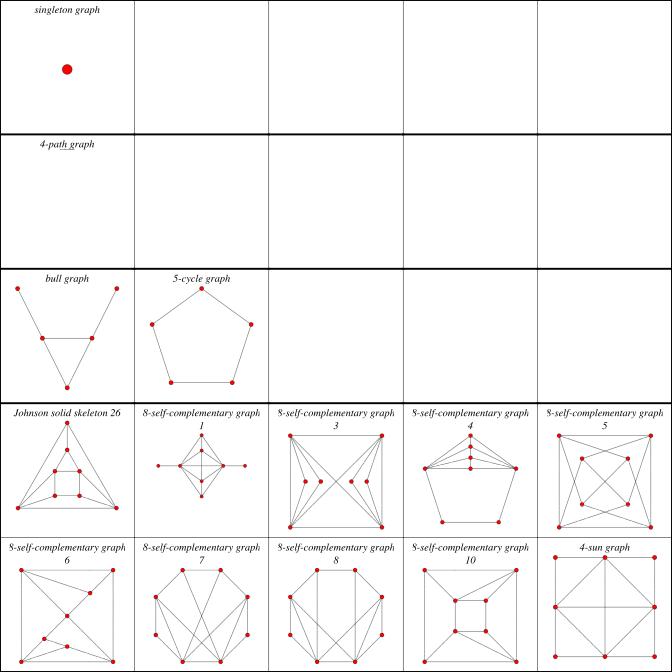
A self-complementary graph is a graph which is isomorphic to its graph complement. The numbers of simple
self-complementary graphs on  , 2, ... nodes are 1, 0, 0, 1, 2, 0, 0, 10, ... (OEIS A000171). The first few of these correspond to
the trivial graph on one node, the path graph
, 2, ... nodes are 1, 0, 0, 1, 2, 0, 0, 10, ... (OEIS A000171). The first few of these correspond to
the trivial graph on one node, the path graph  ,
and the cycle graph
,
and the cycle graph  .
.
Every self-complementary graph is not only connected, but also traceable (Clapham 1974; Camion 1975;
Farrugia 1999, p. 52). Furthermore, all self-complementary graphs have graph
diameter 2 or 3 (Sachs 1962; Skiena 1990, p. 187). For a self-complementary
graph on  vertices, there is a graph cycle of length
  for every integer
  (Rao 1977; Farrugia 1999, p. 51). As a
result, the graph circumference of a self-complementary
graph on
(Rao 1977; Farrugia 1999, p. 51). As a
result, the graph circumference of a self-complementary
graph on  vertices is either
  (i.e., the graph is Hamiltonian),
 ,
or
,
or  (Furrigia 1999, p. 51).
By definition, a self-complementary graph must have exactly half the total possible number of edges, i.e.,  edges for a self-complementary graph on
  vertices. Since
  must be divisible by 4, it follows that
  or 1 (mod 4).
There is a polynomial-time condition to determine if a self-complementary graph is Hamiltonian.
The number of self-complementary graphs on  nodes can be obtained from the "graph polynomial"
 derived from Pólya's enumeration theorem used to enumerate the numbers of
simple graphs as
derived from Pólya's enumeration theorem used to enumerate the numbers of
simple graphs as  . Harary and Palmer (1973, p. 260) list the enumeration
of labeled self-complementary graphs as a graphical enumeration problem.
. Harary and Palmer (1973, p. 260) list the enumeration
of labeled self-complementary graphs as a graphical enumeration problem.
All self-complementary symmetric graphs were identified by Peisert (2001). Peisert (2001) observed that graphs which are both symmetric and self-complementary are necessarily strongly regular, arc-transitive, and distance-transitive, and proved that they are given by the Paley graphs, Peisert graphs, and one exceptional graph on 529 vertices that is not isomorphic to either the 529-Paley or 529-Peisert graph.
See also
Graph Complement, Isomorphic Graphs
Explore with Wolfram|Alpha
References
Camion, P. "Hamiltonian Chains in Self-Complementary Graphs." In Colloque sur la théorie des graphes (Paris, 1974)
(Ed. P. P. Gillis and S. Huyberechts). Cahiers du Centre Études
de Recherche Opér. (Bruxelles) 17, pp. 173-183, 1975.Clapham,
C. R. J. "Hamiltonian Arcs in Self-Complementary Graphs." Disc.
Math. 8, 251-255, 1974.Farrugia, A. "Self-Complementary
Graphs and Generalisations: a Comprehensive Reference Manual." Aug. 1999.
https://alastairfarrugia.net/sc-graph/sc-graph-survey.pdf.Harary,
F. and Palmer, E. M. "A Survey of Graphical Enumeration Problems."
In A Survey of Combinatorial Theory (Ed. J. N. Srivastava). Amsterdam,
Netherlands: North-Holland, pp. 259-275, 1973.House of Graphs.
9-Vertex Self-Complementary Graphs. 1,
2, 3,
4, 5,
and others.Peisert, W. "All Self-Complementary Symmetric Graphs."
J. Algebra 240, 209-229, 2001.Rao, S. B. "Cycles
in Self-Complementary Graphs." J. Combin. Th. |bf 22, 1-9, 1977.Read,
R. C. "On the Number of Self-Complementary Graphs and Digraphs." J.
London Math. Soc. 38, 99-104, 1963.Read, R. C. and Wilson,
R. J. An
Atlas of Graphs. Oxford, England: Oxford University Press, 1998. Royle, G. "Self-Complementary
Graphs." http://school.maths.uwa.edu.au/~gordon/remote/selfcomp/Sachs,
H. "Über selbstkomplementäre Graphen." Publ. Math. Debrecen 9,
270-288, 1962.Skiena, S. "Self-Complementary Graphs." §5.2.3
in Implementing
Discrete Mathematics: Combinatorics and Graph Theory with Mathematica. Reading,
MA: Addison-Wesley, p. 187, 1990.Sloane, N. J. A. Sequence
A000171/M0014 in "The On-Line Encyclopedia
of Integer Sequences."Wille, D. "Enumeration of Self-Complementary
Structures." J. Combin. Th. B 25, 143-150, 1978.
Royle, G. "Self-Complementary
Graphs." http://school.maths.uwa.edu.au/~gordon/remote/selfcomp/Sachs,
H. "Über selbstkomplementäre Graphen." Publ. Math. Debrecen 9,
270-288, 1962.Skiena, S. "Self-Complementary Graphs." §5.2.3
in Implementing
Discrete Mathematics: Combinatorics and Graph Theory with Mathematica. Reading,
MA: Addison-Wesley, p. 187, 1990.Sloane, N. J. A. Sequence
A000171/M0014 in "The On-Line Encyclopedia
of Integer Sequences."Wille, D. "Enumeration of Self-Complementary
Structures." J. Combin. Th. B 25, 143-150, 1978.
Referenced on Wolfram|Alpha
Cite this as:
Weisstein, Eric W. "Self-Complementary Graph." From MathWorld--A Wolfram Resource. https://mathworld.wolfram.com/Self-ComplementaryGraph.html