$\begingroup$
The popular MO question "Famous mathematical quotes" has turned up many examples of witty, insightful, and humorous writing by mathematicians. Yet, with a few exceptions such as Weyl's "angel of topology," the language used in these quotes gets the message across without fancy metaphors or what-have-you. That's probably the style of most mathematicians.
Occasionally, however, one is surprised by unexpectedly colorful language in a mathematics paper. If I remember correctly, a paper of Gerald Sacks once described a distinction as being
as sharp as the edge of a pastrami slicer in a New York delicatessen.
Another nice one, due to Wilfrid Hodges, came up on MO here.
The reader may well feel he could have bought Corollary 10 cheaper in another bazaar.
What other examples of colorful language in mathematical papers have you enjoyed?
$\endgroup$
26
$\begingroup$
I don't even know if this is intentional or not. In his book Teichmüller theory, John Hubbard frequently references the category of Banach Analytic Manifolds. He adheres to the convention that a category be referenced by the concatenation of the first three letters of each constituent word, making the category in question BanAnaMan. This still cracks me up to this day.
$\endgroup$
9
$\begingroup$
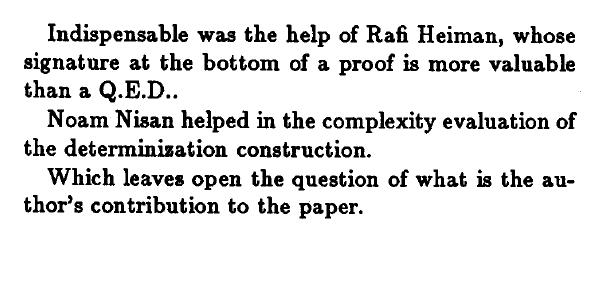
From the ground-breaking paper: On the complexity of omega-automata by Muli Safra (DOI: 10.1109/SFCS.1988.21948)
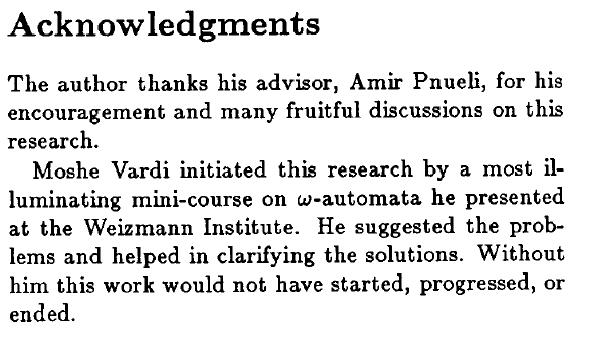
Acknowledgements
The author thanks his advisor, Amir Pnueli, for his encouragement and many fruitful discussions on this research.
Moshe Vardi initiated this research by a most illuminating mini-course on ω-automata he presented at the Weizmann Institute. He suggested the problems and helped in clarifying the solutions. Without him the work would not have started, progressed or ended.
Indispensable was the help of Rafi Heiman, whose signature at the bottom of a proof is more valuable than a Q.E.D.
Noam Nisan helped in the complexity evaluation of the determination construction.
Which leaves open the question of what is the author's contribution to the paper.
$\endgroup$
1
$\begingroup$
Does merely transposing two words count? "It is also hard not to show that ..." [Arnold W. Miller, "Some Properties of measure and category," Trans. A.M.S. 266, 1981, p. 106]
$\endgroup$
3
$\begingroup$
Chang and Keisler's book on Model Theory is dedicated to all those model theorists who have never dedicated a book to themselves.
$\endgroup$
3
$\begingroup$
The reader who makes it to the later chapters of M. N. Huxley's Area, Lattice Points and Exponential sums is rewarded with the following gem:
"If mathematics were an orchestra, the exponentials would be the violins. The $\rho(t)$ would be the flutes; they are introduced by the exponentials. The Poisson summation formula would be the tuba: powerful, but ridiculous when used too much"
$\endgroup$
$\begingroup$
Andre Weil (Oeuvres, vol. 2, page 558) purporting to be R.Lipschitz writing from Hades:
"Unfortunately, it appears that there is now in your world a race of vampires, called referees, who clamp down mercilessly upon mathematicians unless they know the right passwords. I shall do my best to modernize my language and notations, but I am well aware of my shortcomings in that respect ; I can assure you, at any rate, that my intentions are honourable and my results invariant, probably canonical, perhaps even functorial. But please allow me to assume that the characteristic is not 2"
$\endgroup$
3
$\begingroup$
This is a little off the mark (from a textbook), but Exercise VIII.8.3 of Sarason's [Notes on] Complex Function Theory is:
Stand straight with feet about one meter apart, hands on hips. Bend at the waist, knees straight, and touch left foot with right hand. Straighten. Bend again and touch right foot with left hand. Straighten. Repeat 15 times.
$\endgroup$
3
$\begingroup$
At the risk of blowing my own horn, I will mention the line in the book, Category Theory for Computing Science" by Charles Wells and me. After mentioning the Russell paradox and how to avoid it, we say, "This prophylaxis guarantees safe sets." I caught at least one colleague rolling on the floor laughing, but only after reading it aloud.
$\endgroup$
$\begingroup$
In the acknowledgment to Thomason and Trobaugh's paper on localization in algebraic K-theory, Thomason writes:
The first author must state that his coauthor and close friend, Tom Trobaugh, quite intelligent, singularly original, and inordinately generous, killed himself consequent to endogenous depression. Ninety-four days later, in my dream, Tom's simulacrum remarked, "The direct limit characterization of perfect complexes shows that they extend, just as one extends a coherent sheaf." Awakening with a start, I knew this idea has to be wrong, since some perfect complexes have a non-vanishing $K_0$ obstruction to extension. I had worked on the problem for 3 years, and saw this approach to be hopeless. But Tom's simulacrum had been so insistent, I knew he wouldn't let me sleep undisturbed until I had worked out the argument and could point to the gap. This work quickly led to the key results of this paper. To Tom, I could have explained why he must be listed as a coauthor.
Michael Harris has a rather interesting literary analysis of this quote on his webpage.
As far as I know, this was Trobaugh's only foray into mathematics.
$\endgroup$
0
$\begingroup$
Frank Adams was notorious for slipping little gems of humour into his paper and books. For instance, from his book, "Infinite Loop Spaces,"
(p. 128)
The reader may expect me to say something about "double coset formulae." I shall indeed; I advise you to avoid them.
(p. 131)
Of course, this still leaves the question: what do you say to the algebraist who loves double cosets and insists that this is the same thing really? I suggest that you smile politely and say that you are maximizing your chance of finding a helpful and congenial interpretation of the double cosets. There is no need to say that the best interpretation is one which allows you to avoid mentioning the (expletive deleted) things at all.
For further entertainment, look at the entry [85] in the bibliograph, and look at "jokes" in the index.
$\endgroup$
13
$\begingroup$
From Ravi Vakil's notes "Foundations of algebraic geometry."
He says about spectral sequences:
"They have a reputation for being abstruse and difficult. It has been suggested that the name 'spectral' was given because, like spectres, spectral sequences are terrifying, evil, and dangerous. I have heard no one disagree with this interpretation, which is perhaps not surprising since I just made it up."
$\endgroup$
3
$\begingroup$
According to https://en.wikipedia.org/wiki/Chandler_Davis, page 181 in Chandler Davis' "An extremum problem for plane convex curves" (in Victor L. Klee's "Convexity", Proceedings of Symposia in Pure Mathematics, American Mathematical Society, 1963), one has
"Research supported in part by the Federal Prison System. Opinions expressed in this paper are the author's and are not necessarily those of the Bureau of Prisons."
The paper was written while its author was in prison for refusing to cooperate with the House Unamerican Activities Committee.
The quote can be seen in Google books.
$\endgroup$
1
$\begingroup$
P. T. Johnstone's On a Topological Topos has some interesting choices of words. Sometimes the words are discussed in parenthetical notes.
([...] we are tempted also to introduce the term 'consequential space' for an arbitrary object of $\mathcal{E}$, apart from a slight reluctance to give the name 'space' to an object of a category whose underlying-set functor is not faithful—and, we must admit, the fear that somebody will at once invent a notion of 'inconsequential space'.)
Sometimes there is no more than a reference to existing literature.
The rest of the proof of Theorem 5.1 is a fairly straightforward woozle-hunt (Milne [27])
Reference [27] is, as you may have guessed, A. A. Milne's Winnie The Pooh.
$\endgroup$
3
$\begingroup$
While this is not necessarily the meaning of "colorful" intended by the OP, there is probably no better way to find out what motivated the editors of the American Mathematical Monthly to reiterate a damnation by publishing the following erratum, than posting it here:
Erratum: In the article, "On the Ph.D. in Mathematics," by I. N. Herstein, on page 821, line 26, of the August-September 1969 issue of the Monthly, please read "damn" instead of "darn."
American Mathematical Monthly volume 77 (1970) p. 78
$\endgroup$
2
$\begingroup$
From Vector Calculus, Linear Algebra, And Differential Forms. A Unified Approach. by Hubbard:
When a matrix is described, height is given first, then width: an m x n matrix is m high and n wide. After struggling for years to remember which goes first, one of the authors hit on a mnemonic: first take the elevator, then walk down the hall.
$\endgroup$
6
$\begingroup$
What about Johnstone, in his introduction to Topos Theory (1977):
Finally, I have to state my position on the most controversial question in the whole of topos theory: how to spell the plural of a topos. The reader will already have observed that I use the English plural; I do so because [...] the word topos is not a direct derivative of its Greek root, but a back-formation from topology. I have nothing further to say on the matter, except to ask those toposophers who persist in talking about topoi whether, when they go out for a ramble on a cold day, they carry supplies of hot tea with them in thermoi.
That cracked me up. And for many years it was as far as I got into the book.
$\endgroup$
4
$\begingroup$
The paper "Division by three" by Peter Doyle and John Conway has a wealth of colorful language including:
"If the arrows are good, straight, American arrows, it is very natural for each arrow to dream of marrying the arrow next door."
and
"Not that we believe there really are any such things as infinite sets, or that the Zermelo-Fraenkel axioms for set theory are necessarily even consistent. Indeed, we’re somewhat doubtful whether large natural numbers (like $80^{5000}$ , or even $2^{200}$) exist in any very real sense, and we’re secretly hoping that Nelson will succeed in his program for proving that the usual axioms of arithmetic—and hence also of set theory—are inconsistent. (See Nelson [6].) All the more reason, then, for us to stick with methods which, because of their concrete, combinatorial nature, are likely to survive the possible collapse of set theory as we know it today."
$\endgroup$
2
$\begingroup$
One of my favorites has always been Hermann Weyl's "... the gods have imposed upon my writing the yoke of a foreign language that was not sung at my cradle" (in the preface to his classic text `The Classical Groups: their Invariants and Representations') to excuse his supposedly poor English. This was a conceit of course---as the quote itself shows his command of English was impeccable.
$\endgroup$
$\begingroup$
Masaki Kashiwara writes, in the introduction to his Systems of microdifferential equations:
Although this was a course at a French university, several examples of hyperfunctions are given just before Theorem 3.2.45.
and shortly after that:
The reader is kindly advised not to commit seppuku instantly if he feels he does not quite understand 2. of chapter 1.
$\endgroup$
1
$\begingroup$
From Strichartz's A Guide to Distribution Theory and Fourier Transforms:
(p.2) "You have almost seen the entire definition of generalized functions. All you are lacking is a description of what constitutes a test function and one technical hypothesis of continuity. Do not worry about continuity--it will always be satisfied by anything you can construct (wise-guys who like using the axiom of choice will have to worry about it, along with wolves under the bed, etc)."
$\endgroup$
1
$\begingroup$
From the introduction of Model Theory by Wilfrid Hodges:
"Finally a dedication. If this book is a success, I dedicate it to my students and colleagues, past and present, in the field of logic. Many of them appear in the pages which follow; but of those who don't, let me mention here two thoughtful and generous souls, Geoffrey Kneebone and Chris Fernau, both now retired, who ran the logic group of London University at Bedford College when I first came to London. If the book is not a success, I dedicate it to the burglars in Boulder, Colorado, who broke into our house and stole a television, two typewriters, my wife Helen's engagement ring and several pieces of cheese, somewhere about a third of the way through Chapter 8."
$\endgroup$
2
$\begingroup$
Jon Barwise's Admissible Sets and Structures contains the following on page 69:
When used in a class or seminar, section 6 should be supplemented with coffee (not decaffeinated) and a light refreshment. We suggest Heatherton Rock 'Cakes. (Recipe: Combine 2 cups of self-rising flour with 1 t. allspice and a pinch of salt. Use a pastry blender or two cold knives to cut in 6 T butter. Add 1/3 cup each of sugar and raisins (or other urelements). Combine this with 1 egg and enough milk to make a stiff batter (3 or 4 T milk). Divide this into 12 heaps, sprinkle with sugar, and bake at 400 °F. for 10 — 15 minutes. They taste better than they sound.)
There is a response to this (with stronger ingredients) somewhere in Aki Kanamori's The Higher Infinite but I forgot exactly where. Later in that book, on page 289, Kanamori writes:
But first, a respite from the rigors: Instead of yet another recipe, we offer the following chess problem (M. Henneberger, first and second prize, "Revista de Sah" 1928):
White. King on b1, Rooks on b7 and c7, and Bishop on b5.
Black. King on a8, Rook on a3, and Pawn on f2.
White to play and win.
Send complete solutions to the author for a small prize.
$\endgroup$
$\begingroup$
From Tilman Bauer's "p-compact groups as framed manifolds:"
For our purposes, it is enough to work in the category of so-called naive G-spectra. I will drop the word “naive” since it will make this work appear so puny.
And in Tilman's paper with Natalia Castellana, "Adjoint spaces and flag varieties of p-compact groups:"
This comment is only meant to intimidate the reader and is insubstantial for what follows.
$\endgroup$
$\begingroup$
A few days ago, some colorful quotes from Michael Spivak's A Comprehensive Introduction to Differential Geometry were posted here. Yesterday I noticed they were missing, which is a great loss, so I am attempting to restore them. The only one I remember immediately is
Bourbaki has apparently decided that the theory of manifolds has now entered that domain of "dead" mathematics to which he hopes to give definitive form. In this summary of results the corpse is laid out to public view; the complete autopsy is eagerly awaited.
(Volume 5, p.608, of the 2nd edition, 1975)
If anyone recalls some others, please add them.
$\endgroup$
3
$\begingroup$
In his article "Lectures on Mixed Motives" (Proceedings of Symposia in Pure Mathematics, Volume 62.1, 1997), Spencer Bloch writes:
"My experience with these lectures suggests that motives are like onions; they are complicated, multi-layered objects, and any attempt to cut too quickly to the heart of the matter can leave the audience in tears."
I've actually gotten some mileage out of this analogy in my teaching. When doing the first iterated chain-rule examples in calculus classes, for example, I advocate working "from the outside in" as opposed to the other way around, and employ a variant of Bloch's statement.
$\endgroup$
$\begingroup$
I like the following footnote that appears in a paper by G. Baumslag:
"I thank Graham Higman for allowing the dust of Oxford to rest on my unopened manuscript for thirty months."
$\endgroup$
1
$\begingroup$
I was always amazed that Clifford Truesdell could get away with a quote like this:
Nowadays, when the common student seeks a secure berth by grafting himself upon some modest little professor whom he regards as prone to foster painlessly his limaceous glide toward a dissertation not too strenuous or, even better, to draught it for him, tradition is moribund (...)
This is from his introduction to the selected papers of W. Noll. Admittedly, Truesdell was the chief editor himself, and could write therefore whatever he wanted, but it's still pretty strong. Felt too close to home when I first read it as a graduate student!
$\endgroup$
6
$\begingroup$
Yiannis Moschovakis, Notes on Set Theory (1994), p. 81:
6.26 About topology. General (pointset) topology is to set theory like parsley to Greek food: some of it gets in almost every dish, but there are no great "parsley recipes" that the Greek cook needs to know.
$\endgroup$
$\begingroup$
This isn't so much a serious mathematical paper, but Miles Reid - Undergraduate Algebraic Geometry is full of bizarre sentences:
If $I(X)$ is defined as the set of functions vanishing at all points of $X$, then for any point of $X$, all functions of $I(X)$ vanish at it. And indeed conversely, if not more so, just as I was about to say myself, Piglet.
or,
The name of the theorem (Nullstelle = zero of a polynomial + Satz = theorem) should help to remind you of the content (but stick to the German if you don't want to be considered an ignorant peasant).
$\endgroup$
3
You must log in to answer this question.
Explore related questions
See similar questions with these tags.