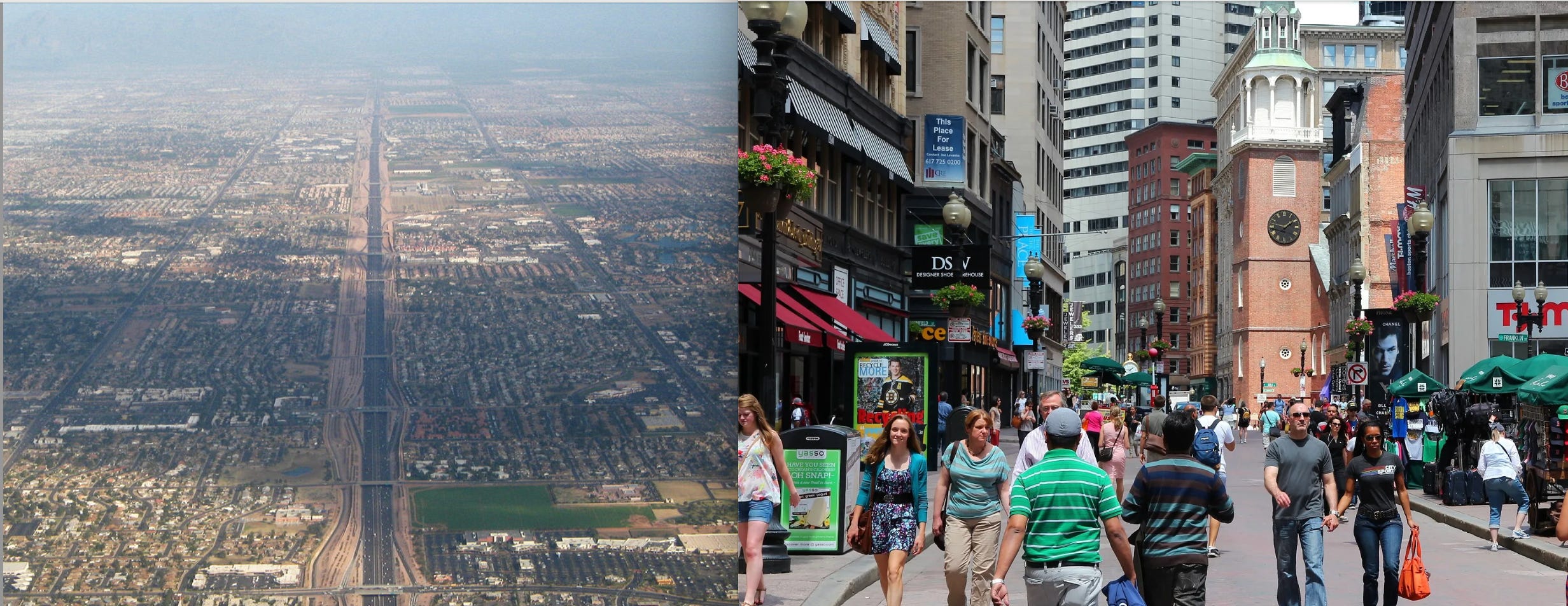
There is a story Americans like to tell about ourselves: that we love our cars, our cul-de-sacs, our three-car garages and two-car commutes. That we “chose” this. That suburban sprawl is the natural expression of an American preference for space, privacy, and the open road, and that anyone who suggests otherwise is a coastal scold trying to force us into a crowded apartment over a noisy bar.
It’s a great story. It is also, in the most literal sense, advertising — sold to us for nearly a century by the auto industry, the oil industry, and others whose business models depend on robust car and oil sales. And the proof that it’s advertising, rather than reporting, is hiding in plain sight, in the price of a house.
Start with a basic question. If Americans truly prefer car-dependent suburbia above all other ways of living, why is it illegal to build almost anything else?
If you want to know what people actually want, look at what they pay for. And what Americans are paying for is the thing we made illegal: Walkable neighborhoods.
Because that is the actual situation. In most American cities, on roughly seventy-five percent of all residential land, it is against the law to build a duplex, a corner store, a small apartment building, or anything denser than a single detached house on a large lot.
It is against the law to build a house without a parking space attached, even if the future occupant doesn’t own a car.
It is against the law in many places to build a building tall enough to be served by a single elevator, or to put apartments above a coffee shop, or to make a street narrow enough that drivers slow down.
And yet, the neighborhoods that most Americans say they love when they visit Paris, or Charleston, or Greenwich Village are functionally illegal to build.
Free Lunches, Free Parking, and Free Markets
We have not had a free market in American housing or transportation for at least seventy years. What we have had, instead, is the most ambitious land-use experiment in human history: a continent-scale effort to make one specific lifestyle — single-family house, two cars, every trip outside the home only possible by driving — not just available, but mandatory.
The rules went by polite names, though YIMBYs have done our level best to make them pejoratives: Zoning. Parking minimums. Setback requirements. Street level-of-service standards. Floor-area ratios.
But strip away the planning jargon and what you find is a driving mandate dressed up as land-use regulation. If your neighborhood requires every home to come with two parking spaces, every store to come with a parking lot four times the size of the store, and every street to be wide enough for a fire truck to do a three-point turn, you have not built a place where people can choose to drive. You have built a place where they have no choice but to drive.
Prior his death last year, I was fortunate enough to work with the economist Donald Shoup on some groundbreaking housing legislation. Actually, it was parking legislation – arguably, these are the same thing – that ended the common and extremely costly practice in California cities of mandating (there’s that word again) parking in new housing developments.
Before he joined YIMBYs in helping to pass AB 2097 in Sacramento, Shoup spent his career documenting the scale of the economic, fiscal, and behavioral distortion of government driving mandates. His 800-page magnum opus The High Cost of Free Parking makes a case that ought to be obvious, but somehow isn’t: there is no such thing as free parking.
Asphalt costs money, land costs money, construction costs money — somebody pays. When the law forces every developer to build parking that customers and tenants haven’t asked for, the cost gets baked into the rent, the price of groceries, the price of a haircut, the price of everything.
Shoup estimated that the value of all the “free” parking in America runs into the hundreds of billions of dollars per year — a subsidy to driving that dwarfs anything we spend on transit, sidewalks, or bike lanes. And everybody pays for it, hidden in every transaction, every lease, every meal out. We have built an enormous cross-subsidy — it touches almost every corner of our economy — to subsidize car-dependence, and called it the natural order of things.
Homes in walkable neighborhoods sell for an average of 34 percent more per square foot than homes in drivable suburbs. Renters are willing to pay a 41 percent premium for the same car-free or car-light access.
And then, having banned the alternatives and subsidized the mandate, we turn to the resulting landscape and say, See? Americans love it.
The Markets are … Wrong?
But the market knows better. The market always knows better. Because if you want to know what people actually want, as opposed to what they say they want or what they’ve been conditioned to expect, you look at what they pay for. And what Americans are paying for, when given any chance, is the thing we made illegal.
In its 2023 Foot Traffic Ahead report, Smart Growth America found that, across America’s 35 largest metros, homes in walkable neighborhoods sell for an average of 34 percent more per square foot than homes in drivable suburbs. Renters are willing to pay a 41 percent premium for the same car-free or car-light access.
People will tell pollsters they want a yard. Then they’ll outbid each other for a townhouse two blocks from a coffee shop. The yard, it turns out, is what they say. The walk to the coffee shop is what they pay for.
In New York, the multifamily premium hits 80 percent; in Chicago, 65 percent. The walkable share of the country’s residential, retail, and office mix sits at just 16 percent — and occupies a mere 1.2 percent of the land. One-eighth of the supply, more than one-third extra in price, and – according to a survey conducted by the National Association of Realtors – a 75-percent willingness among Americans to pay more for walkability if they could find it.
A 2026 study in Transportation Research Part A by Corcoran and colleagues at Arizona State University drives the point home. Surveying a representative national sample of 2,155 urban and suburban Americans, they found that 18 percent of US adults express a strong interest in living without a car, and 60 percent express some interest. Crucially, that includes a large share of people who currently own cars — roughly one in five car owners says they would seriously consider going car-free.
The authors are blunt about the implication: the constraint on car-free living in America is not public willingness, but the lack of neighborhoods where it is feasible. Or as the lead author put it, if the latent demand they measured were ever realized, US car-free rates would approach European levels — “unlikely, given the current land use situation we’re in.”
18 percent of US adults express a strong interest in living without a car, and 60 percent express some interest.
That is the regulatory cathedral talking. People will tell pollsters they love their cars; one in five of them, given a real option, would hand over the keys. That’s over 50 million adult Americans saying they’d like their freedom back.
In Defense of Freedom
This is the part of the story that the sprawl-is-natural argument cannot survive. If suburban car-dependence really is the universal American preference, why does the most basic mechanism of capitalism — willingness to pay — say the opposite? Why does the supply of giant houses with two-car garages, which is roughly 90 percent of what gets built, still trade at a discount per square foot to the small slice of the country where you can walk to buy milk?
In a normal market, dominant supply meets dominant demand and the price clears. In the American housing market, the supply is overwhelmingly one product, the price premium is overwhelmingly on the other product, and the gap has been growing for decades.
That is not a market expressing a preference. That is a market screaming about a shortage.
There is an obvious objection here, and it is worth taking seriously. Some people genuinely do prefer a big yard, a quiet cul-de-sac, and a long driveway, and that’s fine. Those people should be able to have it.
The argument for housing freedom is not that everyone secretly wants to live in Brooklyn. The argument is that some people want walkable urbanism, some people want quiet suburbs, some people want a farmhouse on twenty acres, and in a United States that is truly free, all of them should be allowed to build and buy what they want.
But the current system gives one group everything it wants by force of law, and tells everyone else to move to one of seven vaguely walkable cities — and pay a premium.
The suburbanist position, stripped of its sentimental costuming, is this: “We believe most Americans prefer our way of life so strongly that we cannot risk letting them choose otherwise.”
It is a confession of doubt dressed up as confidence. People who are sure their lifestyle is what others want do not generally find it necessary to outlaw the competition. In fact, it was not so long ago that conservatives – including those at, say, the American Enterprise Institute – would stand on principle and note that if the government has to make you do something, that’s coercion, not commerce.
But my, how far AEI has fallen. Its team recently put a clean version of this argument into the RealClearMarkets op-ed page: the YIMBY movement, the authors warn, has gone wrong by focusing on apartments, when “the vast majority of Americans (86%) want to live in single-family homes.”
That 86 percent figure does a lot of work in the piece. It is also an artifact of the specific survey it comes from — the Institute for Family Studies’ 2024 “Homes for Young Families” report, by Wendell Cox and Lyman Stone — and worth a closer look. The survey asked respondents to “visualize their ideal home” and report what kind it was. Seventy-nine percent said a detached single-family house.
The IFS authors then add townhouses to the count to get to roughly 86 percent and call it a mandate for sprawl. But “ideal home, no constraints” is the textbook example of a stated preference that doesn’t survive contact with a budget. It is the same instrument that, asked the right way, will tell you 90 percent of Americans want a private chef. It tells you nothing about what people will pay for, what they will trade off, or what they would actually choose if walkable neighborhoods were legal to build at scale and priced accordingly.
The market does that work, and the market — as we just saw — answers very differently.
The IFS report also leans hard on the conjoint analysis showing Americans rank “safety/low crime” and “good schools” above almost everything else, then quietly slides from that finding into the conclusion that families therefore want suburbs. This is the move that does the heaviest lifting in the report, and it does not survive a look at the actual data. The IFS authors concede in a footnote that density may merely be correlated with crime, not a cause of it — and then proceed as if it doesn’t matter.
It matters a great deal. The “urban” violent crime number that the report leans on is an average that lumps high-poverty, disinvested neighborhoods together with the safest, most walkable, highest-demand parts of the country. Greenwich Village, Beacon Hill, Park Slope, Cole Valley in San Francisco, Capitol Hill in Seattle, and Old Town Alexandria are all “urban.” None of them resemble the menacing streetscape the report invites readers to imagine.
The dense, walkable neighborhoods that command the 34 to 41 percent price premium we documented earlier are, with very few exceptions, safer than the national average — which is precisely why people are paying that premium (NB, urbanists would do well to take the issue of urban crime more seriously; it is a serious issue).
Meanwhile, the suburbs and rural areas that the IFS report holds up as the safe alternative have themselves been getting steadily less safe. National Crime Victimization Survey data, as reported in a Time essay on suburban crime trends, found that suburban violent felonies jumped 73 percent in a single year (2021 to 2022), and rural violent felonies more than doubled — a 102 percent increase — in the same window.
Rural America has higher rates of intimate partner homicide, gun suicide, and opioid overdose than urban America. The 2022 CDC report on traffic fatalities, which we will get to shortly, finds that the most dangerous places in America to be a pedestrian are car-dependent sprawl roads in the South and West, not city sidewalks.
The IFS survey’s premise — that families flee cities for safety — is built on a perception of urban danger that is partly a stereotype, partly a self-fulfilling artifact of a century of disinvestment, redlining, and white flight, and partly just out of date. Telling families “your only safe option is a place where you have to drive everywhere” and then citing their answers as a verdict on walkability is not science. It is the rhetorical equivalent of locking someone in a room and asking whether they prefer the room or the hallway.
What is most striking about the AEI piece, though, is what is missing from it: any acknowledgment that the supposed “preference” for postwar single-family suburbia was itself the product of the most aggressive set of government interventions in American economic history. The Federal Housing Administration and VA loan programs explicitly refused to underwrite mortgages on multifamily buildings, mixed-use blocks, or homes in older walkable neighborhoods — and explicitly required racial covenants well into the 1960s.
The 1956 Interstate Highway Act spent the modern equivalent of more than a trillion dollars cutting freeways through cities and out to greenfield. Federal mortgage interest deductions subsidized owner-occupied detached homes and nothing else. Local governments layered on parking minimums, single-family zoning, urban growth boundaries, and the rest of the apparatus we have already discussed.
To stand inside the resulting landscape, point at it, and say “see, this is what Americans chose” requires a degree of historical amnesia that should embarrass a self-described conservative think tank.
The free market did not produce postwar suburbia. The state did, on purpose, with our money, and over the objections of the cities it gutted to do it.
A movement that calls itself conservative should at the very least be curious about which preferences are real — and which were manufactured by the largest land-use intervention in human history.
A Toast: To the Suburbs, Comrades
There is a name for an economic system that uses regulation to mandate one product, criminalize the alternatives, and subsidize the chosen one with hundreds of billions in hidden cross-payments. It is not capitalism. It is not the free market. It is central planning — Soviet in structure if not in aesthetic, with cul-de-sacs instead of microdistricts and Olive Gardens instead of bread lines.
The people who have spent the past fifty years calling YIMBYs socialist for wanting to legalize apartments have somehow not noticed that they are the ones running a command economy. The suburbanist who insists the market chose this is standing inside a regulatory cathedral built specifically to deliver his preferred outcome.
A nation truly in love with driving would not be killing each other over it at this rate. People do not get this angry over things they actually enjoy doing, and want to do.
And the cost of that command economy is not just paid in rent. It is paid in blood, on the road, every day. In September 2025, the AAA Foundation for Traffic Safety released a study finding that 96 percent of American drivers admit to aggressive driving behaviors in the past year — speeding, tailgating, cutting people off, confronting other drivers. Eleven percent admitted to outright violent acts: ramming another car, getting out to start a fight.
The motivator most cited by aggressive drivers was, almost poignantly, “to get to their destination faster.”
These are not, on the whole, people who love driving. They are people who are angry that they have to. Road rage shooting deaths more than doubled between 2018 and 2023, from 58 killed and 160 wounded to 118 killed and 365 wounded. AAA’s own conclusion is that aggressive driving begets more aggressive driving — a self-reinforcing cycle of hostility behind the wheel.
It tracks, if you think about it for a second. Force tens of millions of people into a daily activity they find stressful, expensive, and time-consuming. Strap them into two-ton metal boxes. Put them in traffic that exists because the same regulations forcing them into cars also forced everyone else into cars. Then act surprised when they snap.
The Corcoran study found one in five American car owners would consider giving up their car if the option existed. That is twenty percent of the people on the road, every morning, doing something they would prefer not to be doing.
We have manufactured a country in which a huge share of the population is driving against their will, and we have called the resulting rage a personal failing.
The bodies pile up accordingly. Pedestrian deaths in the United States have risen 80 percent since 2009, while every other category of traffic fatality rose just 13 percent. Between 2013 and 2022, the US pedestrian death rate climbed 50 percent — even as the rate fell by a median of 25 percent across 27 peer countries, according to the CDC.
The American rate is now roughly three times the median of comparable wealthy nations. Almost two-thirds of those deaths happen on streets without sidewalks. More than three-quarters happen at night, on roads designed to move cars fast through places people are still trying to walk.
This is not the price of a free society making free choices. It is the price of a regulatory regime that built a country for cars and then handed the wheel to people who would rather not be holding it. A nation truly in love with driving would not be killing each other over it at this rate.
People do not get this angry over things they enjoy doing and actually want to do.
The way out is not to flip the mandate. We do not need a law banning suburbs, or mandating urban living (“you will live in a pod/eat the bugs/15 minute cities/the globalist conspiracy”) any more than we needed the laws banning everything else. The way out is freedom — actual, market-based freedom — to build what people want to live in, and to let them pay for what they actually prefer:
Legalize the missing middle. Legalize the corner store. Legalize a building without a parking lot. Charge market prices for driving, and for street parking. Let the price signal do the thing the price signal is supposed to do – the thing it is best at, and is uniquely qualified to do.
If suburbanists are right that Americans love sprawl, they have nothing to fear from this. The market will deliver them more of what they say it wants. And if they are wrong — if, given the freedom to choose, Americans turn out to want walkable neighborhoods at something like the rate the prices have been telling us for thirty years — then we will finally have what we have not had since before most of us were born: a country where the place that you live is a choice you make, rather than a choice made for you.
The car commercials told us we were free on the open road. The real freedom is the one they spent a hundred years lobbying us out of: the freedom to choose whether we want or need the car at all.
###
Ed. update: I found an old note from Prof. Shoup that is too precious not to append here. “Now I need a nap.” He was truly a joy to work with:


