Imagine an infectious disease that:
Is 100% fatal.
Has no vaccine, no antibiotic, no cure whatsoever.
Is undetectable by tests.
Sits quietly inside your body for years before you show symptoms.
You are dead within 4-12 painful months once you become symptomatic.
It turns your brain to sponge, causing dementia, personality loss, behavioral changes, blindness, uncontrollable movements, etc.
Your body does not recognize it as harmful and mounts no effective immune response, even while it is killing you.
The infectious agent is impervious to high heat, ionizing radiation, microwaves, cold, high pressure, etc.
Shedded infectious material persists for decades in the environment and on surfaces, just waiting to infect the next host.
Unfortunately, don’t have to imagine it. It exists today. Welcome to the horrifying world of prion diseases.
Prions are misfolded proteins whose shape causes other proteins to fold into the same shape, which in their turn misfold others, setting off an unstoppable chain reaction.
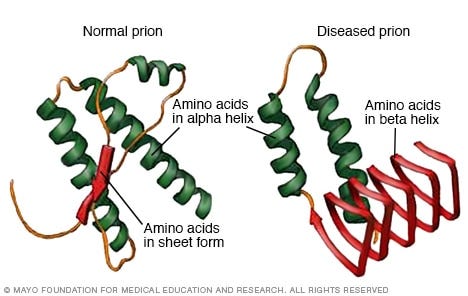
If we debate whether viruses are truly alive, there is no such argument with prions. They do not contain DNA or RNA. In no sense are they alive. Prion diseases are the merest form of memetic domino, like a bunch of mouse traps setting each other off.
Prions in mammals occur in the “PrP” protein, a poorly understood structure found throughout the body, but mostly in the brain and nervous system. Prion disease in sheep is called scrapie, in cows mad cow disease, in deer chronic wasting disease and in humans kuru, fatal insomnia, or Creutzfeldt-Jacob disease. Despite the name differences, these are all types of ‘spongiform encephalopathy’, meaning it turns the victim’s brain into a spongy mass full of small holes.
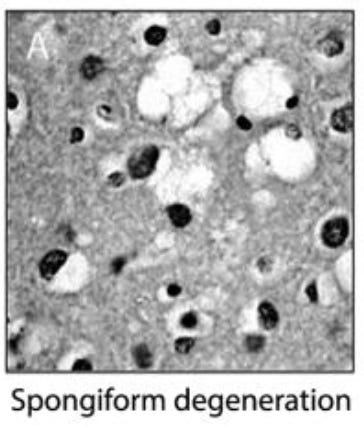
Progress of the infection is exponential. It starts slowly: first one protein molecule, then two, then four and so on with no noticeable symptoms. This stage may last for years, in humans anywhere from 5-20+ years.
The converted proteins clump together, coaxing more and more of the surrounding tissue into prions. At this stage, when only a small part of the brain has been affected, victims begin to notice problems. They start forgetting things, find it harder to keep their balance, they may have dizzy spells, pins-and-needles sensation in their limbs, difficulty understanding what they read, and be more than usually agitated and depressed.
Once the amount of prions hits a critical mass, symptoms get worse quickly. Quickly in terms of how fast the first stages went, but it still takes an agonizing 4-12 months to succumb. Victims experience personality changes, severe agitation, uncontrollable muscle movements, memory loss, nerve pain, convulsions, hallucinations and other horrifying things like not recognizing their own limbs as their brain is turned into fluffy meringue. There is no treatment, and end-of-life care is only palliative.
Prion disease symptoms overlap with a lot of other conditions. So before you start thinking you have a prion disease right now, know that human prion disease, Creutzfeldt-Jacob disease (CJD), has been called “The Great Mimicker”. It is often diagnosed late, and often only suspected to be CJD when the patient gets worse faster than they would if they had regular dementia or whatever it was confused with.
Prion disease is virtually undetectable by tests before symptoms appear. After they do, a spinal tap usually finds it but to be absolutely sure doctors need a post-mortem look at actual brain tissue. Diagnosis in living patients is usually based on a combination of symptoms and circumstantial data from other tests once the doctors know what to look for.
Because prions are just proteins with a different shape, the immune system does not see them as a threat. Even if it did, it has no mechanism to get rid of them. The normal metabolizing process for proteins does nothing to prions.
Prions are just hard to get rid of in general. Fire, acid, standard chemical disinfection and ionizing radiation don’t break them down. Recommended methods for handling prions is incinerating at 1000C/1800F (hotter than a cremation chamber) or flooding with bleach for 1 hour and then cooking in a sterilization oven over the boiling point for 1 hour. Even then, partially denatured prions could theoretically get back to an active disease-causing state!
Prion diseases are diagnosed at a rate of about 1 in a million in the developed world. About 90% of these are ‘spontaneous’, where the person got unlucky enough to have a normal protein misfold and start the prion chain reaction. About 10% are genetically transmitted mutations and less than 1% percent are acquired via infection. This is lucky for us, especially when you compare it to what happened to cows.
Mad cow disease (aka bovine spongiform encephalopathy aka BSE) hit the UK hard in the 80s and 90s. We still don’t know how it started but they think it was spread by feeding cows ground up bits from other infected cows.1
While alive, victims shed infectious prions through saliva, feces and urine. In herd animals there are a lot of fluids sloshing around. More than 184,000 cows in the U.K. were diagnosed with BSE between 1986 and 2015. Four million more were liquidated in an attempt to control the spread, especially after it made the jump to humans.
variant-Creutzfeldt-Jacob (vCJD) is the prion form we think (still unclear!) is caused by eating mad cow beef. The first victims of vCJD in the mid-90’s were thought to have gotten it from eating mad cow a decade earlier in the mid-80’s. Fortunately only 233 cases of vCJD worldwide have been reported because of the strict and decisive actions taken to prevent mad cow meat from entering the food supply. The same control can’t be said about CWD, the variant that affects deer.

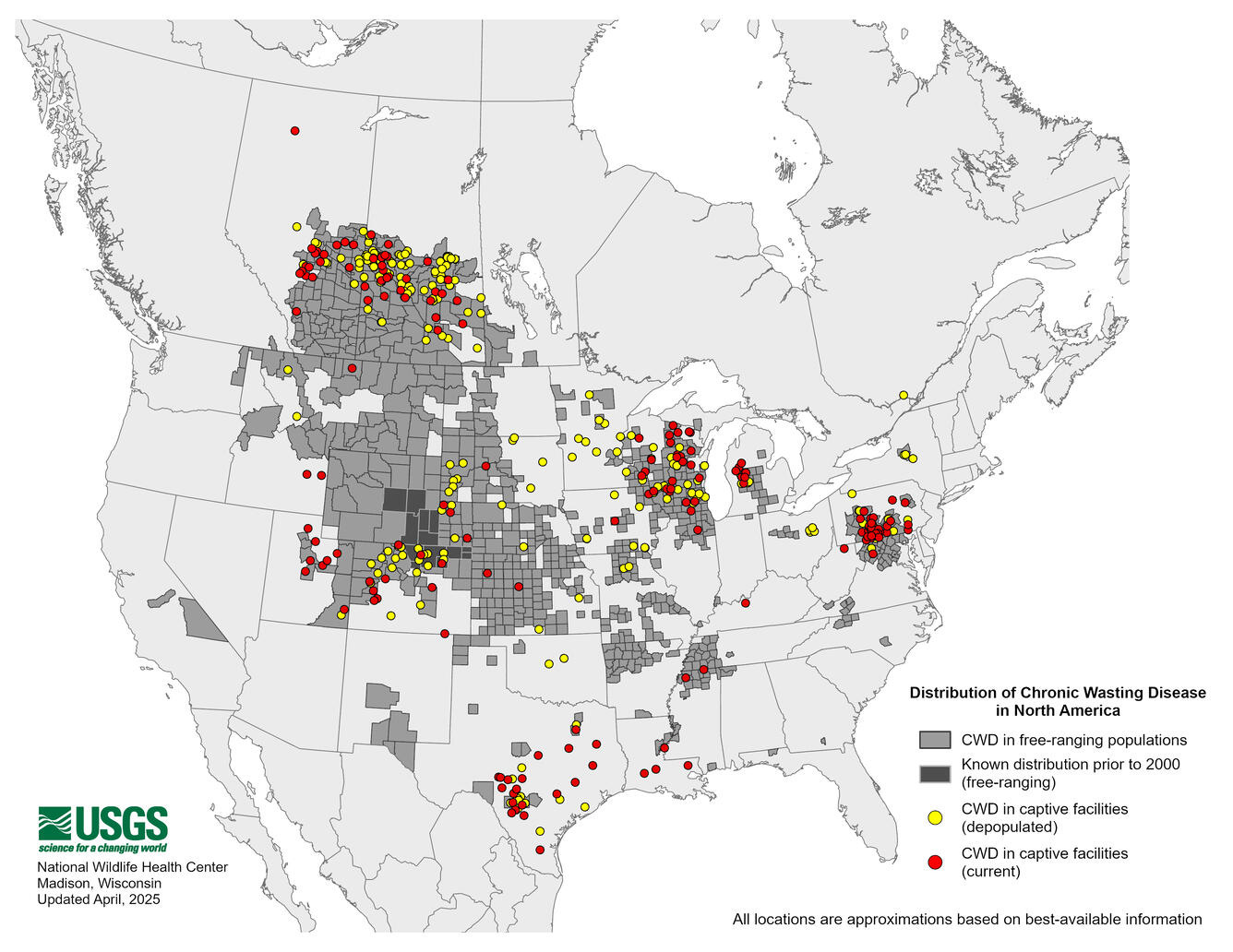
CWD was first detected in a deer research facility in Fort Collins, Colorado in 1967. Since then it has spread across the continent, affecting tens of thousands of animals in the deer family including moose, caribou and elk. In addition to prions in the excreta of infected animals, deer may get it merely from eating grass in CWD positive areas, as shedded prions stay potent in the soil for years.
CWD is now found in 37 US states and 5 Canadian provinces. It has been a top priority for wildlife management and conservation non-profits but despite millions in funding and years of research, CWD continues to spread. It is already starting to show up in Europe, Asia, and other distant places with no solution in sight. It will continue to decimate deer species for decades to come, and in some places, completely eradicate them.
Beyond a few bits of circumstantial data, there is no evidence humans can get prion disease from CWD. Millions of deer are harvested and eaten each year in the United States, about 10,000 of those infected by CWD. Heavily exposed people like taxidermists and wild game butchers don’t have higher rates of CJD than would be expected. Out of an abundance of caution, the CDC recommends not eating meat from CWD positive deer. Most hunters disregard this warning however: it is hard to get them to follow the protocol based on a theoretical risk.
Kuru is one known instance of a human prion disease epidemic. Kuru occurred among the Fore people in Papua New Guinea, who cooked and ate their relatives after death to help speed the spirit on its journey. Women and children ate the brains, and they were the ones most commonly affected. Kuru was recognized in the mid-1950s and studied extensively. It eventually disappeared after authorities prohibited the practice of cannibalism and new infections stopped. Overall, a few thousand people were known to have died from kuru.

Infectious prion disease in humans are extremely rare, require very high infectious load and has robust cross-species barriers. Scrapie (sheep prion disease) for example has been around for over 200 years and it has never made the jump to humans.
Still, a rogue AI or malicious actor intent on eliminating the human race might put prion diseases at the top of their list for getting the job done. Long incubation, undetectable, persistent in the environment, invariably fatal…just need to engineer it to shed heavily, and make it easier to transmit between humans and voilà.
Humans are smarter than cows and deer of course and most people these days don’t eat a lot of brains: if there was a prion disease outbreak there is a lot we could do to slow the spread, and millions of people with a zombie brain disease might be enough necessity to find a cure.
And there may be some hope. A team from the Broad Institute has recently started human trials on a therapy that promises to slow prion diseases by inhibiting production of the prion protein molecules2.
Engineered pandemics are an under-appreciated societal risk. In the past it was very difficult, expensive and the information was limited. But scientific advances and the rise of AI make novel bioweapons a haunting new possibility, one that demands a new approach. Some steps we could take:
Proactively screen for pathogens before they become full-blown pandemics, e.g. by testing wastewater and voluntary nasal swabs for early disease markers.
Restricting access to and regulating data and materials used to engineer diseases.
Stopping AI from helping make engineered novel pathogens, and controlling AI itself as it gets ever more powerful.
Strengthen international agreements against making bioweapons.
So please, let’s make sure horrors like novel engineered prion diseases never become reality.