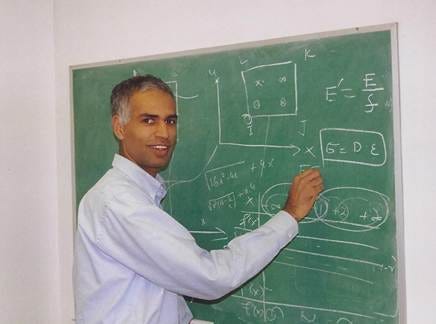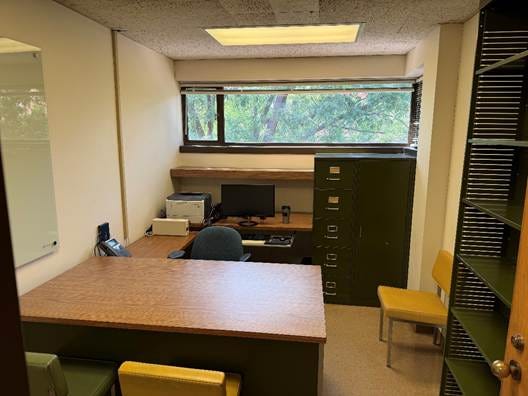
I officially retired this month from the University of Maryland, Baltimore County (UMBC). This meant saying goodbye to the office I’ve occupied for the past 43 years (it’s the only job I’ve ever had). The above photo is the final one I took before turning in the keys. Notice the retro chairs, the army green filing cabinets, the industrial-looking bookcase. All from 1968, when the building first opened. Until a little while ago, I had an old-style green chalkboard as well – I never got to use the spiffy new erasable whiteboard you see at the left.
Imagine how full the cabinets were in their heyday. I’m talking about the bad old days of paper. I moved into this office in 1983, well before the internet age (the invention of the World Wide Web was still six years away). While cleaning out my office, I got to fully appreciate the reams of records, correspondence, research preprints, periodicals and other hard copy items everyone, including me, used in the past. The recycling bins quickly got filled, so I had to pile mounds of accumulated material outside my door.
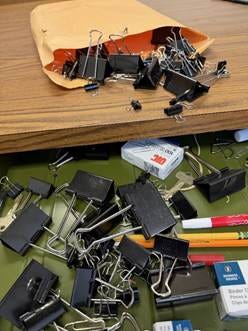
What remained were the binder clips – refugees from the flood of paper that had just been washed away. They looked kind of forlorn – silver arms clasped together in supplication, as if begging for something else to hold together to remain gainfully employed. I took a couple of them home – they’re great for resealing bags of potato chips.
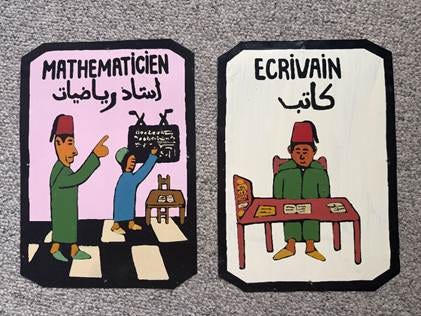
What else to salvage? I was quite ruthless in terms of discards – everything from math notebooks preserved from my grad school days to the transparencies for research talks I’d delivered over the years. I allowed myself a couple of saved thank-you notes from students, and a poster for The Mathematics of Being Human, a play I’d written and staged at UMBC with an English professor. Also, a scathing tirade by a reader against a New York Times piece in which I’d provocatively suggested that the West owes reparations to India for the use of zero, since the Hindus had invented it. And yes, the twin hand-painted signs from a trip to Morocco, which cutely summarized my dual careers of “mathematician” and “writer.”
Back when I started, it was common for faculty to move between academic positions. Math jobs were plentiful: you got a “starter” assistant professor position right after grad school (no post-doc experience needed!) and if your research went well, moved to a more prestigious institution in a few years. I personally managed to wrangle two such opportunities – but each time, instead of moving, used them as leverage to negotiate a raise and stay where I was.
And why wouldn’t I stay? My partner was stably employed in the area, and UMBC, which had not gained the prominence it would acquire later, was a conducive place to explore my writerly aspirations. In fact, my office was where I edited and typed out all my early stories – simply because I didn’t have any computer equipment at home. I remember the hours I spent one Sunday evening getting a story about a gay relationship in perfect shape before sending it to the printer. Except I entered the wrong printer ID. I ran down the hall and through the window, helplessly watched the pages emerge from the printer in the staff enclosure. Pages, juicy and revealing, that would be waiting the next morning for the delectation of all the staff members. I had to call security to let me in. I bought a home computer soon after.
As time went by, the kind of work I did in the office changed. The heavy thinking for proving mathematical theorems was best done in the quiet of home, since there were too many distractions at school (clearly, I’d be singing a different tune if I had kids). But as was common in several branches of applied math, my research had become increasingly computer dependent. As a result, I now spent a good part of my office time running computer simulations.
The more tumultuous change came in in 2001, when my first novel, The Death of Vishnu, became a runaway success. Suddenly, people began asking me not whether I’d quit my day job, but when. I took a year’s sabbatical to try and write my next novel. The pathetically few pages I was able to squeeze out disabused me of any idea of leaving. It would be 7 years before my second book got published.
In time, I learned to balance the writing and math. The office was where one of the best parts of my job occurred – interacting with students. Clusters of them would unfailingly gather outside during office hours. When I started, at age 24, my classes would often have a few students older than I. By the end, there were kids who came up and told me I’d taught their father. In one case, their grandfather.
If you’d asked me two years ago how long I’d continue in my job, I’d have said at least another decade. After all, I loved teaching, had the summers free to write, possessed the drive to keep going. Why not stay with it until I was teaching the great grandchildren of previous students?
But in the fall of 2024, in the middle of a class, a switch flipped somewhere inside me. What I did was pleasant enough, I thought to myself, and I could easily keep doing it, but should I? I didn’t need to, after all. Why not try something else while I still had the energy to break away? While I still (at least I hoped) had the time?
Once this idea sparked, it quickly became a conflagration. I decided within a fortnight that I would relinquish my university position. The spring of 2025 would be my last teaching semester, after which I’d seek a year’s terminal leave. Was I being too impulsive? Recklessly burning my bridges? Not really, since if I missed the job, I could always return to teach a course as an adjunct. Besides, the timing was perfect, since my memoir (A Room in Bombay) was almost complete. Its release in early 2026 would keep me occupied through the transition.
I’m pleased to say that I feel I made the right decision. The imminence of my departure has forced me to branch out, try out different things. (No, I haven’t nailed it all down yet – more on that in a future essay). In addition, the academic world’s turmoil due to AI makes this a particularly fitting time to bow out.
I’m not sure who will occupy my office next. Whoever it is will have to grapple with the enormous AI-related challenges ahead – what to research, what to teach, how to do so. Pedagogical models that have stood for decades seem to have been gutted in an instant, as have fundamental modes of research inquiry. The very idea of what constitutes discovery, or learning, or even mathematics itself, is being retooled, re-examined.
Taking my leave from my office, I’m filled with neither regret nor relief. Rather, I feel gratitude to this room, for having provided the space to pursue so much that’s sustained me. My wish for its next occupant is that they experience the same creativity and fulfillment – and happiness! – that I have in it.