Ken Griffin, the founder of Citadel, recently poured cold water on AI stock-picking abilities. At a JPMorgan investor conference, he argued that while generative AI can boost productivity, it “falls short” when it comes to uncovering investment alpha1. This measured skepticism can be read as a bearish signal for the wave of AI-for-hedge-funds startups. Yet despite Griffin’s doubts, the space is buzzing with interest from both buy-side technologists and Silicon Valley founders. I continue to track over 100 startups building in this space.
List of AI Startups for Hedge Funds
All of these new companies are private, so concrete data to verify whether Griffin’s comments are shared by other managers is hard to come by2. Few have publicly known customer bases or revenue, and in my judgment most haven’t achieved major product–market fit to date. A notable exception is AlphaSense3, arguably the leading “AI for hedge funds” company4 and it actually predates the ChatGPT era. AlphaSense began as a document search engine and later integrated expert network content (partially through its acquisition of Tegus in 2024). In October 2025, the company announced it surpassed $500 million in ARR5, with growth accelerating after launching a suite of AI research features. AlphaSense’s AI capabilities now range from search to an AI research copilot and automated spreadsheet analysis via a recent acquisition. It’s hard to pin down how much of this growth is driven by the new AI features exactly6, but it’s hard to doubt the AI tools haven’t contributed to their revenue success based on the disclosure below:7
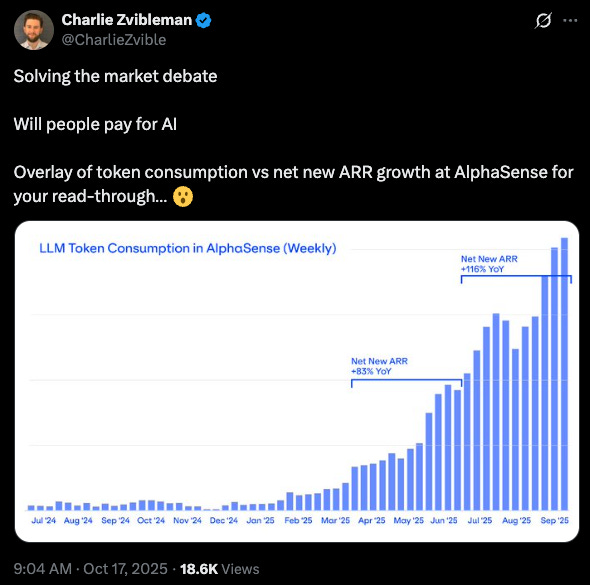
If this remains the trend, it will be worth speculating on the source of Alphasense’ success8. For now, to better track product market fit in this space, I’ve begun categorizing the startups on my list into a few distinct buckets based on their core focus. These categories highlight the common approaches AI startups are taking to serve hedge funds and asset managers:
Research Copilots (AI “Analyst” Assistants): These act like an analyst on demand, answering free-form investment questions and automating parts of due diligence. The goal is to replicate or augment the work an analyst does for a portfolio manager – digesting financial reports, conducting industry research, and even writing up initial findings in response to a natural language query.
Excel Copilots (Financial Modeling Aides): Tools that integrate with Excel or spreadsheet workflows to automate financial model building and data updating based on natural language instructions. For example, you might ask the tool to build a discounted cash flow model or pull the latest financials for a company, and it generates the model or populates data accordingly. These range from general Excel add-ins to more specialized tools focused on particular types of models or data sources.
“Terminal 2.0” Platforms (Next-Gen Market Terminals): Startups re-imagining the Bloomberg Terminal experience with AI at the core. They typically offer real-time news summaries, intelligent alerts, and built-in research copilots as part of the interface. The idea is to provide a modernized market terminal that not only streams data and news but also leverages LLMs to surface insights (for example, summarizing why a stock is moving or flagging unusual patterns) in a more user-friendly way.
AI Model Providers (Alpha, Quant, & Forecasting Labs): Companies developing new foundational models, quant, or machine learning techniques tailored to financial data and time-series forecasting. Rather than a user interface, these firms often sell predictions or signals), or they offer API access to their proprietary models, optimizers, or signals. They frequently target quants.
Data Extraction Tools: Startups focused on pulling structured data from unstructured sources such as SEC filings, earnings call transcripts, websites, or PDF reports. These tools often use AI to parse complex documents and output clean datasets, often in tabular form. In some cases they function as general web scrapers optimized for finance (for example, extracting KPIs from a 10-K filing automatically).
These categories aren’t perfect. Some startups do many things (like Alphasense with their Carousal acquisition). The lines between categories can blur (e.g., new terminals versus research copilots that show real-time data). Other categories might also split in the future. “Alpha, Quant, & Forecasting Labs,” for instance, covers a wide range of activities, from building timeseries transformers to Ai-augmented back-testing tools for quants. This is a first attempt to classify startups, and I’ll certainly revise. Please send any suggestions or corrections.
Beyond these labels, there are adjacent categories where AI is being applied in the broader asset management and finance realm. Some startups target regulatory and compliance automation (e.g. using AI to scan trades or communications for compliance issues). Others build AI tools for financial advisors, investor relations teams, or asset allocators (for instance, helping wealth managers sift through research or aiding IR teams in crafting reports). There are also variants of the above categories aimed at retail investors – usually simplified interfaces with added social or educational features to make AI-driven insights accessible to individuals.