
Senegal’s labor code is, on paper, one of the most protective in the world. If you want to fire someone, you need written notice, a formal hearing, severance scaled to how long they’ve worked for you, and if you get any of those steps wrong, a labor court can force you to take them back and pay damages on top.
It sounds like a system designed to take care of workers. If you read the text of the law without knowing anything else about Senegal, you might believe it does.
As an entrepreneur, I’ve started businesses in the US and in Senegal, and I’ve been involved in ventures across the continent.
In the US, employment is at will. In Senegal, I had to think twice before hiring anyone, because even if they stopped showing up or did poor work, they could walk into the inspection du travail and file a claim against me. The rules that were supposed to protect workers made me afraid to hire them. As I always say, “If I can’t fire you, I can’t hire you.” Most people wouldn’t get married if divorce were illegal.
96 percent of Senegalese workers are in the informal economy.
Why? Because the rules are so expensive to follow that almost nobody enters the formal system at all. People hear that and blame corruption, or weak institutions, or shrug and say that’s just how things are in Africa. But the same logic is eating Europe alive right now, in countries with the strongest institutions on earth. Pieter Garicano wrote a piece in Works in Progress that makes it impossible to look away.
Europe’s labor laws have made it so expensive to let workers go that companies have stopped taking risks, and when companies stop taking risks they stop innovating, and when they stop innovating they fall behind. In the US, restructuring costs about 7 months of salary per employee laid off. In Germany, it’s 31. France, 38. Italy, 52. In Spain, 62 months. Over five years of salary to let one person go.
If it is expensive to lay people off, employers avoid creating jobs that they might subsequently discontinue. Innovation involves experimentation and risk, so jobs in innovative areas of the economy are more likely to be discontinued than jobs elsewhere. High severance costs create a fundamental incentive for European businesses to avoid innovative areas and concentrate on safe, unchanging ones. In the long run, this is a recipe for decline.
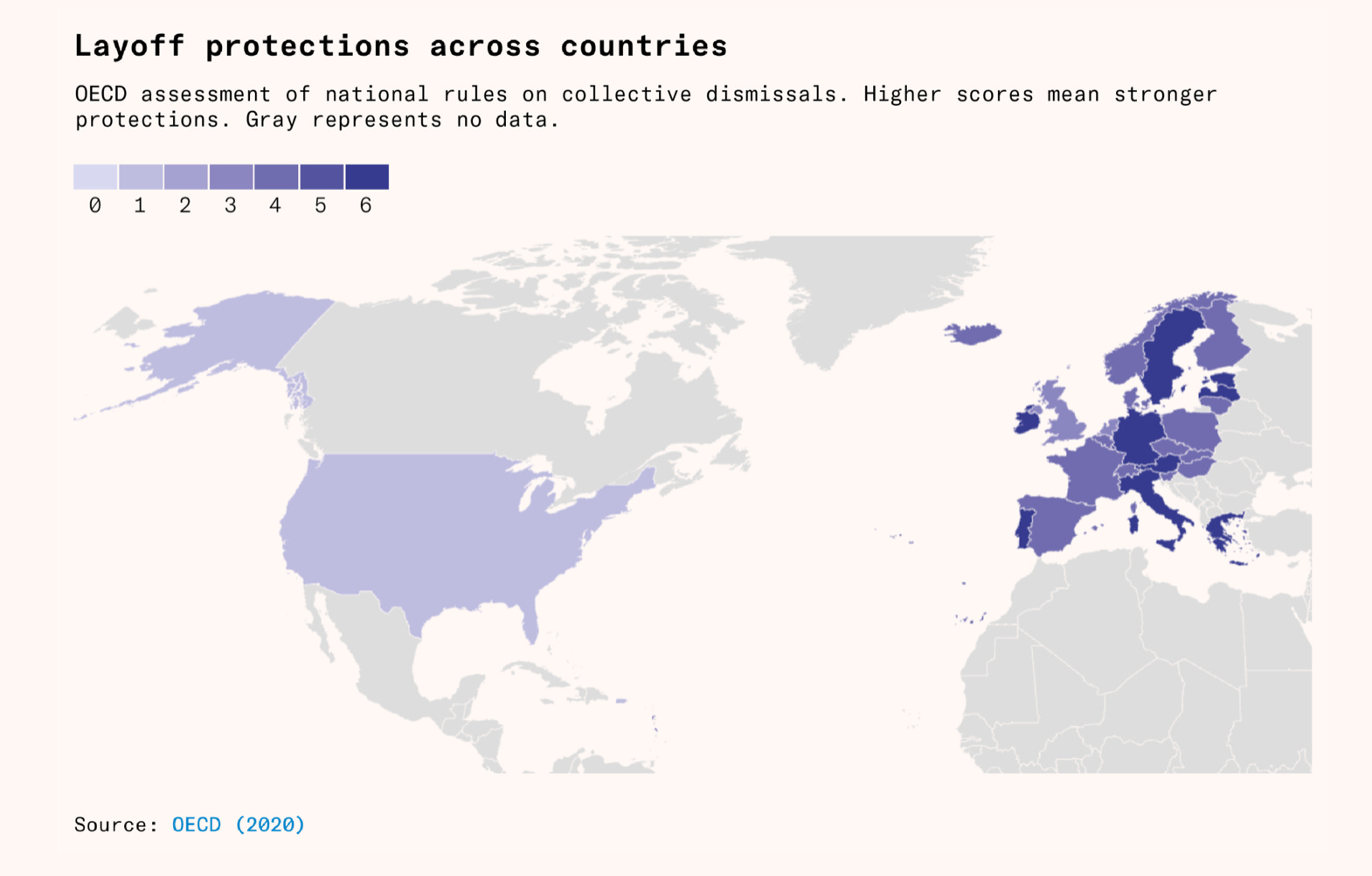
When Audi’s electric SUV flopped and they closed the Brussels factory, severance alone cost €610 million. More than the factory itself was worth. When Volkswagen’s CEO tried to push the company to compete with Tesla, the works council blocked his plans for factory closures and he was fired for it. Nokia spent €200 million to lay off 2,000 people at a single German plant. Amazon offered French employees a full year’s salary just to quit voluntarily, because firing them through the legal process would have cost even more.
In 2000, incomes in the original EU countries were about 10 percent behind the US. Today that gap has doubled to 20 percent. Tesla is now worth more than the next 9 largest carmakers combined, and most of those are European companies with decades of engineering heritage. The continent didn’t run out of talent. It made risk too expensive.
Companies like Grammarly and Hugging Face were once headquartered in Europe... 11 percent of US tech startups have a European co-founder: it is just not the case that Europeans are not entrepreneurial enough. Europe’s problem is that they choose to be entrepreneurial somewhere other than Europe.
Most of francophone Africa modeled their labor codes directly on the French Code du Travail. Senegal did it. So did Côte d’Ivoire, Mali, and Cameroon. Their leaders looked at Europe and saw rich countries with strong worker protections and concluded that the protections were part of what made them rich.
That gets the history backwards. Europe industrialized and built its wealth during a period of relatively flexible labor markets, when businesses could hire and fire without months of legal process and years of mandatory severance. The heavy protections came later, layered on top of economies that were already wealthy enough to absorb the cost. Even with all that wealth underneath them, the cost is dragging Europe down.
Even France knows these laws are a problem. Macron has spent years trying to reform them. France, the country that wrote these rules, is actively trying to undo the damage. Meanwhile, we in Africa are still clinging to the old version of the Code du Travail like it’s sacred text, refusing to touch it, and wondering why we can’t build anything.
India made the same bet decades ago. The Industrial Disputes Act of 1947 requires any company with 100 or more employees to get government permission before firing anyone. Most Indian factories stay under 99 workers on purpose, because crossing that line means entering a regulatory system with 1,536 labor laws and 69,233 compliance requirements. Manufacturing stayed deliberately small for decades.
China went the other way entirely. In cities like Shenzhen during the boom years, labor rules were light and growth-friendly. Companies could hire and fire without begging for bureaucratic approval, which meant they weren’t afraid to scale past 100 employees, or 1,000, or 10,000. Today China accounts for about 28 percent of global manufacturing value added. India is at 3.
When an African leader looks at France or Germany in 2026 and says “let’s adopt their standards,” he is looking at the wrong period of European history. This is the Europe that is losing its car industry to America and China, the Europe whose best founders leave for New York and Dubai and Singapore because the regulatory burden makes scaling a company nearly impossible.
The Europe that built BMW, Siemens and Nokia had flexible labor markets. Starting a business was straightforward, with entrepreneurs having control over their own workforce without extensive legal hurdles. The regulations came after the wealth was already there, not before.
Some European countries figured this out. Denmark lets employers fire at will, but workers receive unemployment insurance that covers 90 percent of their income for up to two years. Switzerland has no mandatory severance but maintains a strong public safety net.
Denmark and Switzerland have given the continent Novo Nordisk, Roche, Nestlé, and Novartis. The small and few countries that have adopted a flexible model are Europe’s innovation heavyweights. Meanwhile, the countries with the strictest employment protection, like the Spaniards and the Italians, are some of the worst.
Africa doesn’t need to become America. But it should stop copying France in 2026, especially when France itself is trying to move on from the laws we imported. If the country that wrote the Code du Travail is reforming it, maybe it’s time we stopped treating it like gospel.