TL;DR: The Census Bureau published new data on AI adoption by new firms. Firms report that the labor market impact of this emerging technology remains very low.
This post covers:
Introduction
Adoption Past and Future
Labor Market Impact
Where Is It Being Used?
Why Not Adopt?
I’m a long-run fan of the US Census Bureau’s Business Trends & Outlook Survey (BTOS), a biweekly data set that queries US businesses about a range of things including AI adoption (“did you use it recently” / “are you planning to use it”). In early 2024, the BTOS also published an AI supplement with detailed data on the technology’s usage. And today, 2 years later, we got a new AI supplement!
This post is intended as a recap of the data in the report. It doesn’t include all the data, which contains a lot of interesting detail by industry and state. But hopefully you get a good flavor from reading it.
The other thing this post won’t do: predict the future. We’re still very early in the process of AI adoption, a process that I suspect will have large impacts on our economy and society but will stretch across years and probably decades. “Small impact so far” does not mean “small impact 25 years from now”.
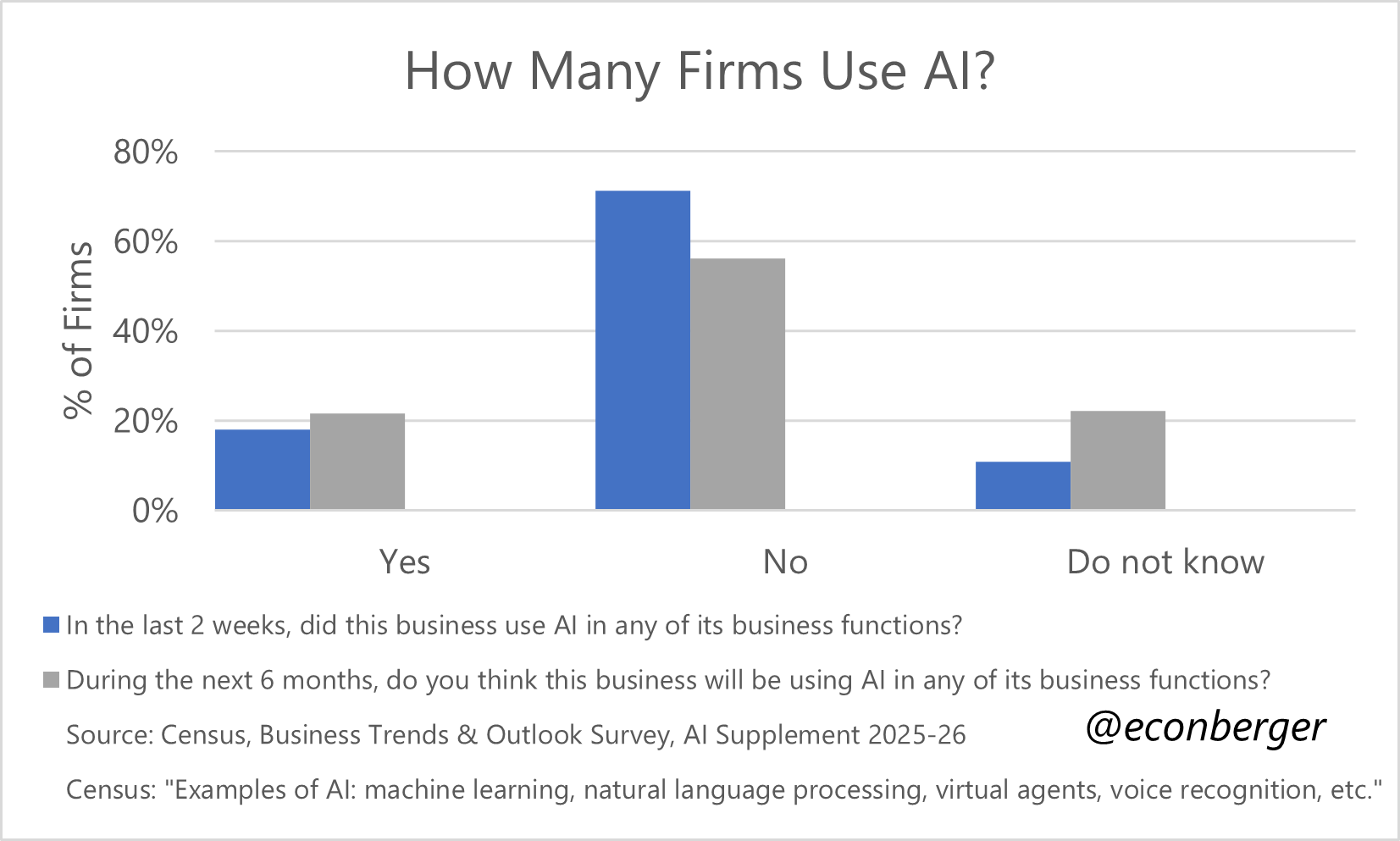
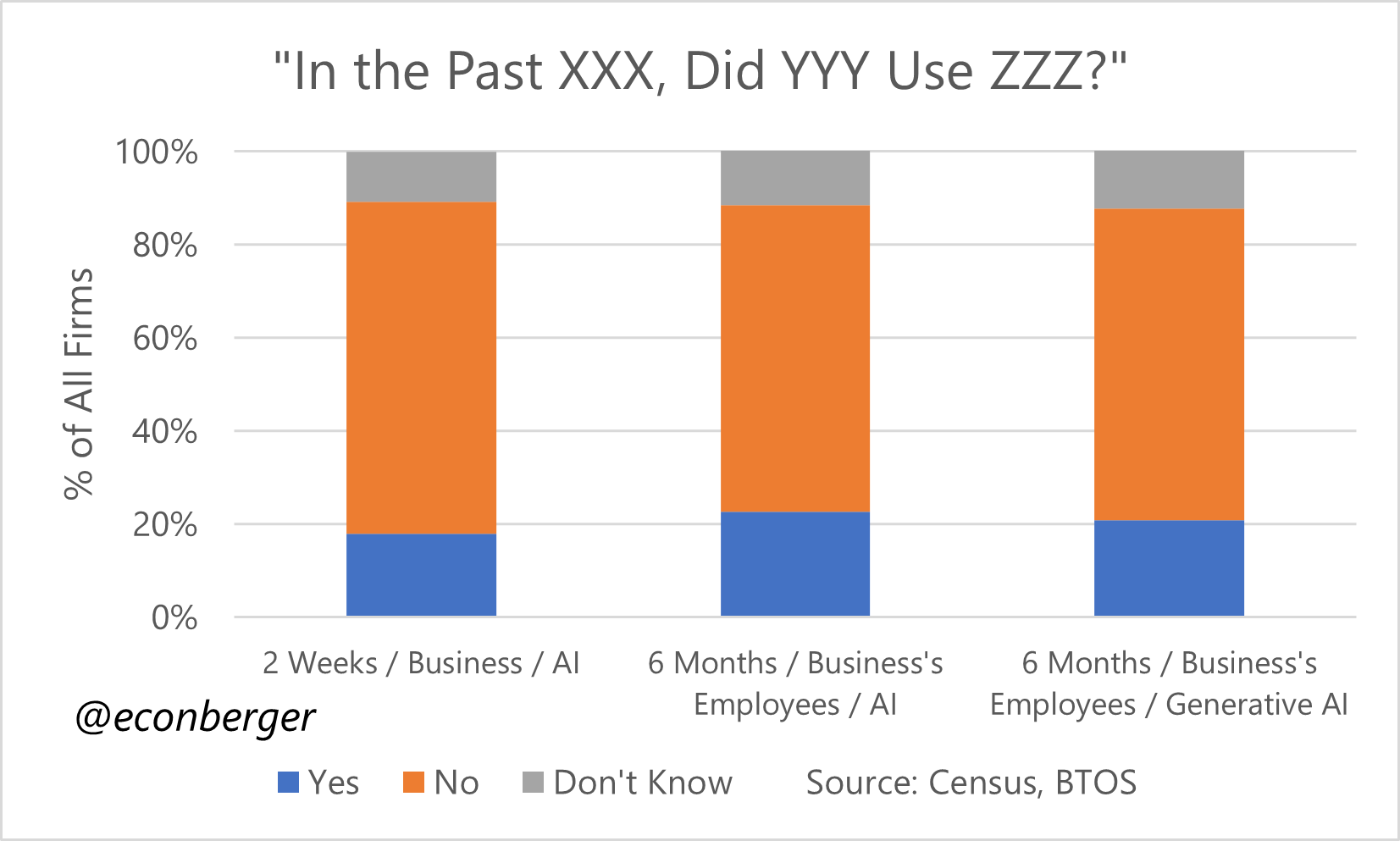
Relative to what I would have expected a few years ago, AI adoption has been fairly high: about 1 out of every 5 firms reports having used the technology, with some variation based on the question. The share of firms planning to use it in the future is slightly higher than the share that used it in the past, though the share of firms who don’t know whether they’ll use it is meaningfully higher than the share of firms who haven’t used it!
A few caveats are worth mentioning here: larger firms are much more likely to adopt AI than smaller ones. So GDP- or employment-weighted versions of adoption measures are going to be higher.
The other caveat: these surveys don’t include wildcat usage. For instance, if Cogswell Cogs’ survey respondent says “no we don’t use AI” but some random person in marketing is using ChatGPT to draft emails, that won’t count as usage. In my opinion, this kind of usage is much less economically meaningful than organizational adoption, but it will be overlooked by the survey.
Since this is a labor market newsletter, not an AI newsletter, this is the section I suspect most of my readers will care most about. And the answer is that, so far, AI adoption has had (according to firms) very little impact on their labor market.
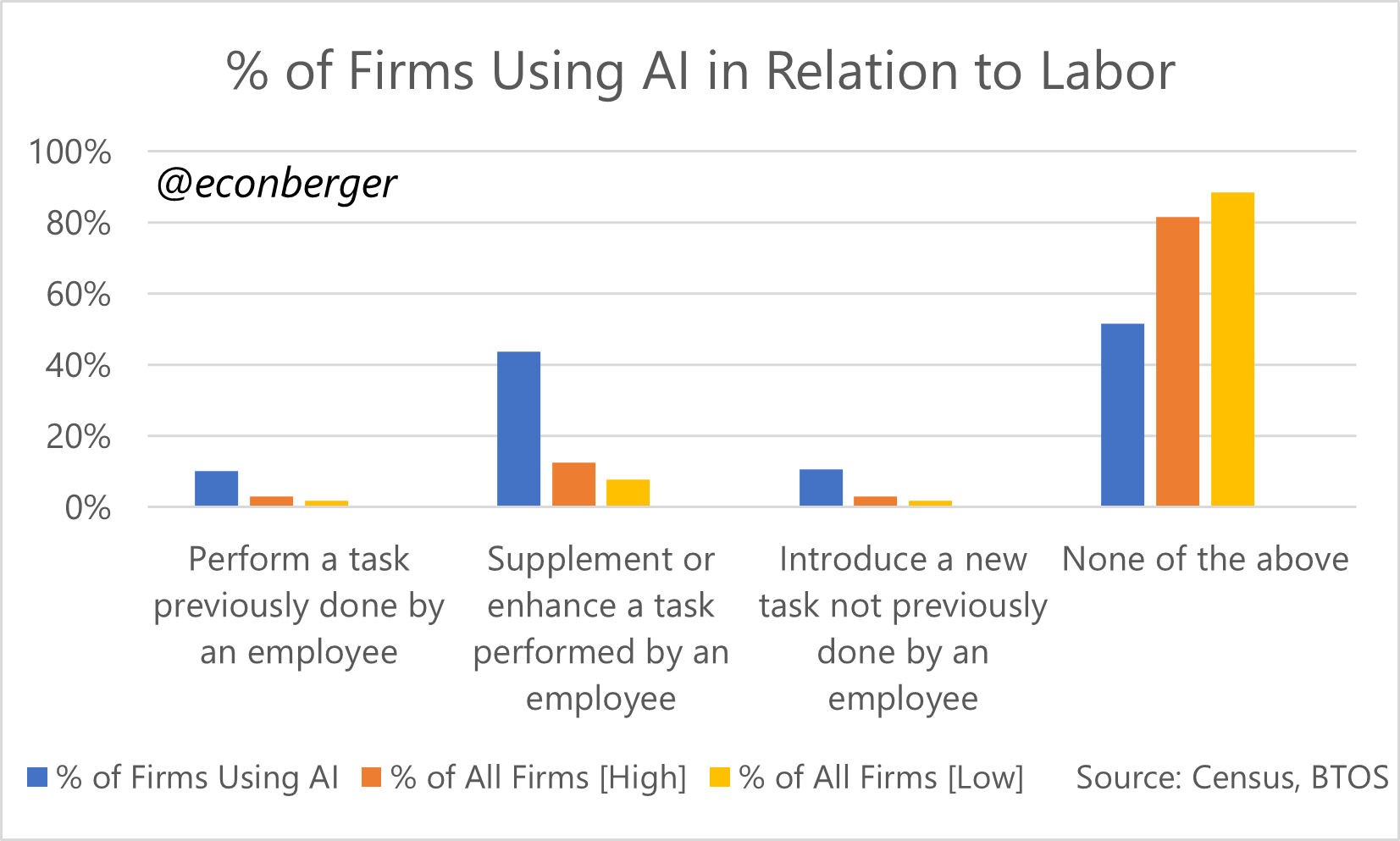
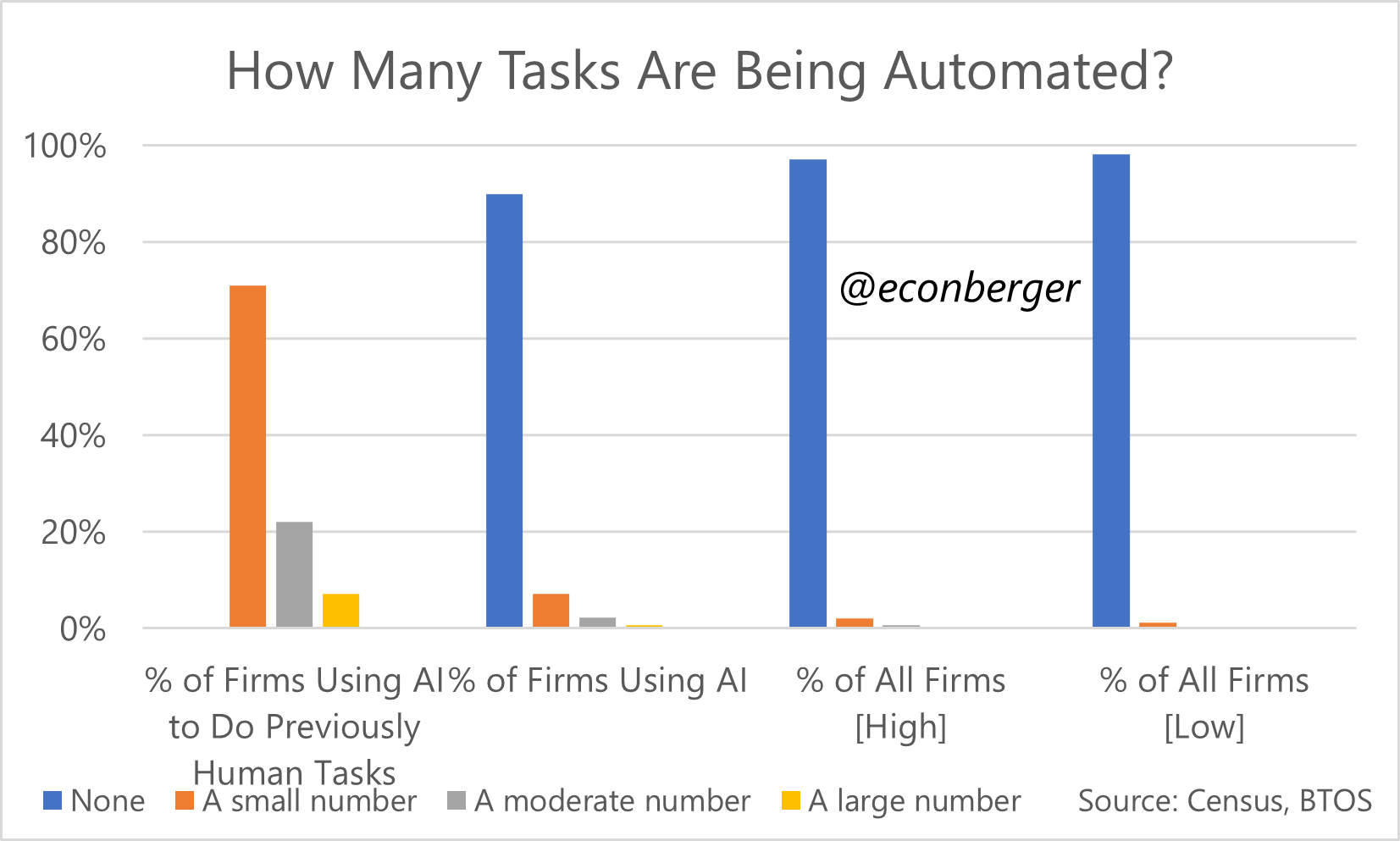
In terms of tasks, only about half of firms that use AI say they are doing so in a labor-relevant way. Taken as a share of all firms, this is about 11%-19% (i.e. 81%-89% are either not using AI, or using it in a labor-irrelevant way).1 About 2%-3% of firms are using AI in an automative way, to “perform a task previously done by an employee”; 8%-13% of firms are using AI in an augmentative way, to “supplement or enhance a task performed by an employee”; and 2%-3% are using it in a novel but arguably also augmentative way, to “introduce a new task not previously done by an employee”.
The survey conveniently splits up the small number of firms saying they are automating labor by the number of tasks they are automating. And it seems like the automation happening so far is very, very light:
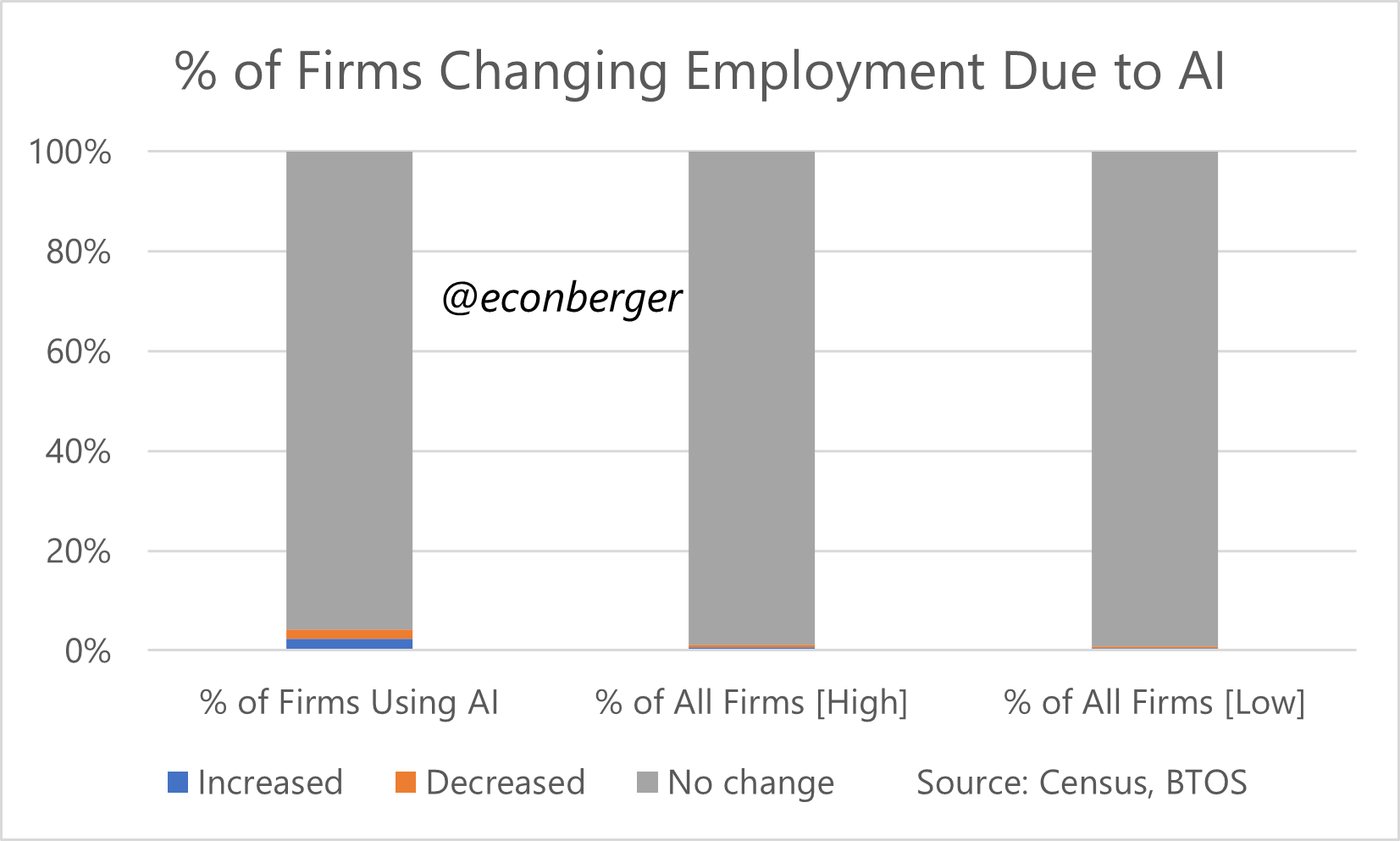
Not surprisingly, given how light adoption has been from a labor-relevant perspective, very few firms are actually changing their employment level due to AI. Keep that in mind whenever you read breathless headlines about AI causing layoffs or dampening hiring. It’s something like 1% of all firms - split roughly evenly between “increasing employment due to AI” and “decreasing employment due to AI”.
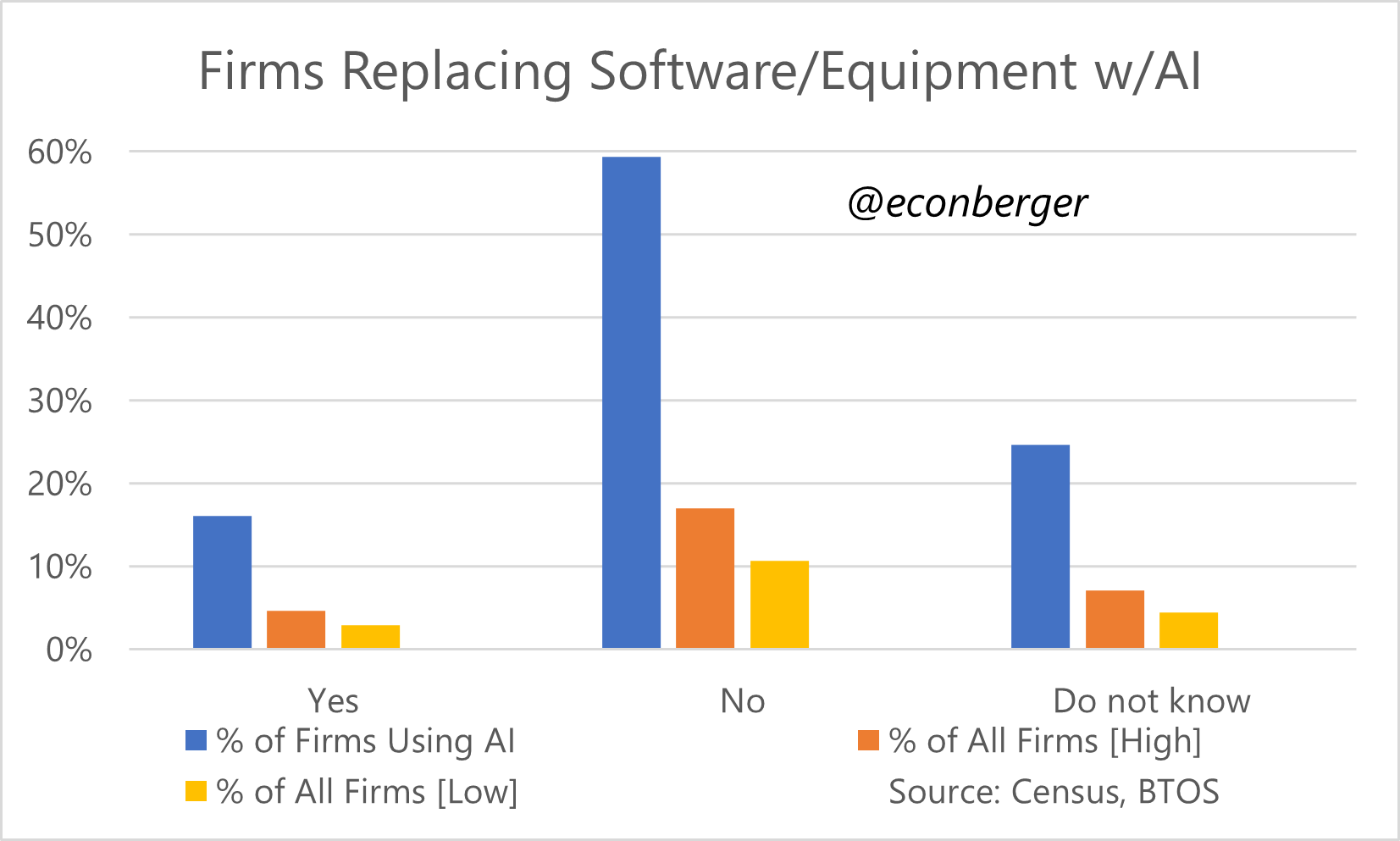
Finally, it’s worth noting that a small number of firms are using AI not to automate labor, but rather to replace existing software or equipment:
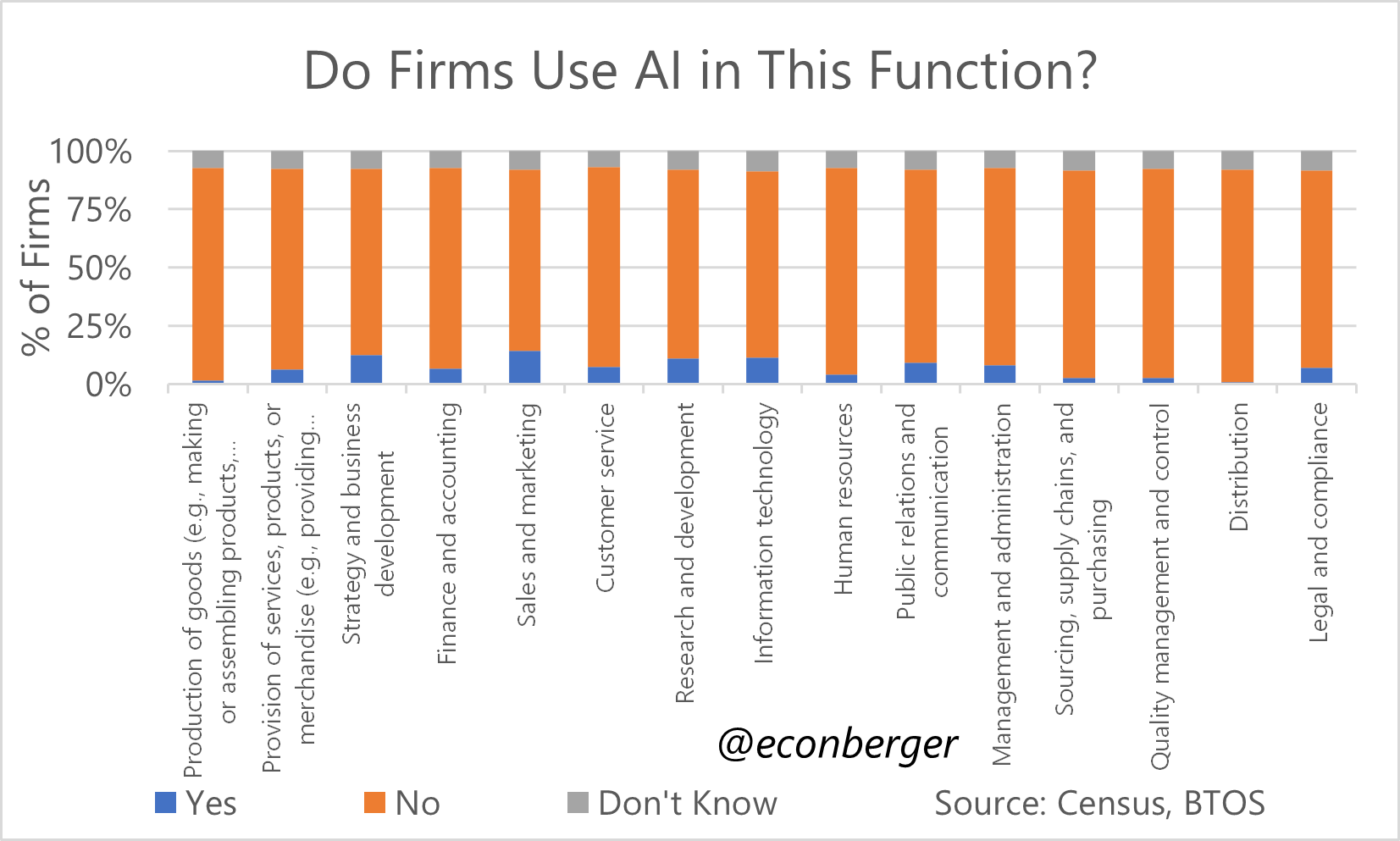
As discussed earlier, a super-majority of firms don’t use AI. So not surprisingly, most functions don’t use AI! But it is more present in sales & marketing (14% of firms say they use it here), strategy & business development (12%), IT (11%) and R&D (11%). It’s most absent from distribution (1%), production of goods (2%), sourcing & supply chain management (3%), and quality management (3%).
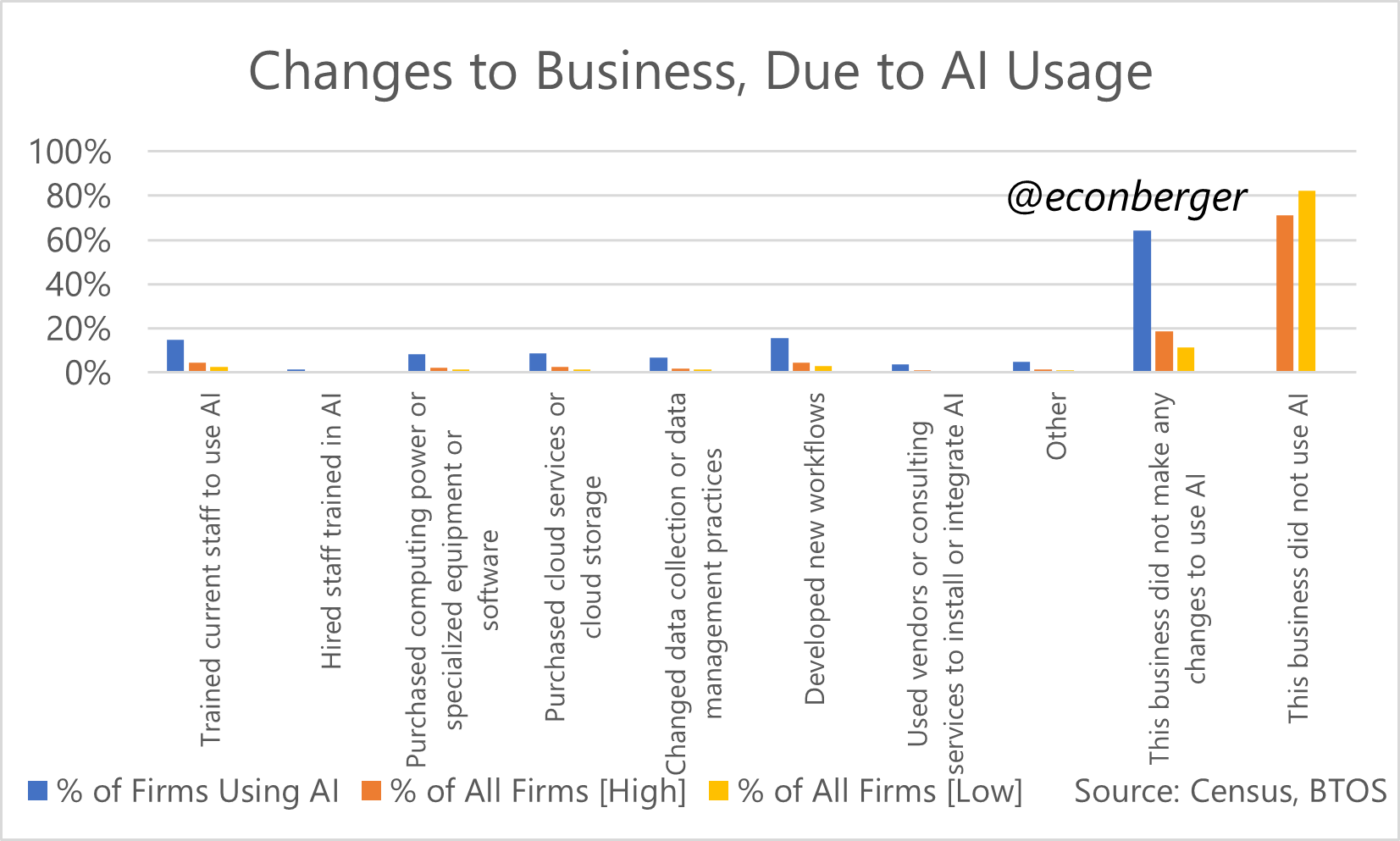
A small share of businesses also changed how they “do things” as a result of AI adoption. (The share is small because not many businesses adopted AI!) The most common changes are developing new workflows (3-5% of all firms) and training current staff to use AI (3-5%). Outside help is rare - very few firms report hiring installers/consultants or hiring AI-trained staff. And about 2/3 of firms who use AI report no business changes (this is around 12-18% of all firms).
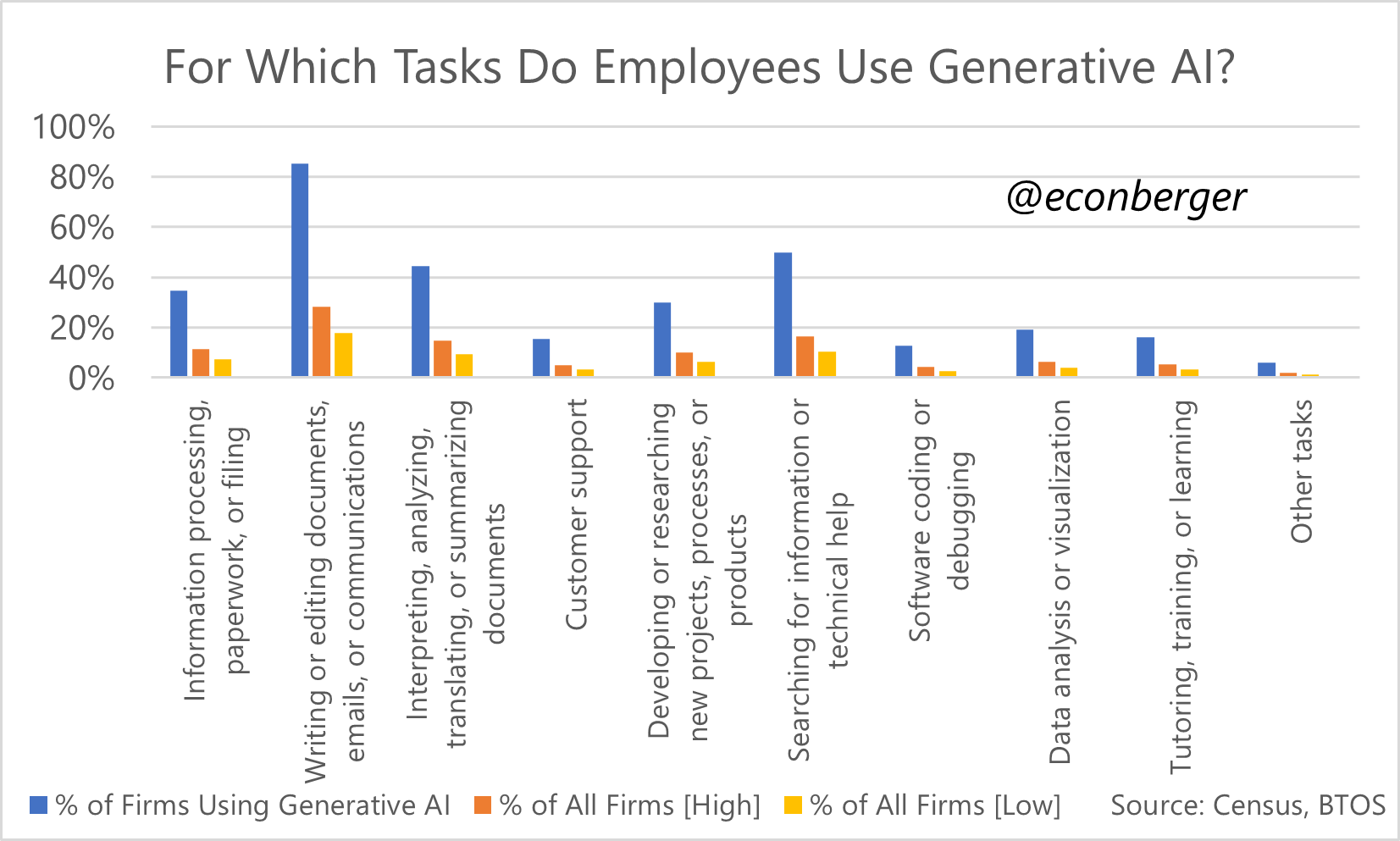
There’s also an interesting question about generative AI usage, since this is the version of AI that most normies encounter (and that has generated most current discourse). The results were more boring than I expected! If you know non-technical people in your office who are using ChatGPT, it’s probably just to write/edit/summarize documents or as a search engine. They’re not vibe-coding apps!
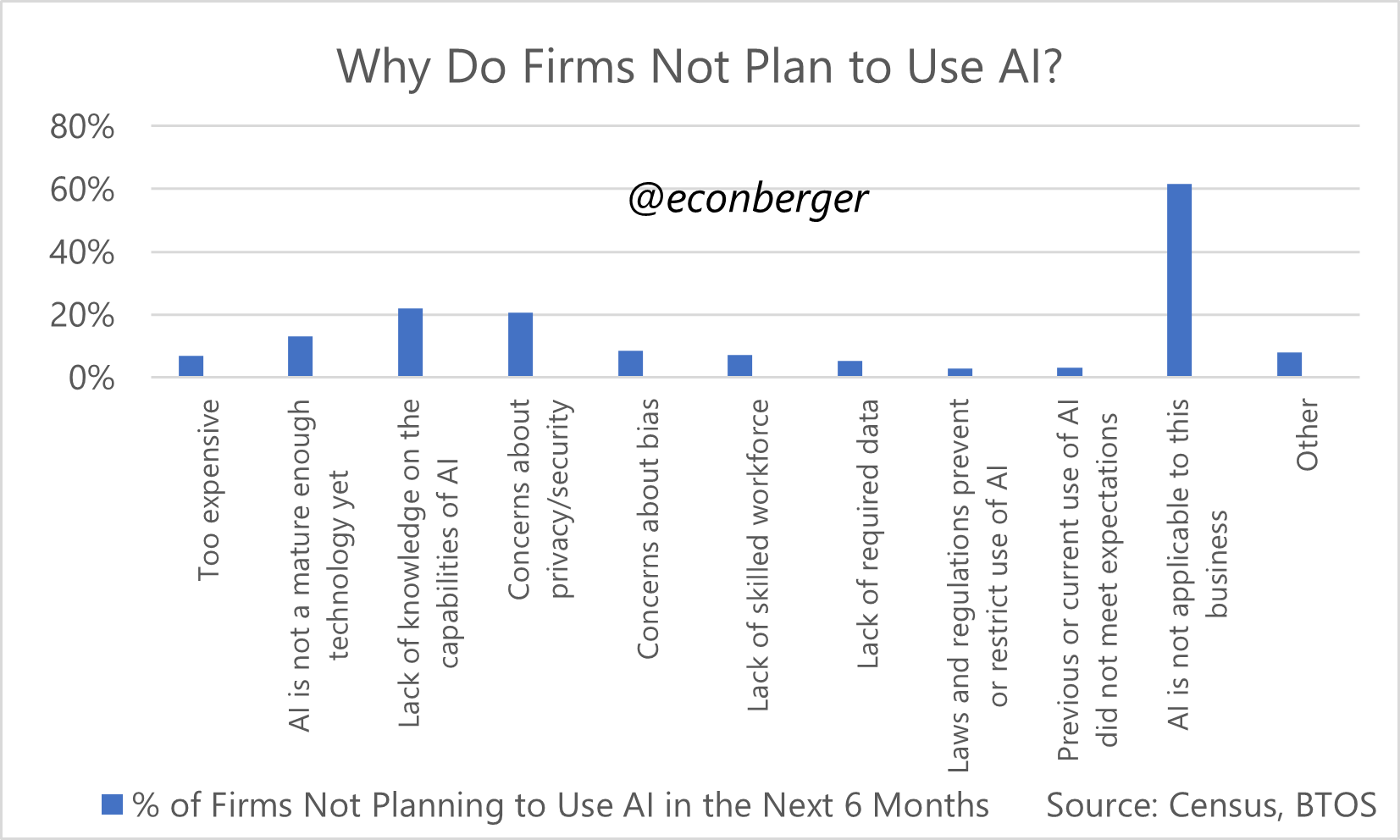
Why don’t firms adopt AI? The boring answer is that about 3/5 of firms don’t see it as relevant to their business. The most common other explanations is that they don’t know what the technology is capable of, or are worried about security/privacy (both about 20%).