Once again, the internet is being brainfried by a Statista chart. As a reminder, if you share a chart in the Statista color scheme, I downgrade my view of your general ability to learn and pick up new information. This heuristic has always served me well, until today, when Tyler Cowen , whom I admire enormously, shared a Statista chart!! Oh no!!
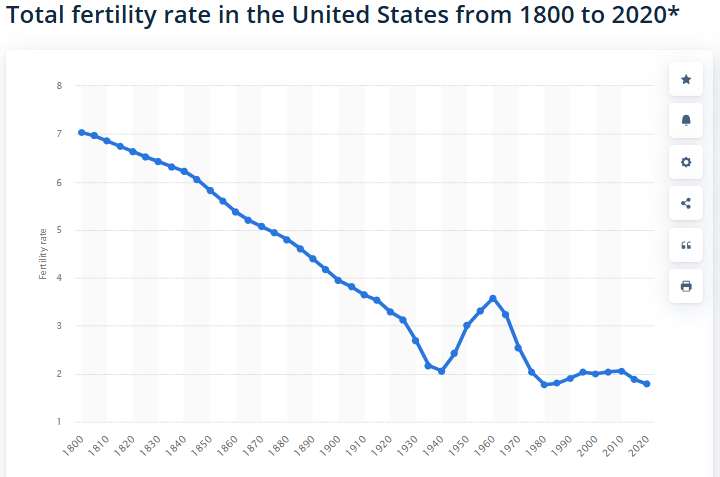
I have already thoroughly debunked this chart in the past.
But in this post, I’m going to try to provide a simple model of how long-run fertility change works, and why it shows that new digital technologies shifting the value of solo-leisure vs. social-leisure may indeed have a big role to play in fertility dynamics.
There are basically three main elements of long-run fertility change. This is not to say that other things don’t matter, but we can conceptualize fertility change in three components and, when we adopt that conceptualization, my own experience has been that new information is very easy to incorporate with minimal creativity or rationalization.
The three big factors are:
Selection pressure via mortality and replacement
Recurrent emergence of cultural valuation of selfishness
Changing cost of fertility and especially intergenerational wealth transfer dynamics
We will very briefly take these in turn. I want to emphasize that I will be citing sources very lightly because my theses here will mostly be on not-terribly-controversial grounds. “Mortality drives cultural selection” isn’t groundbreaking stuff if you know the history of warfare and illness. “Having kids is a costly choice” won’t blow your mind. “Caldwell’s intergenerational wealth transfer hypothesis is basically correct” should surely be well understood by now, especially given all we know about child labor laws, school expansions, and fertility. I’m rehashing stuff here that good demography students learn, memorize, and can recite in their sleep.
The fundamental force shaping human history is death. People die. Cities die. Civilizations die. Death is how we are selected for. Human genetics show extensive signs of major selection pressures over the last 12,000 years, and those signs point a giant boney finger to a long-running history of enormous epidemic and nutritional stress, as well as strong preference for people who are broadly competent and functional in the world. The key vehicles for this selection are differential fertility and mortality, but the preponderance of selective sweeps impacting genes related to nutrition and immunity strongly suggests mortality has been the dominant selection pressure in human history.
We are who we are because the people not like us died off in whole lineage groups.
This being the case, historic humans simply had to have a lot of kids. “Quality vs. quantity” tradeoffs simply couldn’t have been a concern because they were running on a mass death treadmill. For a breeding pool to survive (which is to say, an endogamous group, or what we would call a “culture”), they had to have a lot of kids.
Because endogamous groups very very often correlate with political structures like villages, tribes, cities, states, dynasties, empires, etc, this process easily became a collective action opportunity. Mating, marrying, and breeding norms were essentially political products. Romans kill unwanted daughters, Egyptians don’t. Jews marry one way, Greeks another. Political leaders were analogized to parents, and in the most primordial states in Mesopotamia and China, we often see evidence of fertility cults at the center of political organization. Keeping ahead of the specter of social death was a central concern for many historic cultures.
Thus, mortality pressure created a disciplining force which motivated kinship groups to prioritize reproduction. We see this even in modern contracepting societies: when a child dies, parents often accelerate the next birth as a form of “replacement fertility.” It really is the case even in modern data that eros and thanatos are closely linked.
This matters for the interpreting the long-run graph, because if societies basically target surviving fertility, and if some societies do this via marriage regulation, some via abortion, some via contraception, and some via infanticide or child mortality, then measures of “live births” will be misleading. Some of those live births get killed very quickly. Instead, we want a comparable cross-cultural measure. For that, we need surviving fertility. Here’s surviving fertility for the U.S.:
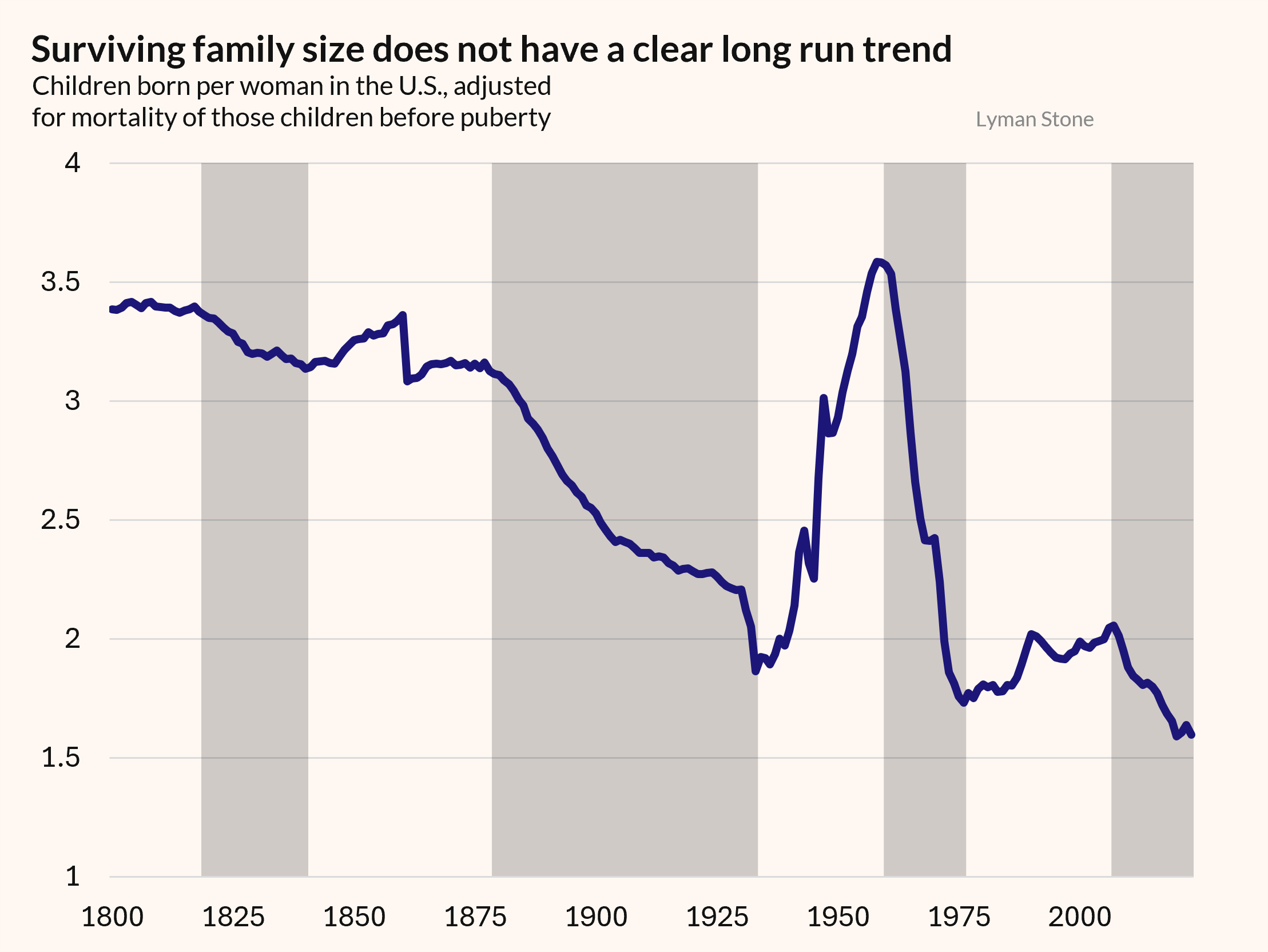
I’ve highlighted the periods of clearly declining fertility. And here’s the same, but with the linear trends for each period drawn:
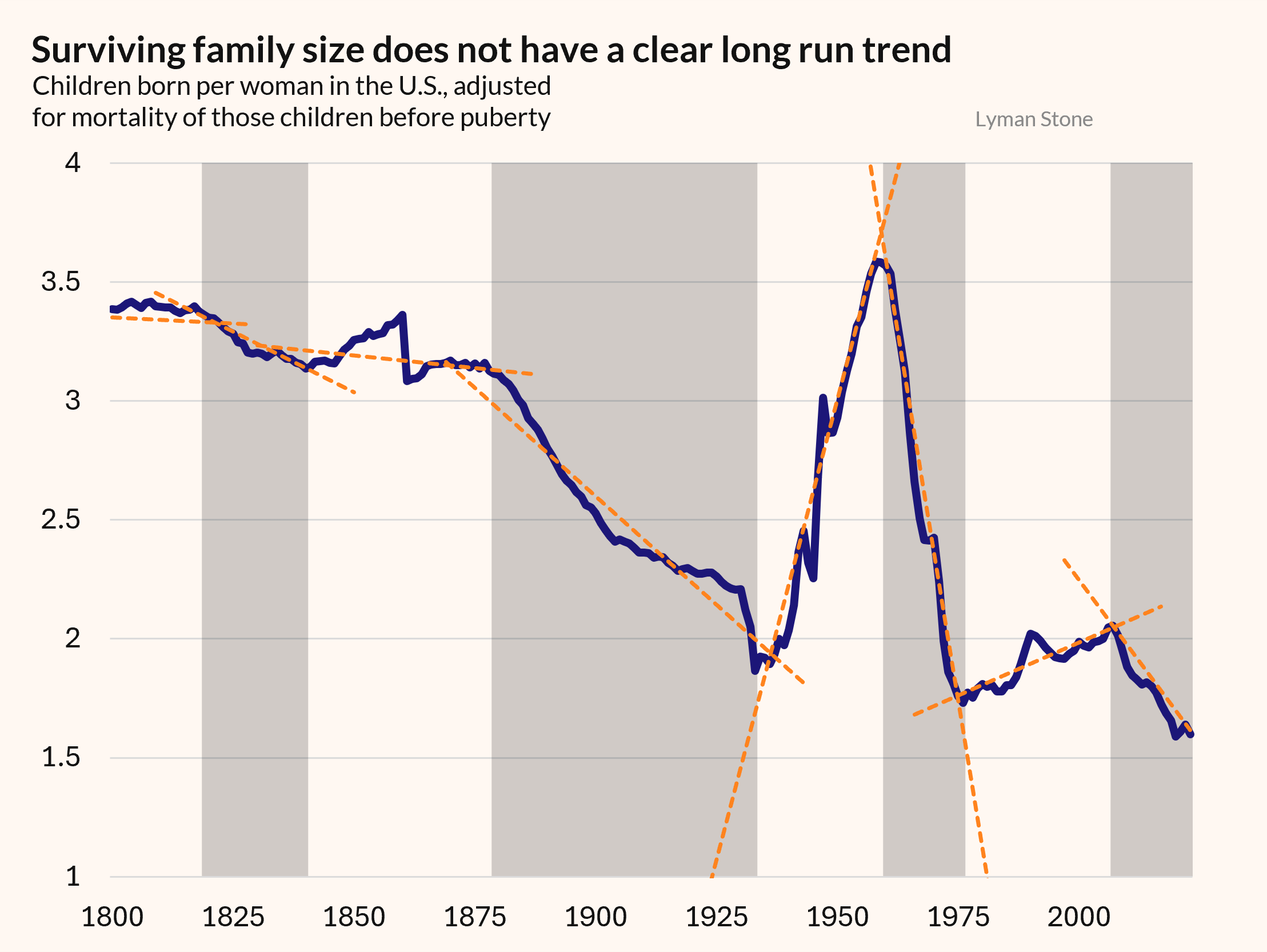
I don’t think it’s possible to analyze that graph in, say, a time series model and come away without finding clear trend breaks. Anybody who looks at the fertility graph and says “Ah, it’s one long decline” is simply incorrect. It isn’t. There are clear breaks in series. You can contest some of the breaks I identify, but there are some breaks in series.
Even if you just drew one long trendline, here it is:
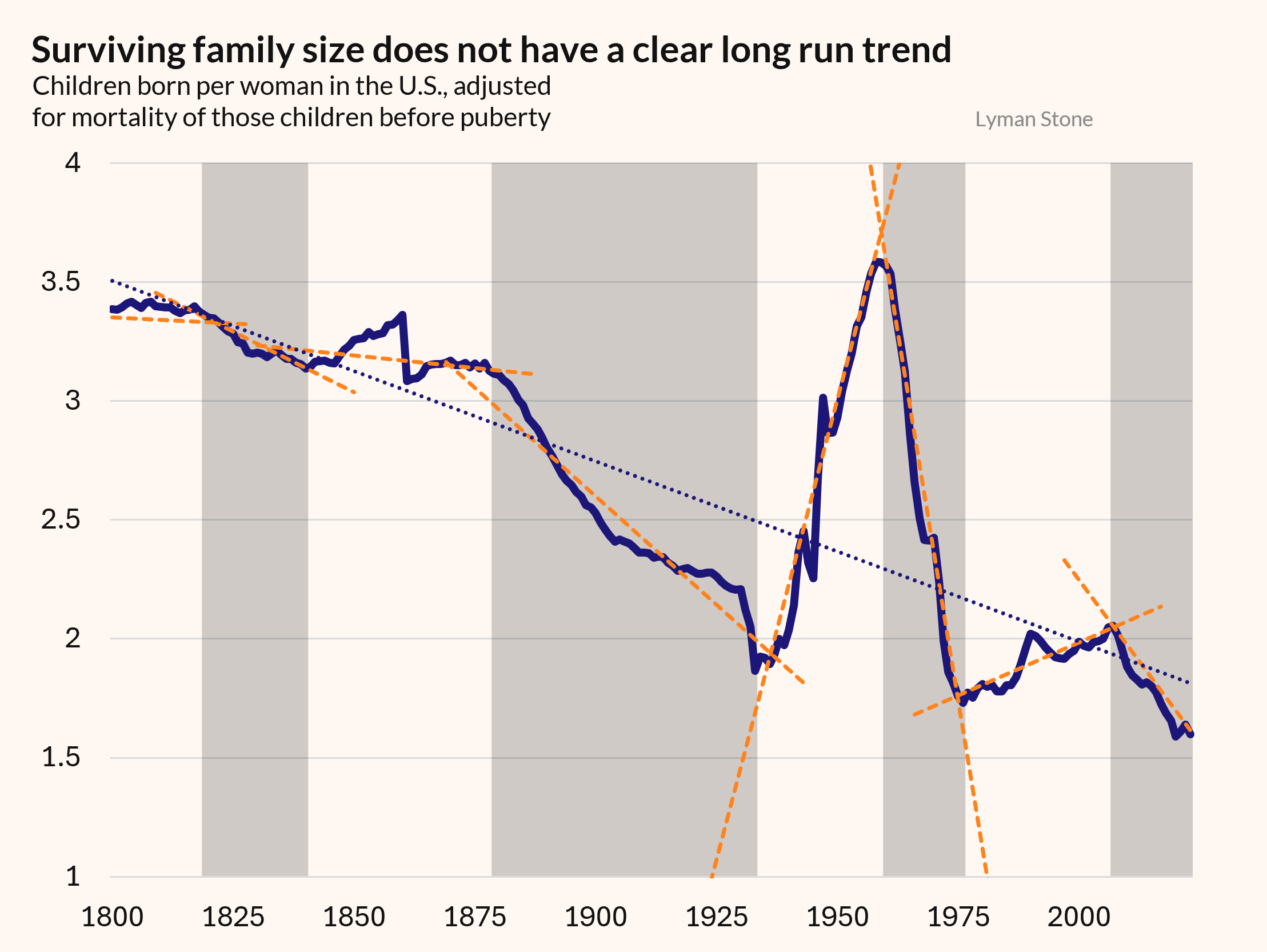
You can see that fertility today is appreciably below the long-run trend, and has been almost every year since 1970. So even if you are a “it’s just the trend” kind of troll, you should still see the present moment as exceptional.
However, reproduction is costly. Having a baby was dangerous, increased caloric needs for mom and once the child was born for baby too, and the baby did not contribute to production for years after birth. Because reproduction is so costly, virtually all beings have a strong incentive to avoid reproducing. You shouldn’t reproduce, it’s a terrible idea, from a purely selfish perspective.
Evolution punches back and motivates reproduction through the incredibly simple strategy of orgasms. Okay, cool, but there’s a problem: orgasms may work as reproductive motivation for creatures with less reasoning ability, but humans tend to figure out fast you can have orgasms without making babies. Hunter gatherer populations practice abortion, infanticide, primitive forms of contraception— humans have always known ways to manage the care burden on a group.
And that’s why cultural norms emerge as above. Humans have a strong motivation to defect from the interests of the genes. But the genes happen to correlate with cultural groups, and those groups create a superstructure to give other non-biological motivations for reproduction. Groups providing such incentives will tend to see their genes proliferate and will tend to see their values proliferate.
So far, our model is basically, “Humans have a constant incentive to avoid having kids, but mortality pressures give kinship groups strong motivations to counterbalance that incentive.”
But here we need to recognize the idiosyncrasy and randomness of human culture. Sometimes memes just take off for no good reason. In many societies, kinship-preferring norms succeed at keeping the selfish impulse squashed. In others, they happen to fail to do so. This is especially likely if mortality pressure is low. The process by which individual incentives for selfishness metastasize into a social norm of selfishness is not entirely clear… but it’s clear it sometimes happens and sometimes doesn’t.
That is to say, some societies by chance end up selfish, or, we might say, individualistic. Those societies often see a break from pronatal norms, and fertility falls.
But of course, if mortality pressure resumes, those societies evaporate. In a society where half of kids die before puberty, you really do just have to have 4-7 kids to maintain civilization. If you’re having 3, your civilization just won’t be maintained. You’ll be replaced by other groups and your values will vanish. By definition, this process will be very hard to spot historically, because the new group will tend to tell their own story, and also because demographic replacement is often outside of the view of historic textual sources and their primary concerns.
In other words, our model here is that “by chance” sometimes societies end up, perhaps inadvertently, scaling up selfish norms instead of pronatal ones. That “works” as long as selection pressures are weak. But if selection pressures intensify again, the pronatal norms come back with a vengeance.
Finally, there is a mediating factor in all of this: the cost of kids. Selfishness is only a big issue because kids are costly. If kids were very cheap, we wouldn’t expect the dynamics above to be problematic, since kids do yield some benefits.
To the extent something happens to alter the costs and benefits of kids, fertility will change, because the extent to which selfishness really pushes against pronatalism will vary.
Thus, consider an agrarian society with no pensions. In such a society, parents may recognize their own odds of sickness and disability in their 30s and 40s and 50s are quite high, and so having a 15-25 year old around at that time would be very valuable. As a result, they would have strong incentives in their teens and 20s to mate, marry, and reproduce, because kids yield a large insurance benefit. This dynamic is very real.
Broadly speaking, if kids are major economic contributors, they will be “cheap,” and selfishness could even militate in favor of having kids. If kids are costly, the opposite. Intergenerational wealth flows around housing, labor, age-dependent care duties, retirement, and sickness are some of the biggest factors here.
Now let’s put these pieces together.
Here’s child mortality over time for three countries with long-running data:
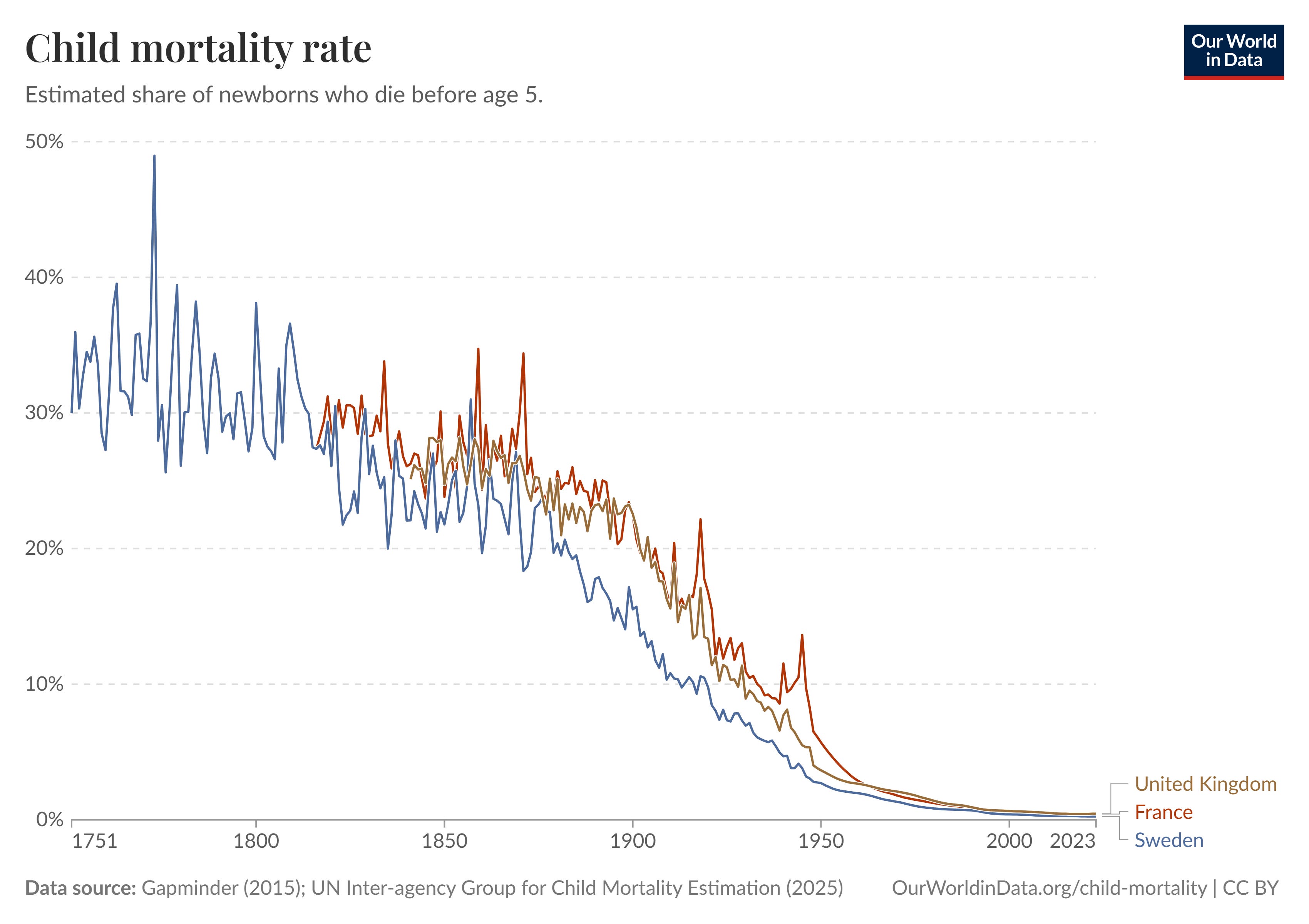
You can see that a decline in child mortality begins maybe around 1800, but really kicks off around 1860-1870, and by 1900 is in high gear.
Do we have data on selfishness? Not exactly. But a fantastic study of French fertility proves that secularization and enlightenment values were the proximate cause of French fertility decline. This matters, because France had a very early fertility transition:
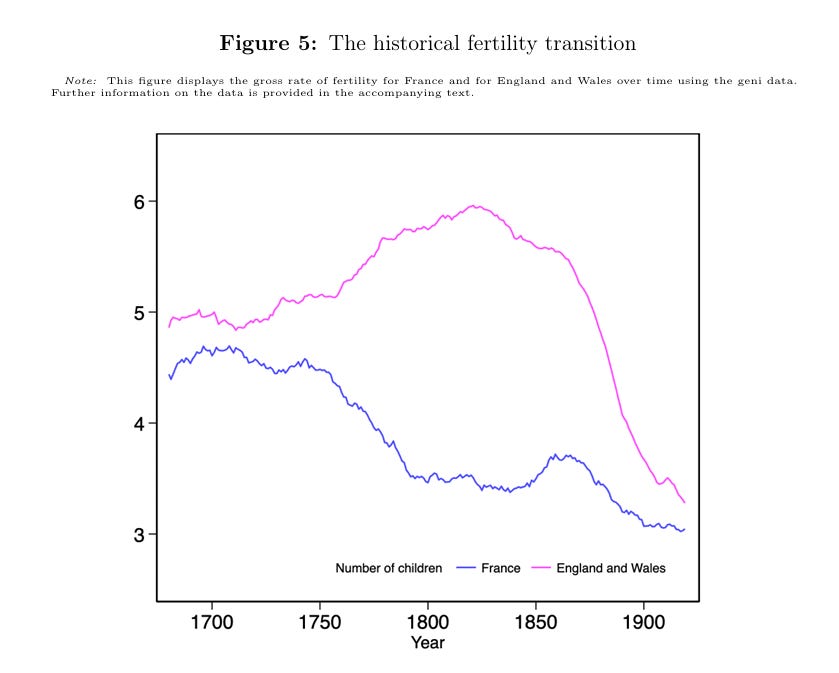
You can see France’s birth rate declined after 1750, even though, as we saw above, France’s child mortality rate did not decline until after 1850.
So France had a bought of selfishness norms after 1750, related to secularization, and fertility plummeted. France then saw revolution and a massive outbreak of continental war. France ultimately lost those wars, and the French selfishness norms mostly didn’t spread. Broader European fertility decline was very slow and limited in the early 19th century.
Instead, broader European fertility decline waited until the 1870s, when English fertility collapsed. We also know why that happened, again, it was an idiosyncratic cultural case.
But whereas the French fertility transition really struggled to spread, the British transition spread like wildfire to other countries, because it was paired with declining child mortality. Mortality selection worked against the French transition, but in favor of the British one.
Meanwhile, other factors mattered too. France’s unique inheritance rules after the French Revolution created high costs of kids. Britain, meanwhile, was fiercely pronatalist, and had abundant access to new lands in the Americas and its colonial empire for population growth to be offloaded onto. In France, kids were expensive. In Britain, they were rather cheap, especially when industrialization created a new boom in demand for child labor. Contrary to the view that industrialization reduced fertility, it may have increased it (Japan’s fertility also rocketed upwards during early industrialization— and we see in many countries such a rise).
What really reduced fertility was a revolution in costs and norms: laws banning child labor, expansion of schooling which created new expenses, and the delayed entrance into economic independence associated with schooling and skills-biased technical change. The emergence of welfare states and pension plans further altered the calculus.
Thus, we have a simple story. Selfish norms recurrently have tried to break through into a dominant position, but mortality selection and intersocietal competition kept a lid on them. When mortality selection collapsed due to technological change, selfish norms could proliferate at a lower cost. Around the same time for related but not intrinsically determined reasons, intergenerational costs of kids rose.
So how does this relate to cell phones? Well, let’s see.
Every demography student learns about the proximate determinants of fertility. Breastfeeding duration. Time to pregnancy. Sexual access. Age-related fecundity. Primary infecundity. I could go on. Babies come from a process and you can cogently and meaningfully decompose any fertility change into a change in parts of the process. If fertility is declining, it must be due to some change in sex, or contraception, or abortion, or whatever.
In our present age, the decline since 2007 is proximately best determined by basically four factors. You can quibble on the model a bit, but any reasonable proximate determinants model will give you something in this ballpark:
Decreasing partnership (~50%)
Decreasing sexual frequency within partnership statuses (~20%)
Increasing contraceptive efficacy (~25%)
Increasing breastfeeding duration (~5%)
Increased abortion (~10%)
Reproductive technology reducing age-related infecundity (~ -10%)
We need a theory that explains these things.
We can rule out mortality. Since 2005-2010 there has not been a big change in mortality.
We should consider the possibility of a new kind of selfish norm.
We should consider the possibility in a change in the net cost of kids.
But we should also consider the possibility of a genuinely new thing. A demographer in 1700 would probably not have talked about mortality per se as a fertility regulator since low-mortality societies had simply never existed. What will be a big obvious factor the future sees that our historic models miss?
To me, the answer is clearly related to the fact that young people are spending way less time socializing independently:
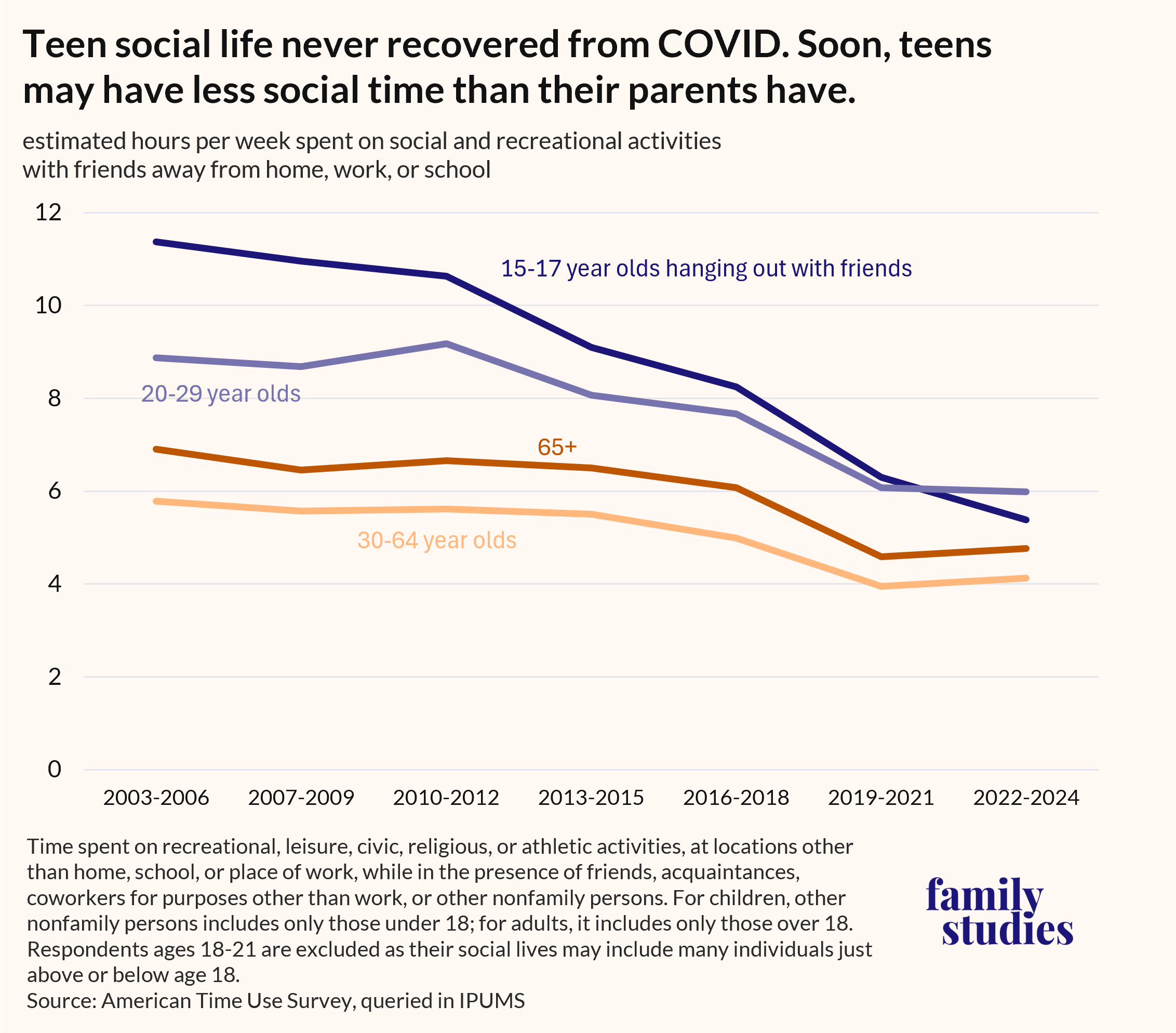
And the answer is clearly related to the fact that fertility decline is extremely age-biased. And the answer is clearly related to the fact that sexual frequency is in firm decline, and marriage is in firm decline and homicide is in decline, and crime generally. In fact basically everything people do together is in decline. “Bowling alone” but on steroids.
What force would simultaneously cause all social life in person to decline?
I have a hard time seeing how a change in the cost of kids would do that, and in general I’m just skeptical that the cost of kids has changed a lot. USDA used to publish data on this and their data showed that the cost of spending on kids, converted into labor hours, has been long-run stable. Motherhood penalties in work are declining, child benefit programs have grown, I just don’t buy that there’s been a massive increase in the cost of kids (which isn’t to say we shouldn’t make them cheaper! if a new selfish norm has arisen, one plausible response is to make kids cheaper!).
That leaves us with “a new selfish norm” or “something else.”
I think both are plausible, and closely related.
If we see a new selfish norm, we have to ask how did it come into being. Much like Protestantism rode the wave of the printing press and small-family norms were carried by newsprint and radio waves, you need to be able to explain why now. The most obvious answer is “improved digital technology.”
But improved digital technology is not just a medium for a new norm. It is also “something else.” It’s trivially easy to see how Netflix and social media and smartphones and video games and pornography, and the constant availability of all of the above, could cause solo-leisure to become relatively valuable even as social-leisure declines in value. Witness the rise in complaints about family holidays, the rise in self-care as a discursive norm. In surveys, I find one of the best predictors of wanting few kids is agreement with statements like “I’m working on developing myself right now.”
Thus, a new selfishness, propelled by digital technology, and indeed made possible by that technology. Being alone is not, in a state of nature, very fun. Being alone with video games and vibrators can, in fact, be rather fun. This has the dual effect of both making attainable a new kind of aspirational loneliness, and also created social incapacitation: people just aren’t hanging out much. Not hanging out much, they meet fewer good partner candidates, filter through fewer candidates, get fewer of the real-world signals of compatibility human evolution requires for good matching, and thus have a harder time finding mates. Within unions, they may have less sex as Netflix remains a temptation even when you share a bed.
That said, we should also bracket the “new selfishness” idea. We have data on, for example, teenagers’ fertility preferences. Note that the huge drop in 2021 is probably not real; it’s likely a change in survey methods post-COVID; but regardless, a big decline in 2021 is way too late to explain a fertility decline that began in 2007.
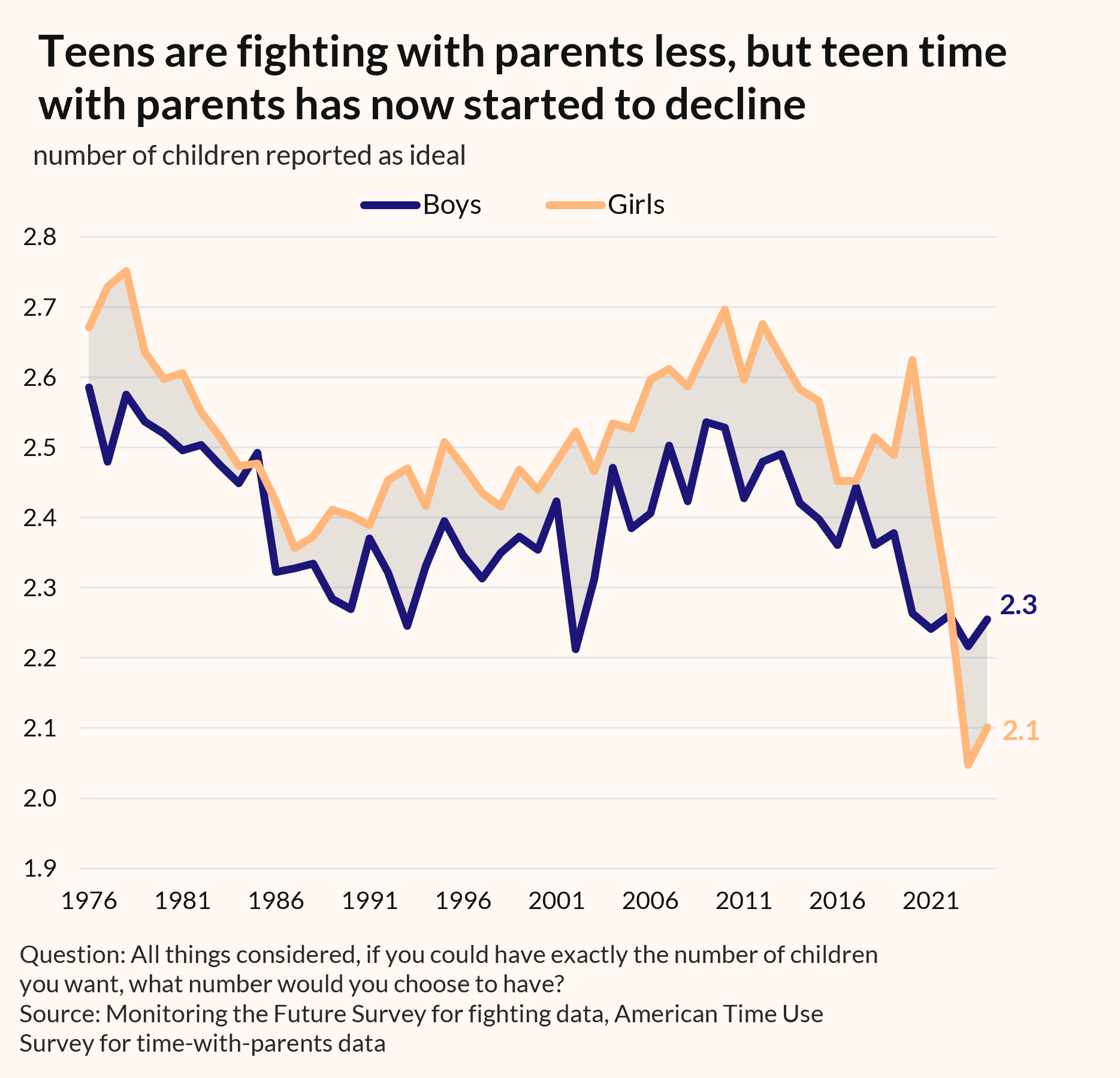
While there has been some decline in desired family size between 2007 and 2024, notice that the numbers there are still all above 2! They’re much, much higher than actual fertility rates! So whatever normative change happened, it wasn’t a change that made young people make some incredible shift away from family in general. Overwhelmingly, young people still want families.
Other factors like abortion and contraceptive efficacy partly reflect technology changes (LARCs, telehealth abortions), but those changes are themselves partly just endogenous innovation (as the Pill itself was— it wasn’t an exogenous shock to fertility, but was summoned forth by demand for its existence, and so it is improper to construe it has having some societal “effect”), and of course telehealth abortions depend on digital technology!
Thus, if we think of where digital technology, and especially smartphones, fit in the long arc of history, we see that they are both “more of the same” (an emergent selfishness pushing fertility lower), but also “this time is different,” because we are seeing a genuine honest-to-God collapse in virtually all kinds of human social life, and this collapse exists across every country and cultural group that uses digital technologies (the Amish and Haredi are mostly immune, but fertility actually is falling for Amish sects that are more technology-flexible).
To that end, we should not see the “long decline” graph as a rebuttal to cell phones, nor should we see digital technology as a mere “accelerator of the trend.” The new selfishness is only a viable ideology because digital technologies made it viable. Sitting at home wouldn’t be appealing without the digital technologies! These norms would not have reached scale without the specific vehicles to propel them, and because socializing is a cooperation problem, even individuals who do not share emergent selfishness norms lose out on potential socializees. People don’t RSVP to the party because they are at home chatting to their AI girlfriend. Even people trying to live in the real world are impacted.
I understand many economists are burned on the “video games cause young male unemployment” takes of a decade ago, but that bad experience is no reason to close your eyes and pretend the world isn’t changing in a sui generis way. Never before in the history of humankind has so radical an experiment in social isolation ever been conducted on such a scale, and the effects on fertility are and will continue to be profound.