In 2018, Kentucky implemented a new law: in absence of other considerations, all else equal, family courts would make 50-50 custody sharing the default assumption in divorces where no abuse or fault is alleged. This type of law has been a huge request of father’s rights and men’s rights movements around the country, so getting it in KY in 2018 was a huge get. Several more states have since implemented it.
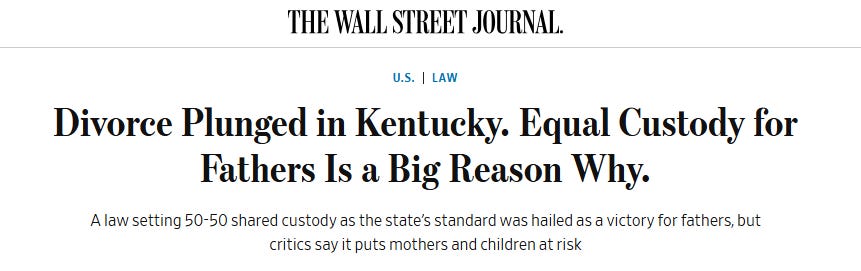
This week, a Wall Street Journal article claimed:
Before I go further, let me put some cards on the table.
I am a lifelong Kentuckian, I currently live in Kentucky.
I personally know people in Kentucky with kids who have gotten a divorce a divorce since 2018 where no fault was alleged by either party.
I think the 50-50 default assumption is obviously good; it’s actually insane to me that any state doesn’t start from 50-50 and then adjust custody from there as needed.
Regardless of my personal experiences and opinions, I detest factual error more than almost anything else in the world.
So with that we are going to analyze the claim, “Divorce plunged in Kentucky.”
TL;DR:
Let’s start from the back. In the WSJ article, there’s lots of reporting on the “effects” of the law. The short version is:
Activists who support the 50-50 law say the law is good because it encouraged families to think twice before getting a divorce, since parties had a stronger expectation that they would be forced to keep working together to raise kids.
Activists who oppose the 50-50 law say the law is bad because it removed divorce as a tool for women to remove their children from dangerous households, since before the law women usually got more custody, so this law reduced women’s ability to extricate children via divorce.
The key thing is what both sides of this debate agree on: any effect, good or bad, operates by suppressing divorce. To the extent the law is good it’s because it reduced divorce and kept families together. To the extent the law is bad it’s because it reduced divorce and kept (abusive) families together.
I want to flag here that the actual reason the law is good is because it ensures children of divorced parents have more access to their fathers than they had before. My view of the law is it is good regardless of its divorce effects, because I just think deferring to joint custody is a preferable default assumption when no fault or abuse is alleged. But the activists on each side prefer, for whatever reason, the divorce-related framing.
So now that you understand that all parties to this debate are thirsty to find falling divorce rates, let’s look at divorce rates.
Sharing is caring, as I tell my toddlers.
The first place to look is official data on marriages and divorces. We are going to ask “How many divorces were there in year X as a share of marriages in years X-10 to X?” People sometimes do divorces per 1,000 people, but this is silly since many people are unmarried. But marriages in the last 10 years are a pretty decent proxy for the population-at-risk-of-divorce, so we are going to express official court-filed divorces and annulments as a percent of marriages in the preceding 10 years. Capiche? Good. Here’s KY vs. neighboring states that publish sufficient data (note: some states are governed by terrorists who hate freedom and thus do not publish official data to NCHS. The current hotbeds of this kind of dangerous anarchist revolutionism are California, Hawaii, Indiana, Minnesota, and New Mexico. I suggest we send in the troops to force them to publish the data):
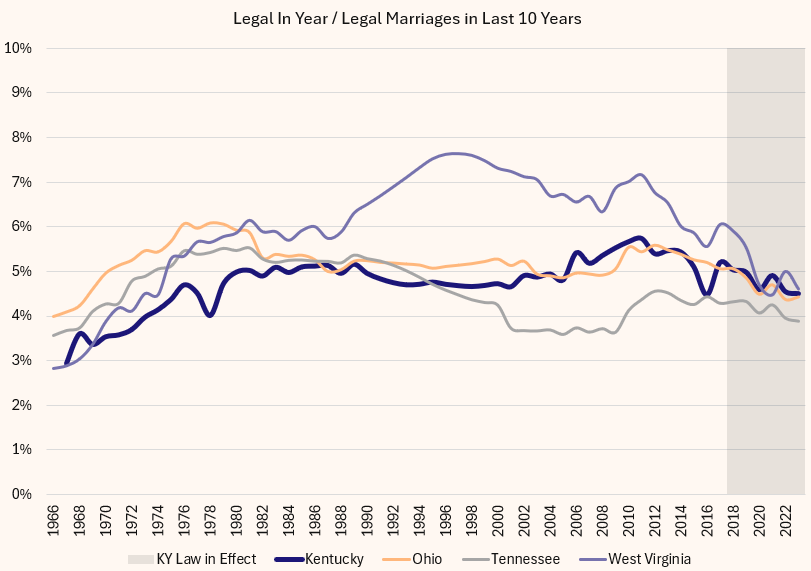
As you can see, there’s nothing special happening in Kentucky. Kentucky’s divorce rate was falling before 2018, as was the divorce rate in neighboring states. It kept falling after 2018 at the exact same rate. In fact divorce fell a lot more in West Virginia than it did in Kentucky, and possibly more in Ohio.
So, purely in terms of legal marriage, it seems clear that Kentucky’s law did not alter the prevalence at which divorces were filed in the state.
But this could be silly for many reasons. This data also suggests that Nevada has a massively high marriage rate— because a lot of people just get married in Vegas. “Official” marriage and divorce is subject to all kinds of quirky reporting issues. Plus, remember, the custody rule should really only impact divorces of couples with children. So we want a more precise figure.