Over the past generation, Estonia has built one of the world’s most advanced digital states. The next shift is not simply toward more digital services, but toward a more agentic model of government.
Estonia laid out an early vision for AI-enabled government back in 2019, when it became one of the first countries to adopt a national AI strategy. The Bürokratt concept, introduced in 2020, envisioned an agent-based public sector, even if the technology at the time was not yet mature enough to fully deliver it. Recent advances in agentic AI are now making it possible to redesign how the state operates.
This post maps concrete developments in Estonia against the 12-layer Agentic State framework (co-authored by Luukas and Ott). It is intended as a working inventory and will be updated over time as new initiatives, decisions and implementations emerge.
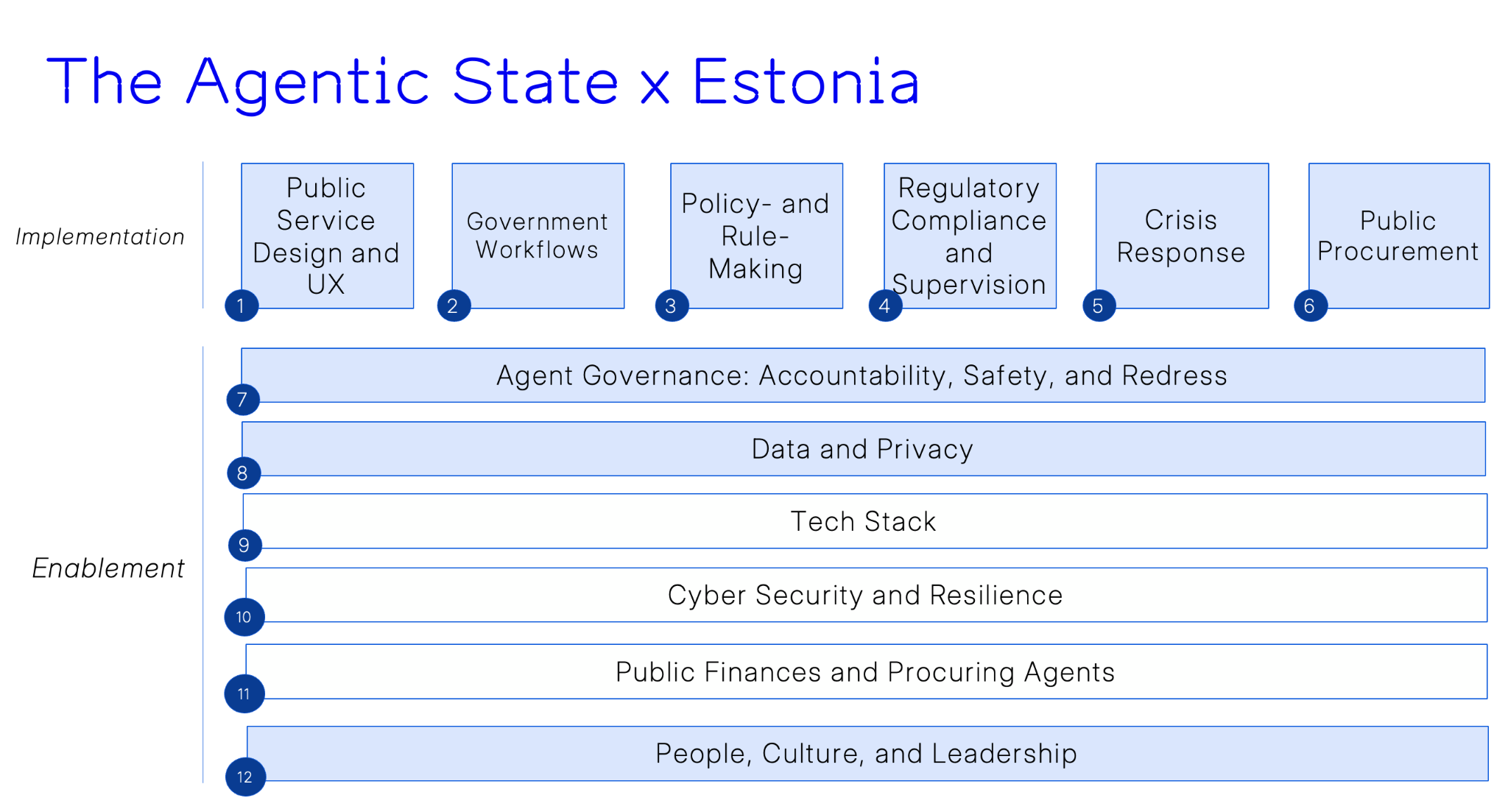
Three strategic milestones frame these developments:
Estonia recently updated its national Digital Society Strategy 2035 to reflect the growing importance of AI adoption at a societal level. The renewed strategy sets concrete targets around AI adoption and trust in public and private sectors. While the AI and Data strategy 2030 and the yearly action plans translate those ambitions into concrete government activities.
The Eesti.ai initiative, launched in early 2026 by the Estonian Prime Minister aims to identify high-value AI deployment projects and brings to bear whole-of-government political support and resources to support their implementation.
Note: links to specific initiatives are included where available, in both Estonian and English.
Public value: Citizens interact with public services through a single intelligent front door, in their own language, across any channel — rather than navigating dozens of separate agency portals.
Bürokratt is Estonia’s public-sector virtual assistant, now live across 18 government agencies. It is not a single chatbot but a framework for multi-agent collaboration: a citizen-facing front door that routes interactions to agents and workflows managed by specific government bodies. The architecture is designed so that a citizen asking about, say, a building permit and a tax question in the same conversation gets routed transparently to the right institutional agent each time. Bürokratt is maintained by RIA, Estonia’s digital agency. More broadly, the aim is to enable people to interact with the state in a channel-agnostic way and, over time, receive more personalised and proactive services.
The eesti.ee citizen portal is the central gateway for public services. Under the DÜAK 2035 plan, the services portal eesti.ee, the government app and Bürkoratt are being merged into personalised, AI-driven interfaces.
Estonia is also confronting the growing phenomenon of “inbound agents” - interactions with the state will increasingly be initiated not only by people, but by software agents acting on their behalf. As in many countries, public authorities are facing a deluge of AI generated filings, funding applications and queries. But Estonia is also looking to meet this inbound with constructive proposals:
The Agent Residency initiative proposes to give every AI agent a digital ID and allow the delegation of rights and responsibilities from individuals and companies to their agents in interactions with public authorities.
A signal of where this is heading: in March 2026, developer Stefano Amorelli demonstrated Claude Code executing tax payments through Estonia’s Tax and Customs Board (MTA) and LHV bank, with no human touching a UI.
The Estonian Language Technology Programme (EKT, 2018–2027) underpins everything in this layer. It funds the development of real-time automatic speech recognition (ASR), neural speech synthesis, sign-language recognition, and avatar creation for Estonian — a language spoken by barely a million people. Much of this work is done by the TartuNLP research group and TalTech Language Technology Laboratory and published as open-source components available through the national Kratid AI component library. Without this programme, Estonian-language AI services would depend entirely on commercial providers with limited Estonian capabilities.
A particularly important focus is the development of Estonian-language corpora, which now contain more than 15 billion words. These are intended to strengthen context, cultural understanding, and language performance in both commercial and open models, while also supporting local AI development.
A complementary eesti.ai-funded project at the Estonian Language Institute aims to create the first public Estonian-language fine-tuning dataset — at least 10,000 expert human preference judgments across law, administration, education, medicine, and culture — to measurably improve open-source models’ Estonian performance.
Public value: Faster decisions, lower costs, and civil servants freed from mechanical tasks to focus on judgment and policy.
The reform of the Administrative Procedure Act (HMS) is one of the key legal enablers of workflow automation in government. Approved by the government on 3 April 2026 and now under discussion in the Riigikogu, it establishes a horizontal legal basis for automated administrative decisions, allowing the widespread introduction of automated administrative procedures without requiring changes to individual legislative acts. Safeguards include automatic notification of decisions, the right to contact a human official, transparency about decision logic, and human review on request. (see post)
The “10 käsku” (Ten Commandments) is a planned list of government services where the use of AI will be mandatory (e.g. meeting memos, preparing talking points, preparing procurement documents).
A function repository was launched in March 2026 to address a chronic problem: agencies building the same solutions and workflows separately. Building on Estonia’s existing mandate to make all code publicly available, the function register addresses sharing and reuse at a higher level of abstraction, and will grow into a marketplace of agentic workflows and use cases.
The function repository is planned to include a separate section for algorithms, functioning as an algorithmic registry that provides an overview of AI systems used across the public sector. This also supports Estonia’s broader direction of making algorithmic transparency more systematic across government, with an ambition to move toward mandatory disclosure requirements.
The function repository is planned to be paired in 2026 with a prompt register that standardises how officials interact with AI systems, building institutional knowledge about what works.
A government-wide classifier is being developed by RIA (Estonia’s digital government agency) to automate the categorisation and routing of internal communications across agencies.
Estonian civil servants report a high rate of using AI in their work, but the adoption of enterprise AI tools is low. Under the Eesti.ai initiative, licenses for approved AI tools will be funded centrally for any civil servant, with plans to conduct pilots of agency-wide adoption and workflow redesign in several agencies.
Public value: Laws that are designed from the start for automated execution, reducing compliance costs for citizens and businesses and enabling the state to act proactively rather than reactively.
Estonia’s lawmaking guidelines are also being updated to require that new regulatory initiatives consider, from the outset, whether AI could address the problem more effectively or reduce the future compliance burden (see post).
An eesti.ai-funded project (€920K) is building dedicated AI tools for the legislative process: consolidating consultation comments, comparing EU and Estonian law, and detecting contradictions, overlaps, and reference errors in draft legislation. Piloting begins in the Justice and Digital Ministry, then scales to all ministries. Targets include a 25% reduction in the time spent analysing and processing legislative consultations per draft act, and fewer rejections and correction rounds.
Public value: Moving from sample-based, periodic inspections to more continuousdata and AI-driven oversight, and reducing the administrative burden on citizens and businesses — catching problems earlier without increasing the burden on compliant actors.
Several regulators are already piloting AI for their specific mandates: TTJA (the Consumer Protection and Technical Regulatory Authority) is developing advertisement compliance monitoring; the Gender Equality and Equal Treatment Commissioner is scanning job advertisements for compliance; and the Data Protection Inspectorate (AKI) is automating checks on personal data processing conditions.
The Real-time economy initiative focuses on the elimination of “unproductive work” performed by businesses, citizens and the state, which can be done through real-time exchange of high-quality data.
Public value: Using AI to predict, prepare for, and respond to crises faster — from flood risk to medical logistics.
Most activity here is at the pilot or planning stage. Some projects of note:
A government crisis resilience tool aims to improve coordination and decision-making during major incidents.
The eKiirabi (e-Ambulance) project is an initiative supported by Eesti.ai to develop AI-powered automated transcription for ambulance incident documentation, enabling paramedics to spend their time on patient care instead of paperwork.
Public value: Making it faster and cheaper to buy the right things, while making the entire procurement process transparent and data-driven.
The Ministry of Justice and Digital Affairs has created an assistant to automate the creation of simpler procurements.
An eesti.ai project aims to automate various labor-intensive steps of the procurement process, including supplier matching, bid invitations, negotiation support for simpler procurements, and IT architecture compliance assessment. The targets include reductions in document preparation time and increases in the number of companies bidding.
A new procurement plan module consolidates previously scattered annual procurement plans into one searchable, machine-readable system. Scale: 9,000 public procurements per year, €6 billion in annual procurement volume. Velsberg’s framing: “The next phase of digital government is not only about new applications or new AI tools. It is also about making the underlying operational data of the state more visible, machine-readable and usable across institutions.”
The national procurement register has also added multilingual procurement capabilities and open data access, making Estonian public procurement more accessible to international suppliers, including through EU tenders portal
Public value: Ensuring that as government deploys AI agents, citizens can trust them, understand what they do, and challenge their decisions.
This is one of Estonia’s deepest and most distinctive layers.
TARK provides central trust assessments for cloud-based AI tools used across government. It currently covers ChatGPT, Gemini, Claude, and Copilot, with approximately 20 additional services planned. Each assessment includes risk scoring, usage principles, and mitigation measures. Regulatory and compliance uncertainty — not technology — is the primary obstacle to AI adoption: TARK addresses that by giving agencies a clear, centrally vetted risk profile before they adopt a tool.
A new AI technical and regulatory sandbox, launched in March, will be rolled out in phases through end 2026, targeting at least 30 AI systems assessed in a national AI risk register. Capabilities include legal and compliance guidance, real-world controlled testing under supervision, secure data processing, local HPC access, algorithm transparency alignment, and audit trails.
The Trustworthy AI toolbox entered early beta in March 2026. It addresses the observation that public-sector AI typically fails not at the model layer but earlier — at problem framing, data quality, procurement, testing, and accountability. Estonia now has 220+ public-sector AI applications in production; the toolbox aims to move from isolated pilots to repeatable, coherent adoption.
RIA is piloting an Agent registry to create a unified system for managing AI agents across government. The design includes cryptographic machine identities (extending the national eID to machines), capability manifests defining what each agent can and cannot do, authorisation scopes, and kill switches.
From an agentic state perspective, EquiTech initiative was launched to detect and prevent bias, discrimination, and opaque decision-making of AI systems. The project built the practical methods, guidelines and training materials needed to ensure that AI systems remain fair, transparent, and trustworthy. Equitech
Public value: Citizens control their own data, can see who accesses it, and can grant or revoke consent — while government and business get the data they need to build effective AI.
The Andmejälgija (Data Tracker) gives citizens visibility into government access and processing of their data. It becomes mandatory for all government agencies by 2028 - a world first in operationalising data transparency at scale. Citizens can view their data trail at eesti.ee.
The Andmenõusolekuteenus (Data Consent Service) lets citizens grant private-sector entities access to their government-held data. Over 2 million consents have been processed. Estonia is now the first country with a legal basis for consent-based personal data sharing that is already in practice. In healthcare, data consent enabled pre-checkup analysis of medical data that has freed ~100,590 doctor appointment slots and saved ~€900,000 annually.
The andmed.eesti.ee data portal has grown from ~700 datasets in 2022 to over 8,000 today — a 10x increase driven by treating open data as core infrastructure rather than a compliance exercise. From August 2026 the data portal aims to provide a holistic overview of all government held data and different means how data can be re-used, including X-Road data services, open data, data scientist environment, as synthetic data, using restricted query interfaces and more.
A Data Management Tools Catalogue is now publicly available, helping organisations match their data governance needs to available tools — covering data catalogues, quality platforms, master data management, modelling, and integration.
Privacy-Enhancing Technologies (PETs) have a dedicated government funding line, supporting the development of language data spaces and health data spaces. A four-stage PII pipeline — detection, tokenisation, anonymised cloud query, token rehydration — allows AI training on sensitive data without exposing personal information to external providers.
Public value: A population and civil service that can actually use, govern, and shape AI — rather than being displaced by it.
Survey data gives a snapshot: 37% of public-sector workers and 45% of leaders use AI daily. 31% use it for task substitution. 67% believe AI raises productivity, and 35% think their job is at least partially substitutable — but only 2% believe full substitution is possible. Estonia’s updated Digital Society Strategy targets 80% of public and local government employees using AI daily, with a unified training system in place by 2028. Digiriigiakadeemia (Digital State Academy) is Estonia’s central training platform for civil servants.
Over the next year, Estonia aims for 100 000 Estonians (10% of the adult population) to participate in an AI workshop and 1 000 000 completions of AI-related online education modules. The goal is not just general awareness, but deeper skills for professionals across every sector (including the public sector and governments)
For sensitive and higher-trust use cases, Estonia is moving toward a more sovereign AI compute model in which workloads can rely on local HPC capacity as well as shared European infrastructure such as the LUMI AI Factory. The Ministry of Justice and Digital Affairs assessed Estonia’s future AI compute needs, while also preparing for larger-scale investment choices, including possible participation in an AI gigafactory model. These steps build on significant investments made in infrastructure in 2025, and reflect a broader recognition that trusted AI in government also requires trusted compute.