One awesome thing about the way this feature was implemented is that there is no
need to add any specific support to the user-space server implementations: as
long as the FUSE server uses libfuse, all the details are totally transparent
to the server.
In order to use this new feature one simply needs to enable it through a fuse kernel module parameter, for example by doing:
echo 1 > /sys/module/fuse/parameters/enable_uring
And then, when a new FUSE file system is mounted, io_uring will be used. Note
that the above command needs to be executed before the file system is mounted,
otherwise it will keep using the traditional /dev/fuse device.
Unfortunately, as of today, the libfuse library support for this feature
hasn't been released yet. Thus, it is necessary to compile a version of this
library that is still under review. It can be obtained in the maintainer git
tree, branch uring.
After compiling this branch, it's easy to test io_uring using one of the passthrough file system examples distributed with the library. For example, one could use the following set of commands to mount a passthrough file system that uses io_uring:
echo 1 > /sys/module/fuse/parameters/enable_uring
cd <libfuse-build-dir>/examples
./passthrough_hp --uring --uring-q-depth=128 <src-dir> <mnt-dir>
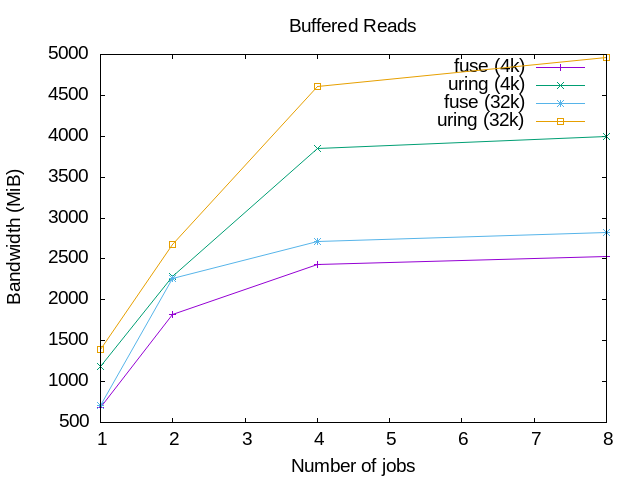
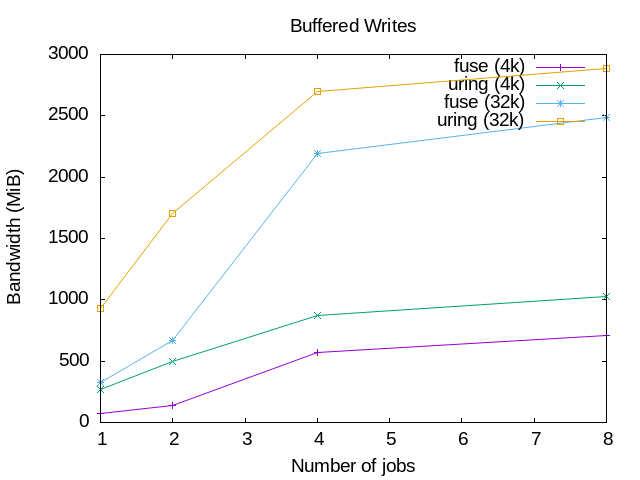
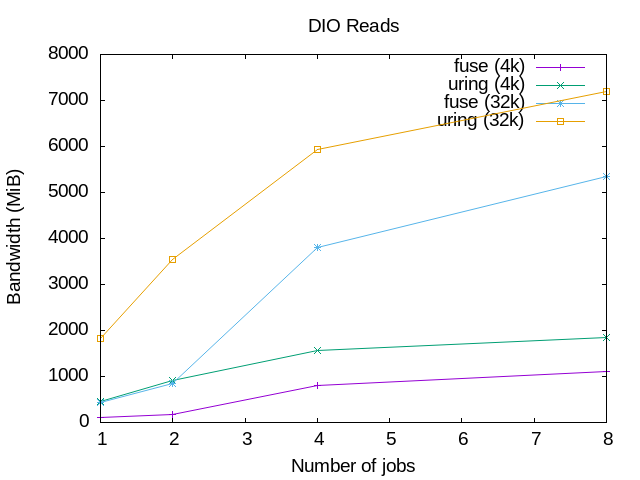
The graphics below show the results of running some very basic read() and
write() tests, using a simple setup with the passthrough_hp example file
system. The workload used was the standard I/O generator fio.
The graphics on the left are for read() operations, and the ones on the right
for write() operations; on the top the graphics are for buffered I/O and on
the bottom for direct I/O.
All of them show the I/O bandwidth on the Y axis and the number of jobs (processes doing I/O) on the X axis. The test system used had 8 CPUs, and the tests used 1, 2, 4 and 8 jobs. Also, for each operation different block sizes were used. In these graphics only 4k and 32k block sizes are shown.
| Reads | Writes |
|---|---|
 |
 |
 |
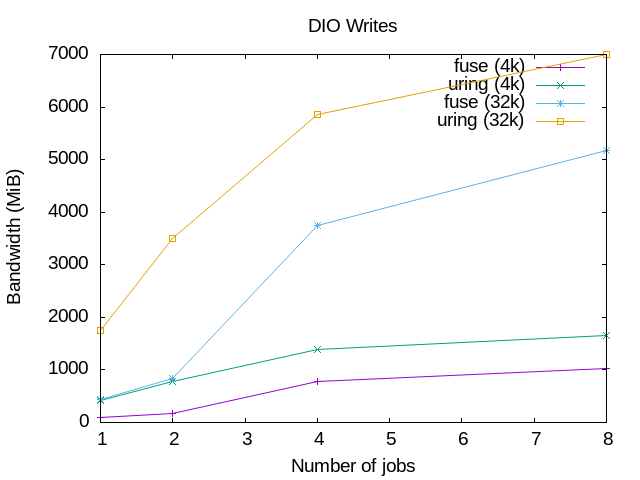 |
The graphics show clearly that the io_uring performance is better than when
using the FUSE /dev/fuse device. For the reads, the 4k block size io_uring
tests are even better than the 32k tests for the traditional FUSE device. That
doesn't happen in the writes, but io_uring are still better.