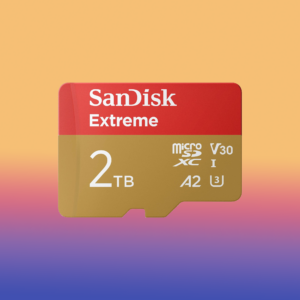
 Last week I was preparing for a long plane ride. I grabbed my preferred travel video player – an Amazon Kindle Fire, which has a handy microSD port – and dug out a fingernail-sized piece of storage media to insert. It occurred to me that this tiny centimeter-sized slab of plastic and silicon holds more data (1TB) than the entirety of the first datacenter I worked in back in the early 90s.
If I had 1″ cube, I could fit about 625 micro-SD cards in it. The current biggest microSD card is 2TB, so that’s nearly 1 petabyte in cube I could fit in my pocket.
Talk about a time to be alive.
It made me wonder how far this can go. Will we one day have 4TB microSDs? 8TB? Perhaps 128TB?
The answer is: yes — with some qualifications. Let’s unpack.
What’s the Theoretical Limit?
The microSD card format is governed by the SD Association, which defines four classes:
- SD: Up to 2 GB
- SDHC: Up to 32 GB
- SDXC: Up to 2 TB
- SDUC: Up to 128 TB
n paper, the official standard tops out at 128 TB for microSD. BTW, the filesystem isn’t the probem: exFAT can handle sizes well into the petabyte range (128PB, to be specific).
The Hard Limits Are Physical
The absolute constraints come from:
- NAND flash density — how many bits we can store per cell, reliably.
- Error correction overhead — as density increases, so does the risk of data errors.
- Heat and power — jamming trillions of cells into a tiny plastic card creates serious thermal management problems.
- Manufacturing costs — at ultra-high densities, yields drop, and prices rise, perhaps beyond feasibility.
Right now, we’re pushing QLC (Quad-Level Cell) flash, and companies are working on PLC (Penta-Level Cell), which would store 5 bits per cell. But each step adds complexity and reliability risks.
Economics Are the Killer Constraint
There’s also a simple market reality: beyond a certain point, it becomes cheaper and more reliable to buy a small external SSD instead of pushing microSD to extremes. You could make a 128 TB microSD card — in theory — but the cost would make your eyes water.
There’s also, at present, a limit to how much someone would want to put on a microSD. Having a 1PB microSD would be cool, but I wouldn’t pay a lot more for it than I would pay for, say, an 8TB because I don’t have 1PB of data I want to put on one.
Roadmap: When Will Bigger microSD Cards Arrive?
Capacity | Status | Forecast |
|---|---|---|
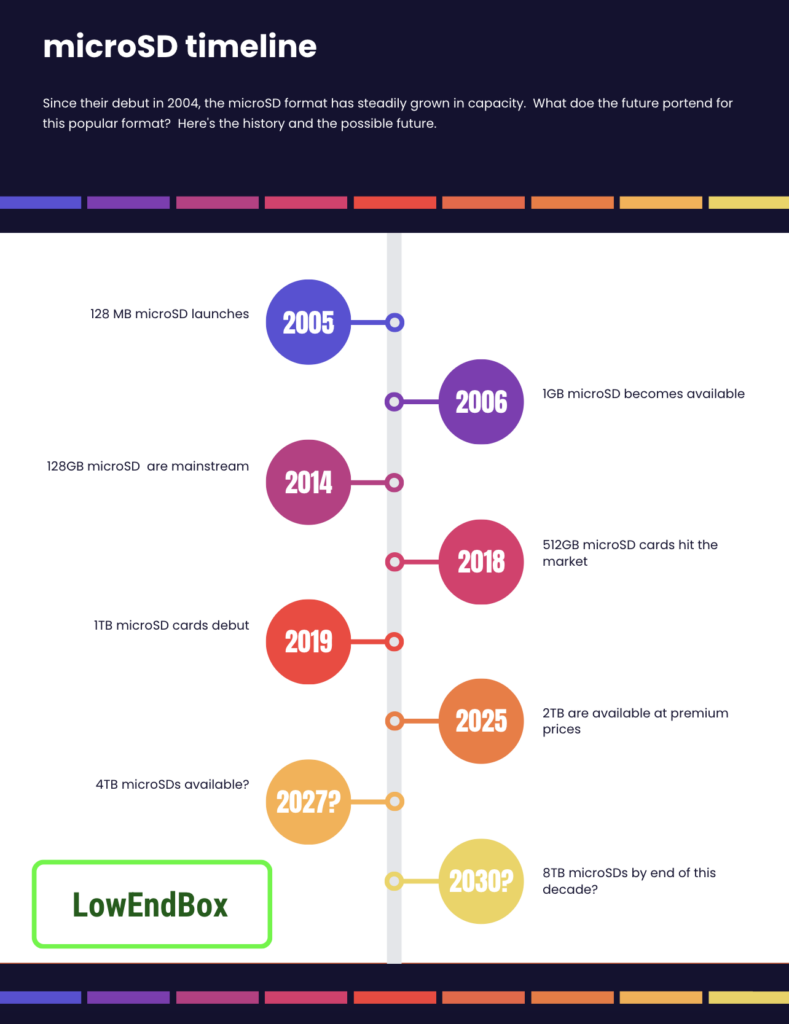
1 TB | Available since ~2019 | Mainstream now |
2 TB | Available since 2024/2025 | Cutting-edge, premium |
4 TB | R&D stage | Possible ~2027–2028 |
8 TB | Experimental labs only | Maybe 2029–2030 |
128 TB | Theoretical standard limit | Maybe never — or far future |
Expect to see 2 TB and 4 TB microSD cards this decade — maybe even 8 TB by 2030.
Beyond that, the future is unclear. The USB thumb drive, for example, topped out at 2TB – not because there is a hard physics reason, but because of market forces and the changing technology landscape. Most people simply don’t have enough data to store on external media, and if they do, they’re willing to make the leap to a different format (such as the 4TB external SSD I use to backup my laptop).
Related Posts:

raindog308 is a longtime community LETizen, technical writer, and self-described techno polymath. With deep roots in the *nix world, he has a passion for systems both modern and vintage, ranging from Unix, Perl, Python, and Golang to shell scripting and mainframe-era operating systems like MVS. He’s equally comfortable with relational database systems, having spent years working with Oracle, PostgreSQL, and MySQL.
As an avid user of LowEndBox providers, raindog308 runs an empire of LEBs, from tiny boxes for VPNs, to mid-sized instances for application hosting, and heavyweight servers for data storage and complex databases. He brings both technical rigor and real-world experience to every piece he writes.
Beyond the command line, raindog308 has a life-long love of German Shepherd Dogs, high-quality knives, target shooting, theology, tabletop RPGs, playing guitar, and hiking in deep, quiet forests.
His goal with every article is to help users, from beginners to seasoned sysadmins, get more value, performance, and enjoyment out of their infrastructure.
You can find him daily in the forums at LowEndTalk under the handle @raindog308.