
Last year, on May 26, 2021 @alvin posted on Low End Talk about Oracle releasing 200 GB of storage for Oracle Free Tier VMs.
Beginning last year, according to the screenshot @alvin posted, the Oracle Free Tier included:
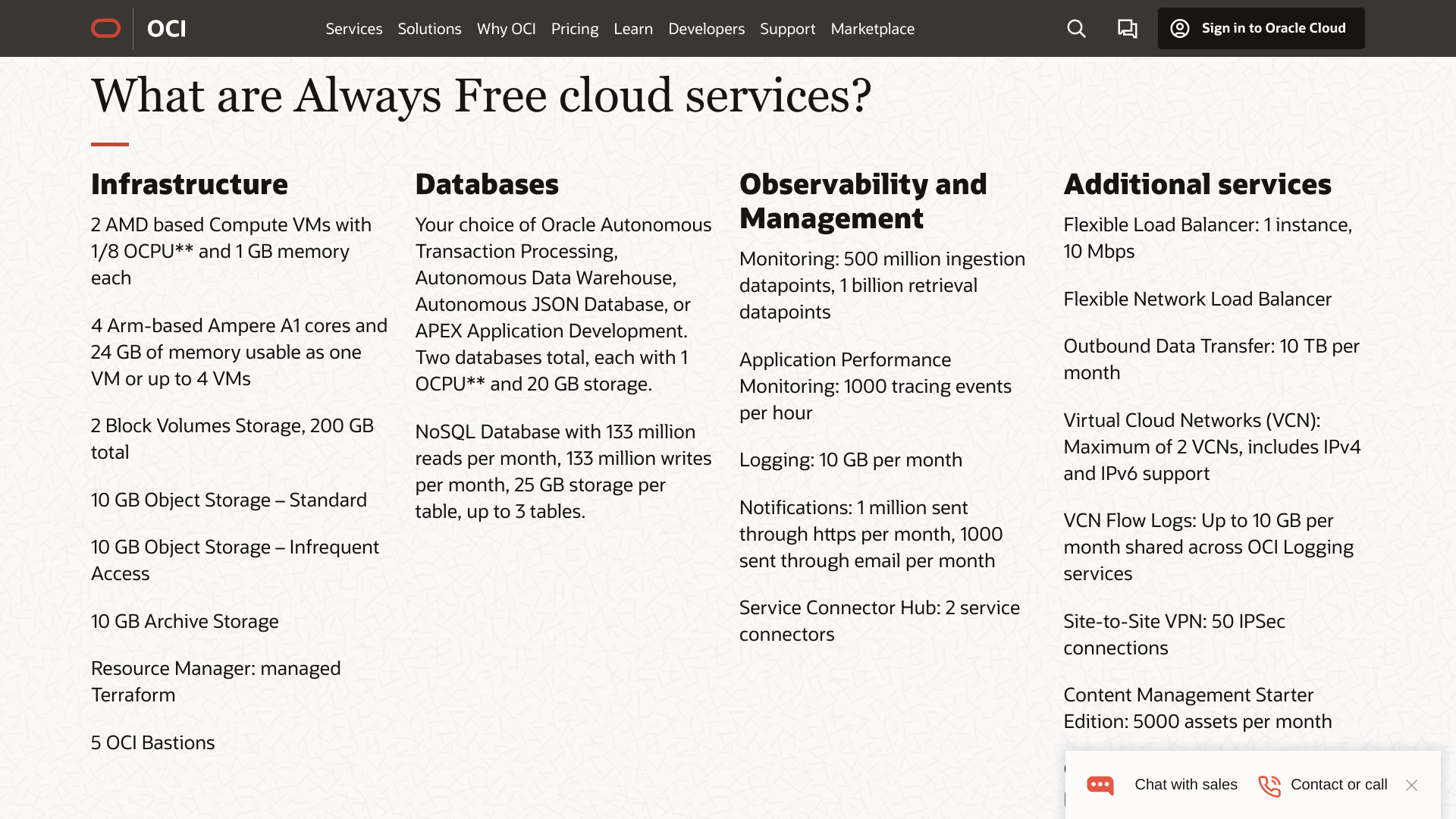
— 4 Arm-based Ampere A1 cores and 24 GB of memory usable as one VM or up to 4 VMs
— 2 Block Volumes Storage, 200 GB total
Wow! Why would any Low Ender need to buy a VPS when Oracle was giving away 4 core, 24 GB RAM, 200 GB storage VPSes for free?
I even wondered whether Oracle’s newly upgraded free tier offer might mean “the End of the Low End?”
Of course, I headed right over to Oracle’s Free Tier page and opened a free account.
In my limited testing, each of those 4 free Ampere cores seemed approximately half as fast as the super fast Ryzen 9 5950X cores on a Hetzner AX101. Folks, half as fast as super fast is pretty good when you consider that Oracle is giving out the Ampere instances for free! Plus, 24 GB RAM and 200 GB storage seems plenty for many Low End purposes, again, especially when we consider that it’s free.
Indeed, as of this writing, March 3, 2022, the Oracle Free Tier page is still up! Oracle still shows the same nicely performant setup with 4 Ampere cores and 200 GB storage! And it’s still free. Here’s a current screenshot:
By now it’s almost a year since Oracle initially made their momentous free offer. Nevertheless, our beautiful, fun Low End has survived! We did not see everybody moving to Oracle! Instead, we saw, and we still see, lots of non-Oracle posts and lots of non-Oracle activity on Low End Box, on Low End Talk, and on other Low End forums.
That one big thread about Oracle still continues. But, could that big thread be mostly posts by a lot of people searching for information about Oracle Free Tier that they did not seem easily to find at Oracle?
For example, one of the most frequently asked questions about Oracle Free Tier is, “What’s free, and for how long?”
As Oracle itself says, there are “no time constraints”:
Use your Always Free resources as long as you want with no time constraints—subject only to the capacity limits noted. When your 30-day trial period for the expanded set of services ends, you can continue using Always Free services with no interruption.
On the other hand, Oracle practices “reclamation.” What does reclamation mean?
On the Oracle Free Tier page and on the Oracle Cloud Free Tier FAQs page we find the question, “What happens when my Free Trial expires or my credits are used up?” Oracle explains that certain resources, including Ampere instances, might be “disabled and then deleted after 30 days, unless you upgrade to a paid account.”
In order to get an Oracle Free Tier account, one apparently needs, during the account setup process, to enter a credit card for identification. However, the credit card used for identification during account setup seems not to be used for billing.
Thus, one of the prime features of Oracle Free Tier seems to be that one might not need to enter a credit card to be used as a payment method. Since there is no credit card payment method to be billed, accidental bills such as those which famously sometimes happen with Amazon Web Services apparently might not be able to happen at Oracle Free Tier as long as one simply does not enter any credit card to upgrade to a paid account.
Could it be that one of the reasons why Oracle Free Tier hasn’t taken over the Low End might be confusion about “always free” vs “reclamation?”
What seemed to happen with my Oracle account was that my Free Trial instances were, as expected, reclaimed following the end of my trial period. Nevertheless, subsequently, I have been able and currently still seem able to create new Ampere instances and use them. All without having entered a credit card to upgrade to a paid account.
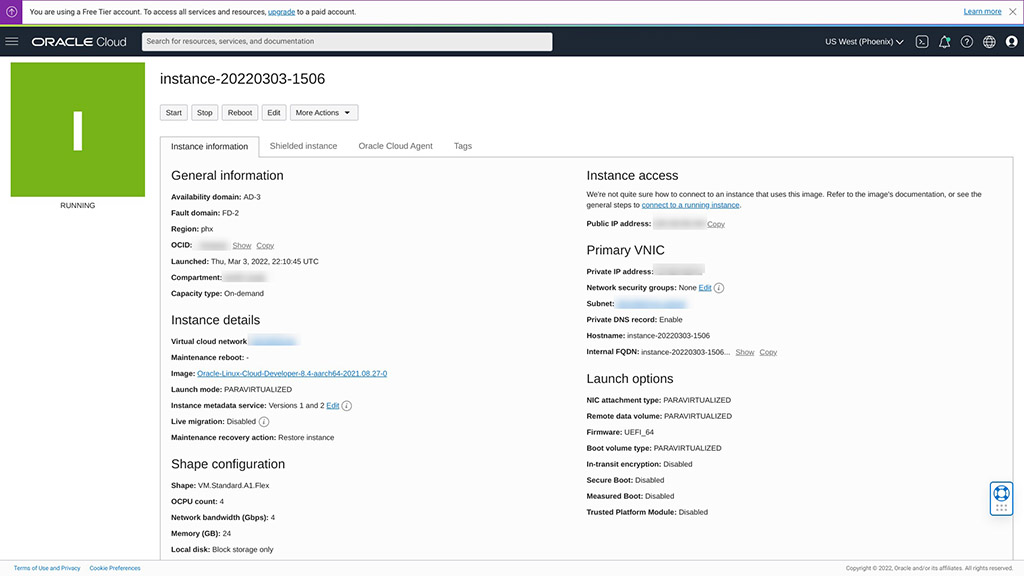
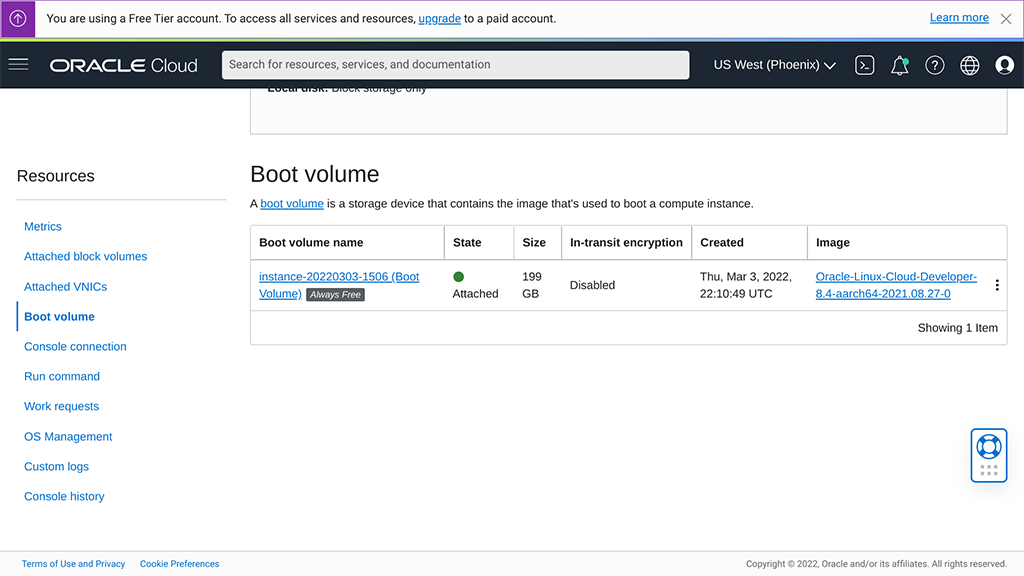
Here are screenshots of an instance I created just now. Note the 4 Ampere cores, 24 GB RAM, and 199 GB boot volume:
Related Posts:

It feels like just yesterday—but it was actually fifty years ago—that I stood in a doorway, watching yard after yard of ASCII art scroll out of a Teletype Model 33, surrounded by a group of laughing, wide-eyed tech enthusiasts. That was my first taste of computing, and I’ve been hooked ever since.
My Low End Adventure began right here on LowEndBox, when I stumbled across the perfect deal on a dedicated server from OVH a few years ago. That moment opened the door to a whole new world of tinkering, learning, and community.
Today, I’m the proud owner of Darkstar—a lovingly maintained antique server currently colocated in Dallas, Texas at LevelOneServers.com. She may be older than most, but she runs like a champ and has taught me more than a few lessons about hardware and humility.
In addition to writing for LowEndBox and helping out as a moderator on LowEndTalk, I spend my time exploring the worlds of programming, networking, and Linux system administration. There’s always something new to learn—and luckily, the LowEnd community is filled with brilliant, generous people who are more than willing to teach.
All these years later, I’m still learning, still experimenting, and still having a blast.
It’s very, very fun here on the Low End… isn’t it? 😊