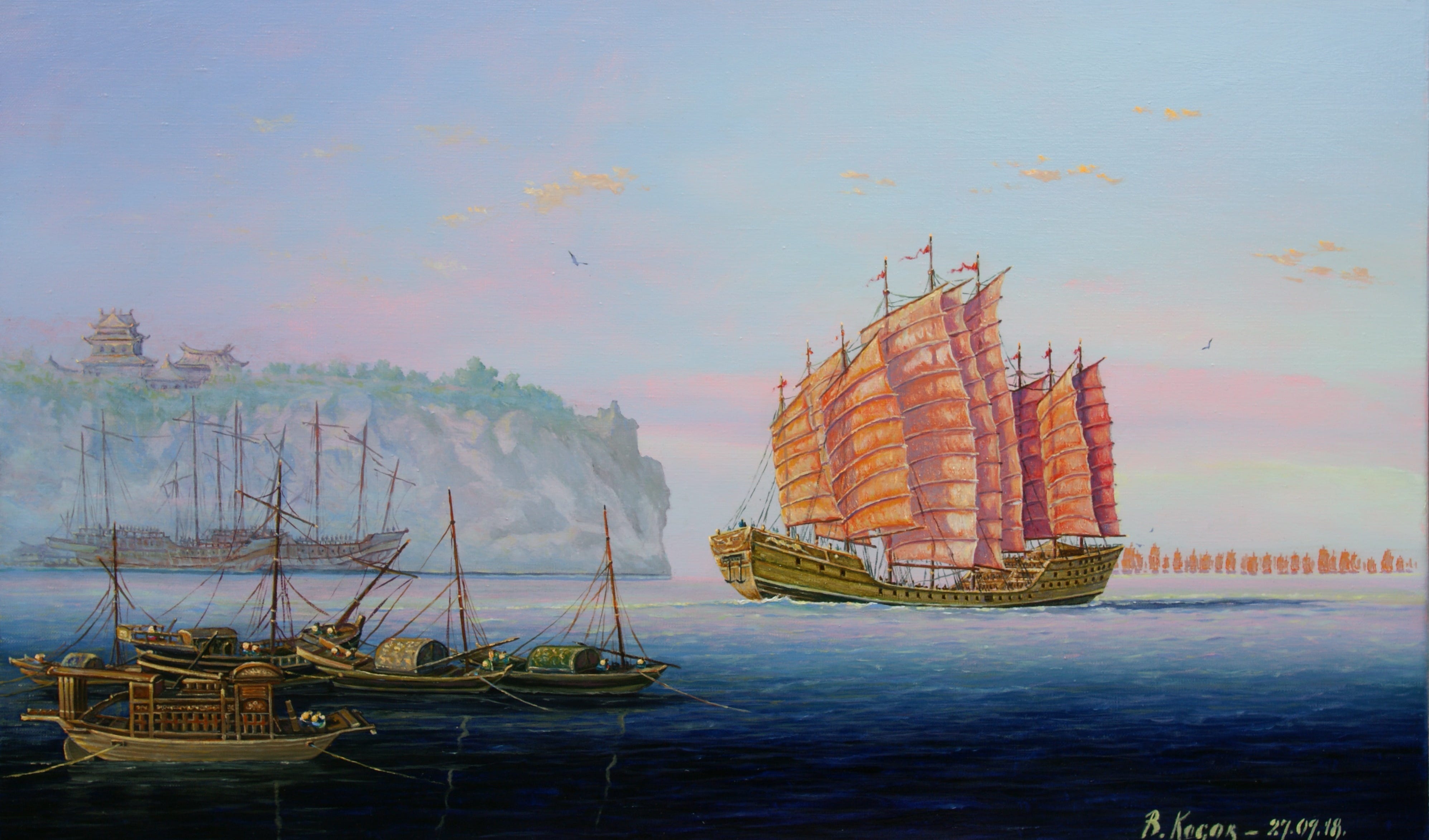

Two thousand Chinese soldiers crouch outside the walls of a foreign capital. It is night, somewhere in the southwest of Sri Lanka. The year is 14111. They are outnumbered, deep inland, and waiting for the signal.
Their commander is Zheng He, the Muslim eunuch admiral of the Ming dynasty, leading the third of seven2 great imperial voyages.
Then comes one shot from a huo-p’ao, a gunpowder signal gun.
The earliest known record of a gunshot on Sri Lankan soil.
The soldiers charge the walls. They break through. They reach the inner court and capture the man who rules there: Vīra Alakēśvara, a strongman who controls Kotte in practice, if not by uncontested royal right. They seize his wife, his children, and his officials. Then they turn around and fight their way back toward their fleet against a pursuing Sinhalese army.
The captives are loaded onto the fleet and carried to Nanjing, China’s capital at the time. There, the Yongle Emperor pardons Alakēśvara, chooses his replacement, and inserts the Ming court into Sri Lanka’s politics.
Today, this conflict is known as the Ming-Kotte War. Official Ming records presented it as unfortunate but unavoidable. Alakēśvara had been hostile to the imperial fleet since its first appearance on the Sinhalese coast in 1405. He had plotted against Zheng He’s soldiers. He had tried to extract gifts and tribute by force. He had to be removed. The emperor’s justice had been done.
Popular modern conceptions of Zheng He’s expeditions vary, but they tend to cluster around a few key ideas. His seven voyages between 1405 and 1433 were grand. He commanded one of the largest fleets in the medieval world, the treasure fleet, consisting of many large ships. He sailed across the Indian Ocean and back. He brought silk and porcelain. He exchanged imperial gifts. He did not conquer or colonize. He was an Asian counter-image to Columbus.
That story is not exactly false.
But it is incomplete.
Zheng He carried treasure. He also carried soldiers, guns, and the authority to remove rulers.
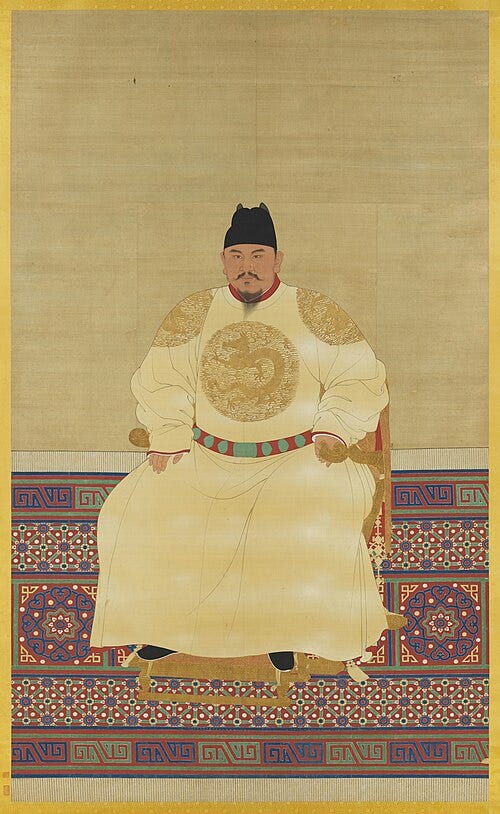

More than forty years before Zheng He’s signal gun fired in Sri Lanka, a former peasant rebel drove the Mongols out of China and founded a new dynasty.
His name was Zhu Yuanzhang. History remembers him as the Hongwu Emperor, founder of the Ming. Born into extreme poverty, he rose through rebellion and civil war to defeat the Yuan dynasty and proclaim the Ming in 1368. He built his new state around military discipline, agrarian recovery, strict law, suspicion of merchants, and tight control over the coast. Officially, he banned private Chinese overseas trade outright, in a policy called the haijin, the “sea ban.” Enforcement varied over time.
When Hongwu died in 1398, the throne was not passed to one of his sons, but instead to his grandson, the Jianwen Emperor. Jianwen was young and politically vulnerable. His scholar-advisors urged him to reduce the power of his uncles, the imperial princes who commanded major forces on the frontiers.
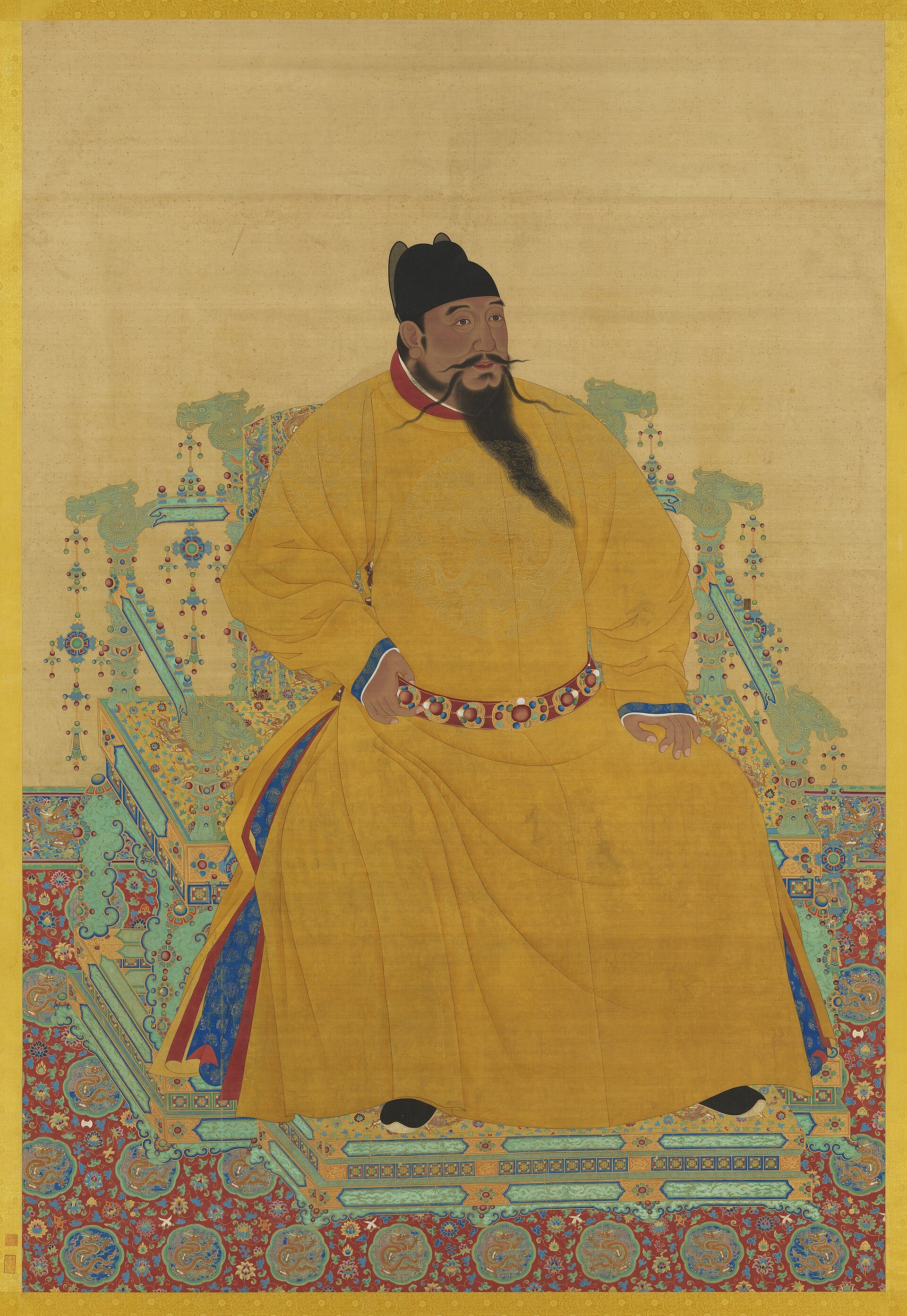

One of those uncles was Zhu Di, the Prince of Yan. Based in Beijing, Zhu Di was a frontier commander hardened by campaigns against the Mongols. In 1399, he rebelled. After three years of civil war, he seized Nanjing. The palace burned. Zhu Di became emperor under the reign name Yongle. Jianwen disappeared. Officially, he died in the fire. Unofficially, rumors that he had escaped in disguise haunted the Yongle emperor for the rest of his life.
He purged officials who had served Jianwen, rewrote the record to justify his accession, and began looking for ways to make his reign look not merely successful, but chosen.
For most of imperial Chinese history, that kind of legitimization campaign would have focused inward. China was a continental power after all. Its frontier was the steppe to the north. Its ceremonial axis ran between the imperial altars and the auspicious mountains of the interior. The sea was for fishermen and devious merchants and pirates.
But the capital of the early Ming was Nanjing, literally “Southern Capital”. For almost all of China’s history, political power remained in the north. However, Hongwu had broken that pattern, choosing Nanjing as the Ming’s first capital. Nanjing was a river city, perched on the lower Yangtze just before it opened toward the sea. And Hongwu had already constructed extensive shipyards. Southeast Asia looked closer to China than ever before.
And so the Yongle emperor’s eye drifted south.
Between 1403 and 1424, Yongle launched an overseas-projection program on a scale the Ming never attempted before or after. It restored and enlarged the tribute system. It moved to control maritime chokepoints between China and the Indian Ocean trade network. It accumulated Buddhist sacred capital. It brought foreign rulers and envoys to Nanjing. It made the world visibly come to the usurper’s court.
The most theatrical part involved a giraffe.
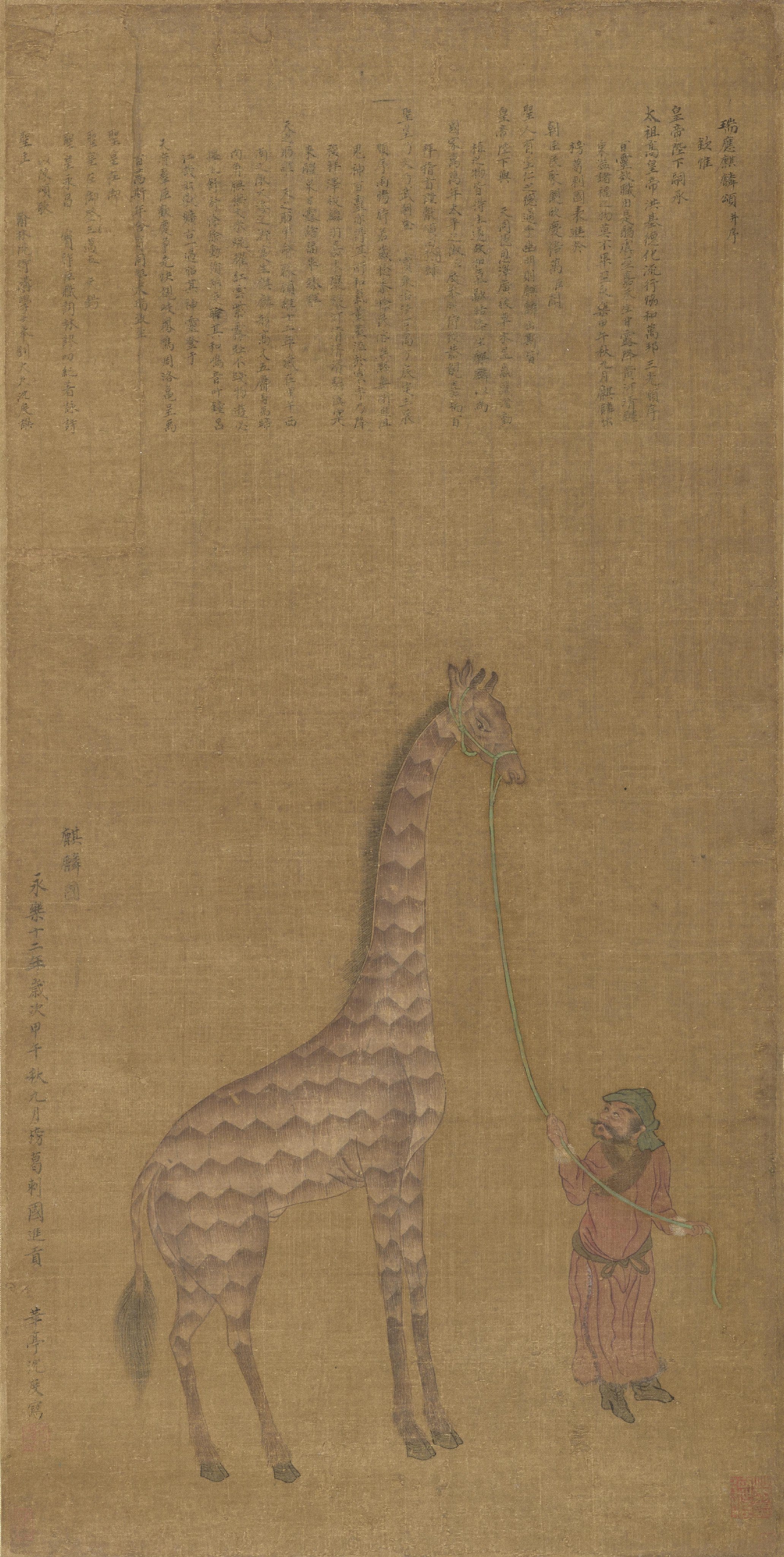

In 1414, Saifuddin Hamza Shah, Sultan of Bengal, sent a giraffe to the Ming court. The animal was a re-gift, originally having come from East Africa. The Ming court identified it as a qilin, the mythical horned beast said to appear only under a sage ruler. For Yongle, the giraffe was cosmic politics. The court painter Shen Du commemorated the giraffe in an imperial portrait. Officials composed poems celebrating the apparition. Heaven approved the man on the throne.
More giraffes followed: One from Malindi in 1415, another from Aden in 1419. Each was identified as further confirmation that Yongle’s mandate was real.
This is the program Zheng He’s voyages belonged to. They were not primarily exploration. Nor were they simply a vanity campaign to display Ming wealth. They were the largest maritime arm of a wider Yongle project: legitimacy, tribute, sacred spectacle, commercial control, and imperial intimidation all at once.
The same system that handed out gifts and searched for Buddhist relics also dispatched soldiers.
Zheng He was the star of the show. But he was not the whole show.
Two years before Zheng He’s first voyage, another eunuch envoy named Yin Qing had already crossed the South China Sea, visited what is now modern day Malaysia and India, and returned to the Ming court bringing foreign envoys with him. This mission began in 1403, just a year after Yongle took the throne.
The Ming already had a maritime state apparatus. Hongwu had maintained fleets since the dynasty’s founding. Ming ships patrolled the coast against pirates, moved men and grain through the empire’s waterways, and drew on imperial shipyards at Nanjing. Yongle’s contribution was not inventing the navy. It was scaling it up and pointing it outward.
Nor was Zheng He the only eunuch commander in the program. Hou Xian was also quite the traveler. He carried an invitation from Yongle to a Tibetan religious ruler, went to Bengal to deepen relations, and later successfully pressured Jaunpur to stop attacking Bengal. While most other envoys sailed to the "Western Ocean" (the Indian Ocean), Zhang Qian was dispatched to the southeast. The Ming Shilu records his missions to Brunei (1410 and 1411) and to Kumalarang in Mindanao (1417). The Yongle court's Eastern Ocean program brought many foreign rulers to China in person. Three of them never returned. A man who was said to be King of Brunei3 died in Nanjing in 1408. The East King of Sulu (part of modern-day Philippines), one of three Sulu kings brought to China together in 1417, died at Dezhou on the return journey. And in 1421, the King of Kumalarang (also part of modern-day Philippines), whom Zhang Qian had personally escorted to Nanjing the previous year, died before leaving China.4
The popular framing presents Zheng He as a solitary protagonist. The Ming records show something larger around him: A state initiative with multiple commanders, multiple destinations, and objectives, running across the Yongle reign and into the reigns of his successors.
Zheng He was the face of that project. He was not the whole of it.
Yongle’s outward-projection program was not a European-style colonial empire like the one Portugal would build in the region just a few generations later. There were no settler colonies. No imperial governors ruling foreign populations. The Ming did not arrive at a harbor, plant a flag, and proclaim the territory annexed to China.
But it was also not just trade. Or diplomacy. Or exploration.
It was a project built from specific institutional materials: ships, envoys, seals, titles, tribute permits, local rulers granted Ming recognition, sacred objects, elaborate ceremonies, foreign embassies brought to Nanjing, threats, and occasional bursts of military violence.
Some historians call it Pax Ming. Whatever the name, the project had pieces.
One such piece was a pair of imperial supply bases called guanchang, or official depots. The Mao Kun map, a Ming navigation chart later preserved in the Wubei Zhi, marks guanchang at two sites: Malacca, on the Malay peninsula, and Samudera, near today’s Lhokseumawe in northern Sumatra.5
These were not just warehouses. Ma Huan, the Chinese Muslim interpreter who sailed on Zheng He’s later voyages, describes the Malacca compound in detail. When the treasure ships arrived, soldiers erected stockades “like a city-wall,” with four gates, watch-drum towers, night patrols, an inner enclosure, storehouses, and granaries.
A fenced compound. Armed patrols. Watchtowers. Storehouses. Granaries. This was a logistics-and-security installation on foreign soil, secured by Ming soldiers under Ming command.
While it isn’t known for sure, these compounds were probably only fully assembled and staffed when Ming fleets were docked. And local rulers still held sovereignty, at least in theory. The Ming presence existed by permission. But permission meant something different when the visitor commanded the largest fleet in the world, complete with an onboard army of thousands.
At Old Port, near Palembang in Southern Sumatra, the Ming established more than a guanchang. It created a frontier office.
A “Pacification Superintendency”, or xuanwei si, was an existing Ming administrative category used for non-Han frontier polities. A local ruler received an imperial title, an imperial seal, and a place in the Ming bureaucratic order. In return, he sent tribute, hosted envoys, and could be called on for service.
This did not make his territory “China” in the ordinary sense. But it did place the polity in a middle ground between foreign tributary and direct imperial administration. On the land frontier, becoming a Pacification Superintendency sometimes led to absorption: Over time, some native offices were converted into regular Chinese prefectures and counties.
In 1407, after Zheng He defeated the maritime warlord Chen Zuyi at Palembang, the Yongle court applied this category overseas for the first time. The new Pacification Superintendent at Old Port was Shi Jinqing, a local Chinese Muslim merchant who had emerged as a leader of the Palembang community.
Old Port already had a substantial overseas Chinese population. The Ming did not bring them. They had been there for decades, sometimes longer. What the Yongle court did was place an imperial title over an existing diaspora community, then call the arrangement a Ming administrative office. As far as I can tell, this arrangement was unique. The Ming and later Qing both treated unauthorized overseas Chinese communities with suspicion, for they had deserted the realm. As such, they were rarely recognized in an official capacity. Old Port was an unusual exception.
But the geopolitical landscape was complex. Old Port was also claimed by Majapahit, the dominant Javanese empire in maritime Southeast Asia. Even the Ming's own records sometimes refer to Old Port as “Java's Old Port Pacification Superintendency,” acknowledging that the polity was simultaneously claimed by Majapahit even at the peak of the Ming arrangement. Shi Jinqing held a Ming office, but the place he administered remained nominally under Javanese suzerainty too.6
Three layers of sovereignty sat on the same piece of Sumatra: A Chinese Muslim merchant community ruling itself in practice, recognized by the Ming as a frontier office, while still tied to Majapahit’s imperial world.
Not quite a colony. Not merely a trading post. Something in between.
Throughout a thirty-year run of voyages, Zheng He’s fleet was involved in three significant military campaigns. The Ming records describe them as defensive responses to hostile foreign rulers. But, there’s a pattern: Remove a problem ruler at a strategic node and install a Ming-aligned alternative.
The first was Palembang (Southern Sumatra), 1407. This is the Old Port story. Chen Zuyi, a Chinese fugitive turned warlord was preying on shipping near the Malacca Strait. When Zheng He arrived, he appeared to surrender. Shi Jinqing warned the fleet that the surrender was a feint. Zheng He attacked. Chen Zuyi was taken alive to Nanjing and executed. Shi Jinqing received the title of Pacification Superintendent.
The second was Sri Lanka, 1410 or 1411. Our opening scene. Zheng He’s troops captured Vīra Alakēśvara, took his family and officials to Nanjing. They were pardoned and the navy was dispatched to deliver the Ming-approved replacement. The same voyage had also carried the Galle Trilingual Inscription, a stone tablet composed in Nanjing and addressed in Chinese to the Buddha, in Tamil to a Hindu deity, and in Persian to “The Light of Islam”. Gift and gun belonged to the same mission.
The third was Samudera (Northern Sumatra), 1415.7 Ming intervention backed Sultan Iskandar against a rival claimant named Suganla. The operation did not come out of nowhere. Chinese envoys visited frequently. Zheng He’s voyages had called there repeatedly. The Ming had a guanchang near the capital. In 1414, Zheng He had presented the sultan with the Cakra Donya bell, a bronze bell cast in Nanjing and inscribed in Chinese and Arabic. One year later, the fleet defeated Suganla, captured him, and sent him to Nanjing for execution.
These were the battles. But the same system could sometimes work without combat.
Malacca was a small port on the Malay peninsula, harassed by Siam (modern-day Thailand). Ming recognition helped protect it. Yin Qing visited in 1403. The Yongle court issued Parameswara, Malacca’s ruler, an imperial mandate and seal in 1405. Parameswara himself traveled to Nanjing in 1411 with a large royal retinue. When Siam later resumed pressure, he complained to Yongle. In 1419, Zheng He carried an imperial edict to the Siamese ruler, scolding him and demanding he stop. Siam complied.
No war. The pressure worked.
The same pattern appears in Bengal. In 1420, Bengal complained that the Sultanate of Jaunpur had repeatedly attacked its territory. Yongle sent Hou Xian with imperial instructions, silk, money, and gifts. He brought no army. The message put Ming pressure behind Bengal’s complaint, and Jaunpur backed off.8
This was the same instrument in a softer register. The court that sent gifts also sent threats. The court that conferred titles could remove rulers.
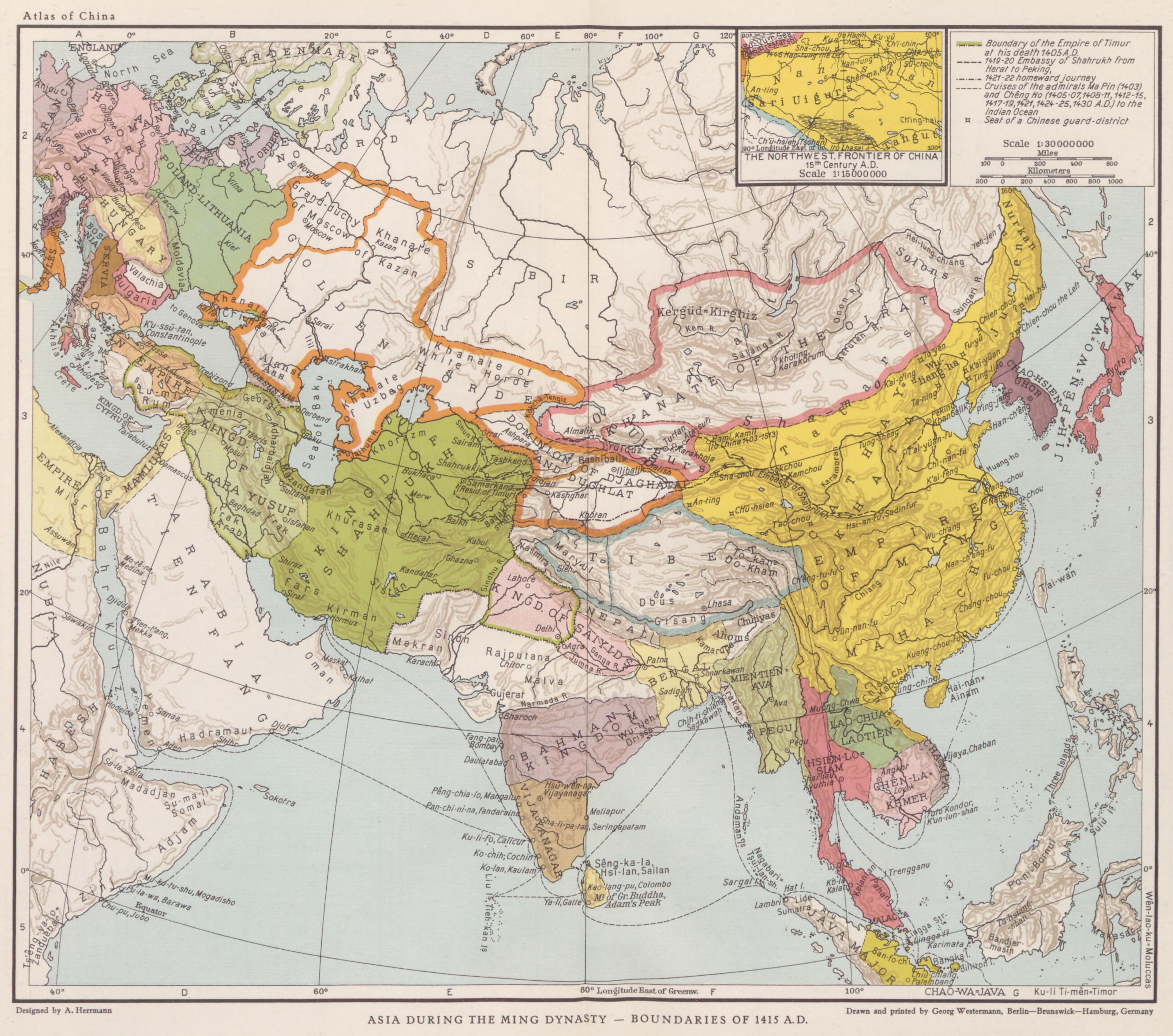

The voyages were the photogenic part of Yongle’s outward projection. They were not the largest part. At its core, Ming China remained primarily a land power.
While Zheng He sailed, the Ming was pushing south by land. In 1406, two Ming armies invaded Đại Việt, today northern Vietnam. By 1407, the country had been annexed as Jiaozhi, the Ming’s fourteenth province. In the first year of occupation, thousands of Vietnamese artisans were deported to Nanjing, including gun founders. For twenty-one years, the Ming held Jiaozhi against near-continuous guerrilla insurgency. In 1428, four years after Yongle’s death, they were driven out.
At the same time, the Ming was expanding beyond Yunnan into the Tai-polity zone of what is now northern Burma, northern Thailand, and Laos. Local rulers received Ming titles and seals. Pacification Superintendencies were minted.9 Ming clerks entered their courts. Tribute was collected. Troops were levied.
The maritime project was not an isolated experiment. It was one theatre in a wider southern expansion.
Most of that expansion failed.
North Vietnam was lost. Most of the Tai polities slipped Ming control over the next two centuries. The durable success was not Yongle’s spectacular expansion, but the slower absorption of the inner Yunnan frontier, which Hongwu had conquered before him and later dynasties continued to integrate.
As for Old Port, it shared no land border with the Ming. Once the fleets stopped coming, the maritime offices and depots that sustained them quickly faded into memory.
Yongle died in 1424. His son, the Hongxi Emperor, immediately suspended the maritime program. Hongxi reigned less than a year. His son, the Xuande Emperor, ordered one final voyage from 1431 to 1433. By the time it returned, Zheng He was dead.10
The reasons for retreat were not mysterious. The voyages were expensive. The civil bureaucracy disliked the eunuch-led program. The northern frontier demanded attention. Jiaozhi had become a costly disaster. And the whole project sat uneasily beside the late emperor Hongwu’s instructions.
Hongwu had written a foundational text, the Huang-Ming Zuxun, the Ancestral Injunctions of the Ming. It named 15 foreign polities that were not to be targets of Ming military conquest, including Annam (Northern Vietnam), Java, Srivijaya/Palembang, and Sumendala. Yongle had violated these wishes. After his death, officials who wanted the program gone had a dynastic constitution to point to.
To the scholars, this was not retreat, it was restoration. Already by the later days of Yongle’s reign, more and more attention returned to the north. The Mongols, though driven out from China generations earlier, seemed to be gathering newfound strength. In 1421, he officially moved China’s capital from Nanjing back to Beijing. It was time to turn the Ming’s focus back to the traditional threat.
So the program ended. The guanchang fell into disuse. Old Port was forgotten. The last official mention of the Pacification Superintendency dates to 1430, three years before Zheng He’s seventh and final voyage returned. After that, silence. When Majapahit reabsorbed Old Port around 1440, the Ming court appears to make no record of the event. The institution was so obscure in the imperial memory that its dismantling went not only unchallenged, but unnoticed.
Sri Lanka’s fate was similar. After the original ruler’s ousting, the Ming had attempted to install a man named Yebanaina as “King of Ceylon” in 1412. He was murdered, by some accounts, the very night he returned to the island in 1414. It’s unclear if the Ming court ever even learned of this. There’s no known record of his death and no known attempt to install a successor. Even in its prime, the Ming government seemed disinterested in managing Yongle’s maritime project.
But despite the unraveling of its brief maritime empire, Ming engagement with Southeast Asia continued. Envoys continued throughout the fifteenth century. In 1457, only twenty-nine years after expelling the Ming from Jiaozhi, the new Lê dynasty of Đại Việt asked the Ming court for formal enfeoffment.
The Ming did not abandon Southeast Asia. But it discarded its hegemonic arm and withdrew itself from overseas interventionism.
Later memory simplified the rest. Zheng He’s voyages became nothing but peaceful exchange, gifts, and friendship. No conquest, no war. The battles at Palembang, Kotte, and Samudera fell to the wayside. The Pacification Superintendency at Old Port disappeared. The Annam occupation became a different topic in a different textbook. The Cakra Donya bell stayed in Sumatra. The Galle inscription stayed in Sri Lanka. And the story connecting them faded.