This week, Anthropic filed its blockbuster S-1, projecting a valuation of $1.8 trillion to $2.0 trillion and ranking it as the second-largest market debut, behind only SpaceX.
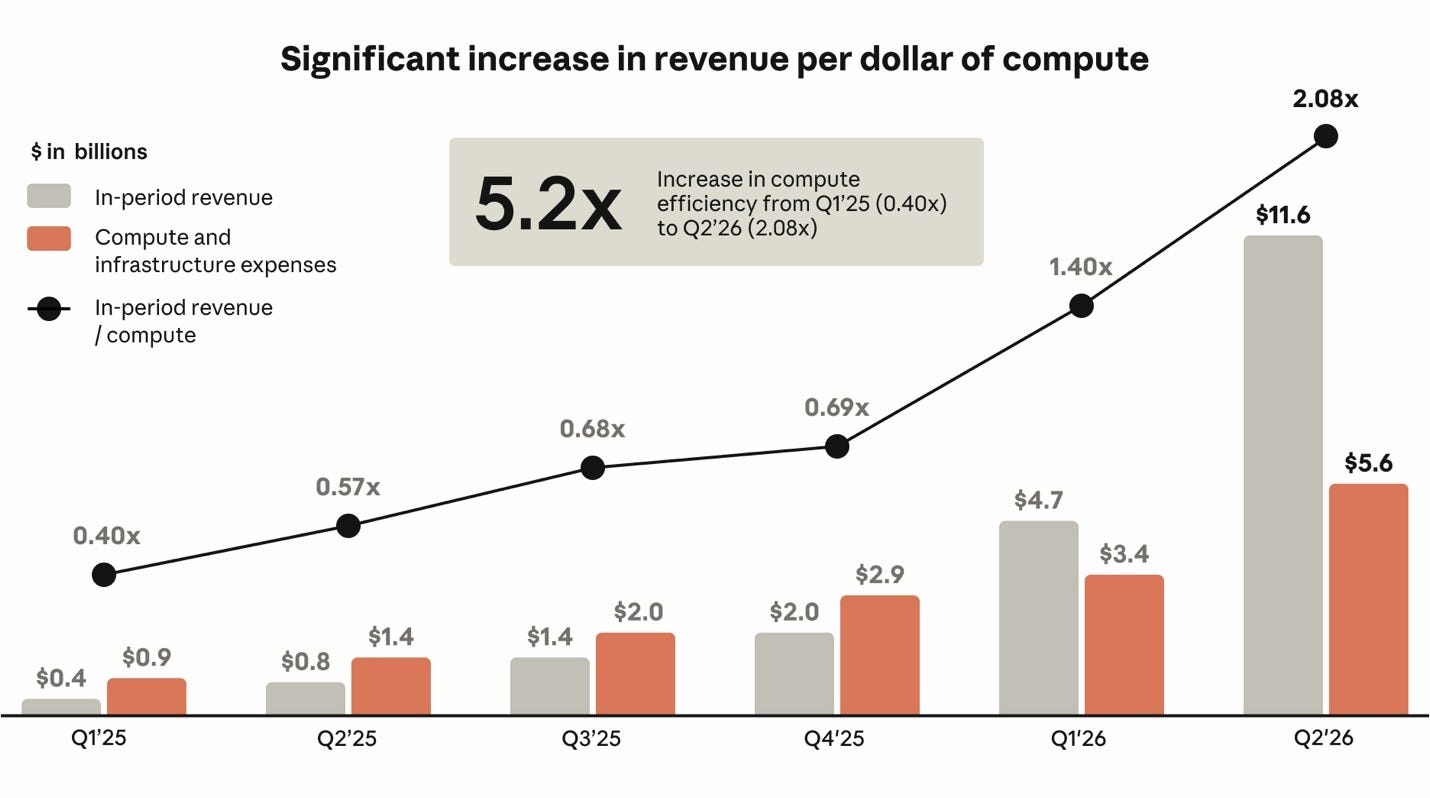
The highlight of the S-1 that has the AI community buzzing is the “Significant increase in revenue per dollar of compute” chart on page 136, showing a 5.2x increase in compute efficiency (revenue / compute and infrastructure expenses) from Q1 ’25 (0.40x) to Q2 ’26 (2.08x). But there’s one other thing I don’t see people talking about nearly as much: the extraordinary 26.4x increase (!) in commercial spending between H1 2025 and H1 2026.
This matters because technical efficiency improvements lower the underlying cost of intelligence and create room to pass those benefits on to customers, while revenue growth driven by commercial expansion doesn’t necessarily deliver the same benefit.
In other words, can we finally Opus-everything, and will token-maxing be a thing of the past? Could pricing finally move to business outputs, abstracting tokens from customers altogether and unlocking AI economics at scale? Or is Anthropic just getting better at selling very expensive tokens?
To answer this, we need to take a closer look at how much of that 5.2x improvement comes from genuine reductions in the compute required to deliver equivalent intelligence, versus improved monetization, distribution, and utilization of existing compute capacity.
Let’s start by taking a look at that at the comparable first-half periods.
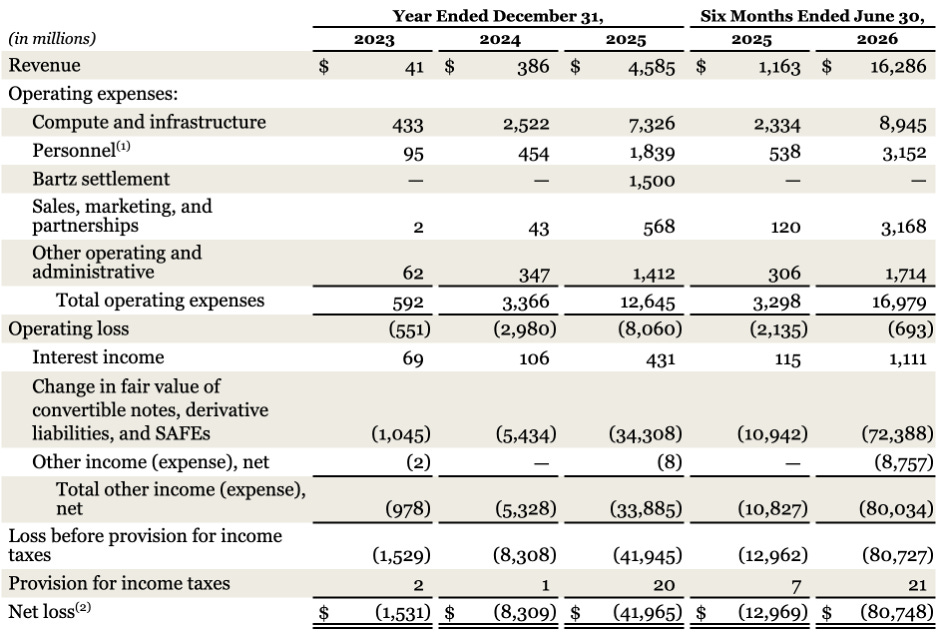
The increase in revenue relative to compute is undeniable, but so is the extraordinary increase in commercial spending (26.4x!). And there’s a particularly important detail in the filing: of the $3.05 billion increase in sales, marketing and partnerships, approximately $2.7 billion came from increased channel partner fees, while $273 million came from marketing and advertising.
Now channel partner fees are not necessarily spending to generate new demand (they can be expenses associated with distributing and fulfilling existing demand, which may rise alongside revenue), so the data does not establish that Anthropic simply bought its revenue growth through advertising; however, it does establish that its commercial costs grew substantially faster than revenue, and that the revenue-per-compute metric alone does not capture those costs.
The S-1 contains another important detail: Anthropic recognizes revenue from cloud marketplace distribution on a gross basis, while the associated channel partner fees are recorded separately as expenses. This is a key point for evaluating the efficiency claim.
For example, the $2.7 billion increase in channel fees is equivalent to about 18% of the $15.1 billion year-over-year increase in first-half revenue. Consequently, growth in revenue per dollar of compute could partly reflect improved commercialization and distribution rather than improved compute productivity.
There is also a timing effect. Anthropic says it typically commits compute 12–18 months in advance, with expenses largely fixed in the short term. Revenue can therefore grow much faster than compute expenses as demand catches up with the previously committed cost base.
Ultimately, this would represent a genuine improvement in financial efficiency, but not necessarily a breakthrough in the amount of intelligence produced by a given amount of hardware.
Anthropic can perform more inference, complete more tasks, or deliver more intelligence at a given quality level using the same hardware.
Economic implications: Marginal costs fall, creating room for lower customer prices, greater usage allowances, stronger margins, or some combination. Competitors may eventually force part of these savings into customer pricing.
This expands the amount of AI intelligence the industry can economically deliver.
More customers purchase the service, existing customers consume more, distribution improves, or the company monetizes a greater share of available capacity.
Economic implications: Revenue and operating leverage improve, but the physical cost of producing a given amount of intelligence might be unchanged. Furthermore, channel fees and customer acquisition costs consume part of the additional revenue.
This improves the company’s ability to monetize intelligence, but doesn’t necessarily make intelligence cheaper to produce.
It is worth noting though that technical cost reductions don’t automatically produce lower prices; that depends on competition, demand and pricing strategy. Second, commercial scale can also reduce unit costs through better capacity utilization, although that benefit is often less structural than a breakthrough that reduces the compute needed per task. Nevertheless, technical progress creates a fundamentally stronger basis for passing savings downstream to the end customer.
Looking past the financial data, there is evidence in the S-1 that Anthropic’s efficiency improvements go beyond a successful commercial execution. There’s mention of optimizations in training, inference, hardware utilization and orchestration across multiple chip architectures, and more importantly, Anthropic reports that the September 2026 release of Opus 5.5 reduced customers’ cost per task by approximately 40% compared with Opus 5 (it attributes that reduction to a combination of improved efficiency and lower pricing, without quantifying how much each contributed, so efficiency questions still remain).
I think the 5.2x figure is impressive as a financial metric, but it’s not sufficient evidence of a 5.2x technical efficiency improvement. The filing supports the existence of both technical and commercial improvements, but doesn’t provide enough information to attribute the observed increase between them.
There’s also a broader industry implication: if AI providers are making enormous strides in technical efficiency, we should eventually expect the cost of completing equivalent tasks to decline substantially, even as models become more capable. If, instead, much of the improved revenue-per-compute ratio comes from stronger monetization, distribution, and pricing power, then the economic benefits may accrue disproportionately to model providers and their distribution partners.
Ultimately, revenue per dollar of compute tells us how effectively Anthropic captures value. Cost per equivalent task tells us how efficiently Anthropic creates value. And cost per task to the customer tells us how much of that value is being shared. Those are three very different stories, and I would be hesitant to treat the first as proof of the other two.