Baby Emma’s parents are waiting on hold for customer support for a new experimental diaper. The robo-voice cheerfully announces: "Our call center is rarely busy!" Should Emma’s parents expect a response soon?
Baby Ali’s parents are touring daycares. A daycare’s glossy brochure says the average class size is 8. If Ali attends, should Ali (and his parents) assume that he’d most likely be in a class with about 8 kids?
Baby Maria was born in a hospital. She looks around her room and thinks “wow this hospital sure has many babies!” Should Maria think most hospitals have a lot of babies, her hospital has unusually many babies, or something else?
For every room Baby Jake walks into, there’s a baby in it. Why? Is the universe constrained in such a way that every room must have a baby?
Baby Aisha loves toys. Every time she goes to a toy box, she always finds herself near a toy box with baby-friendly toys she can play with, not chainsaws or difficult textbooks on cosmology or something. Why is the world organized in such a friendly way for Aisha?
Baby Briar’s parents are cognitive scientists who love small experiments. They flipped a coin before naptime. If heads, they wake Briar up once after an hour. If tails, they wake Briar up twice - once after 30 minutes, then again after an hour (and Briar has no memory of the first wake-up because... baby brain). Briar is woken up and wonders to himself “Hey, did my parents get heads or tails?”
Baby Chloe’s “parents” are Kaminoan geneticists. They also flipped a coin. They decided that if the coin flip was heads, they would make one genetically enhanced clone and call her Chloe. If the coin flip was tails, they would make 1000 Chloes. Chloe wakes up and learns this. What probability should she assign to the coin flip being heads?
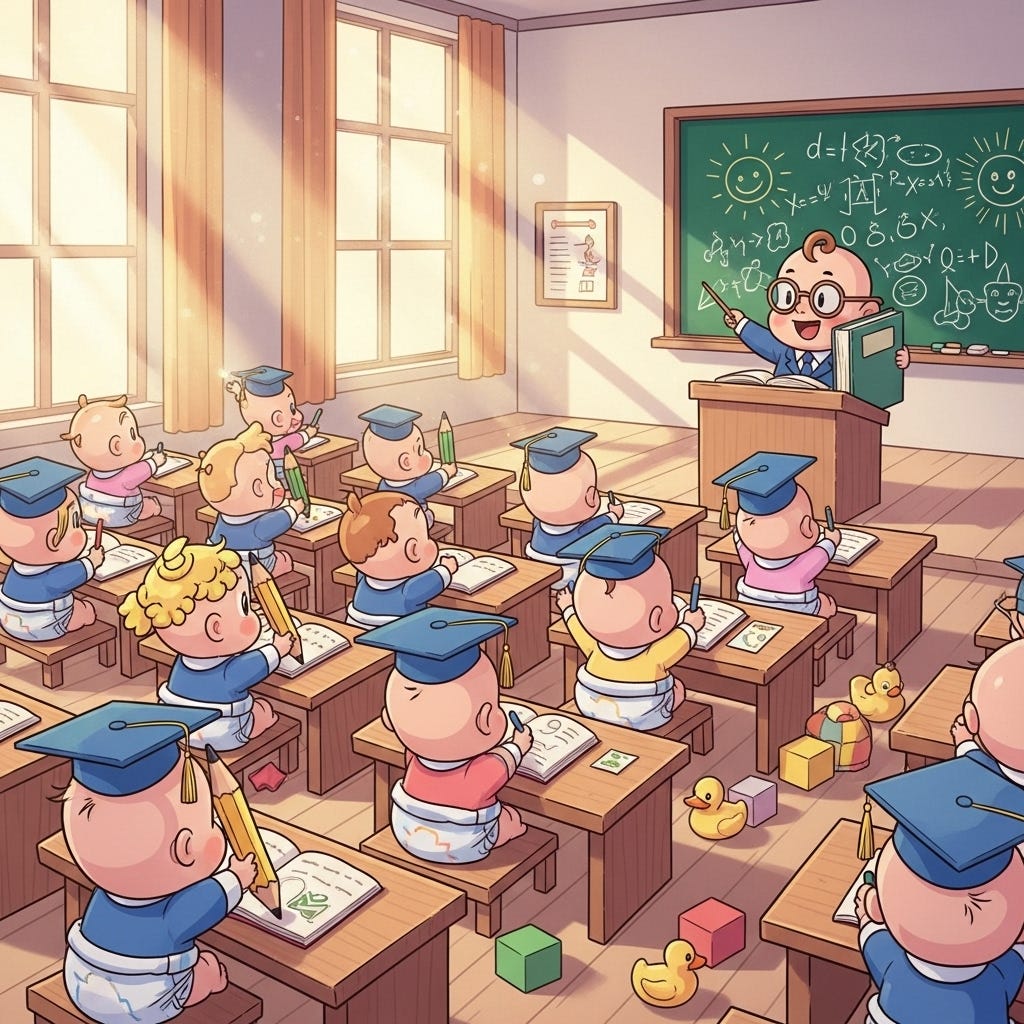
If you or a loved one happen to be a precocious baby1 pondering these difficult questions, boy do I have just the right guide for you!
Let's start with Baby Emma's diaper dilemma. Her parents are on hold, and the robo-voice just chirped: "Our call center is rarely busy!" Should they expect a quick response?
Probably not! Why? Because the fact that they're on hold right now tells us something. When do most people call customer service? During the rush! So Emma's parents, like most callers, probably picked a terrible time. They're not experiencing the "average," normal, time. They're stuck in the above-average mess, along with everyone else.
This is anthropics in a diaper-sized nutshell. Sometimes also called observation-selection effects, it's realizing that where you are affects what you see. Or more precisely: the fact that you exist to observe something gives you more information about what you're observing.
Think about it! This simple idea explains SO MUCH. Why does every room Baby Jake enters have a baby in it? Why does Baby Aisha always find herself near baby-appropriate toys? The universe isn't mysteriously baby-optimized. It's just that Jake brings a baby (himself!) everywhere he goes, and Aisha's parents aren't monsters who leave her next to power tools.
What about Baby Maria in the maternity ward? She observes that her hospital has lots of babies and wonders if it's special. Well, where else would Maria be observing from? Hospitals without maternity wards don't have baby observers! Maria's not in a randomly selected hospital. She's in a hospital that, by definition, has at least one baby (her). Of course it has a maternity ward!
Adults2 use this same thinking for their boring grown-up questions: Does God exist? Are we alone in the universe? Why does math work? Will humanity survive? But forget about them for now. The baby questions are way more fun!
Now let's talk about Baby Ali and the daycare deception.
Adults face the same problem, via colleges. So I'll use a college example because I've never been to daycare3.
Example College brags: "Average class size of 25! Over 95% of classes have fewer than 10 students!" Sounds cozy, right? WRONG! Here's the sneaky part:
Imagine Example College has:
4 massive lecture halls (500 students each)
96 tiny seminars (3-10 students each)
The college isn't lying. 95% of their classes ARE tiny! But do the math: 2,000 students in sweltering lecture halls, only about 500 in those intimate seminars. Most students spend most of their time packed like sardines.
This is the second idea of anthropics: the reference class question. Ali needs to ask: "Am I a random class or a random student experience?" Spoiler: He's a student, not a classroom. He should expect4 the typical student experience (sardine can), not the typical class experience (cozy seminar).
See how asking "typical of what?" changes everything? It's like when babies compare heights - are you tall for a baby, tall for a 1-year-old, or tall for a human thinking about the anthropic principle? The answer depends on who's in your comparison group!
Remember Baby Briar, whose scientist parents kept waking him up? If heads, once. If tails, twice. When Briar wakes, what should he think?
Here's the trick: Imagine running this experiment 100 times. About 50 times you get heads (50 wake-ups total). About 50 times you get tails (100 wake-ups total). So out of 150 total wake-ups, 100 of Briar’s wake-ups come from tails-worlds. From a randomly selected wake-up experience, there's a 2/3 chance it's tails!
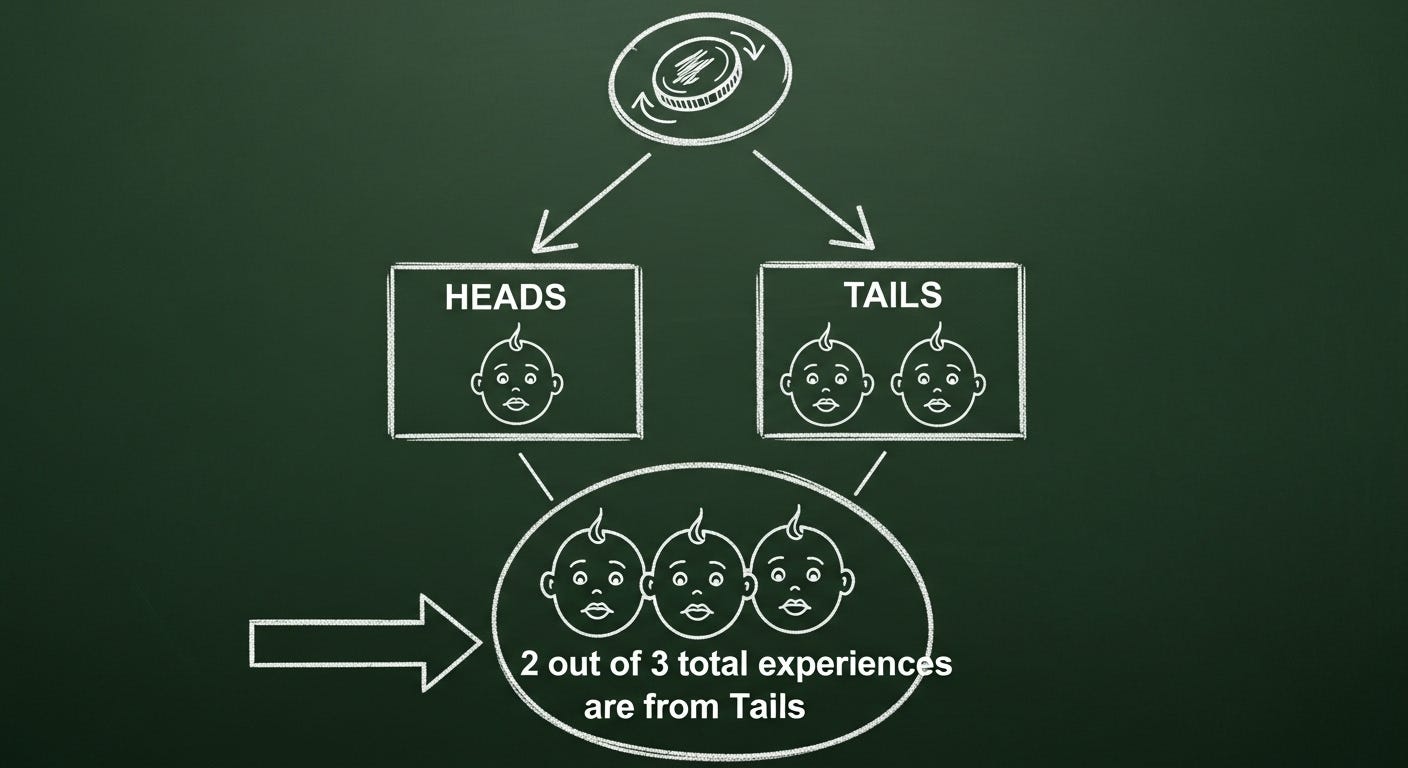
Even though the “objective” probability of the coin flipping heads is ½, Briar can update on waking up to realize that he’s more likely to be in a tails-world!
Baby Chloe's clone situation is even more extreme. If heads: one Chloe exists. If tails: 1000 Chloes exist. When Chloe finds herself existing, she should think: "I'm way more likely to exist in the world with 1000 Chloes than the world with just one." Specifically, about 1000/1001 likely to be in tails-world.
Philosophers call this conceptual trick the “self-indication assumption(SIA)”5 : the fact you exist itself is evidence for worlds with more observers like you. Or more formally, an observer should reason as if they are randomly selected from the set of all possible observers.
I hope the exercises above were fun and enlightening. To get better practice at anthropic reasoning, it helps to familiarize yourself with thinking in anthropic terms, not just reading about them!
So before we dismiss the class, do some of your own thinking! Go through all the examples in the beginning, try to apply anthropic thinking for yourself, and see whether you have a conclusion you are satisfied with.
Discuss with a friend or leave a comment if any of the examples still confuse you!
Let’s do a final review. To recap, the most important ideas are the observation-selection effect and the reference class question.
Observation-Selection Effect (sometimes just called Anthropics, or the Anthropic Principle): The core insight of anthropics: the fact that you exist to observe something gives you more information about what you're observing.
Reference Class Question: A very common question within anthropic thinking: what group of observers we should consider ourselves typical members of? Are we typical among all babies? All conscious beings? All humans? All humans at our technological level? Sometimes this choice can significantly affect anthropics conclusions.
Self-indication assumption: The fact you exist itself is evidence for worlds with more observers like you. This simple statement has radical implications, for everything from cosmology to the existence of aliens.
This concludes the anthropics installment of our Precocious Babies Guide series. Our next lecture will be on object permanence and the philosophy6 of Zhuangzi. Babies, sleep well!

Thanks for reading! This post is public so feel free to share it.
THE FOLLOWING CONTENT IS ONLY APPROVED FOR TODDLERS 4 YEARS AND OLDER. BABIES, PROCEED AHEAD AT YOUR OWN RISK.
“Everybody generalizes from one sample. Or at least, I do” — Scott Alexander
Yes. And not just for philosophy nerds.
I use anthropic thinking regularly in everyday life. When I'm stuck in traffic, I remember: most drivers experience worse-than-average traffic (because that's when the most cars are on the road). When a restaurant seems surprisingly crowded, I realize I'm probably there during peak hours like everyone else. When I see a surprising headline, I consider what selection effects may have resulted in that headline coming to my attention.
I also regularly check whether I'm assuming I'm special when I'm probably typical (and less frequently, vice versa). Are the people I argue with on the internet uniquely stupid, or do most people feel this way? Is my experience representative, or am I generalizing from an unusual sample? Simple anthropic math can help calibrate expectations.
Anthropics isn't some esoteric philosophy toy. It's a practical thinking tool that, combined with other mental models, helps you understand the world and your place in it.
Yeah, that's the problem. Other guides introduce anthropics through cosmic questions: Does God exist? Where are the aliens? When will humanity end? Why does the universe support life?
This is like teaching how to count via the ethics of saving 10^100 shrimp. When you introduce a thinking tool only through mind-bending philosophical puzzles, students either bounce off entirely or treat it as abstract, mystical, puzzle, rather than practical reasoning.
That's why this guide starts with babies and daycares. Test out anthropic thinking on everyday problems first. Build intuition with traffic jams and customer service calls. Then, and only then, tackle the fate of the universe. You'll be a lot less confused with these big-picture questions once you have a solid basis in everyday anthropics thinking.
So, we've learned that where we are influences what we see. This pairs perfectly with another powerful mental tool that's often overlooked: asking “how many of us are there?”
This is the core of population-weighted reasoning7. While not strictly anthropic reasoning, thinking about social science questions from a population-first perspective will improve your ability to think well on anthropics, and vice versa.
In the social sciences, we love our categories: nations, regions, classes, ethnic groups, time periods. But for many questions, the most natural unit is simply people, and the most natural grouping is simply counting them. The population-weighted lens is criminally underused but incredibly powerful.
Here’s a question that often trip people up:
Anatomically modern humans have existed for 300,000 years. Why did nearly all major innovations happen in the last 500?
If you think chronologically, this seems very unlikely! But population-weight your thinking and the mystery largely dissolves. About 7% of all humans who ever lived are alive right now. Half of all anatomically modern humans were born in the last 1,000 years.
Now this doesn’t mean there are no questions left about the origin of the industrial revolution. In particular, why did the industrial revolution start in Europe (~70 million, or 15% of world population)? Even more specifically, why didn’t it happen in China, with a higher population (24%) and higher starting wealth and technological level?
But a population-weighted accounting reduces the mystery greatly. Now we’re no longer confused about 1500 Europe vs 150000 BC Australia, but only about 1500-1800 AD Europe vs 1300-1800 AD China (and similar). Progress!
Similarly, when studying history in general, it’s helpful to keep past relative populations in mind. Europe used to be much bigger, and Africa smaller, relative to the world population.
When designing cities, planners obsess over population density to avoid overcrowding. The standard metric? "People per square mile"8. But this has a major flaw: if most residents cluster in a narrow strip while the rest of the area sits empty, the average density looks reasonable while the lived experience is sardine-can crowding.
Population-weighted density fixes this by asking the right question: "For the typical resident, how many neighbors live within walking distance?" This captures what people actually experience rather than what shows up on planning maps.
Consider two neighborhoods with identical "25,000 people per square mile":
Neighborhood A (“Pleasantville”): Mixed development with 4-10 story buildings throughout
Neighborhood B (“Tower Town”): 15 40-story towers in a row, surrounded by parking lots and a golf course
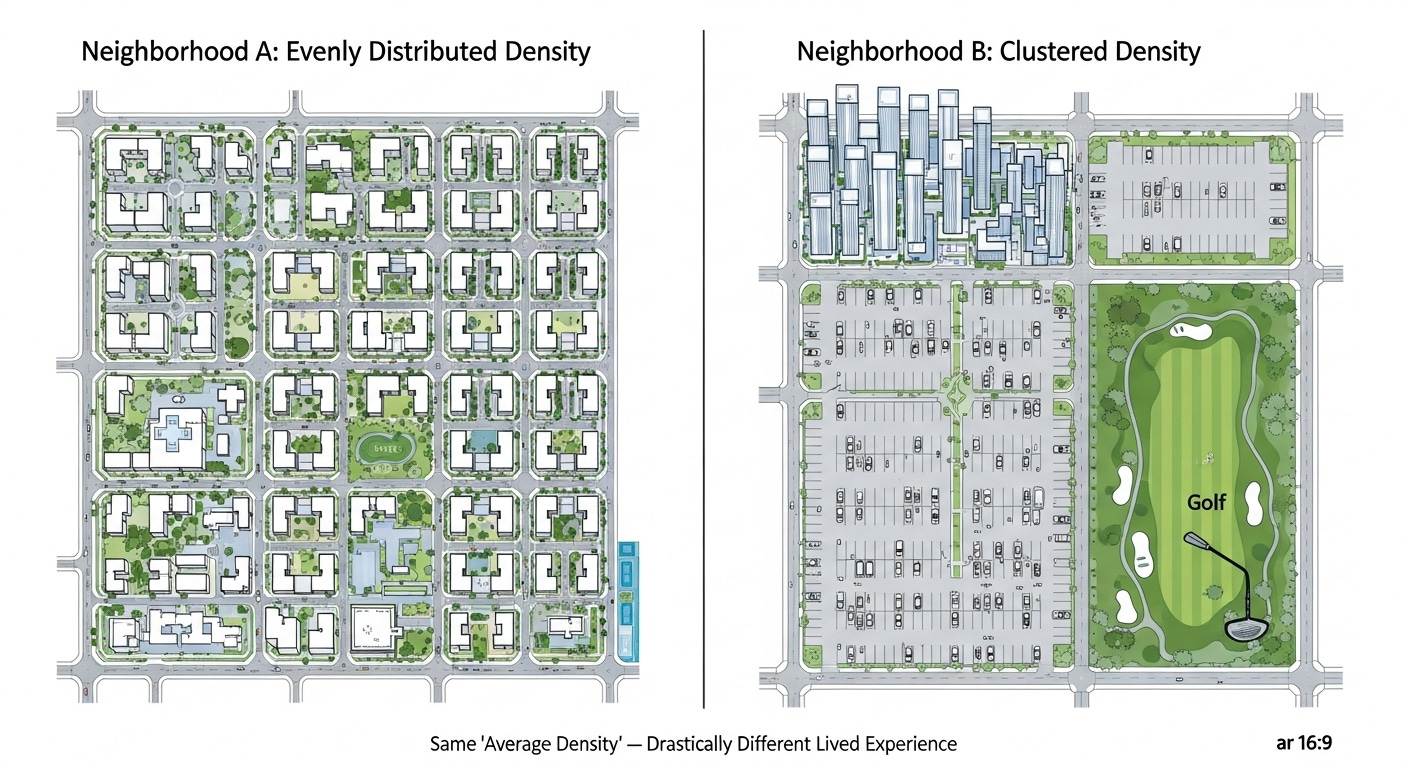
Same official density, completely different lived experience. In Pleasantville, everyone enjoys moderate density with shops and cafes nearby. In Tower Town, tower residents face extreme density while the "average" is diluted by empty land. A good urban planner tries to design to where people actually are, not where land happens to be.
Jeff Kaufman has more examples and calculations on his blog.
Suppose you’re a large, impartial grantmaker funding research in global health. Should you give your money to AIDS research? Heart disease? Antimalarial vaccines? ALS? Air pollution? The 247 types of rare pediatric cancers with heartwrenching sob stories?
A naive grantmaker first thinking about “impartiality” might want to spread their money equally among all causes.
But causes don’t deserve equality, people do. In a world of limited resources and almost unlimited needs, you have to prioritize. And it’s much better to prioritize research and interventions that can cost-effectively save many lives than the ones that can only save a few.
For people who like thinking about physics, cosmology and philosophy of physics:
The Trouble with “Puddle Thinking”: A User’s Guide to the Anthropic Principle by Geraint F. Lewis and Luke A. Barnes is my favorite intro to anthropics questions in cosmology
For more readings, the paper’s index also lists some other sources on the intersection of anthropics and cosmology.
For the philosophically inclined:
The biggest methodological dispute is between proponents of Self-Indication Assumption (SIA) and Self-Sampling Assumption (SSA). In short, SIA says “count all possible observers first.” SSA says “figure out which world you're in first, then count.”
Remember Baby Briar and Baby Chloe from earlier? SIA proponents say Baby Briar should answer ⅔ for tails, and Baby Chloe should answer 1000/1001.
SSA proponents instead say: "Hold up! You can't just count observers like that. First figure out which world you're in, THEN figure out which observer you are in that world."
For Baby Briar, these philosophers say: The coin was fair, so there's still a 50% chance of heads. Yes, you're more likely to have a wake-up experience in a tails-world, but that doesn't change the original coin flip probabilities! Briar should stick with 50% for heads.
For Baby Chloe, it's even more stark: The coin flip had 50-50 odds. The fact that you exist doesn't change what happened with the coin: it just means you're the lucky Chloe who gets to exist. Still 50% chance of heads, whether there's one of you or a thousand.
So which baby philosophers are right? After decades of sandbox arguments, pacifier-throwing, and timeout-inducing tantrums... it’s still debated!
For an impassioned defense of the Self-Sampling Assumption, read:
Anthropic Bias by Nick Bostrom (warning: dense)
For an impassioned defense of the Self-Indication Assumption9, read:
Learning from the Fact You Exist by Joe Carlsmith
For a secret third thing, read:
Anthropic Decision Theory by Stuart Armstrong
For more overall discussion, check out this video by Veritaseum.
If you’re interested in the existence of God, friend of the blog Bentham’s Bulldog wrote up the anthropic defense of God’s existence (I personally think it’s wrong; not sure why but partially because it invokes infinity and nothing plays well with infinity, including anthropics).
If you’re interested in the Fermi paradox (why don’t we see aliens?), I think this post by Tristan Cook is the most comprehensive treatment I’m aware of (warning, long and technical!)
If you want bite-sized philosophy in blog posts, check out the Anthropics tag on LessWrong (Warning: rabbit holes!).
For practical applications:
Jeff Kaufman has some writings on population weighted thinking
“Population-weighted density” as a metric shows up from time to time on various different urban geography/urban planning sources
GiveWell has some writings on cause prioritization in global health
For people who like my writing:
Why Reality has a Well-Known Math Bias is a previous essay by me reconciling anthropics, evolution and an old puzzle in the philosophy of science about the mathematical tractability of the natural sciences
For fun:
"Transdimensional Brain Chip" : A short graphic novel where your decisions about copying yourself determine which experiences you're likely to have. Like Baby Chloe's dilemma, but with universe-hopping consequences.
Answer to Job by Scott Alexander : What if theodicy (why does evil exist?) has an anthropic answer?
Congratulations! You've completed your first Precocious Baby Lecture: Anthropics! You can now think about observation selection effects, reference classes, and population weighting. You question whether you're typical or special. You can recognize when existence itself provides information.
Most importantly, you've learned to ask the key question: "What am I seeing and not seeing because of who I am?"
The universe isn't designed for you. You're not the center of anything. But precisely because you exist, you can only observe universe-configurations that allow observers. That's either deeply profound or totally obvious: which one might depend on your reference class.
Now go forth and anthropically reason responsibly. And remember: From now on, every room you enter will contain at least one person who knows about anthropics.