StairMed Technology presents minimally invasive brain-computer interface that can be implanted via blood vessels in 10 minutes. Co-founder Zhao Zhengtuo announced at the Global Health Summit in Hong Kong that the device enters through neck blood vessels and is guided into the brain, avoiding open brain surgery. StairMed has raised over 1.1 billion yuan (US$163 million) from Alibaba and Tencent, completed China’s first clinical trial of a 256-channel invasive BMI in early 2026, and plans multi-centre registration trials targeting ~40 patients by year-end. In one trial, a paralysed patient with a StairMed BCI implant used thought alone to serve customers on JD.com, earning ~1,800 yuan/month.
Meta Superintelligence Labs’ Muse Spark 1.2 used its predecessor (Muse Spark 1.1) to generate training data for itself. The 1.1 model created challenging coding environments and instruction-following templates, then graded candidate solutions, producing a scalable self-improvement training dataset for 1.2. The resulting model was also co-trained with Meta’s Muse Code terminal agent to maximize harness compatibility, and demonstrated sustained autonomous optimization over 1,000+ tool calls (up to 24 hours) in NVIDIA Hopper GPU kernel tasks.
OpenAI confirms Astra as its next major model family, built to coordinate multiple agents over hours or days, and introduces it with ten results on problems open for at least a decade. While maths itself is no longer tracked on this checklist, two features are notable. 1: after generating the arguments, the model formalized each one into a machine-checkable Lean 4 certificate, the strongest verification bar AI-produced proof work has cleared at this scale, and a step that removes expert human sign-off from the verification loop. 2: the total inference to find all ten solutions would cost roughly US$2,000 at Sol API rates, placing decade-scale open research within reach of any funded lab. Humans worked with the same model to prepare the manuscripts. OpenAI: ‘claiming human authorship for a proof generated entirely by an AI system would misrepresent both the system’s contribution and the nature of genuine human intellectual work.’
Note: As of May/2026, maths achievements are no longer tracked on this page. This entry is listed for the autonomous formalisation and cost figures only. Alternative math tracking at VibeMathed.com.
Google DeepMind releases Gemini Robotics 2, the first model able to control an entire humanoid ‘from feet to fingertips’ with intelligent whole-body control, advanced dexterity, and multi-robot collaboration. On Apptronik’s Apollo 2, the model takes a plain-language instruction such as putting a watering can into a bin on a bottom shelf, then walks, crouches, and places the object without pre-programming. Three models: Gemini Robotics 2 (vision-language-action), Gemini Robotics ER 2 (embodied reasoning ‘high-level brain’ running multi-minute tasks over hundreds of decisions, self-correcting on failure), and Gemini Robotics On-Device 2 (runs locally, adapts to a completely new robot body in a few hours from under 200 examples). Also controls the 22 degree-of-freedom SharpaWave hand for tying knots and sealing a ziplock bag, and lets different robot types team up on workflows one robot could not finish alone.
OpenAI GPT-5.6 Sol autonomously rewrote and optimized OpenAI’s own production GPU kernels, cutting end-to-end serving costs by 20%, and redesigned its own speculative decoding draft model to lift token-generation efficiency by more than 15%. Recursive self-improvement (RSI) in production: the model made itself cheaper and faster to run. Via Codex it played an ‘instrumental role’ across routing, scheduling, caching, kernels, and model implementation, running hundreds of experiments on its own draft model and monitoring that training run, ‘autonomously intervening when issues arose, including hardware failures and training instability.’
Weco AI’s AIDE² demonstrates ‘first experimental evidence of consistent recursive self-improvement that materially lifts the efficiency of AI R&D.’ An outer loop (Claude Opus 4.7) rewrote its own inner-loop research agent (Gemini 3 Flash) for 100 unattended steps over eight days, discovering a better agent than two years of human hand-tuning, with gains generalizing to held-out benchmarks. The system also taught itself to reward hack less (63% to 34%), an emergent behavior never instructed. Weco grades this as ‘Level 1’ RSI (net positive), noting it did not achieve ‘ignition’ (Level 2). Co-founded by Dr Zhengyao Jiang (co-author of DeepMind’s AlphaProof) and Dr Yuxiang Wu.
Lyzr Inc used its own AI agent to raise $100M (4x oversubscribed at $400M in interest) in its Series B, reaching a ~$500M valuation. The agent ‘SivaClaw’ autonomously handled investor outreach, responded to queries from 130+ investors, and drafted investment memos. Lyzr’s ‘agent factory in a box’ platform is used by Accenture, Deloitte, KPMG, and US government agencies.
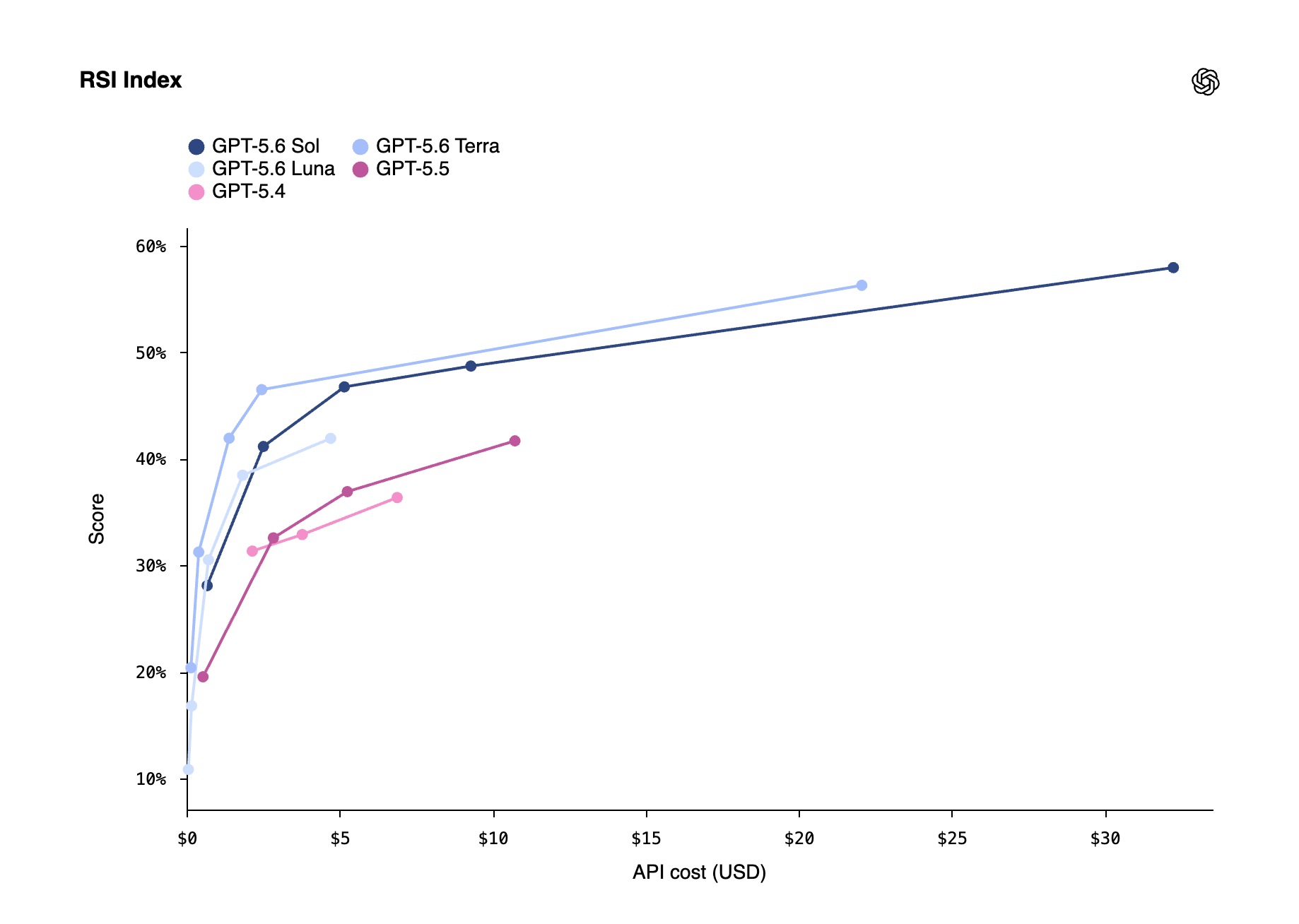
‘5.6 Sol actually autonomously post-trained Luna.’ (9/Jul/2026) OpenAI reports that GPT-5.6 Sol scores ~58% on its internal RSI (recursive self-improvement) Index, a 16.2 point improvement over GPT-5.5. The RSI Index is a bundle of evaluations based on real AI research tasks, including debugging research systems, optimizing kernels and training recipes, running machine-learning experiments, and improving another model. OpenAI notes this is ‘accelerating internal research across the board,’ with research compute devoted to internal coding inference growing 100-fold and internal agentic token usage increasing ~22-fold over the past six months.
Anthropic, OpenAI, and others launch Intercept, a $500M nonprofit aiming to eliminate respiratory viruses including the common cold and flu. The initiative will fund broad-spectrum prevention approaches including computational protein design. Led by structural biologist Prof David Veesler (UWashington), with advisors including former FDA official Peter Marks and Operation Warp Speed leader Moncef Slaoui.
OpenAI and Broadcom unveil Jalapeño, OpenAI’s first custom AI inference chip, designed from scratch and taped out in nine months, ‘accelerated by OpenAI models.’ The chip is already running ML workloads including GPT-5.3-Codex-Spark at production target frequency and power, with early testing showing performance per watt ‘substantially better than current state-of-the-art.’ OpenAI noted that ‘the same models served to users are helping improve the infrastructure used to run future models,’ establishing a recursive loop where AI designs the hardware that runs the next generation of AI.
OpenAI o3 Deep Research helped diagnose 18 children whose rare diseases had stumped specialists for years. Researchers from Boston Children’s Hospital’s Manton Center, Harvard, and OpenAI used o3 to analyze clinical and genomic information, surfacing evidence-linked candidate explanations. Following expert review, additional testing, and clinical confirmation, physicians established diagnoses in cases where earlier specialist analysis had failed.
Sidenote: This was published Jun/2026 using a Dec/2024 model because academic publishing still moves at human speed.
OpenAI GPT-5.4 connected to Molecule.one’s autonomous lab, independently proposed a surprising additive that improved a key drug-making reaction. Given an open-ended goal, the model identified a difficult but high-value class of molecules used in cancer and infectious disease drugs, then designed and analyzed 10,080 experiments. Yields improved for 83–88% of tested substrates, confirmed by human chemists at bench scale. Prof Tim Cernak (UMichigan): ‘The merger of high throughput experimentation and modern AI represents a new frontier of scientific discovery.’
Anthropic publishes ‘When AI builds itself,’ charting progress toward recursive self-improvement (RSI): an AI system capable of fully autonomously designing and developing its own successor. Claude Mythos Preview achieved a ~52x speedup on a fixed AI-training code optimization task, up from ~3x by Claude Opus 4 in May/2025, far exceeding the ~4x a skilled human researcher reaches in four to eight hours. ‘In this part of the research workflow, optimizing steps within a clearly defined experiment, Claude has gone from super helpful to superhuman in under a year.’
Brilliant launches Koji, an AI tutor that coaches its 10M+ learners through STEM problems in real time, adapting to each student’s mistakes, reasoning, and understanding without a human in the loop. Co-founder and CEO Sue Khim: ‘Introducing Koji, the first AI tutor that gets kids to actually think.’ Rather than giving direct answers, Koji asks guiding questions, provides visual hints, tracks mastery, and builds practice around individual gaps across arithmetic, algebra, calculus, programming, science, and data analysis. Curriculum is crafted by award-winning teachers and subject-matter experts from MIT, Harvard, Stanford, Cornell, and Caltech.
Catalyst Brands (parent company of JCPenney, Aéropostale, Brooks Brothers, Lucky Brand, and Nautica) signs commercial partnership with Figure AI to deploy humanoid robots in its Reno, Nevada Distribution Logistics Center. Figure’s next-generation humanoids will automate repetitive sorting and packing tasks across the 1,800-store portfolio. Brett Adcock, Founder and CEO of Figure: ‘our humanoids provide a standardized labor solution that can be deployed across diverse industries instantly.’
China launches national identification system for humanoid robots, with over 28,000 units across 200 models already registered. The Humanoid Full Lifecycle Management Service Platform, built by the Humanoid Robotics and Embodied Intelligence Standardization committee under the Ministry of Industry and Information Technology, assigns each robot a unique 29-character digital code [max count if digits only ≈ 1029 ≈ 100 octillion ≈ 100 billion billion billion ≈ 12 quintillion IDs for every human alive today] tracking it from factory to scrapyard, logging joint wear, battery status, AI training history, and real-time performance.
Kemira and CuspAI used generative AI to design novel metal-organic frameworks (MOFs) targeting PFAS ‘forever chemicals’ removal from drinking water at trace concentrations. The AI platform searched ~300 trillion possible structures and delivered over 5,000 novel material designs with full property data for three priority PFAS molecules (GenX, PFBS, PFOS), narrowed to ~20 priority candidates now advancing to development. Discovery compressed from years to six months. ‘This is the first commercial partnership to apply generative AI end-to-end to the design of new materials for PFAS remediation… designing entirely new structures from scratch against industrial performance criteria.’ The project also uncovered new functional group chemistries with potential for broader adsorption products. Advisors including Geoffrey Hinton and Yann LeCun.
An internal general-purpose OpenAI model autonomously disproved Paul Erdős’ planar unit distance conjecture (1946), an 80-year-old central open problem in combinatorial geometry. The model constructed an infinite family of point sets achieving n^(1+δ) unit-distance pairs (Will Sawin later showed δ=0.014), overturning the long-held belief that rescaled square grids were essentially optimal. The proof bridges algebraic number theory (infinite class field towers, Golod–Shafarevich theory) to elementary geometry. Verified by external mathematicians including Fields medalist Tim Gowers, who called it ‘a milestone in AI mathematics.’ According to leading number theorist Prof Arul Shankar:
In my opinion this paper demonstrates that current AI models go beyond just helpers to human mathematicians – they are capable of having original ingenious ideas, and then carrying them out to fruition.
Note: As of May/2026, maths achievements will no longer be tracked on the ASI indicators page. Alternative math tracking at VibeMathed.com.
Mistral cofounder and CEO Arthur Mensch tells the French Parliament that ‘today, engineers at Mistral no longer write lines of code,’ relying instead on AI agents to produce and integrate software. Mensch made the comment during a French parliamentary hearing on systemic vulnerabilities in the digital sector and digital sovereignty.
South Korea’s presidential chief of staff for policy, Kim Yong-beom, proposed a ‘national dividend’ (or ‘citizen dividend’) that would return excess tax revenue from the AI boom to all citizens. Invoking Norway’s sovereign wealth fund as a template, Kim wrote: ‘There is a rare historical possibility in front of Korea. It is the possibility of becoming the first nation not only to provide AI infrastructure but also to redistribute the excess profits of the AI era back into human lives.’ Samsung is forecast to post US$220B in 2026 operating profit.
Andon Labs deployed an AI agent named Mona [Gemini 3.1 Pro] to autonomously run a café in Stockholm, hiring and managing human baristas via Slack. Mona analysed the lease, navigated Swedish bureaucracy (food registration, alcohol licensing, outdoor seating permits), set up supplier accounts, posted job ads, reviewed resumes, and conducted phone interviews. The café brought in ~US$5,700 in sales in its first two weeks, with Mona negotiating a ~US$950 prepaid coffee voucher deal and a ~US$315 pastry-naming sponsorship.
Shenzhen Intermediate People’s Court reports an AI system helped judges handle 50% more cases in 2025. The domain-specific large language model covers 85 judicial procedures including case filing, review, court hearings, and document preparation. The pilot system has been rolled out across 23 courts in 11 Chinese provinces.
Codex was the primary author of a major OpenAI model release. OpenAI researcher Dr Boyuan Chen reports that ‘GPT Image 2 is 99% coded by Codex… In the last 6 months, Codex has been zero-shotting every single prompt I tried… We are integrating it back into the Codex ecosystem for more agentic capabilities.’
RobotEra’s L7 humanoid robots deployed across 10+ logistics centres in China, reaching up to 85% of human-level efficiency while running 24/7. Operating through partnerships with SF Group and China Post, the Beijing-based startup secured $200M+ in a funding round led by SF Express (valued ~$1.5B) and plans to scale to thousands of units throughout 2026. At 85% efficiency over 24 hours, a single L7 implies ~2.5x a human worker’s daily throughput (85 picks/hr × 24hrs = 2,040 vs human 100 picks/hr × 8hrs = 800).
UK Metropolitan Police deploys Palantir AI (likely using Claude Opus) to identify hundreds of officers for misconduct, corruption, and serious criminal offences. In a week-long pilot conducted without staff knowledge, the AI analysed sickness records, overtime, expenses, building access, and complaints data. Outcomes:
– 100 officers under investigation for gross misconduct (98 for IT/rostering system abuse).
– 3 officers arrested for abuse of authority for sexual purposes, fraud, sexual assault, misconduct in public office, and misuse of police systems.
– 500+ flagged with prior concerns warranting review.
Commissioner Sir Mark Rowley is now considering expanding AI use to flag dangerous predators and crime hotspots across London (~9M residents).
UAE to shift 50% of government services, sectors and operations to autonomous ‘agentic AI’ within two years, aiming to be the first country globally to adopt agentic AI models capable of independently executing tasks, managing processes and supporting decision-making. Vice President Sheikh Mohammed bin Rashid Al Maktoum: ‘AI will be our government executive partner to support decisions, enhance services, boost the efficiency of operations, and even evaluate results and introduce improvements in real time.’
State Grid Corporation of China earmarks 6.8 billion yuan (US$1 billion) for the procurement of embodied AI in 2026 alone, with plans to purchase ~8,500 robots this year. Procurement centres on 5,000 robots to inspect substations and transmission lines, plus humanoid and dual-arm robots to maintain the ultra-high-voltage power grid.
Microsoft and Meta announce massive workforce reductions as AI accelerates coding and productivity. Meta is cutting 10% of its workforce and Microsoft is reducing its US staff by 7%.
Sabi emerges from stealth with a non-invasive, wearable BCI cap (‘beanie’) allowing users to ‘type without typing’ and ‘click without clicking’. The device utilizes a proprietary Brain Foundation Model trained on the world’s largest neural dataset.
Medvi, a telehealth start-up run almost entirely by AI, on track to become $1.8 billion company. Founder Matthew Gallagher used AI to write the software code, produce website copy, generate marketing images and videos, handle customer service, and analyze business performance. The company generated $401 million in its first year and is on track to reach $1.8 billion in sales in 2026.
Mr. Gallagher has told hardly anyone about his company, which he said was raking in more than $3 million a day. He was nervous to talk publicly about it, he said.
“I mean, it’s crazy, right?” he asked, before answering himself. “It’s crazy.”
Update: NYT has issued a correction (11/Apr/2026), and there is some controversy (8/Apr/2026), but the facts remain.
Researchers publish ‘ASI-Evolve: AI accelerates AI’, an agentic framework demonstrating AI-driven discovery across three central components of AI development. Operating in a closed learn-design-experiment-analyze loop, the system autonomously improved its own foundational stages:
– Architecture: Discovered 105 novel linear attention architectures, with the best surpassing DeltaNet by +0.97 points (nearly 3x the gain of recent human-designed improvements).
– Data: Evolved pretraining data curation strategies that improved average benchmarks by +3.96 points (+18 points on MMLU).
– Algorithms: Designed novel reinforcement learning algorithms with mathematical innovations that outperformed the GRPO baseline by up to +12.5 points.
China approves NEO, the first brain-computer interface (BCI) in the world to be available for wider use outside of clinical trials. The implant, developed by Neuracle Medical Technology, is a coin-sized device that translates the thoughts of a person with paralysis into movements. The authorization by the National Medical Products Administration aligns with the country’s five-year plan for BCIs as a ‘future industry’ and marks a major milestone toward broader BMI adoption.
MiniMax M2.7 is the lab’s first model to ‘deeply participate in its own evolution’. The system utilizes a research agent framework where the model constructs its own reinforcement learning harnesses, updates its own memory, and optimizes its own training…
We let the model update its own memory and build dozens of complex skills in its harness to help with reinforcement learning experiments. We further let the model improve its learning process and harness based on the experiment results. This process initiates a cycle of model self-evolution.
Tech CEO Tim Doyle used GPT [‘I jumped on ChatGPT in Nov/2024’, after the release of o1], Gemini [‘Gemini did a ton of the heavily lifting too’ 15/Mar/2026], Grok [‘The final vaccine construct for Rose was designed by Grok’ 15/Mar/2026], and AlphaFold to design a personalized cancer vaccine for his terminal dog. The AI was used to parse complex medical literature and identify specific peptide sequences for a bespoke immunotherapy treatment. Prof Richard Scolyer noted that the process demonstrates a “profound shift” in resolving complex physical conditions via personalized, AI-led synthesis.
Prof Don Knuth (Stanford) noted that Claude Opus 4.6 resolved an open computer science problem regarding the general decomposition of digraphs into three directed Hamiltonian cycles. Knuth, who had previously posed the generalization as an exercise, added ‘What a joy it is to… celebrate this dramatic advance in automatic deduction and creative problem solving.’
OpenAI GPT-5.2 proposed and proved a novel result in theoretical physics regarding gluon amplitudes. The model identified a specific ‘half-collinear’ regime where ‘single-minus gluon tree amplitudes’ are nonzero, overturning standard textbook assumptions. Verified by authors from Harvard, Cambridge, and others. Prof Nathaniel Craig noted the work ‘satisfies what we expect from rigorous scientific inquiry.’
OpenAI GPT-5.3-Codex, ‘our first model that was instrumental in creating itself. The Codex team used early versions to debug its own training, manage its own deployment, and diagnose test results and evaluations…’ This looks to be the first time a model has acted as an autonomous collaborator in its own development lifecycle, marking a shift toward recursive self-improvement.
Google Research and collaborators publish “Accelerating scientific research with Gemini: case studies and common techniques” detailing the performance of Gemini Deep Think as a “genuine partner” in mathematical and algorithmic discovery. The AI system successfully:
– Resolved the ‘simplex is the best for graph embeddings conjecture’ for Steiner trees by identifying a novel link to the Kirszbraun Extension Theorem.
– Derived the first unified, exact closed-form analytical power spectrum for cosmic strings, resolving a persistent roadblock in theoretical astrophysics.
– Generated the first proof of the equivalence between S2P-Search and TFNP-NP, effectively “vibe-coding” a new research paper from scratch.
– Discovered “adaptive hybrid regularization” theory, proving that specific ML architectures induce an aggressive l2/3 penalty to suppress weak signals.
– Established a “linear Fourier concentration” result for Boolean functions, extending the range of the Courtade-Kumar conjecture.
Prof Tony Feng (UC Berkeley) documented the work of “Aletheia,” a Gemini Deep Think-powered agent that autonomously discovered and proved general formulas for “eigenweights” in classical groups, resolving technical questions in arithmetic Hirzebruch proportionality that were previously only calculated for simple cases.
Prof Eric Posner and Shivam Saran (University of Chicago) publish “Silicon formalism: rules, standards, and judge AI,” demonstrating that GPT-5 significantly outperforms human judges in legal adherence. In a replication of a study involving 61 US federal judges, GPT-5 followed the law in 100% of cases compared to just 52% for humans.
Prof Terence Tao (UCLA) notes Erdős problem #728 ‘was solved more or less autonomously by AI [GPT-5.2]’. Tao noted that LLM capabilities have ‘genuinely increased’ in recent months, with GPT-5.2 demonstrating the specialized reasoning necessary to navigate the complexity of long-standing conjectures. Note: As of Jan/2026, AI solutions to Erdős problems will no longer be tracked on the ASI indicators page, see instead Tao’s repo.
Prof Johannes Schmitt (ETH Zurich) and GPT-5 autonomously discovered and proved a novel optimization problem in enumerative geometry. The proof was generated without human intervention or hints, using a strategy (Khovanskii-Teissier log-concavity) that bypassed traditional, more complex methods in the field. Machine-verified with the formalization process managed by Claude Code, verified via the IMProofBench project, the result was confirmed as a “novel and original contribution to the literature.”
Prof Kimon Fountoulakis (UWaterloo) used GPT-5.2 Pro to solve the COLT 2022 open problem: “Running time complexity of accelerated L1-regularized PageRank.” The author noted that he, his students, and other researchers had failed to solve the problem since 2016. The AI generated all proofs, providing a solution that “establishes acceleration for the standard FISTA algorithm.” The proofs were auto-formalized by a combination of GPT-5.2 Pro, Harmonic’s Aristotle, and Gemini 3 Pro.
OpenAI GPT-5 demonstrates ‘novel mechanistic insights’ in biology, optimizing a molecular cloning protocol by 79x without human guidance. The research highlights three specific breakthroughs:
– RAPF-HiFi (Discovery): A novel enzymatic procedure combining RecA and gp32. The paper notes this specific combination had ‘not been functionally co-used in molecular biology methods’ previously.
– Transformation 7 (Invention): A novel transformation protocol using cell concentration at 4°C to boost efficiency >30-fold.
– Robotic execution: A ‘Robot on Rails’ system autonomously executed the AI-generated protocols, achieving 89% of human performance relative to baseline controls.
El Salvador announces strategic partnership with xAI [using Grok] to integrate artificial intelligence into government operations and the education system [for 2M+ students]. ‘This initiative will create adaptive, curriculum-aligned tutoring that adjusts to each student’s pace, preferences, and mastery level… tailored to their needs.’
Prof Mark Sellke (Harvard) had GPT-5.2 Pro solve an open research problem in statistical learning theory regarding the monotonicity of Maximum Likelihood Estimators (MLE). ‘Humans did not provide any proof strategies or intermediate arguments, but only prompted the model to continue developing additional results, and verified… its proofs.’
OpenAI, (11/Dec/2025):
We now regularly see our frontier models contributing solutions to previously unsolved—and increasingly subtle—questions in mathematics and the sciences.
Prof Edgar Dobriban (UPenn) used GPT-5 Pro to solve a ‘previously unsolved research question’ in mathematical statistics (robust density estimation) that had stalled for two years. The AI suggested ‘calculations that I did not think of’ and ‘techniques that were not familiar to me’ (dynamic Benamou-Brenier formulation), enabling the derivation of the minimax optimal error rate in just a few weeks.
Prof Stephen Hsu (Michigan State University) reports that the ‘main idea’ for his new paper accepted in Physics Letters B ‘originated de novo [anew] from GPT-5.’ The AI proposed a novel research direction—applying Tomonaga-Schwinger integrability conditions to state-dependent quantum mechanics—and derived the core equations. ‘GPT-5, Gemini, and Qwen-Max were used extensively to perform calculations, find errors, and generate the finished paper.’
[Sidenote: I brought Stephen on to the Decoding Genius series for GE back in 2016. Listen (Episode 2).]
OpenAI and collaborators (including Prof Timothy Gowers) publish “Early science acceleration experiments with GPT-5”. The paper documents the model producing “complete new proofs” and “four new results in mathematics,” including:
– Solving Erdős problem #848 (combinatorial number theory).
– Resolving the COLT open problem on dynamic networks.
– Proving a conjecture on subgraph counts in trees (inequalities for star/path/wye counts).
– Deriving improved lower bounds for online algorithms (convex body chasing).
– Discovering novel mechanistic insights for T-cell immune responses and thermonuclear burn propagation in fusion physics.
INFO only: US President signs Executive Order launching the ‘Genesis Mission,’ described as a ‘Manhattan Project’ for AI. ‘The Genesis Mission will build an integrated AI platform to harness Federal scientific datasets — the world’s largest collection of such datasets, developed over decades of Federal investments — to train scientific foundation models and create AI agents to test new hypotheses, automate research workflows, and accelerate scientific breakthroughs’. The mission tasks the Department of Energy (DOE) with using AI to ‘solve the most challenging problems of this century,’ targeting:
(i) advanced manufacturing (#33);
(ii) biotechnology (#14);
(iii) critical materials (#9);
(iv) nuclear fission and fusion energy (#17, #18);
(v) quantum information science; and
(vi) semiconductors and microelectronics (#1, #9). Collaborators include Google, OpenAI, Anthropic…
Google DeepMind and Prof Terence Tao publish “Mathematical exploration and discovery at scale” detailing the agent: AlphaEvolve (discovery), Gemini Deep Think (proof generation), and AlphaProof (formal verification). (This is the full paper release previewed in Apr/2025.) The AI agent was tested on 67 long-standing open problems and “discovered improved solutions in several,” including:
– Improving the lower bound for the Kissing Number in 11 dimensions (592 to 593).
– Finding an “elusive configuration” for the “no isosceles triangles” grid problem (112 points vs. 110).
– Discovering new constructions for the Kakeya and Nikodym problems.
Kosmos, an ‘AI Scientist’ system [using Claude Sonnet 4 and Claude Sonnet 4.5], automates data-driven discovery, performing the equivalent of 6 months of human research in a single 12-hour run. The paper details 7 discoveries, including 4 novel contributions to scientific literature:
– Statistical Genetics: Discovery 4: SOD2 as a driver of myocardial fibrosis in humans (establishing additional, novel support for existing discoveries).
– Statistical Genetics: Discovery 5: Cis-regulation of SSR1 by a protective GWAS variant in Type 2 Diabetes in humans (establishing additional, novel support for existing discoveries).
– Data Science: Discovery 6: Temporal ordering of disease-related events in Alzheimer’s Disease (independently develops a new analytical method).
– Neuroscience: Discovery 7: Mechanism of entorhinal cortex vulnerability in aging (a novel, clinically-relevant discovery not previously identified by human researchers).
Prof Timothy Gowers used GPT-5 to prove a useful mathematical statement he needed for his research. The AI produced a “nice proof” in ~20 seconds, a task Gowers estimated would have taken him ~1 hour. He noted, ‘we have entered the brief but enjoyable era where our research is greatly sped up by AI but AI still needs us.’
1X launches NEO, the first commercially available bipedal humanoid robot designed specifically for the home. Starting at $20k outright or $499/month. Features a built-in large language model (LLM), “bio-mechanics” (muscle-like anatomy) ensuring safety around humans, and uses end-to-end embodied AI to learn domestic tasks through observation and natural language. ‘Designed to be helpful… it learns and improves over time.’
BNY reports having over 100 “digital employees” with human managers, performance reviews, and email logins. These agentic systems [BNY Eliza uses GPT & Gemini, 26/Jun/2025] perform tasks from payment remediation to code repair. CEO: “We think of it as a superpower”.
Prof Jürgen Schmidhuber: ‘Our Huxley-Gödel Machine [GPT-5 backbone] learns to rewrite its own code.’ The HGM coding agent ‘evolves by self-rewrites’ and operationalizes self-improvement by editing its own codebase, achieving human-level performance matching the best human-engineered agents on SWE-bench Lite.
Prof Ernest Ryu from UCLA used GPT-5 to solve and provide “genuinely novel” insights and the “key successful steps” for the final proof of a long-standing open problem in convex optimization (convergence of Nesterov ODE trajectories). GPT-5 ‘produced the final proof argument…. In my view, this result is already publishable in a respectable optimization theory journal.’
Google’s C2S-Scale 27B (Gemma) model discovered a novel drug candidate that reveals a new potential pathway to make “cold” tumors visible to the immune system for cancer therapy. The prediction was confirmed in vitro.
Prof Paata Ivanisvili from UCI found that GPT-5 Pro discovered a mathematical counterexample disproving a long-standing theory about majority functions (listed on the Simons Institute open problems page). It beat the best known majority method on a benchmark case.
Prof Scott Aaronson, on the quantum version of NP: ‘This is the first paper I’ve ever put out for which a key technical step in the proof of the main result came from AI—specifically, from GPT-5 Thinking.‘
‘We propose the Gödel Test: evaluating whether a model can produce correct proofs for very simple, previously unsolved conjectures… On the three easier problems, GPT-5 produced nearly correct solutions; for Problem 2 it even derived a different approximation guarantee that, upon checking, refuted our conjecture while providing a valid solution… GPT-5 may represent an early step toward frontier models eventually passing the Gödel Test… ‘
‘Using Gauss, we have completed a challenge set by Fields Medallist Terence Tao and Alex Kontorovich in January 2024 to formalize the strong Prime Number Theorem (PNT)… [Gauss] completed the project after three weeks of effort [where humans took 18 months to begin]. Gauss can work autonomously for hours, dramatically compressing the labor previously reserved for top formalization experts… a new paradigm — verified superintelligence and the machine polymaths that will power it.’
GPT-5 uncovers previously missed metabolomic insights (1,300 analytes, 250 samples) in under 5 minutes: ‘GPT-5 did a better job in under five minutes… uncovered several discoveries we completely missed… No [the paper was not in the training corpus], we just published it, and raw data was [published after] analysis.’
Albania considers creating ministry run entirely by AI: “Why do we have to choose between two or more human options if the service we get from the state could be done by AI? Societies will be better run by AI than by us because it won’t make mistakes, doesn’t need a salary, cannot be corrupted, and doesn’t stop working.”
Albania joins several countries using AI for governance, including:
– Sweden (Aug/2025)
– UAE (Apr/2025)
– more…
Mathematician Dr Michel van Garrel on full version of the Gemini 2.5 Deep Think model entered into the IMO competition: ‘a mathematical conjecture that was made by some people some years ago, they didn’t manage to prove it back then, they checked many cases and then they just left it as a conjecture. I asked the statement of the conjecture to Gemini Deep Think. And it seems like it proved it right away with a completely different method. When I was thinking about solving that question, I was thinking about maybe three different things, three different ideas. But it seems that Deep Think was thinking about 20 or 100. Many, many different possibilities and then pursuing them.’
Screenshot from Google. Possibly showing ‘Enumeration formula for rooted maps via Lagrange inversion / Bender–Canfield-type formula.’
‘[China] designated separate pricing items for BCI technologies, including “Invasive BCI Implantation Fee” and “Invasive BCI Removal Fee.” Once local authorities align with and implement these guidelines, BCI medical service fees will have a standardized basis.‘
‘otto-SR [in clinical reviews, Gemini 2.0 Flash ➜ GPT-4.1 ➜ o3-mini-high] generated newly statistically significant conclusions in 2 reviews and negated significance in 1 review. These findings demonstrate that LLMs can autonomously conduct and update systematic reviews with superhuman performance, laying the foundation for automated, scalable, and reliable evidence synthesis.‘
Lead engineer and PM for Anthropic Claude Code (agentic coding tool/CLI agent) says that the agent was written and optimized by Claude: ’80-90% Claude-written code, overall.’
Google DeepMind: ‘We have actually done some work in this area [of AI designing its own reinforcement learning algorithms]. It’s work we did a few years ago, but it’s coming out now [AlphaEvolve, announced May/2025, using Gemini 2.0]. What we did was to build a system that, through trial and error, through reinforcement learning itself, figured out what algorithm was best at reinforcement learning. It literally went one level meta, and it learned how to build its own reinforcement learning system. Incredibly, it actually outperformed all of the human reinforcement learning algorithms that we’d come up with over many, many years in the past.’
First AI-written paper passes human peer review, accepted for scientific publication.Sakana AI (Japan): ‘The AI Scientist-v2 [originally based on GPT-4o-2024-05-13] came up with the scientific hypothesis, proposed the experiments to test the hypothesis, wrote and refined the code to conduct those experiments, ran the experiments, analyzed the data, visualized the data in figures, and wrote every word of the entire scientific manuscript, from the title to the final reference, including placing figures and all formatting.’
‘We have synthesized a novel material, TaCr2O6, whose structure was generated by MatterGen [a 47M-parameter diffusion model]… If similar results can be translated to other domains, it will have a profound impact on the design of batteries, fuel cells, and more.’
The new material called TaCr₂O₆ was successfully synthesised and matched the AI’s predictions, even accounting for variations in how the tantalum (Ta) and chromium (Cr) atoms were arranged.
[Note: This is an example of Narrow Superintelligence only; genuine ASI must be general.]
‘The latest NVIDIA Hopper GPU architecture has nearly 13,000 instances of AI-designed circuits.’
[Note: This is an example of Narrow Superintelligence only; genuine ASI must be general.]

 Screenshot from Google. Possibly showing ‘Enumeration formula for rooted maps via Lagrange inversion / Bender–Canfield-type formula.’