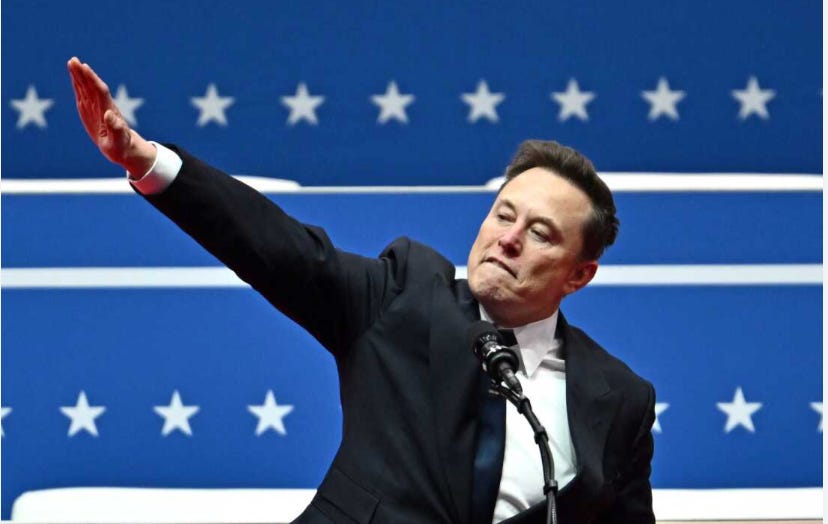
When Elon Musk decided to weigh into British politics in January 2025, he fired off forty tweets attacking the Prime Minister’s handling of the grooming gangs inquiry. That was it. Forty tweets. And yet, as Professor Alan Jagolinzer - a former US Air Force pilot who now runs the Cambridge Disinformation Summit - put it to me, the entire British news media spent the best part of a week covering almost nothing else.
“I cannot say this loudly enough,” Alan told me. “Musk hijacked the entire narrative around the UK for about six days. With forty tweets.”
That episode tells you a lot about the state of British politics - and it was the sheer breathtaking scale of American influence in British populist politics that was amongst the biggest surprises researching my new book, Why Populists Are Winning. Because what it reveals is that the information ecosystem feeding Reform-curious voters in Britain isn’t really British at all. It’s American. And it’s been engineered - deliberately, profitably - to enrage.
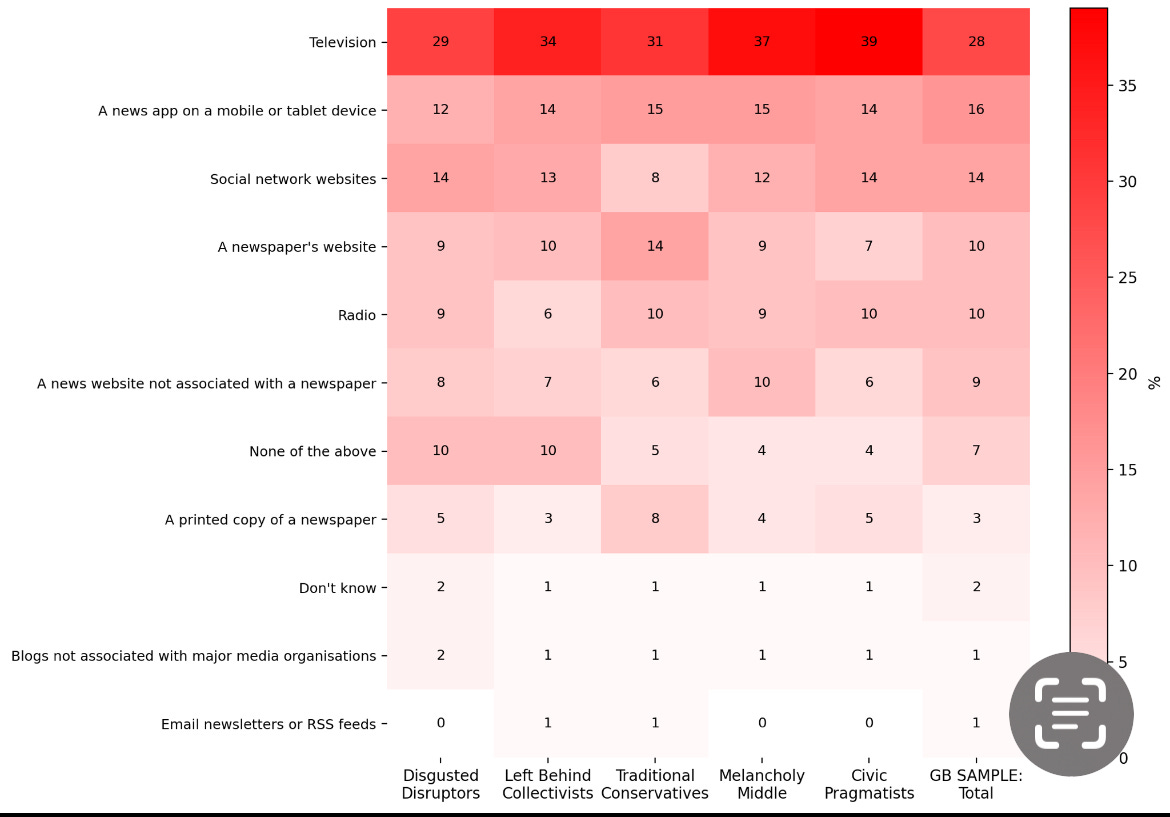
Our research on Decoding Populism started with a hard look at how populist voters get their news. Our research reveals a media landscape that is fast changing, and the direction of travel is deeply revealing. Television remains the single most-used news source across all voter groups, but the real story lies in what sits alongside it.
Where does Britain - and the five tribes of Reform - get its news?
QN: Which, if any, of the following sources do you consider to be your MAIN/PRIMARY source of news? Please select one option only.
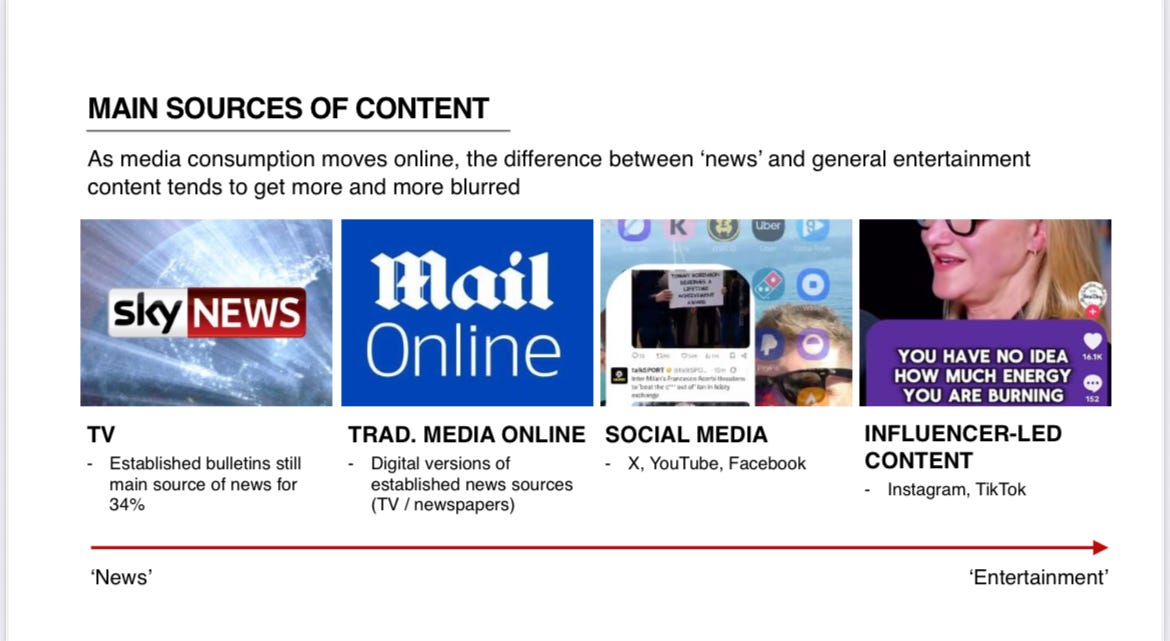
As media consumption has moved online, so the boundary between news and entertainment dissolved: from established TV bulletins and traditional newspaper websites at one end of the spectrum, through social media platforms like X, YouTube and Facebook, to the highly personalised, algorithm-driven world of influencer content on Instagram and TikTok at the other.
It is at that far end - the entertainment end - where the most partisan and inflammatory material lives, and where the algorithm constructs a coherent, self-reinforcing worldview that is never meaningfully challenged.
For younger Reform-curious voters especially, this populist ecosystem becomes the permanent backdrop to their digital lives: not an echo chamber, but something larger; a system that creates, sustains, and above all normalises a particular view of the world.
Ethnographic research had some great insights. One respondent described influencer content as giving “a real insight instead of a biased view of things” - treating street-level videos as more authentic than mainstream journalism. Another cited far-right commentators Charlie Veitch and Paul Joseph Watson as trusted sources on immigration and urban decline, describing their content as “quite truthful.” And this is exactly why we have to look deeper into the digital world in which the populists have prospered.
The machine we built to make us angry
It’s impossible to understand why populism is winning, without understanding both the demand side for populism - the voters who are choosing it - and the supply side; the message, the money - and the digital media which has a transformed the populists’ reach.
Populists have a message strategy that social media is tuned to accelerate. These platforms, their engineering and economics, were built by some of the smartest people on earth to optimise for a single metric: engagement. And their designers discovered very quickly that three features were essential to maximise it - visible social metrics (likes, shares, follower counts), algorithmic ranking of feeds, and one-click sharing. Together these shift your feed from chronological order to predicted reaction: content that provokes fast, emotional responses rises to the top, while slower, more reflective material sinks without trace.
The design borrows directly from the science of behavioural reinforcement - variable, intermittent rewards attached to metrics. Early studies showed that tweets with moral and emotional language spread far faster than neutral ones. Facebook posts containing indignant disagreement were more widely shared and commented on. False news, rich in novelty, was found to be 70 per cent more likely to be shared than true stories. The algorithmic lesson was brutally simple: outrage travels. Accuracy doesn’t.
And here is the key fact that should disturb everyone: populists and platforms share a business model:
Populists politicise anger, fear and threat. Social media firms commercialise anger, fear and threat. One seeks to mobilise. The other seeks to monetise. One seeks votes. The other seeks profits. But both seek power - and both are served by the same raw material.
Fox News perfected a tone. Facebook perfected targeting. Twitter perfected speed. TikTok perfected the hook. Together, they transformed the terrain on which politics is fought. And populists are far more effective on social media than mainstream politicians for the simple reason that they are masters of exactly the methods these platforms reward.
The network
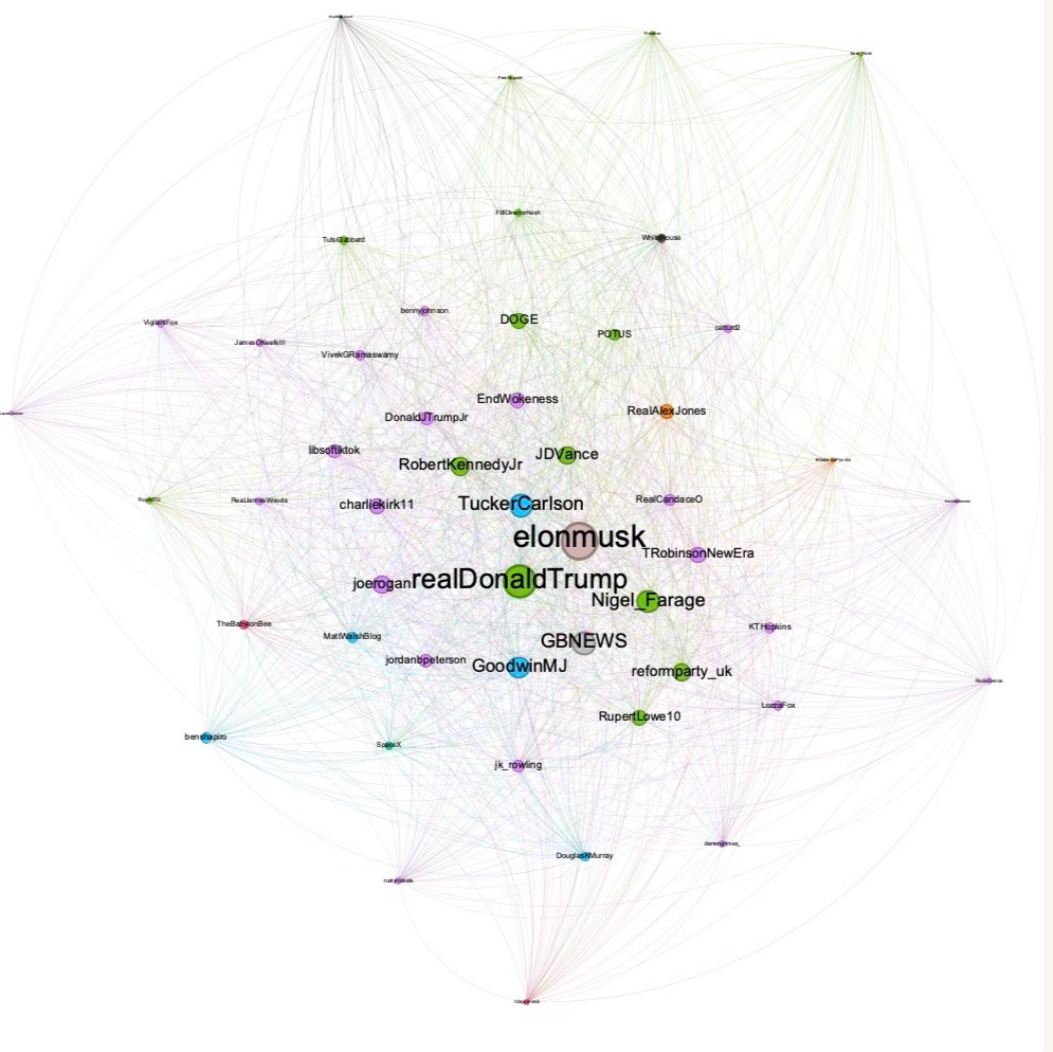
I wanted to understand the specific information ecosystem shaping Reform-curious voters in Britain. So I worked with the ethical data science company Signify to build a digital network map. They took three key UK accounts on X - GB News, Reform UK, and Matthew Goodwin - because polling shows they’re go-to voices for voters leaning towards authoritarian-populist views. Between them they have more than 1.5 million followers.
Signify pulled a 30,000-follower sample, scraped who those people followed, and built a picture of the influencers shaping their world.
What emerged stunned me. It was not a British conversation at all. It was American.
The top 20 most influential accounts in this network are overwhelmingly US-based. At the centre: Elon Musk and Donald Trump - dark suns with the gravitational mass to pull millions into their orbit. Seven of those top 20 are part of, or closely aligned with, President Trump’s political machine: Trump himself, his son, Vice President J.D. Vance, Robert F. Kennedy Jr., and the Department of Government Efficiency.
Only three of the top 20 are British (beyond GB News, Goodwin and Reform UK): Nigel Farage, Rupert Lowe, and Tommy Robinson.
Four of the American accounts push hateful content at scale. End Wokeness — an anonymous account with 3.2 million followers — has repeatedly amplified debunked claims about minorities. Bloomberg reported that Musk replied to it more than 420 times in two years. Alex Jones, previously found guilty of defaming Sandy Hook families, continues to distribute white nationalist talking points. Libs of TikTok, run by Chaya Raichik, pushes anti-LGBT content to 4.3 million followers.
When Signify zoomed out to the top 200 accounts, the dominance held: nearly two-thirds were American, just one-fifth British. Almost half are influencers — self-shot, direct-to-camera pundits blending politics with lifestyle branding. Some sell self-help or Bitcoin tips. Others operate in the manosphere, channelling grievance into misogyny. Common threads run through almost all of them: anti-trans rhetoric, climate denial, pandemic conspiracies. Monetisation is a constant subtext. Most offer paid subscriptions. Some promise to teach followers how to make “tens of thousands” from X itself.
A quarter of the top 200 are politicians — but four in five of them are American. The media outlets are GB News, Fox News, TalkTV, and a cluster of hyper-partisan startups: the Daily Wire, Breitbart, Newsmax. Some “news” accounts have no masthead, no reporters, no physical footprint. Their posts are pure propaganda: inflammatory one-liners, video clips stripped of context, opinion dressed as fact.
Britain’s populist right, forever shouting about sovereignty, is just another node in an American network.
The Signify Network Map
The economics of hate
If this doesn’t trouble you, then perhaps this will. This is not just politics. It is a business.
The most disturbing illustration came in the wake of the Southport murders in July 2024. Three young girls were killed at a Taylor Swift-themed dance class. Before the suspect’s name or religion was even known, a torrent of disinformation ignited riots outside asylum centres across the country. False claims about the attacker reached 155 million impressions on X. A fabricated name circulated in posts with a potential reach of 1.7 billion.
And then the money began flowing. As the House of Commons Science & Technology Committee confirmed, in the week after the attack, right-wing influencers pulled in nearly 40 million ad impressions - generating almost £28,000. A day.
Hate not only spread. Hate paid.
The first models of online extremism required bot factories, sock puppet accounts, industrial-scale deception. Vladimir Putin had to build entire infrastructure to spread division. Now accusations mount that the platforms’ algorithms amplify right-wing semantic content - organically, at scale, with the invisible hand of the marketplace replaced by the deliberate hand of the algorithm.
The radicalisation pipeline
The research reminded me of a a conversation I had many years ago with with the Security Service’s behavioural science team. They explained that radicalisation is like a game of snakes and ladders. People are taken to the threshold of violence through a combination of push factors - a family fracture, a personal crisis, a festering grievance - and pull factors: a community, an ideology, a figure online who gives the grievance a name and a target. But extreme behaviour requires something more: a switch, a shock, an ideological opening that provides connection to some great redemptive conflict.
That is what, at its extremes, radical right-wing populists do (they’re not alone in this effort of course). And it shows up on the streets and doorsteps and in MP’s inboxes in the explosion of verbal and physical abuse that now disfigures our democracy.
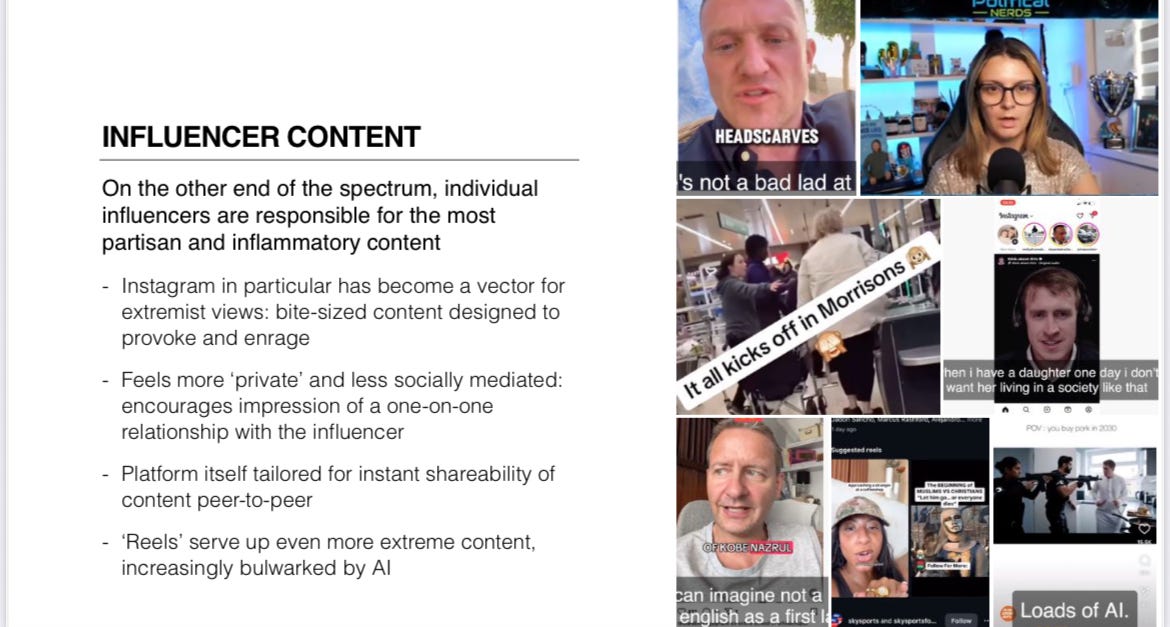
The online ecosystem doesn’t just spread news. It recruits. It radicalises. And for younger users in particular, the algorithmically curated feed evolves with startling speed into a closed-loop worldview. Instagram has become, in our research, a particularly powerful vector: bite-sized content designed to provoke and enrage, creating the feeling of a private, one-on-one relationship with the influencer. But it is not an echo chamber. It is something far bigger - an entire ecosystem that creates, sustains, and above all normalises a particular view of the world.
What it means
There is a profound irony at the heart of all this. The media landscape that most powerfully shapes Reform-curious voters in Britain - that fills their feeds, fires their anger, shapes their view of what is happening in the country - is not generated by any organic British conversation. It is imported, wholesale, from America. Driven by American billionaires. Funded by American ad revenue. Amplified by American algorithms. Britain’s populist right, forever shouting about sovereignty, has surrendered its information environment to a foreign power.
And the timing could not be more acute. As Donald Trump wages economic war on Britain with sweeping tariffs, as Elon Musk uses his platform to openly campaign for Reform UK and the AfD, and as the relationship between Washington and Westminster enters its most turbulent period in decades - the question of who controls the information ecosystem of British politics is not an abstract concern. It is a national security question.
Trust in news has already collapsed. Just 36 per cent of British people now say they trust what they read or watch. Nearly half - 46 per cent - actively avoid the news altogether, a figure that has doubled in eight years. Into that vacuum, this American-built ecosystem of permanent outrage has poured. The old guardrails - the editor’s red pen, the broadcaster’s duty of balance - are gone. What has replaced them is an architecture of amplification, owned by billionaires with their own political agendas, answerable to no electorate and subject to diminishing regulation.
This is why the coming debate over the Elections Bill matters so much. In the UK, Fraser Nelson is writing forensically about the issue. France is taking the question of algorithmic accountability seriously - French authorities recently raided X’s Paris offices over alleged abuse of its own algorithm. This is why the work underway at Demos about the health of our ‘information supply chains’ and epistemic security deserves to move from think-tank papers to parliamentary action.
There must always be strong safeguards for free speech. But there is no human right to amplification. Platforms that reward outrage and suppress reason are not neutral utilities - they are political actors. And a democracy that allows its information environment to be owned, shaped and monetised by foreign billionaires is not fully sovereign at all.
Understanding the machine is the first step to beating it.
Why Populists Are Winning - And How to Beat Them is published by Head of Zeus on 26 March 2026. You can pre-order here, or on Amazon here.