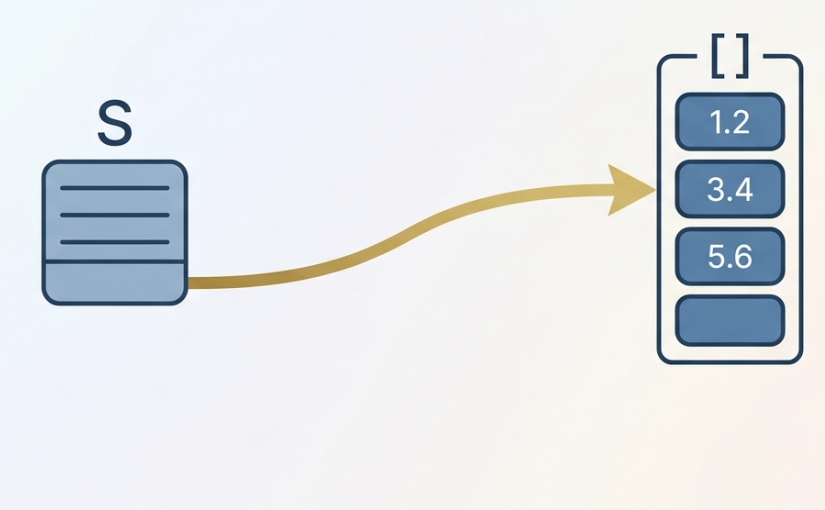
A common pattern in modern software is to map a string key to a small array of floating-point numbers. Word embeddings, feature vectors, lookup tables for physical constants: all variations on the same theme. In Go, the obvious way to write this is a map[string][]float32. But how fast is it, really, and can we do better?
I have been working on constmap, a Go library that builds an immutable map from strings to uint64 values using the binary fuse filter construction. A lookup amounts to one hash, three array reads, and two XORs. There is no comparison, no chaining, no probing. The whole table fits in roughly 9 bytes per key, which often means it fits in cache where a Go map does not.
Go has fast maps, you cannot easily beat them in performance. But if you build a smaller data structure that causes fewer cache misses, you can definitively go faster.
By default, the constmap returns a uint64. But what if your value is an array of eight float32 numbers? You have at least two options:
- Keep the arrays in a separate slice
[][]float32. The constmap returns the index. - Store a pointer to the float array directly inside the constmap’s
uint64.
The second option requires the unsafe package because we are smuggling a pointer through an integer field. It has some limitations.
- You cannot and should not deserialize the data structure to disk.
- You must make sure that a reference remains to your float array, or else the garbage collector could collect it and you’d be left with a dangling pointer. It is trickier than it sounds because Go can collect your memory if it sees that it is no longer used. And it cannot see through your
unsafecalls converting an integer to a pointer value. Thankfully, you can just put all your arrays of floats in an array and callruntime.KeepAlive(mybigarray)at a strategic location: this will prevent Go from collectingmybigarray. The call toruntime.KeepAliveis not free but also quite cheap so you can possibly use a lot of such calls. benchmark
I built three lookups over 100,000 keys, each mapping to an 8-element []float32. We always access the first element of the array, to make sure that the bencmark is a bit fair. We have a large set of random queries (a query is a string).
We compare map[string][]float32, the standard constmap coupled with an array (so that the constmap constains indexes), and the constmap that contains what is effectively a pointer to the location of the []float32.
Run on an Apple M4 Max with Go’s standard benchmark harness:
| Lookup | Time per op |
|---|---|
map[string][]float32 |
21 ns |
ConstMap → index → [][]float32 |
11 ns |
ConstMap → pointer → *[8]float32 |
8.7 ns |
The constmap with an index is already a twice as fast as the Go map. Replacing the index by a raw pointer shaves another 2 ns by skipping the indirection through the [][]float32 slice header. It is a speedup of about 20% in my case.
The result is interesting on its own: a constmap lookup is fast enough that the next memory load, the slice header read, becomes a measurable fraction of the work.
The benchmark and code are in github.com/lemire/constmap. Run them with:
go test -bench 'FloatArray' -benchtime=1s
