Quick Summary
FRACTRAN is an esolang built upon register machines, a theoretical alternative to turing machines for computation. We code the original 1987 paper to understand John Conway’s vision. We further code Geipel’s 2017 paper for fast cycle detection.
I’m an index calculus (advanced logarithms) guy by profession but Trump defunded my math PhD. Please consider becoming a paid subscriber while I figure out my next move.
As usual, you can code along to the GitHub.
The 1987 paper FRACTRAN: A Simple Universal Programming Language for Arithmetic (Conway, 1987)1 implements a register machine : an alternative to Turing machines where logic is represented within arithmetic, not as read/write heads on a tape (Wesstein, 2025)2.
In the simplest terms, Fractran is a computer architecture based entirely on the multiplication of fractions (Linvega, 2008)3.
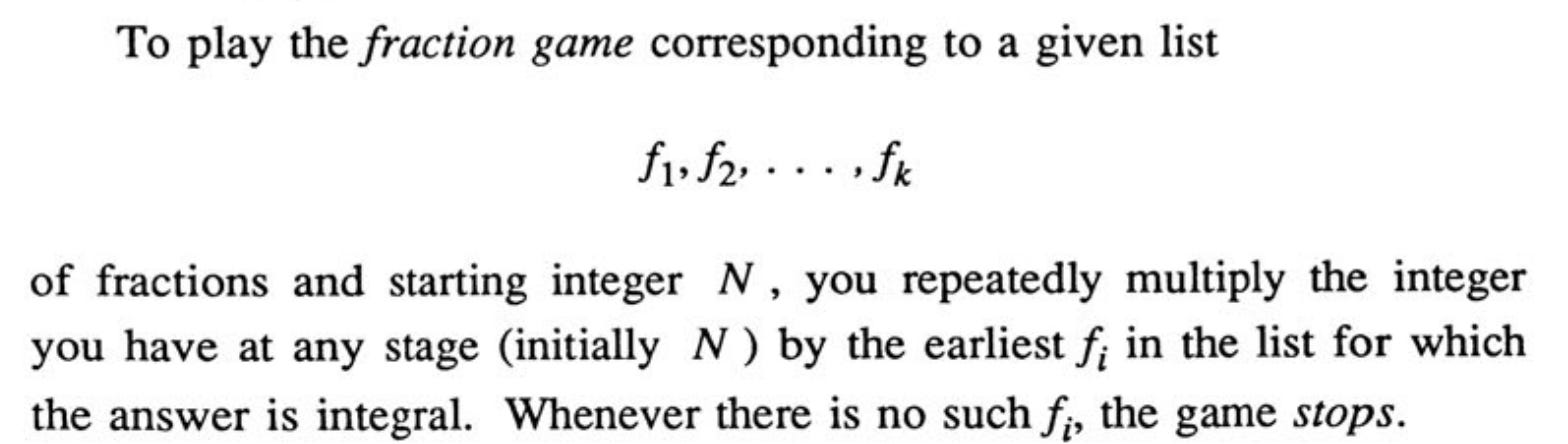
The paper (Conway, 1987) asserts that a list of fractions alongside basic Start, Multiply, Stop rules permits Turing-complete computation.
Fractran uses prime numbers as registers and builds on the laws of logarithms we covered here. Here’s a quick recap for the noobs:
Fractan can be viewed as a slightly more general Turing machine in that it accepts an integer both as input and output, rather than outputting a boolean (Geipel, 2017)4.
So, using the laws of logarithms, Fractran accumulates results in the exponent of the prime factors of an integer.
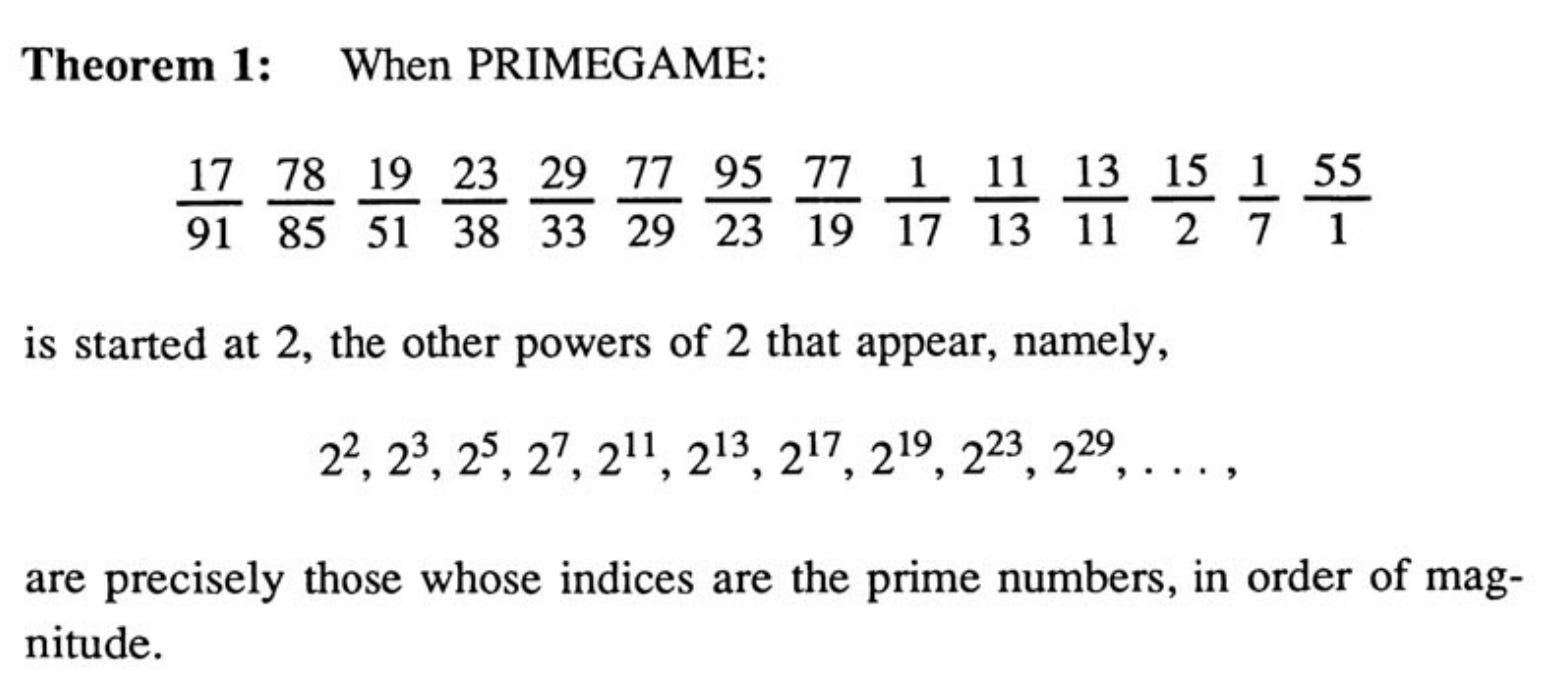
A Fractran program is defined as a finite list of fractions. Given a positive integer input n, the algorithm calculates the next instruction by multiplying n with a fraction that yields another integer. The algorithm halts if no such fraction exists (Ramanathan, 2019)5.