Once, because of an emergency, my manager asked me to take ownership of something that had previously been handled by another team. «It’s just a matter of doing this» was the request.
A request driven by the situation itself, which didn’t allow him to provide much more context. To do that work properly, though, I needed to ask an incredible number of questions.

As it often happens when we use the word “just”, we’re actually hiding an entire universe of unspoken things: assumptions, context, past decisions, and much more. Things that are impossible to guess for someone who has never worked on that activity before. Especially when there isn’t enough documentation.
Not surprisingly, a tweet I wrote a few years ago was about exactly this 😅

Simone D'Amico@dymissy
Karma is what happens whenever you say "you just have to..."
10:10 AM · May 21, 2021
1 Like
I realized that I had been annoying in that situation, but improvisation has never been my strong suit.
The point is that I’ve been on the other side too, even without being in a leadership role. Back when I was an individual contributor, I found myself in situations where I passed a task to a colleague using the usual phrase “it’s just a matter of doing…”, only to get back a thousand questions about something that, in my mind, didn’t need any explanation.
Another time, during my very first experience as a leader, a team member suggested a way to simplify our review process. A suggestion that felt trivial, almost naive, to me. I ignored it. Years later, I realized they were absolutely right, and that what they had proposed worked really well. I know this because, eventually, years later, I adopted it.
There’s that famous cavemen meme: one of them offers the wheel, and the others reply «No thanks, we’re too busy», while dragging a cart with square wheels. Looking back at that moment, I was the one dragging the cart.
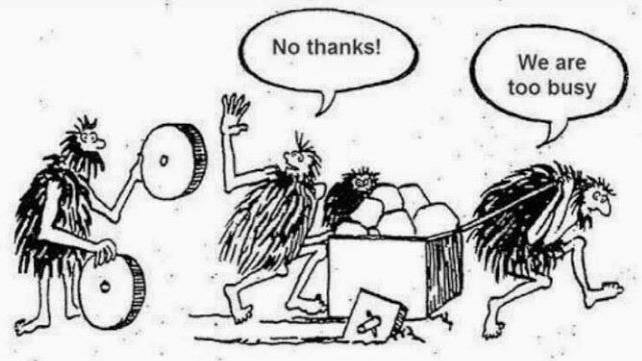
As you might have guessed, today’s topic is exactly this: appreciating and valuing the people who ask a lot of questions, even the ones that seem obvious, because they are one of the team’s greatest strengths.
It took me a while to understand this, but today it’s one of the qualities I value the most in the people on my team.
If you think about it, you’ve probably caught yourself thinking, “What kind of question is that? It’s obvious that…”, only to realize that the question triggered a conversation about something that seemed clear to everyone, but actually hid a few traps.
This is exactly the point: even obvious questions make you spell out what you’re assuming. But not only that. They help you notice the blind spots in your thinking before they cause trouble, and they pause things just long enough to avoid big mistakes.
And the cost of not asking questions is something I know very well. Years ago, we were upgrading a payment system and everyone, myself included, assumed that the new system had to work exactly like the old one. No one questioned it. It was obvious.
Months later, we discovered that this constraint didn’t actually exist, when it was already too late and we had spent a huge amount of time adapting flows just to make everything work as before. One question would have been enough. Just one question, at the beginning, to avoid all of this.
One big lesson I learned is that the annoyance you feel when someone asks “too many” questions is often a sign that you haven’t thought deeply enough about what they’re asking. If it were really that clear, those questions would have immediate answers.
Saying “feel free to ask questions” is not enough. I’ve said it a thousand times, and it never worked. As I’ve mentioned many times before, people pay more attention to behaviors than to words.
Instead, I want to share a few things that, in my experience, actually work.
React well the first time
When you receive a question that seems obvious, the first reaction in a group sets the precedent. Responding with impatience sends the message that you’re annoyed, and people shut down.
Take the initiative yourself
Instead of expecting others to ask questions, ask them yourself. Some questions that can work are:
“Are there decisions we’ve already made without discussing them explicitly?”
“Is there anything you think I might have forgotten to tell you?”
Separate the person from the idea
Don’t let the source of the question influence you. Don’t filter the idea based on who it comes from.
Today, when someone on my team asks a question, I feel like I have heart eyes. Someday I’ll have to ask my team what face I actually make in those moments. But it hasn’t always been like this, and the difference is that the old attitude never paid off.
And when someone suggests something that seems trivial, I try to remember the meme. Maybe I’m the one dragging the cart.
Credits: Illustration 1