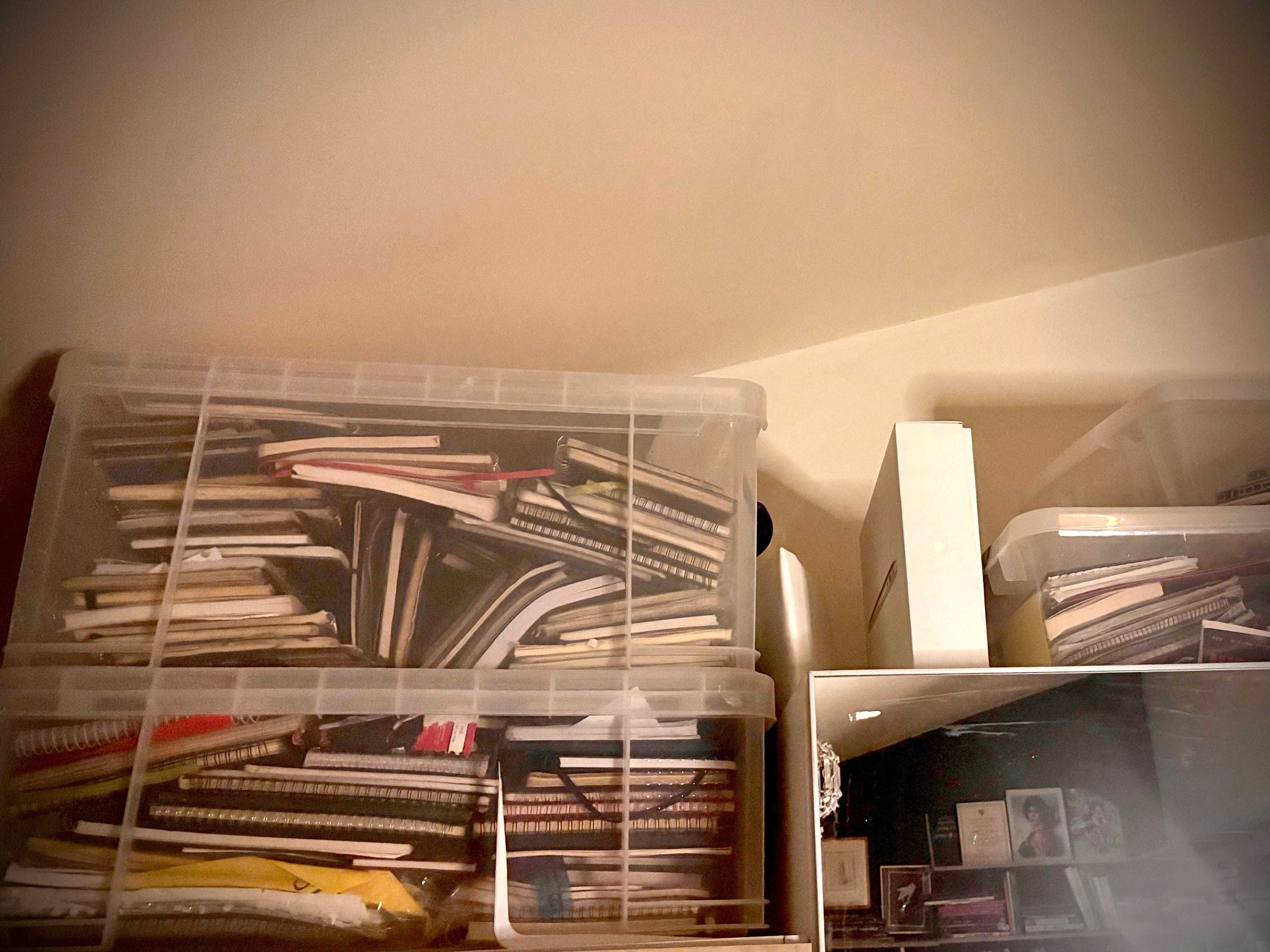
This is about a quarter of my stash of filled notebooks. One of them is probably a mimic.
It has come to my attention that you might not be carrying a notebook with you at all times. You should. Unless some sort of physical or developmental disability prevents it, all writers should write by hand - especially now, because only human writers do, and that matters.
I write on paper. Always have. All of my journals, my first drafts, my pitches and story structures and odd notions and late-night brain excursions, everything I want to remember or understand. I take a notebook with me almost everywhere I go. I thought all writers did. Someone, after all, must be keeping those natty little Moleskine stores in business. Someone, I assumed, must be using them.
Apparently I was wrong about that. A few months ago, not long ago I went to a panel about the future of publishing at the London Book fair, which turned out, of course, a room full of terrified writers wondering if there would be snacks. I got out my notebook out to start jotting things down, as is my habit during talks, at work, on the train, in front of the tv, on zoom calls, on phone calls, in the bathroom, when I’m sad, when I’m angry, when something amazing happens, when I can’t work out what I’m feeling, when I want something I can’t have, when I need to pay attention, when I need to look like I’m paying attention - you get the idea. My friend, one of my top five favourite burned-out geniuses in town, leaned over and said - get you, with your notebook! There’s a proper writer.
At first, I thought he might be taking the piss. I looked around and, sure enough, nobody else had a notebook out. Not one other person, in an entire roomful of writers who were not required to do anything but sit in silence and contemplate the impending collapse of whatever shoddy security we had managed to build. For what it’s worth, I built mine on the back of boxes of notebooks which are, by now, a significant proportion of what I own by weight and volume.
My notebooks are the one thing I’ve kept, consistently, for almost twenty five years. I started carrying one around when I was about thirteen, when I played Anne Frank in a school play. The major prop, obviously, was notebook in red check cloth, and it couldn’t be obviously blank and figured I might as well start using it because. While my pre-pubescent life was different from Anne Frank’s in several crucial ways, I liked the idea of having a secret, special friend who would always listen.
I tried out keeping a normal diary, like I was writing fully-formed thoughts to a far-away friend, but that didn’t last. I couldn’t pretend I was writing to anyone other than myself - but I didn’t have to pretend, and that was the real magic. Taking notes helped me concentrate in class. It helped me focus when everything felt chaotic. When I got sick with eating disorders in my late teens, it was writing by hand in my notebooks- endless stacks of them- that helped me recover. I remember feeling frantic to scratch my way out of the carapace I’d built around my future, to write myself back into being, and it worked. I still have those notebooks. One day, I’ll take the plunge and reread them.
I’m not precious about my notebooks. I’m fussy about them, but in very private and unexpected ways that work for me. They’re are not organised, or tidy, or in any particular order. I often keep a to-do list at the back, and I rarely start writing at the front. They’re incomprehensible to anyone who isn’t me, and most of them are booby-trapped with erotica, which is of course another way of saying porn that works for me. You might also find snippets of dialogue, workout routines lists of pitches, loglines, something clever a friend said in the car, and lots of biro drawings of eyes. Sometimes of strange elf-women, but mostly eyes.
When I look through my old notebooks, they look back.
It’s disconcerting.
Anyway. Writing by hand is an important discipline for almost every writer. Here’s why.
It cannot be pinched or copied or fed to a slavering algorithm to suck up the smallest squeeze of potential profit for whoever happens to be buying and selling your data at this time. It’s private. That means iThe only way to snoop, steal or otherwise exploit what I write in my notebooks is to physically rob me. Admittedly, I’m fairly distractible and easy to rob, but you’d have to put in at least a little effort, and then you’d have to decipher my handwriting. And most of my notebooks are booby-trapped with scraps of really weird erotica. Go ahead, make my day.
It’s not connected to the flashing dopamine casino - your emails, your calendar, the firehose of doom pumping out of the daily news, a hundred sources of cheap and immediate distraction, every possible game you might ever play and your entire social world.
No, really truly, it’s private. Your notebook is just for you. Obviously, feel free to make it pretty and aspirational and paste in your favourite stickers, but it should be just for you, so you can be as weird and evil as you like. You can have actual inside ideas before you work out how to translate them. Your family and future employers and fanbase will never see your notebooks, and if they do you can deny all knowledge and I’ll back you up, I promise.
Writing by hand forces you to think in a slightly different key, to really chase a thought across a page. It uses different ‘muscles’ of your brain. At least I’ve always found it to be so, and a handful of reputable studies and Neal Stephenson agree.
A blank page is less intimidating than a blank screen. Writing by hand and then typing up a clean copy is an easy way to produce a really solid first draft of anything.
You can’t delete your mistakes. You can cross out, annotate, go back, rethink, but you can’t just type and delete over and over again and end up with nothing to show for it. It’s a good discipline.
It’s a lot less antisocial than getting your laptop out.
It makes people feel like they’re really being listened to, even if you’re not listening and are instead drawing another picture of an eyeball.
If anyone accuses you of using AI, your handwritten rough drafts are probably a good defense.
It’s good to have a ritual for creative practice of any sort. And I find writing in a notebook does make me feel like I’m a ‘real writer’, even if it’s indecipherable rubbish or lists of my favourite homonyms or, yknow. More eyeballs.
You really don’t have to use anything fancy. I grew up writing on yellow legal pads and sometimes still do. I’m very fussy about what works for me, but that doesn’t correlate at all with price or quality - people have brought me a lot of pretty notebooks over the years, but I mostly don’t use them, because I like what I like.
It’s not too late to start. Nobody’s checking how long you’ve kept up the habit. Carry a notebook and write in it whenever you find yourself drifting or doomscrolling or freaking out or melting down or needing to work out what you think.
I write by hand to find out what I think. You should too.
For paid members and everyone following the Write Like A Person seminar, I’m getting together my best advice for how to start writing by hand, how to carry on, what helps, what not to do, and some exercises for kicking off the habit.