Good morning from California!
I have to go on an elimination diet because my gut is eating itself and that apparently is also destroying my thyroid because I am not absorbing any nutrients. In order to address this, I have to stop eating wheat, dairy, corn, egg, tomato, peanuts, coffee, soy, cacao, sugar and manyotherthings (this is not like a juice cleanse or something fun, it’s something I have to do to stop my body from attacking itself). I have to write down what I do eat and how I am feeling and then evaluate from there as to what I can eat in the future.
If there was a quick fix - say an injection - I would try to take it. I don’t KNOW what’s happening to me, I just know that I got lots of vials of blood drawn and the miracle of modern science has informed me that some things are not going very well.
But, funnily enough, part of the problem is that I took shortcuts. I traveled 40 out of the 52 weeks last year (a lot for me) and some days, I would just subsist on granola bars and about 14 cups of coffee. I would also run and work a lot and sleep very little because I was totally and completely invincible. After all, I was an optimization machine.
And for a time, I sure was. But then, I wasn’t. Turns out, I wasn’t really optimizing anything, I just was avoiding what I actually should have been doing like sleeping. What I needed was to stop adding things and start figuring out what was making me sick. That's the opposite of what we've been sold.
Americans love optimization. So when things come along that promise to help us optimize even more, fast fixes with near immediate results, it’s hard to say no. We’ve built entire identities around being efficient.
The desire for control is really intense right now, showing up in lots of corners of both the digital and physical world.
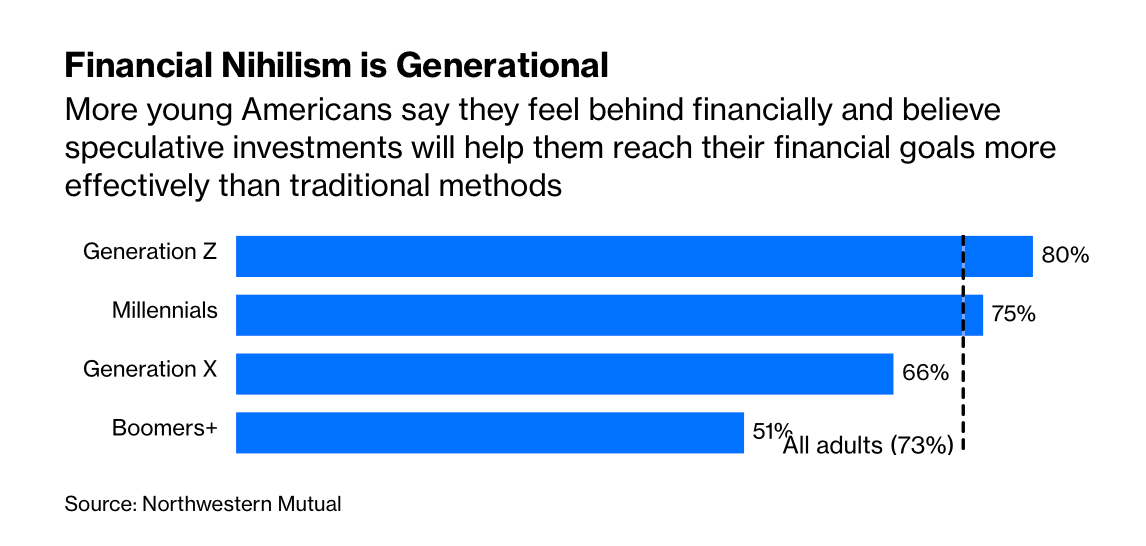
I think it is functionally a response to financial nihilism, where people stop believing that the underlying economy is working for them and turn to gambling or some other seemingly quick fix instead to try and find stability.
80% of Gen Z and 75% of Millennials feel behind, according to a survey from Northwestern Mutual, and that drives them to speculation.
Same with social media - if you’re having trouble establishing connections in real life, the online world provides a form of that, but people are increasingly disturbed by our collective reliance on it, as we saw in the recent Google and Meta ruling.
Naturally, industries have formed to monetize this nihlism through promising solutions. But the solutions never arrive, because the nihilism, the giving up, must persist in order for these products to survive. It’s a version of Ivan Illich’s Limits to Medicine, where he argues that the medical establishment itself produces illness by making people dependent on professional intervention rather than building health. That effect carries across all these optimization tools, creating dependency on the fix rather than addressing the cause. The optimization economy can't deliver control, because the desperation is the market condition, and the pursuit of control through optimization is itself a loss of control.
Our tools are also heavily focused on the individual. As Raymond Williams wrote in his 1975 book Television: Technology and Cultural Form:
The earlier period of public technology, best exemplified by the railways and city lighting, was being replaced by a kind of technology for which no satisfactory name has yet been found: that which served an at once mobile and home-centred way of living: a form of mobile privatisation.
Williams was describing the shift from infrastructure that served everyone to technologies built around the mobile, private individual. The shift from railways to peptides is the shift from “we built this for everyone” to “you can buy this for yourself.”
One example of an individual optimization tool that really works is Ozempic. Some people need to be on it for medical reasons1 and others are self-admittedly doing it for aesthetics. To be clear, Ozempic is a wonderful technology that solves a very real problem for individuals but it leaves the collective problem like the food system and healthcare access2 untouched.
It also marks a shift. The internal body has a thing we can really control, with time and resources. What we have is the Ozempic optimization of everything - Ozempicization, if you will. We have a suite of magic shots now in the form of peptides and everything else that address effort and discomfort and complexity. Everything can be optimized. Everything can be controlled.
The body is always a site of control precisely because it’s a system that still responds to input. Systems are hostile at the moment. The economy and institutions tend to mostly ignore the plight of the individual. But the body listens.
It makes sense that Bryan Johnson and his multi-million dollar experiment to become 18 years old has captured the public consciousness. Bryan has something everyone wants - total control over outcomes. The appeal of Don’t Die is the control - controlling your nutrients, your supplements, your longevity. And for the viewer that’s the appeal - the body is something to control, in the era where everything feels uncontrollable.
This patterns happens a lot. Personally, when I was in college and my dad was very sick, I developed an extreme eating disorder to try and regain control. The control over the body is the first refuge when everything external becomes unmanageable. This is a genderless dynamic. Many people resort to the body as last resort, across the entire human species - and that form of control is becoming content.
Clavicular is one of the new and notable streamers of the moment, known for bone smashing and ‘looksmaxing’ and exists in his own makeshift WWE-like universe. He has his own language in his universe, a battle for #1 Chads (decided on an online leaderboard). He is obsessed with how he looks and is obsessed with control.
Looksmaxing itself simulates a value (status, desirability) that these people might not economically possess. It's control over the body as compensation for lack of control over economic outcomes. This is also seen in wellness culture, MAHA, the peptides, the cosmetic surgeries and enhancements - it’s serving an individual purpose of wanting to be healthier or stronger, but it also serves an economic purpose, another vector of control.
It’s revealing that Silicon Valley’s word of the moment is ‘agency’ as it dresses up that desire for control. Optimization is the process, control is the desite, and agency is the branding. It’s not clear what agency means in startup land (similar to other words often used, like taste) but it does hint at someone who will force the universe to bend to their will, one way or another3.

a16z@a16z

7:38 PM · Mar 23, 2026 · 183K Views
266 Replies · 455 Reposts · 4.87K Likes
Cluely is a company that embraced this wholeheartedly, the final boss of the hustler economy. Their original ethos was cheating (they have since pivoted into AI notetaking) and they have raised millions and millions of dollars4. For them, “scamming” was being “agentic” which is indeed the “hottest commodity in Silicon Valley” as Sam Kriss wrote in his piece Child’s Play:
The future will belong to people with a very specific combination of personality traits and psychosexual neuroses. An AI might be able to code faster than you, but there is one advantage that humans still have. It’s called agency, or being highly agentic. The highly agentic are people who just do things.
And they are just doing things, driven by (understandable) fears of the permanent underclass and becoming useless in the age of AI. Apparently, the way that you avoid both of those is by “constantly chasing attention online.”
What Bryan Johnson does is highly agentic and highly online. He is always self-experimenting with supplements and psychedelics, with a very strict regime of diet and exercise. It’s perhaps the most control (agency?) that anyone has ever had over their body. He is in fact trying to get so much control that he is essentially playing a version of God.
People have to ask themselves:
Do I believe in his assertion that we can live forever?
Do I believe that his body is a proof of concept?
Do I believe the content that he continuously generates sells the believability of the project well enough?
It quickly turns into a belief market, with Bryan Johnson as an asset. Same thing with Cluely - the investment was based on belief, a belief in control and a belief in agency. But once the body (or the mind, in the sense of agency) becomes an optimizable surface, the self becomes an asset class5, driven mostly by narrative, and once that happens, you're already inside the logic of belief markets.
Prediction markets and crypto run on the same logic - bets on narrative rather than fundamentals, agency through participation. Belief markets promise an exit from limits, physical or financial. They monetize the fear of being left behind, in forms of (1) dying while others don’t (2) not cheating when others are and (3) being poor while others aren’t.
They all mark a shift that has been happening.
Old capitalism valued productive capacity, the ability to make things.
Financial capitalism valued cash flow rights, claims on future earnings.
What we might call belief capitalism values narrative adhesion, the ability to keep enough people inside a story long enough that the story stays load-bearing.
Belief markets require the appearance of accessibility to stay alive. The product sold is “you could be this too”. Brian Armstrong of Coinbase, operates in a similar mindset to Bryan Johnson. He is also into longevity and biohacking (and prediction markets) and says that getting old should be optional in the future.
And that mindset carries over into his product. The pitch for Coinbase prediction markets is quite literally “take back control.” Kalshi’s, a prediction market competitor, is “make your grandkids proud.”
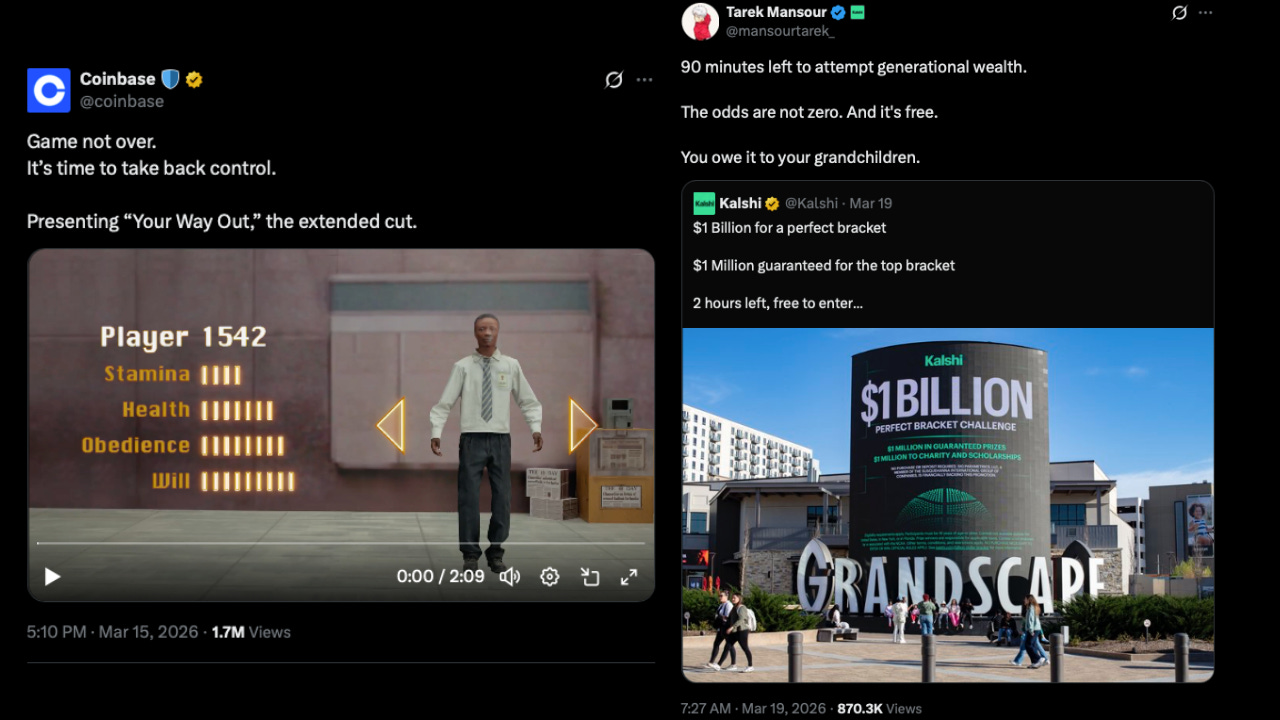
Control your future, with us, your friendly neighborhood gambling apps. The founder of Novig, yet another prediction market app, said that only 20% of their users make money, and touted it as much higher than the rest of the industry. That doesn’t sound like much control. That doesn’t sound like much of a future.
Everyone is chasing after the gold. Everyone is trying to strike rich, easily and quickly, to “get in on the next big thing and hope for the best” as Allison Schrager writes.
The general lack of rules6 combined with the inability to take back control despite it being promised is the extraction part of a belief market. The gap between what participation promises (free yourself) and what it delivers (enormous losses and even less freedom than before).
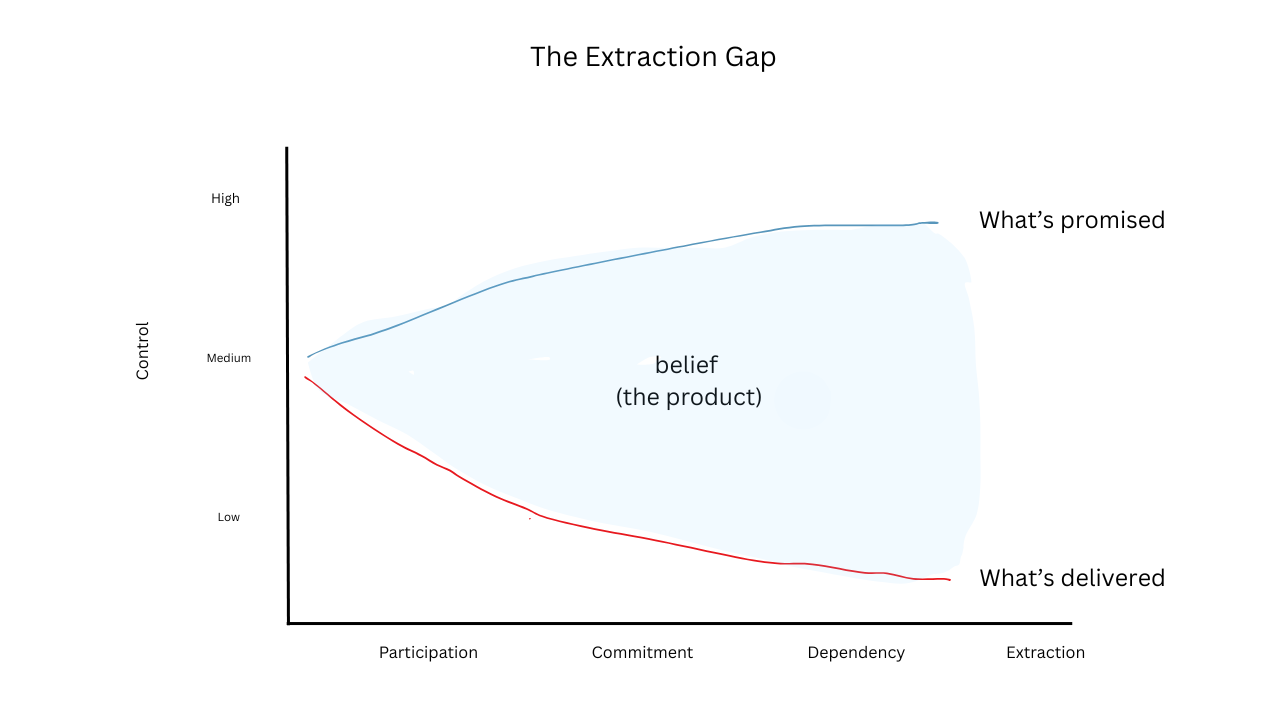
Every solution to “systemic failure” that promises control gets packaged as a product that re-enrolls you into something deeper than what you were escaping.
The extraction logic of belief markets migrates to wherever desperate people are, and some of that desperation is in the manosphere, the online universe promoting masculinity. I think the manosphere audience is actually smaller than we might think, but it is illustrative of the control impulse, belief markets and subsequent extraction, and the spectacle economy.
Louis Theroux’s Inside the Manosphere documentary captures these belief markets in a revealing way. It shows the paranoia that broadcasting your life to thousands of people can create. The men depicted are terrified of being seen as (1) small (2) poor (3) weak and (4) undesirable, so they create these false enemies in their mind (Louis becomes one of the enemies) and become fixated on escaping ‘the Matrix’.
The streamers in the Manosphere (and beyond) are functionally human zoo exhibits. People throw treats into their enclosure and demand they dance (for example - on Twitch and Kick people get sent tens or hundreds of dollars to answer questions or do backflips or something).
This leads to vice signaling, appealing to the worst parts of ourselves, as the streamer does crazier stuff because the audience demands crazier things. The crazier things then get clipped and posted and shared for the specific purposes of going viral. Sometimes the clips are interviews out of context or rage bait or worse and then everyone yells and gets mad, shares them, it goes viral and then society erodes at the edges just a little bit more. You can run entire shows just on the clips and rake in millions and millions of dollars.
The Manospherefluencers are essentially MLM leaders - they recruit young men and young women into their trading courses or their OnlyFans management company, taking a percentage of pain and despair.
Polymarket, a top prediction market, is doing something similar with their new referral program - prediction market influencers are rewarded for bringing new users to the platform, getting a cut of fees that the new users generate. Polymarket also follows the messaging strategy of the Manosphere - they “[amplify] unproven claims from the Trump administration and baseless conspiracy theories” in order to “attract young men, who are most likely to become paying users” as Stuart Thompson, David Yaffe-Bellany, and Mike Isaac write in the New York Times.
They teach people that it’s easy and simple and just watch the crude oil chart for a triple witching or bet on how much it’s snowing or bet on the Oscars but most of all bet on yourself and you can be a millionaire just like me. And yes, you must have it all, easily, because it is easy now. But it’s not. As Benjamin Fogel wrote about Andrew Tate, leader of the Manosphere:
He is a symptom of a new brand of capitalism unencumbered by any illusions about progress. For Tate and his followers, the whole system is a scam and the only way to succeed is by pushing others down and clawing your way to the top.
Tate is the kingpin of the Manosphere and doesn’t pretend that he does anything useful or helpful - he embraces his “predation, exploitation, and relentless clout chasing” because everything is a scam. And he has a point. Fogel again:
A decade of slow growth following the financial crisis made possible the hustler economy of precarious gig work that was billed as empowerment, but that in fact was merely a way of subsidizing the incomes of the poor. Today, “hustling” has become thoroughly egalitarian. From Amazon drop shipping to crypto day-trading, anyone can get in on the action.
So, can you really condemn the Manosphere for saying “it’s all a scam and the strong take from the weak” while celebrating excessive stock buybacks or the leveraged buyout that extracts value by loading debt onto the acquired company and laying off its workforce? Is there that much difference between the (1) manosphere playbook of extracting value from people weaker than you, taking no responsibility for the damage, and moving to the next target and the (2) private equity model of identifying undervalued assets and extracting operating efficiencies and returning capital to shareholders?
Confusion and nihilism are products, not symptoms, of this regressive world. The people selling “agency” benefit from a world where nobody trusts institutions, because distrust is the market condition that makes their product necessary. Tate needs the system to be a scam. Polymarket needs uncertainty to be permanent. The worse things get, the better their pitch works.
The fans of the Manosphere who Theroux interviewed had truly harrowing stories (as did some of the Manosphere creators) of experiencing homelessness and fatherlessness and joblessness and deep pain. They watched people like HSTikkyTokky because they wanted to emulate him - they want to be rich. And of course they do.
The act is a facade but the message hits. People believe in it because they naturally want these quick and easy fixes to these huge and horrible problems. As Fogel wrote:
None of this is connected in any sense to a progressive vision of capitalism as a system capable of increasing productivity by creating laborsaving technology or producing actual things. Peddled instead is the indebted, alienated consumption of anxious lonely subjects.
Anxious and lonely subjects, seeking control. The Manosphere extracts value from desperation using spectacle. AI does this too - but it doesn't need a desperate person performing for a desperate audience. It replaces reality itself with synthetic feeling. We move from extraction through spectacle to simulation through spectacle.
We tend to seek control in every facet of our lives, including information consumption. Amanda Mull wrote a brilliant article about “monitoring the situation” - people (clearly, like me) who get glued to their screens trying to piece things together. And there is a lot to sort through: war, a government partially shut down, erratic fiscal policy, weak labor market, high prices, etc. It’s soothing to go to places like Twitter and read the OSINT feeds and to feel like you’re… informed. As Mull searingly writes:
If you can dial in your feeds’ algorithms just right, maybe you can bear a type of witness so complete it feels like participation, or maybe even control. After all, there’s decent evidence that the people launching the bombs are monitoring some of the same feeds you are.
We monitor the situation because monitoring feels like participation, and then the government exploits that by replacing the situation with spectacle. Throughout the war, the White House communicated entirely through AI7-generated memes not unlike Fruit Love Island (a TikTok account where AI-generated fruit act out Love Island plotlines), combining video game footage with bombing footage. A senior White House official said as much according to Politico:
We’re over here just grinding away on banger memes8, dude
First as farce, then as tragedy, or something like that.
But just as individuals use various things to simulate control, institutions are increasingly using spectacle to simulate stability they can no longer guarantee. Spectacle is the solution9, because seriousness requires accountability and accountability requires consequences and consequences require institutions that are willing to enforce them. That just doesn’t seem to exist at the moment10.
The Fed is in wait-and-see mode, doing the best they can given the circumstances. The government is half-shut down. Corruption is slithering through sewers and escaping from air vents. And diplomacy is replaced by memes. Iran and the United States have been fighting this war via Twitter. MB Ghalibaf, the speaker of the Iranian parliament, tweeted:
We are aware of what is happening in the paper oil market, including the firms hired to influence oil futures. We also see the broader jawboning campaign. But let’s see if they can turn that into “actual fuel” at the pump —or maybe even print gas molecules!
It’s a dig at the financialization of the United States and Trump’s approach to managing the war (no war during market hours11, big war on the weekends, endless showmanship). He’s right - you can’t meme your way through a war (although the markets don’t seem to care about anything at the moment).
As Juliette Kayyem wrote in the Atlantic about the combination of the enormous TSA lines (now supported by ICE) and the tragic Air Canada crash at New York’s LaGuardia airport:
These twin crises are separate but related: They are both the result of an approach to governance that neglects the work of governing [...] The Trump administration has devoted this term to manufacturing fake threats and neglecting quite a few real ones, such as the steady erosion of departments and systems designed to protect people, including airline passengers.
Public safety is not a given—and Americans are learning that it is no longer something that they can take for granted.
The administration has focused on the fake. The great works - Baudrillard, DeBord, Postman - they all saw this coming. People see it coming now. But now, the real is here. This is a war of economics, with 25% of the world’s traded oil and almost half of the world’s urea, a fertilizer that makes high yield agriculture feasible at risk. Oil could go as high as $200 a barrel, leading to another inflationary spiral far worse than COVID. And for what? People are dying. So much is at stake, seemingly for the sake of… engagement?
What should people do in such a world other than to try and control what they can, to optimize, to be ‘agentic’. When uncertainty is the defining force and there is no clear path toward something different, of course people are going to seek out quick fixes and easy solutions. What else could they do?
It does feel like if Trump had an Ozempic for Geopolitics, he would have injected it by now (things do not seem to be going well, at time of writing). But we don’t have a peptide stack for the economy, at least not yet. The understandable cultural response to this instability (which has persisted for many years) has been quick fixes that feel like optimization but are actually avoidance to fixing the larger problems.
They address the symptom (I feel out of control)
Without touching the cause (the economic ladders are broken)
The pain that drives people to the Manosphere and to prediction markets and to speculation is real.But the entire model depends on the absence of the thing it promises.
Raymond Williams wrote in 1961 that “every aspect of our personal life is radically affected by the quality of general life” and yet we insist on seeing it in completely personal terms - and all of this is a great case study of that. What’s being sold as personal control is not actually control. Control would go beyond the individual, to mean affordability and functional institutions and to quote Kayyeem, a government that actually governs What’s being sold instead is the feeling of individual control through the bet, the hack, the feed, the subscription, the optimization, in my case.
The reason we can't solve our problems is not lack of tools or information - it's that the dominant method (add, optimize, measure) is the wrong method for the problem (figure out what's poisoning you.) Do the slow and boring work and don’t assume invincibility. Perhaps the economy (like the body) requires more of an elimination diet approach. People are trying that, like Mamdani’s Chief Savings Officers in NYC. What can we cut to be more functional in a healthy way?
Williams also wrote that to be truly radical is to make hope possible rather than despair convincing. Despair right now is extremely convincing and extremely profitable. Hope would be the opposite - something that doesn't need you to feel desperate in order to work.
Thanks for reading.