A Big Idea in System Design

The pretext library made a big splash on tech Twitter/X the other week. There are lots of cool demos of what the library unlocks, and I think the library itself demonstrates a number of important lessons about software design. The creator of the library @_chenglou touched briefly on a big idea in a long post - here's an excerpt:
[...snip...]
The idea of laying out text isn't new (after all, browsers do it). but exposing the programmability makes a huge system-level difference.
[...snip...]
But my hope is that there's a simple core there, this time an interpreter instead of data format (I wish Alan Kay was on X to chat about this), that we can restart taking seriously
[...snip...]
This somewhat opaque tweet touches on a powerful idea in software design.
Every system that sends information must answer a fundamental question: who does the thinking: the sender or the receiver? Deciding where you put the intelligence has consequences that run through the whole system. A classic example is PostScript, a printer specification from 1982.
Sending a Data Structure
The Drone
In this approach, the sender does all the thinking. It computes a result, packages it into a data structure, and hands it off. The receiver simply parses the format and executes a fixed, predetermined set of actions. It’s a drone: the sender thinks; the receiver just executes.
This works well when the behaviour is simple and stable. But as requirements evolve, the format has to evolve with them. Each new capability makes the structure larger and the logic more tangled. The sender must encode more; the receiver must parse and act on more. Complexity spreads across every system that touches the format.
Eventually, the data structure is forced to carry meaning it was never designed to express, and the systems around it become more and more complex.
Examples
- REST API (serving JSON/XML): The "intelligence" is hard-coded into the receiver's version of the model. If the sender adds a new field, the receiver is literally "blind" to it until its own code is updated.
- HTML + CSS. Markup is parsed and rendered by browsers. What started as a simple markup format (HTML) has evolved into a complex set of specifications. As the specifications evolve, browsers and clients must be updated to support the new features. As every web developer knows, we’re at the mercy of the browser vendors to support the latest 'data' we want to send.
- SVG. A set of predetermined XML tags that the receiver parses and renders. SVG does not contain any logic (eg conditionals or loops).
Sending a Program
The Interpreter
In the second approach, the receiver isn’t a drone: it’s an interpreter, with a fixed set of primitives it natively understands. The sender composes programs from those primitives, and the receiver executes them. The output (eg: the page, the layout, the rendered result) isn’t contained in what was sent. It’s produced by it.
The complexity doesn’t go away, but it gets contained in a more manageable form. Instead of accumulating in an ever-growing data format - and in every system that reads and writes it - it lives in the programs the sender composes. The interpreter itself remains stable. Define it once, and any sender that targets it gains the expressive power of a programming language.
Examples
- GPU Shaders (GLSL/HLSL): Instead of the CPU telling the graphics card exactly which pixels to color (raster data), it sends a "Shader" - a small program that runs on the GPU.
- Virtual Machines in Games. Quake pioneered the use of an embedded interpreter (QuakeC) to decouple gameplay from the engine. The engine provides a stable set of primitives for rendering and physics, while the specific "game" is a program that tells those primitives how to interact.
- Database Queries (SQL): When you send a complex SQL statement, you are sending a declarative program to the database engine. The engine (the receiver) doesn't have a hard-coded "Monthly Revenue Report" feature; it has a set of relational primitives (select, join, filter) that execute the program you sent to produce a result.
- eBPF (Extended Berkeley Packet Filter): In modern Linux networking, developers can send sandboxed bytecode directly into the OS kernel. Instead of waiting for a new kernel version to add a specific security check or monitoring tool, you "send a program" that the kernel executes whenever a network packet arrives.
The most influential "Send a Program" success story happened inside a printer. In the early 1980s, the computing world faced a problem: how do you send a document to a printer without knowing the printer’s brand, resolution, or memory capacity?
PostScript - The Proof of Concept
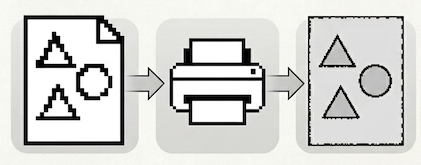
Before PostScript, printing followed the first approach. The host computer knew the printer’s exact resolution, computed every pixel, and sent a raster bitmap. The printer simply stamped it out. The sender was smart, the receiver was dumb.
PostScript, designed by John Warnock and Chuck Geschke at Adobe in 1982, reversed this. The printer contained a full interpreter with built-in primitives: geometric operations, curves, colour, text. The host sent a program. That program described intent: draw this curve, place this character at this size, render this shape. The interpreter executed it at the printer’s native resolution, producing the page fresh each time.
The easiest way to see this is to compare PostScript with a raster image. A bitmap is a fixed artifact - the frozen output of a computation that has already happened. Send it anywhere and you’re sending pixels.
A PostScript file is a program. Send the same file to a cheap desktop laser printer and it renders at that device’s best capability. Send it to a high-resolution imagesetter and it does the same. The sender doesn’t need to know anything about the receiver in advance. That knowledge lives in the interpreter, not in what was sent.
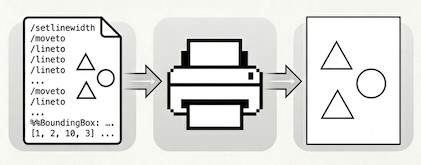
The interpreter becomes a stable foundation: defined once and understood by all senders. Expressive power scales on the sender side, through the programs it composes. The receiver stays simple.
The Price of Programmability
Sending a program is a powerful technique, but it has its own trade offs.
Isolation is Mandatory
Executing code on a remote system introduces a clear security boundary. A robust, sandboxed environment is mandatory for this approach.
Reasoning - Inspection and Debugging
Data structures can be comparatively easy to inspect and debug. Use the appropriate viewer tool for the data structure and you can see what is wrong. A program can be opaque until it runs. Writing code that is hard to maintain or reason about is always a potential problem.
Performance Predictability and The Halting Problem
The performance of parsing a data structure is predictable and easy to test. A program may contain heavy computation that ties up resources or may never terminate. Any system that receives a program needs to be able to handle such cases.
Why It Still Matters
PostScript shows the power of this approach. pretext, the text layout library, is built on the same idea. By moving layout into a program instead of a data structure, pretext enables more flexible layouts and new kinds of UIs, beyond what CSS can provide.
Whenever a data format is being stretched to encode behaviour it shouldn’t, whenever you find yourself writing ever more complex data parsing code and conditional logic throughout a system maybe it’s worth asking: should this be a program instead?
Send a program, not a data structure.