On February 25, 1948, the Communists took power in Czechoslovakia. Most non-Communist ministers resigned from their posts and the ailing President Beneš - he would die just half a year later - accepted the reconstruction of the government into an almost totally Communist one.
One of the few remaining exceptions was the Foreign Minister, Jan Masaryk, a democratic politician and an heir to the founder of the country. But just two weeks later, he was found dead on the pavement, under the open window of his own service apartment at the Černín Palace. The Communists framed his death as suicide.
But it could also have been murder, and that uncertainty has been plaguing the nation until, quite literally, today.
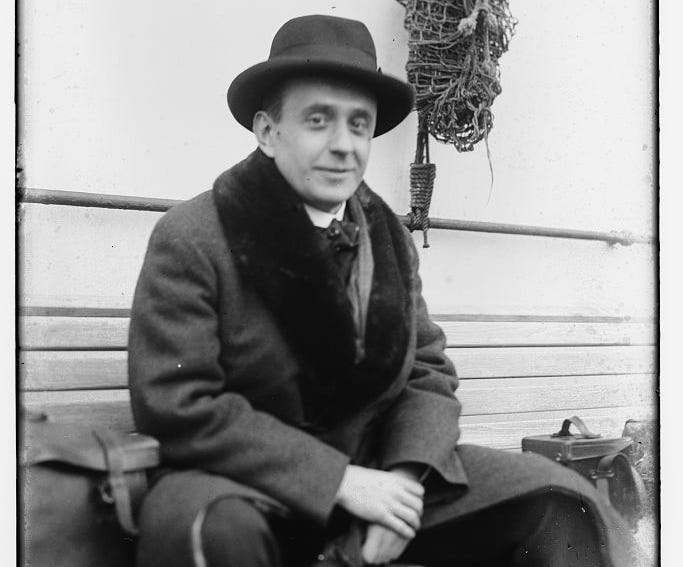
It does not make sense to talk about Jan Masaryk without discussing his father first. By 1948, Masaryk was not just a name, but a political brand.
(Czech readers may find the following facts boring, as we learn about Masaryk at school. Sorry.)
Tomáš Garrigue Masaryk, also known as TGM, was a self-made rural boy born in 1850 right at the border of the Czech and Slovak lands. After studying philosophy in Vienna, he became a university professor in Prague and soon turned towards politics. He was the kind of guy who preferred being right to being popular, and was known for joining several high-profile controversies on the minority side, confidently telling the majority that they were wrong and why1. When he married, he took his wife’s maiden name as his middle one (Garrigue), in a time which definitely did not expect such shenanigans to happen.
In 1914, at the age of 64, TGM left Austria-Hungary and embarked on a seemingly quixotic quest for Czech self-determination. During the first years of the war, no one important would listen to him; the Hapsburg empire was, after all, an ancient fixture of Europe, and it was expected to survive. But as the war wore on and mutual hatred and distrust between the warring parties grew deeper, the idea of dissolving the empire became at least thinkable, until it found an important supporter in American President Wilson. Long story short, four years after going into his exile, Tomáš Garrigue Masaryk, now the leader of the provisional Czechoslovak government in exile, returned to Prague to meet the ecstatic crowds, and became the first President of Czechoslovakia.
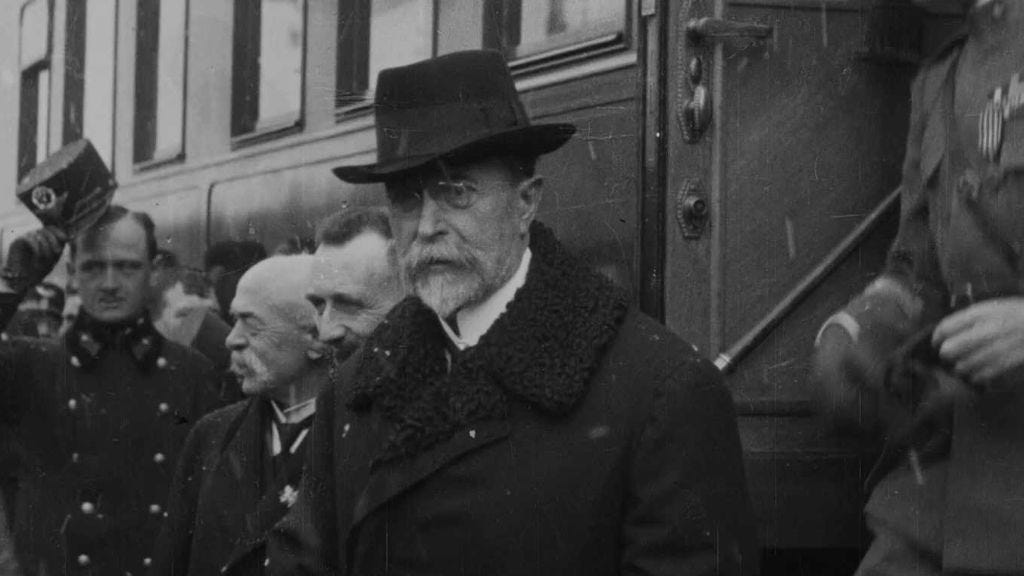
Actual popularity of any president in Prague is always measured by jokes about him, and, by this measure, Masaryk enjoyed the genuine respect of his nation. He was nevertheless a staunch believer in democracy and never succumbed to the temptation of becoming a Dear Leader for Life by Force.2 Inter-war Central Europe was a hotbed of coups and strongmen in black boots, among which Czechoslovakia alone remained an exception with free and fair elections.
On account of his worsening health, TGM resigned from his presidential post in 1935 and died two years later, aged 87. His creation, the First Czechoslovak Republic, survived him by only a single year.
It is not easy to be a son of such a personality, if only for all the expectations that people heap on you. Jan Masaryk, born in 1886, was definitely a softer man than his father, but also somewhat more open, warmer and more charismatic. During the inter-war period, he mostly served in various diplomatic functions abroad, which was a role that suited him well.
On the eve of the Second World War, the Czechoslovak government relocated to London. In 1940, Jan Masaryk became the Foreign Minister of said government and held that position until his death. Unfortunately, post-war Czechoslovakia was no longer a fully independent state. This became quite obvious when Stalin forbade the country (together with Poland) to join the Marshall Plan, a project intended to funnel mostly American money into reconstruction of the badly damaged continent. Masaryk later commented on this occasion with bitterness: “I went to Moscow as a Foreign Minister of a sovereign country and returned as Stalin’s footman.”
Nevertheless, Masaryk did not resign from the government on February 25, 1948, when the Communists took power. His tenure in Communist Czechoslovakia lasted for two weeks. Then, on the morning of March 10, his lifeless body was found on the pavement under an open window.
The scene of the tragedy looked very suspicious. His apartment was in state of extreme disorder (things thrown around, a stray pillow lying in the bathtub), indicating a home invasion. The dead minister had his pajamas on, but was wearing them inside out. His body was almost immediately moved from its original location - a big sin against the most basic rules of forensic investigation - and when the regular murder investigators arrived at the scene, they were told that the secret police (StB, by now full of Communists) would take over the case immediately. The doctor who first examined Masaryk’s body, MUDr. Teplý, was soon found dead himself, allegedly another victim of suicide. Even though Masaryk was said to have been depressed in the previous days, those were very weird circumstances to die in.
The investigation in 1948, of course, went nowhere and ended up with a quick “suicide” verdict. Twenty years later, during a period of a political thaw, there was another, more neutral investigation, which ended abruptly when the brotherly tanks arrived.
When the Brotherly Tanks Arrived

In the West, the year 1968 is strongly associated with the rebellion of leftist students in Paris: an abortive microrevolution which was visually attractive and indeed televised by a dozen journalistic crews. This microrevolution didn’t achieve much, but it was the shape of things to come. The staid, mostly conservativ…
The next opportunity presented itself after the Velvet Revolution of 1989, but by then, most of the witnesses were dead and any material evidence long gone. Yet another attempt without a clear conclusion.
Another investigation attempt in 2001-3 employed some more sophisticated techniques, including biomechanics. The conclusion was that Masaryk’s body flew out of the window with a significant force, possibly larger than a single person could muster, and that the victim was not fighting back, having possibly been suffocated before. This investigation ended up with a verdict of a murder, perpetrator unknown.
Then, in 2024, a document surfaced in Western archives - a protocol from a hearing of Masaryk’s secretary, who testified that he had heard the Minister shouting loudly at three unknown men: “I will never sign that! Over my dead body!” That happened on the day before his death.
This document prompted yet another investigation round. On September 2, 2026, Masaryk’s body was exhumed from his family grave. His body turned into wax, in a grisly process called adipocere, but that also meant that some evidence might be still there to detect, almost 80 years later.
Let us hope that this investigation will finally bring about some form of closure. Three generations later, it is slowly time to let go.
The extent of AI use in this article: 11 mistakes and bad formulations corrected, 1 picture recommended. No editing.