One of the most-talked-about recent stories in my corner of the internet has been the Supreme Court’s refusal to take up the case of Thaler vs. Perlmutter - a lawsuit filed by Dr. Stephen Thaler, a computer scientist1, against the U.S. Copyright Office back in 2022 over its refusal to grant copyright to his AI-generated artwork “A Recent Entrance to Paradise".”
This case - and its apparent terminus - has generally been celebrated by AI skeptics, who along with the overwhelming majority of U.S. media seem to have interpreted it as a decision that makes AI-generated artwork not copyrightable in any form due to a lack of human involvement in its creation.
However, nothing could be further from the truth. Thaler v. Perlmutter actually has nothing to do with whether AI-generated artwork can be copyrighted, or how much human involvement is necessary.
It is narrowly and exclusively about something else entirely, which technology journalists would have realized if they had done even the barest bit of due diligence.
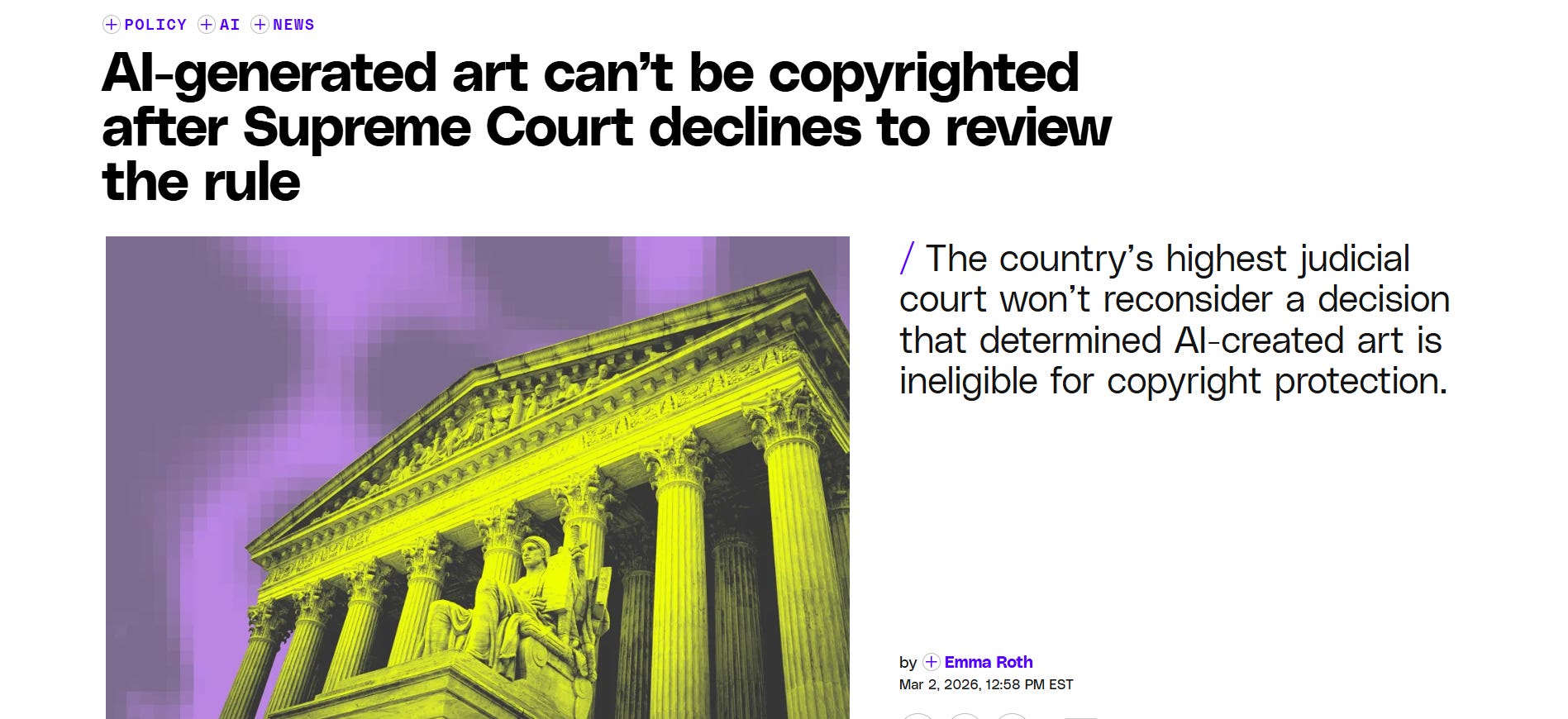
The Supreme Court’s decision not to hear Thaler v. Perlmutter has been almost universally celebrated by AI skeptics, who see it as making AI-generated artwork ineligible for copyright. Here’s The Verge’s straightforwardly-named article, “AI-generated art can’t be copyrighted after Supreme Court declines to review the rule,” from March 2, 2026:
The country’s highest judicial court won’t reconsider a decision that determined AI-created art is ineligible for copyright protection.
Similar stories were written by Artnet (“U.S. Supreme Court Rejects Bid to Grant Copyright to A.I.-Generated Artwork), Reuters (“US Supreme Court declines to hear dispute over copyrights for AI-generated material”), and many other outlets.
It’s easy to see why AI skeptics are excited about this decision, and why the media is covering it the way it is: a decision that AI generated art is blanket ineligible for copyright would have massive ramifications for not just artists and AI companies, but for the larger media ecosystem - it would, essentially, become a clear disincentive to use AI to generate commercial media at all. If it can’t be copyrighted, there’s nothing to prevent it from being shared freely - and it’s much harder to make money selling something you can legally steal!
But, again, that’s not what the court case was about.
There are several major errors in the media’s reporting over this case, which become clear almost immediately upon looking at the actual court decision (PDF).
First of all: contrary to most coverage, Thaler’s application for copyright protection was NOT rejected because it was created by an AI system (in this case, Thaler’s “Creativity Machine” program). It was rejected because, according to Thaler’s own application, “A Recent Entrance to Paradise” was created entirely autonomously and without human authorship.
That’s right: the court didn’t decide that Thaler wasn’t the author due to his use of AI. Thaler told them as much himself.
Quoting from the U.S. District Court’s original 8/15/23 decision (emphasis mine):
[P]laintiff informed the Register that the work was “[c]reated autonomously by machine,” and that his claim to the copyright was only based on the fact of his “[o]wnership of the machine.” […] The Register therefore made her decision based on the fact the application presented that plaintiff played no role in using the AI to generate the work, which plaintiff never attempted to correct. See First Request for Reconsideration at 2 (“It is correct that the present submission lacks traditional human authorship—it was autonomously generated by an AI.”)
In other words, the original rejection had nothing whatsoever to do with the actual use of AI to generate the image: it was entirely due to the fact that Thaler specifically said it lacked human authorship (more on this term later) and emphasized that it was generated autonomously, without his involvement at any stage (including prompting, editing, selection of the work from many possible options, etc.)
But doesn’t this still have wider ramifications? The Copyright Office has, after all, issued a variety of guidelines around AI artwork (stating, for instance, that merely writing a prompt does not entail human authorship).
And yet, no, it straightforwardly does NOT have wider ramifications on the question of AI art. That’s because elsewhere in the decision, the court makes absolutely clear that the case hinges on one question only, that question of autonomous generation:
By design in plaintiff’s framing of the registration application, then, the single legal question presented here is whether a work generated autonomously by a computer falls under the protection of copyright law upon its creation.
Why does this matter? Well, the question of specifically autonomous creation is much less thorny than that of what exactly is entailed by “authorship” or what extent of human involvement is necessary. If it was autonomous, then by definition no human was involved! The copyright office has long held that only works with some degree of human involvement are eligible for copyright. This was established all the way back in 1884 in the lawsuit Burrow-Giles Lithographic Co. v. Sarony, as noted (again) by the District Court’s original decision:
In Sarony, […] the Supreme Court reasoned that photographs amounted to copyrightable creations of “authors,” despite issuing from a mechanical device that merely reproduced an image of what is in front of the device, because the photographic result nonetheless “represent[ed]” the “original intellectual conceptions of the author.” […] Copyright has never stretched so far, however, as to protect works generated by new forms of technology operating absent any guiding human hand, as plaintiff urges here. Human authorship is a bedrock requirement of copyright.
But Sarony was also a very different case, because Sarony - whose portrait of Oscar Wilde was reproduced without permission by a lithographer - specifically asserted that he, a human, was the author of the photograph. Thaler, you will recall, went out of his way to insist the opposite: that he was not the author and that it had no human author, even going so far as to list his AI system as the author on his application. In this regard, the Thaler case more closely resembles other examples of admitted non-human authorship such as Naruto v. Slater, which attempted to assert that a monkey owned the copyright for a picture it had taken - and which similarly concluded that the monkey, much like Thaler’s AI system, was ineligible to hold copyright on the straightforward basis of being non-human.
The court emphasizes over and over throughout the decision that the case concerns, and was decided, solely this issue of autonomous, human-free creation - an issue that Thaler essentially decided for them.
The court also takes Thaler to task for attempting to complicate his argument after-the-fact by describing the piece in question as “work for hire”:
Plaintiff attempts to complicate the issues presented by devoting a substantial portion of his briefing to the viability of various legal theories under which a copyright in the computer’s work would transfer to him, as the computer’s owner; for example, by operation of common law property principles or the work-for-hire doctrine. […] These arguments concern to whom a valid copyright should have been registered, and in so doing put the cart before the horse.
It also dings him for changing his tune: after initially claiming that no human was involved at any point, he attempted to argue that actually he HAD been involved - arguments that the court dismisses, because the original decision of the Copyright Office had to be made solely on the grounds of the application itself:
While plaintiff attempts to transform the issue presented here, by asserting new facts that he “provided instructions and directed his AI to create the Work,” that “the AI is entirely controlled by [him],” and that “the AI only operates at [his] direction,” […] implying that he played a controlling role in generating the work—these statements directly contradict the administrative record.
In other words: Thaler’s arguments about work for hire or the vagueness of the term “authorship” (another point he raised) have no bearing on the case, because the only question is whether a human was involved and Thaler himself said no humans were involved. (And when he did claim that he was involved, it was, as the court says, “too late.”)
To sum up: The only question the court considered was if a human was involved at any step. Thaler himself said no human was involved. Only humans can be authors, according to the government, and so the case was open and shut.
To quote the court once more:
On the record designed by plaintiff from the outset of his application for copyright registration, this case presents only the question of whether a work generated autonomously by a computer system is eligible for copyright. In the absence of any human involvement in the creation of the work, the clear and straightforward answer is the one given by the Register: No.
There’s one big, open question that this case essentially dances around: How much human effort is necessary for a work to be considered authored by a human?
Unfortunately, no answer will be forthcoming, at least not from Thaler v. Perlmutter. Thaler seems to have designed his entire case from the outset specifically to test the question of whether a human author is necessary from a legal standpoint - nor is it his first time doing so. Thaler attempted to file a patent application for two products back in 2019, listing a different AI system called DABUS as the sole inventor, and was rejected on similar grounds: patents require a human inventor. His subsequent court cases were also decided in almost identical fashion.
It’s tempting to take Thaler v. Perlmutter and attempt to read into it the larger question of human authorship - that by rejecting an authorless AI work, it’s implying that all AI work is authorless and therefore ineligible for copyright. But contrary to all that media reporting, the court actually acknowledges this question - and several others of equal importance to people concerned about AI’s impact on the arts - then goes out of its way to leave the door open for the issuing of copyright to works that are largely AI generated:
Undoubtedly, we are approaching new frontiers in copyright as artists put AI in their toolbox to be used in the generation of new visual and other artistic works. The increased attenuation of human creativity from the actual generation of the final work will prompt challenging questions regarding how much human input is necessary to qualify the user of an AI system as an “author” of a generated work, the scope of the protection obtained over the resultant image, how to assess the originality of AI-generated works where the systems may have been trained on unknown pre-existing works, how copyright might best be used to incentivize creative works involving AI, and more.
In other words: the court recognizes these as important issues, which will need to be decided some other time, by some other court hearing some other case.
It’s also worth looking at the other examples of potential non-human authorship cited in the case, because they’re both informative and very fun. Consider Urantia Foundation v. Kristen Maaherra, a case which hinged on the question of whether a work that was the creation of a divine being was eligible for copyright:
Both parties believe that the words in the Book were “authored” by non-human spiritual beings described in terms such as the Divine Counselor, the Chief of the Corps of Superuniverse Personalities, and the Chief of the Archangels of Nebadon. These spiritual entities are thought to have delivered the teachings, that were eventually assembled in the Book, “through” a patient of a Chicago psychiatrist, Dr. Sadler.
In that case, though, the document was deemed to be copyrightable, because the arrangement of the revelations into a published book was enough to constitute human authorship:
The copyrightability issue is not a metaphysical one requiring the courts to determine whether or not the Book had celestial origins. In this case, the belief both parties may have regarding those origins, and their claim that the Book is a product of divine revelation, is a matter of faith, and obviously a crucial element in the promotion and dissemination of the Book. For copyright purposes, however, a work is copyrightable if copyrightability is claimed by the first human beings who compiled, selected, coordinated, and arranged the Urantia teachings, “in such a way that the resulting work as a whole constitutes an original work of authorship.”
If the simple act of arranging divine revelation was deemed sufficient to constitute human authorship, it seems foolhardy to assume that this wouldn’t also apply to AI artwork.
The question of AI artwork is of intense interest to a great many people: artists, who see AI as a plagiarism machine; labor advocates, who see it as an attempt to replace human workers with an uncomplaining, compliant, and above all less expensive alternative; businesses, who are to varying degrees anxious to adopt AI wherever and however possible; and many others.
There will undoubtedly be a future court case over the question of the authorship of AI art. How much human involvement constitutes authorship? Does merely selecting one out of dozens of possible AI outputs constitute authorship? Is something as simple as cropping or adjusting color balance sufficiently transformative to constitute authorship?
These are all important questions, but they’re not ones that have or will be answered by this case. And upon review it’s quite obvious why the Supreme Court declined to hear the case: it can be decided simply on the available facts, and the statements of the Plaintiff. If Thaler had simply listed himself as the author, rather than attempting to engineer grounds for a court case by listing his computer program as the sole author, he almost certainly would have been granted copyright. This was effectively a problem of his own creation, and anyone wishing to copyright AI artwork can simply, well, not go out of their way to get the application rejected as Thaler did.
Of bigger concern to me is the media’s complete inability to do even basic research into the case. This is not some arcane, convoluted bit of caselaw; it was literally decided over the grounds of “Copyright needs a human author and the plaintiff said there isn’t one.” I have to assume that the reason so many publications are misreporting this is either because they couldn’t be bothered to do five minutes of research before publishing (possible), because doing so would render the decision basically uninteresting and unimportant (also likely), or because most of them simply rewrote someone else’s story as publication timelines have been slashed to the bare minimum (the most likely of all).
Whatever the reason, most people who follow these matters now have a dramatically incorrect understanding of the issue due to a lack of due diligence or even basic research. Given that the impact of technology on human endeavors is one of the foremost issues now facing the public, I would call this journalistic malpractice in the extreme.
And whatever you think of AI art, we should expect - and frankly demand - far better from our media.
[END OF LINE]