There is a particular kind of cognitive dissonance that comes from watching the venture capital industry operate in 2025 as though the economic conditions of 2015 still hold.
The models, the pitch decks, the partner meetings, the insistence on headcount as a proxy for ambition, all of it calibrated for a world that has structurally changed. Not evolved. Changed. And the founders who are building the most interesting companies right now know it. They are not raising pre-seed rounds to hire a team of twenty. They are building with AI as a co-founder, fractional operators as a bench, and a single conviction: that the window between idea and proof has collapsed to the point where the traditional raise-then-hire-then-execute sequence is not just inefficient. It is, increasingly, unnecessary.
This is not a prediction. It is a description of what is already happening. The infrastructure to support it, however, has barely begun to exist.
What AI Actually Did to the Cost of Building
The most important thing artificial intelligence did to entrepreneurship was not make products smarter. It made the production of those products dramatically, asymmetrically cheaper.
GitHub’s research into Copilot adoption — published in 2023 and updated in 2024 — found that developers completed tasks up to 55 percent faster when working with AI assistance. A follow-on study across enterprise developers found that the productivity effect compounded: not just faster individual tasks, but faster debugging, faster code review, faster context-switching between projects. The implication for startup economics is significant. A founding CTO who once needed a team of four engineers to maintain velocity can, in many categories of product, operate closer to a team of one and a half.¹
But code is only part of the story. The McKinsey Global Institute’s 2023 analysis of generative AI’s economic potential estimated that AI tools could automate tasks accounting for 60 to 70 percent of employee time across knowledge work — not by replacing humans, but by dramatically compressing the time those humans need.² What that means at the startup level is that the labour cost of going from idea to minimum viable product has fallen by an order of magnitude in categories including software, content, design, data analysis, customer support, and — increasingly — sales prospecting. The Sequoia Capital analysis of AI-native companies, published in its “Generative AI: A Creative New World” series, noted that the cost to train a frontier model had already fallen 10x in 18 months and that the cost curves for inference were following the same trajectory.³
None of this is theoretical. Founders building in 2025 routinely report shipping in weeks what previously took quarters. Not because they are more talented. Because they have access to a fundamentally different toolset — one that compresses execution time and lowers the cash required to reach proof.
The economic consequence is specific: the amount of capital a founder needs to reach their first meaningful proof point has fallen dramatically. And the amount of time required to reach it has fallen with it.
Speed as the New Moat
The venture capital playbook of the 2010s was built on a particular assumption: that capital was the primary input to competitive advantage. Raise more, hire faster, acquire users, establish network effects, repeat. The “blitzscaling” thesis — popularised by Reid Hoffman and Chris Yeh in 2018 — argued explicitly that prioritising speed over efficiency was the correct strategy in winner-take-all markets, and that the willingness to burn capital at pace was itself a form of competitive moat.⁴
That assumption has fractured.
In a world where any well-resourced founder can produce a functional product in weeks using AI tools, the advantage no longer belongs to whoever raised the most. It belongs to whoever understands their customer most precisely, iterates fastest, and accumulates proof of product-market fit before their competitors have finished their seed pitch decks. The moat has shifted from capital to execution intelligence.
Tomasz Tunguz, founder of Theory Ventures, argued in a widely-cited 2023 analysis that AI-native companies would have fundamentally different unit economics from software companies of the prior generation — lower cost of goods sold, higher automation in sales and support, and dramatically compressed time-to-revenue for companies that could identify the right wedge quickly.⁵ The companies he described are not capital-intensive in the traditional sense. They are talent-intensive in a very specific way: they need the right expertise at the right moment, applied to the right problem. What they do not need is a permanent payroll built to sustain that expertise across every phase of the business.
What Happened to the Founding Team
The canonical startup founding team, technical co-founder, business co-founder, perhaps a design lead, was always a simplification. What founders actually needed was access to a full range of senior expertise: product strategy, go-to-market, technical architecture, financial modelling, regulatory navigation, and more. The founding team model assumed that this expertise either lived in the founders themselves or could be hired cheaply on a full-time basis once capital had been raised.
Both of those assumptions are now under pressure from opposite directions.
The AI tools that make individual founders more capable have simultaneously raised the bar for what constitutes meaningful expertise. Being a competent generalist is less valuable. Being a genuine domain expert with the pattern recognition to apply AI tools with precision is more valuable. The gap between senior and junior has widened, not closed.
At the same time, the labour market for senior operators has permanently fractured. MBO Partners’ 2024 State of Independence report found that 17.3 million Americans now identify as full-time independent workers — a number that has grown every year since 2011 and accelerated sharply since 2020.⁶ The European equivalents are less tracked but directionally identical: the EU’s ETUI research on platform work and independent professional services has documented consistent growth in senior-level portfolio careers across the UK, France, Germany, and the Netherlands.⁷
The key insight here is not that senior people are working independently because they cannot find employment. They are working independently by design. They have reached a career stage where the traditional employment contract — fixed salary, single employer, structured advancement - offers less value than portfolio exposure: the ability to work across multiple high-potential companies simultaneously, accumulate diverse equity positions, and compound their impact rather than specialise it in a single direction.
Sam Altman stated in a 2024 interview that he expects AI tools to enable a “one person doing the work of ten” dynamic to become common in knowledge industries.⁸ He was describing a productivity effect. But the structural consequence is more interesting: if one person can do the work of ten, then a senior operator can credibly carry responsibilities across five or six companies at once without any of those companies suffering. The fractional model is not a compromise. It is the optimal deployment of senior expertise in a world where the tools exist to amplify individual contribution at an unprecedented scale.
The Venture Capital Model Was Built for a Different Era
The traditional VC model, raise a fund, deploys capital into early-stage companies, harvest returns at exit, was designed around a set of economic conditions that have materially changed.
It was designed when capital was the primary constraint on company building. It was designed when the time from incorporation to exit was long enough to justify ten-year fund structures. It was designed when the information asymmetry between founders and capital was significant enough to justify the power imbalance embedded in term sheets. And it was designed when the “proof” a founder needed to close a round could only be generated by spending that round.
Each of those conditions is weaker than it was.
Carta’s analysis of seed-stage funding in 2023 found that the median dilution for founders across pre-seed and seed rounds now approaches 30 to 40 percent of the cap table before Series A.⁹ In a world where many companies can reach meaningful traction with significantly less capital than a decade ago, that dilution profile is increasingly hard to justify as a structural necessity. It is, to a growing number of founders, simply a bad deal.
Paul Graham’s observation — made in “Default Alive or Default Dead,” his 2015 essay that has aged into something approaching prophecy — was that founders should think of cash as the oxygen supply on a deep dive.¹⁰ The longer the dive, the more oxygen consumed. The right question is not “how much can I raise?” but “how quickly can I reach a position where raising becomes optional?” The AI tools now available to founders have compressed that timeline in ways that Graham could not have anticipated in 2015, but that his framework anticipated perfectly.
The venture capital industry is adjusting. Slowly. The “lean pre-seed” thesis — advocated by investors including Precursor Ventures, Hustle Fund, and a growing number of European micro-funds — explicitly acknowledges that the capital required to reach proof has fallen.¹¹ But the fundamental structure of the VC model — equity for capital, power held by the investor, dilution as the cost of building — has not fundamentally changed. The terms have softened at the margins. The architecture remains.
The Incentive Gap That Nobody Solved
If the fractional talent model is structurally optimal, and if founders increasingly need senior expertise more than they need capital, the obvious question is: why doesn’t the market simply clear?
The answer is an incentive gap that sits precisely in the intersection of how experts are compensated and how early-stage companies can afford to compensate them.
Cash does not work. A founder who can access a senior fractional CTO, CMO, or CFO at their genuine market rate — £15,000 to £25,000 per month for genuine tier-one operators — cannot afford to do so without burning through runway before achieving the milestones that would justify a raise. The financial mathematics are straightforward. At £20,000 per month across two fractional operators, a founder with £150,000 in the bank has fewer than four months before insolvency. That is not enough time to build proof. It is barely enough time to scope the work.
Equity does not work either — not in its traditional form. Advisory equity, founder grants, side-letter arrangements: the structural problems are well-documented. There is no settlement mechanism. There is no milestone gate. There is no governance preventing the arrangement from becoming a source of cap table complexity without corresponding value delivery. The operator takes on full execution responsibility in exchange for equity whose value is contingent on events entirely outside their control, timed to a horizon that is entirely outside their visibility, and documented in agreements that are entirely outside any standardised framework. The incentive alignment is directionally correct but structurally unenforceable.
What the market needs — and does not yet have in any standardised form — is a governed execution currency: a unit of value that is neither raw equity nor raw cash, but captures the economic upside of the equity position while providing the governance structure that makes it credible, the milestone-gating that makes it earned, and the liquidity logic that makes it worth holding.
The Four Forces
These are not separate problems. There are four dimensions of the same structural shift — and they converge.
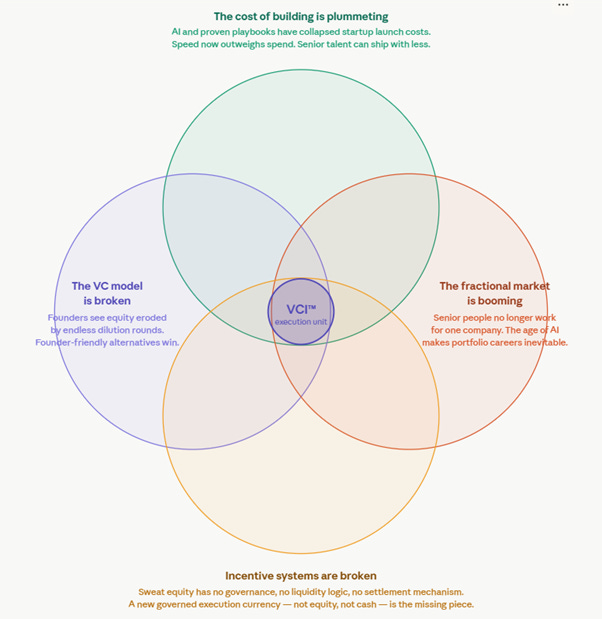
The cost of building is falling. The VC model is under structural pressure. Senior talent has reorganised itself around portfolio careers. And the incentive mechanisms designed to align that talent with founder upside have not kept pace with any of it.
Each force, taken alone, is a market observation. Together, they constitute a design brief.
What the New Infrastructure Looks Like
The structural response to these four forces is not a financial product and it is not a staffing business. It is something that sits precisely at the intersection: a governed execution model that connects founders who need senior talent with operators who want portfolio exposure, through a settlement mechanism that is neither traditional equity nor traditional cash.
The mechanics are not complicated. The governance is.
At its core, the model disaggregates what traditional employment bundles together: the time, the expertise, the incentive alignment, and the accountability. In the traditional full-time hire, all four are bundled into a single contract. The operator shows up and gets paid whether or not meaningful milestones are delivered. The founder has no enforcement mechanism short of termination. The equity vests on a schedule tied to tenure, not output.
In an execution-first model, these are separated deliberately. Scope of work is defined as a discrete Ticket: a deliverable, with acceptance criteria, a timeline, and a settlement event. Compensation is blended a cash component to cover the operator’s near-term costs, and an equity-linked component that ties their upside directly to the portfolio value they help create. Settlement occurs only on verified delivery. The operator has no incentive to prolong the engagement. The founder has no exposure to cash burn without corresponding proof of progress.
This is not a radical idea. It is, in fact, how the most sophisticated principal-agent structures in financial services have worked for decades. Performance fees, carried interest, milestone-based earnouts, the principle that compensation should be tied to the value created rather than the time spent, has deep roots in institutional finance. What is new is the application of that principle to the pre-seed execution layer of the startup market, where the need for it is arguably most acute.
The equity-linked component, structured as a portfolio-level unit rather than a direct equity stake in a single company, solves several problems simultaneously. It distributes the operator’s risk across a portfolio of engagements rather than concentrating it in any one outcome. It removes the need for individual equity negotiations at the cap table level, preserving the founder’s equity structure. And it creates a governed unit of account whose value is tied to the aggregate performance of a ring-fenced ecosystem, subject to a defined pricing policy, a mark cadence, and a liquidity logic that gives operators a credible basis for holding the position.
The governance layer is what makes the structure credible. Without it, equity-linked compensation is effectively another form of advisory equity — directionally aligned but structurally unenforceable, with all the attendant risks for both parties. The governance layer is what converts a good intention into a functional instrument.
The Implication for How Founders Build
If the model described above is structurally sound and the evidence from the four forces suggests that the demand for it will only increase, then the implication for how founders approach the pre-seed stage is significant.
The traditional sequence, raise, then hire, then execute, is a product of the assumption that capital was the scarce resource. In a world where senior talent is available on a portfolio basis, where AI tools dramatically compress the cost and time of execution, and where proof can be built with a fraction of the capital previously required, the sequence inverts. Execute first, build proof, raise later.
This is not a concession to circumstance. It is a strategic advantage. Founders who arrive at a seed conversation with executed milestones, paying customers, and a documented execution track record are not just more fundable. They are more powerful. They are negotiating from proof rather than from promise. The terms they can command, the dilution they can resist, the investors they can choose — all of these improve non-linearly when the founder controls the narrative rather than depends on the investor to believe it.
Aileen Lee of Cowboy Ventures, whose 2013 “Welcome to the Unicorn Club” analysis helped define the vocabulary of startup ambition, revisited the data in 2023 and found that the most successful unicorns of the recent generation shared a common characteristic: they had achieved remarkable capital efficiency relative to their predecessors, reaching scale with significantly less dilution.¹² The pattern she identified is not coincidental. It is the early signal of the structural shift described throughout this article.
The founders building on these terms — capital-efficient, execution-first, proof-led — are not outliers. They are the early adopters of what will become the dominant model for company building in the AI era.
References
GitHub, The Economic Impact of the AI Coding Assistant (2023). Internal research report; see also GitHub Blog, “Research: quantifying GitHub Copilot’s impact on developer productivity and happiness” (September 2022).
McKinsey Global Institute, The Economic Potential of Generative AI: The Next Productivity Frontier (June 2023). McKinsey & Company.
Sequoia Capital, Generative AI: A Creative New World (September 2022); updated analyses in the “AI Ascent” series (2023–2024).
Hoffman, Reid and Yeh, Chris. Blitzscaling: The Lightning-Fast Path to Building Massively Valuable Companies. Currency/Crown Business, 2018.
Tunguz, Tomasz. “The Unit Economics of AI-Native Companies.” Theory Ventures blog, 2023. Available at: tomtunguz.com.
MBO Partners. State of Independence in America 2024: The Rise of the Independent Professional Economy. MBO Partners Research, 2024.
Eurofound / ETUI. New Forms of Employment: 2023 Update. European Trade Union Institute, 2023.
Altman, Sam. Various public statements, including appearances at MIT Technology Review’s EmTech Digital and Lex Fridman Podcast #367 (March 2024).
Carta. State of Private Markets: Q4 2023. Carta Data Insights, 2024.
Graham, Paul. “Default Alive or Default Dead?” paulgraham.com, October 2015.
See Precursor Ventures’ investment thesis (precursorvc.com); Hustle Fund, Why We Back Pre-Product Founders (hustlefund.vc, 2022); and similar lean pre-seed positions from Tiny Capital and Calm Company Fund.
Lee, Aileen. “Welcome Back to the Unicorn Club, 2023: Learning from Decade-Plus Unicorns.” Cowboy Ventures, 2023. Available at: cowboy.vc.