In the US, about 1 in 100,000 people die each year from fire (a little less). That means it’s way way down the list of causes of death. But apparently, the US spent about $270 billion on stopping fires in 2014. Is that a good deal? It depends on how many deaths that money averted.
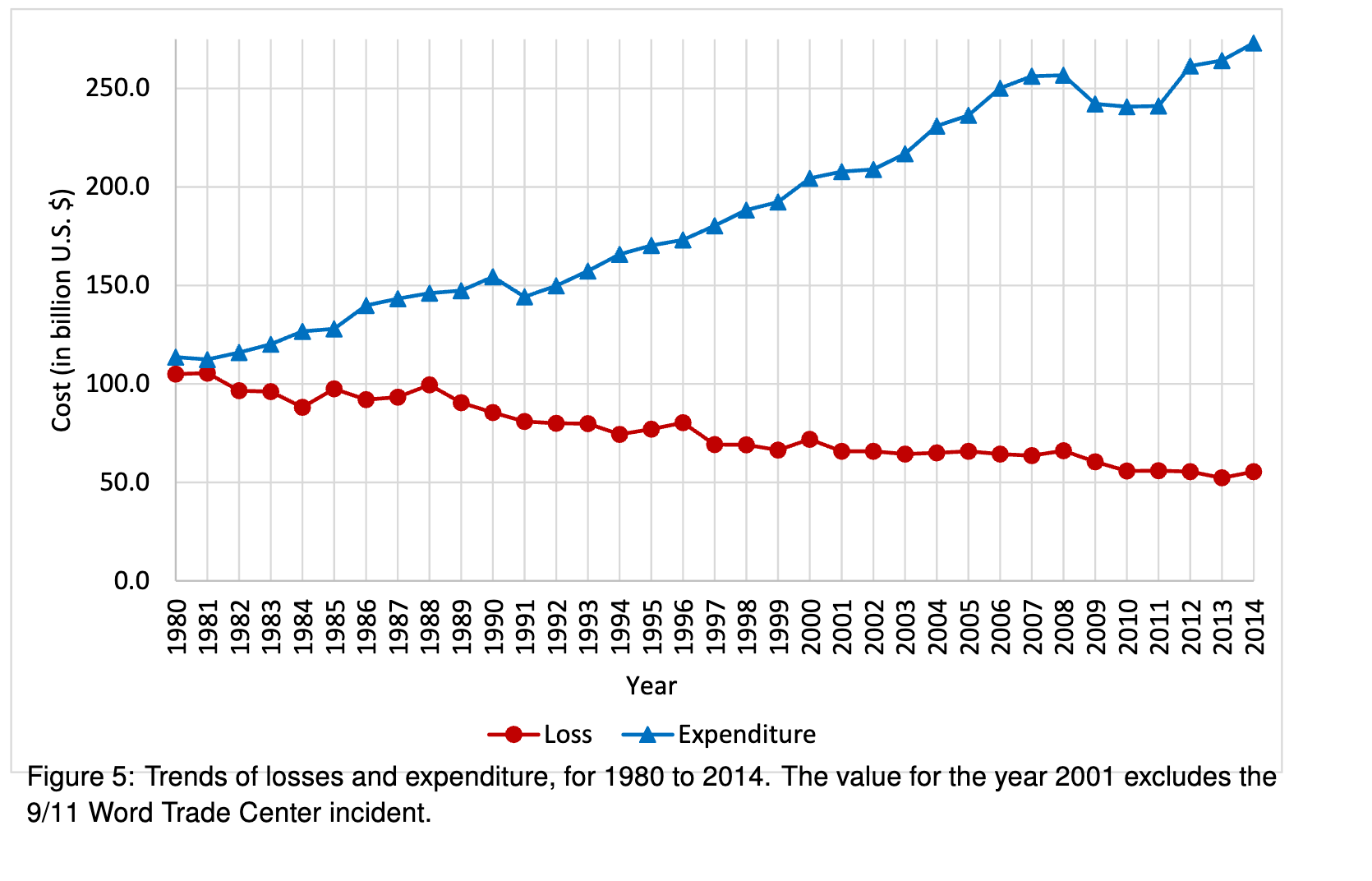
Here is a graph from the National Fire Protection Association’s Research Foundation. They’re estimating how much money the US spends on preventing and fighting fire (which they show in the blue triangles), and how much money they estimate the US loses to fire (the red circles). The costs have been inflation-adjusted to be 2014 dollars throughout.
The losses include things like buildings that got burned down, and also people who died or were injured in fires. You might wonder how they financialise the cost of the lost lives. They use a figure from the US Department of Transportation. The DOT looks at studies of how people trade off risk of death against money. What’s the wage premium for a risky job? How much will they pay for a safer car? And stuff like that. This chart uses the value from a 2016 study, no matter the year.
Between 1980 and 2014, the US increased its expenditure on fire prevention by, eyeballing, $160 billion dollars. And it decreased its losses by, eyeballing, $50 billion dollars. For a net loss of $110 billion dollars. Like, to clarify, this is saying we could have saved way more lives (and saved more property and so on) if we’d spent the money elsewhere, but we chose fire as the place to waste all this money.
That’s kind of weird, right?
Before we go further, I should admit that I took a pretty cavalier approach to interpreting that chart.
For example, I assumed that the 2014 losses would have been the same as the 1980 losses if the US hadn’t spent more on prevention. But that’s probably not true. For example, there were more people in the US in 2014 than 1980 (about 40% more). So maybe, without intervention, the loss of life would have grown similarly to the population. And also, maybe 2014 property is more valuable on average than 1980 property, so if it were getting destroyed at a similar rate, that would be costlier.
Also, this chart, perhaps wisely, doesn’t seem to try and account for effects on economic growth. It accounts for the direct cost of spending on fire safety, but not how that money might have otherwise been invested. Or consider: a lot of economic growth comes from agglomeration (people being able to live near each other and collaborate and find their niche). But slower and more onerous building processes make it harder to get that agglomeration. On the other hand: having houses burn down and people die in fires is also not good for economic growth. My guess is the balance comes out with the expenditures costing more in this calculus, but I’m not going to bank on it.
Let’s just look for a second at adjusting for population growth. Would that change things much? The report estimates the “human loss” (things like deaths and injuries) in 1980 to be $28 billion. Increasing that by 40% would give $40 billion. We could add that extra $12 billion to the averted losses. But, even with that adjustment, expenditures are still resoundingly larger than the averted losses.
People are weird about fire spending
Here’s a quote from the report where that figure comes from (emphasis mine):
[All] of the loss components ($55.4 billion) add up to only 16.9% of the total cost, while the expenditure components ($273.1 billion) add up to the remaining 83.1%. While at first, this may appear imbalanced, in a counterintuitive sense, this highlights the importance of savings provided by the active and passive fire protection efforts, including the fire service. Nevertheless, a conventional cost-benefit analysis may not be practical in the case of fire protection as the potential losses of the resources that are at stake are immense.
I think they’re saying something like “the potential losses of fire are so large, that maybe it’s way more than ten times as bad to lose all these people and buildings to fire than it would be to lose a tenth as many”. But I don’t think that really holds? I’d love for fewer people to die, including from fire, but if fire would cause like 5% of all deaths (rather than about 0.1%), it probably wouldn’t change how well society could function.
In the UK in 2017, a social housing block caught fire and killed 73 people. In response to this, people considered mandating sprinklers in high rises. Part of the government wrote a report on it. I’m going to go into this report in a bit of detail, because I find it so baffling. Listen, I’m sorry that I’m about to show you some tables from a government report, but I am a bit het up about this. I really wonder if I’m misreading. Please help me out if I am!
The report considered three different options:
Do nothing
Require sprinklers and signs in towers >18m
Require sprinklers and signs in towers >11m
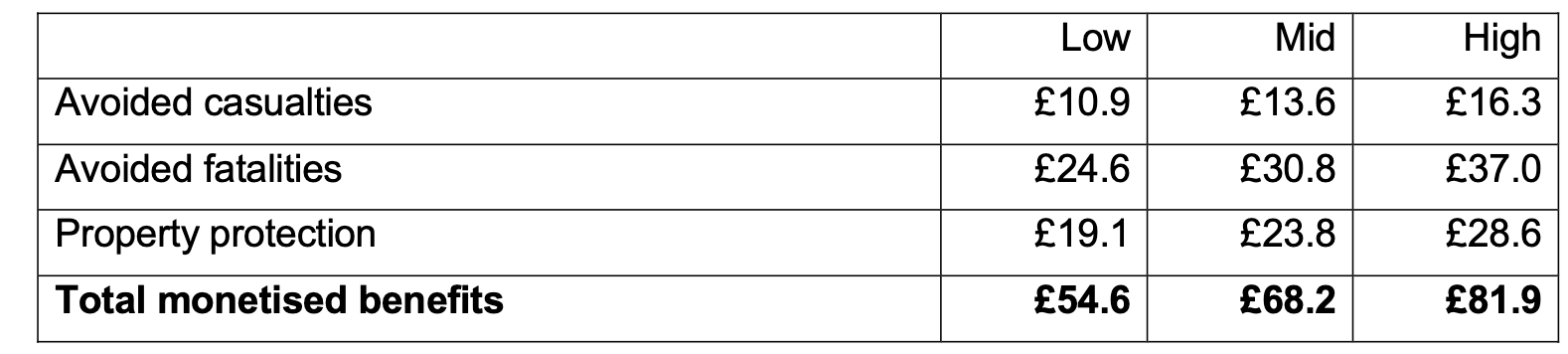
They found that Option 1 would save about £8.4M of lives and health and properties. And that Option 2 would save about £68.2M of the same. Of course, Option 0 saves nothing
For costs, they find that, Option 1 would cost £150M, Option 2 would cost a vast £760M, and of course Option 0 would cost nothing.
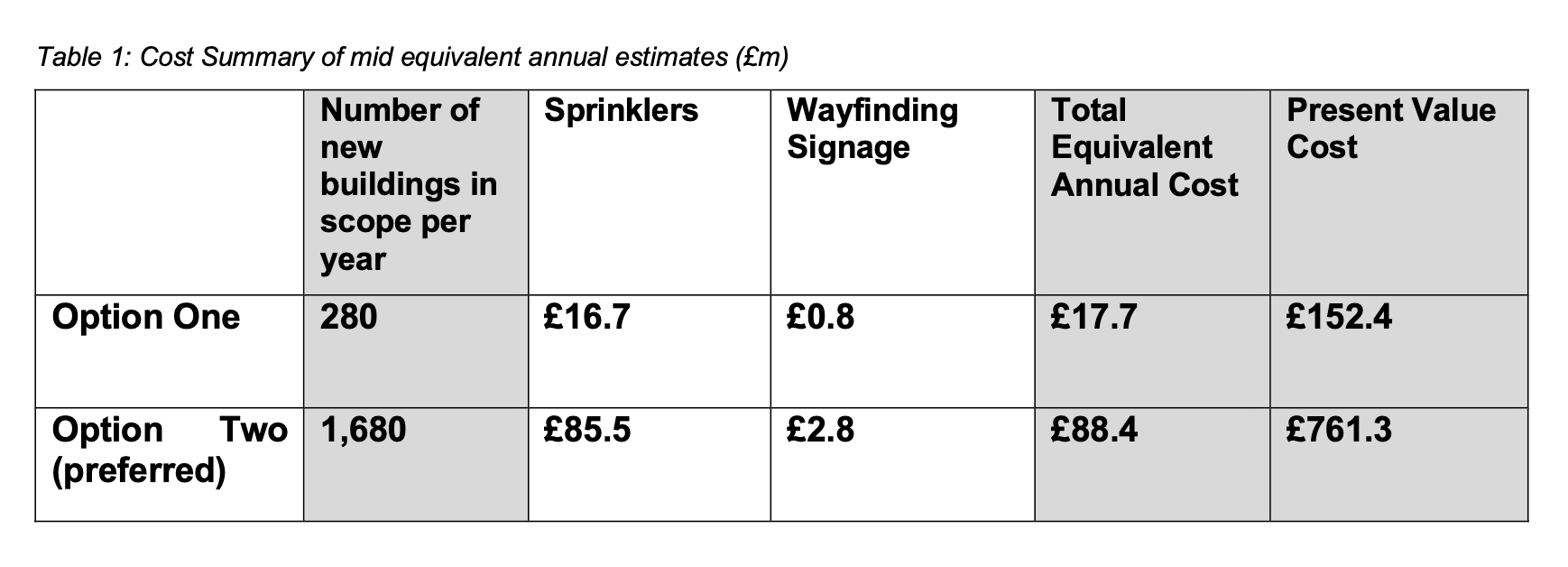
So, Option 0 nets out £0. Option 1 nets out at -£144M. Option 2 nets out at -£680M. What is their preferred option?
Option 2 is the preferred option as we consider this will have the biggest benefit to fire safety in new residential buildings and the fewest risks associated with it.
Why are people weird about fire spending?
Is it because fire is particularly scary, and dying in fire is worse than dying in a car crash? That might make sense.1
Is it because we’re worried about other people’s fires spreading to ours?
Maybe it’s just that there are lots of interventions available to reduce fire death. And maybe, whenever there’s an intervention, we choose to take it.
Maybe it’s that sometimes renters die in fires, and it’s sad that they didn’t get to control their own fire safety. And so we make lots of rules to make landlords make their places very fire safe, because of the additional sadness.
I think I’m currently most inclined towards the scariness theory, but I’m really not sure. If you know, please tell me!