
The Hidden Power of Empty Spaces: Why Your Brain Sees What Your Metrics Miss
Tonianne DeMaria | 3 min read
Stand in front of your Kanban board right now. Notice anything? That gut feeling about something being “off,” even though your metrics look normal?
There’s a fascinating reason why you should trust it.
Your brain has one primary mission: to keep you alive and thriving while using as little energy as possible. It’s not just intuition telling you something’s wrong; it’s millions of years of optimization at work.
A-Ha Moments Need Triggers
Years ago, I was standing in front of Modus’ Kanban board when something caught my eye. Our Done column was overflowing with green “Kaizen Camp” cards, specifically related to six 2-day continuous improvement events spread across four continents, scheduled over the next 6 months. In contrast, our red cards—client work—were still stuck in the Doing stage. Metrics showed us we were completing work efficiently. Our cycle time was good, our throughput was steady.
But the visual pattern our Kanban was surfacing told a different story: we were slowly transforming into an event planning business instead of the consulting company we aimed to be.
The decision was painful but clear. Jim and I looked at each other and knew: we had to cancel at least half of those events to regain focus on our consulting practice.
This insight did not come from a spreadsheet or a quarterly review. It came from my brain processing triggers: thousands of spatial relationships in a matter of milliseconds, spotting a pattern that metrics had completely missed. That one moment of visual clarity led to a crucial pivot in our organization’s business strategy, months before the numbers would have warned us we were off-course.
There’s a reason for that, and it’s pretty mind-blowing.

Triggers are Faster than You Think
You see, when you glance at your board, your brain processes every single card, column, and space between them in approximately 13 milliseconds (give or take). That’s:
- Before you’ve consciously read a single card
- Before you’ve counted any numbers
- Before you’ve calculated any metrics
- Before you’ve even finished your sip of coffee
While metrics force your brain to work hard, expending cognitive energy processing one number at a time, visual patterns are processed automatically and effortlessly. In the time it takes you to start thinking “I should check the metrics,” your visual cortex has already:
- Mapped every work item’s position
- Detected unusual clusters
- Spotted irregular gaps
- Identified abnormal patterns
- Compared this pattern to boards you’ve seen before
Think about your last major process breakthrough. Did it come from studying numbers? Where did you first notice something visually that made you dig into the metrics? Those moments where you step back and say, “Wait – why do we always have a clump of cards right there?” – that’s not just a casual observation. That’s your visual cortex processing thousands of spatial relationships simultaneously, spotting patterns that your metrics might take weeks to reveal.
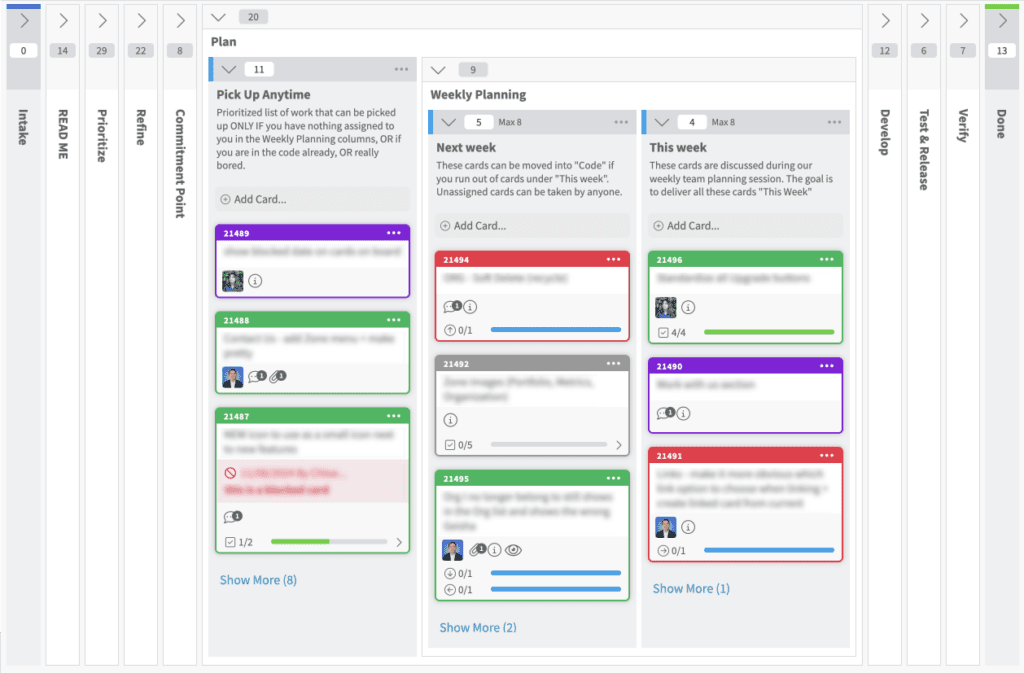
Try this right now: step back from your board. Don’t count anything. Don’t analyze anything. Just look. Those empty spaces between cards? Those aren’t just gaps – they’re your workflow telling you a story. The clusters aren’t just cards waiting; they’re signals your brain processes automatically, using the same pattern recognition that helped our ancestors spot hungry predators rooting around in the tall grass of the savannah.
So the next time someone asks for more detailed metrics, remember: your visual system evolved to spot a predator in the brush from 100 yards. It can certainly spot a process problem before any spreadsheet.
The real magic of Kanban is not in the cards – it’s in the spaces between them. And your brain has been optimized to read those spaces since before humans invented counting.
Want to improve your flow? Stop staring at numbers and start trusting what you see. Your prehistoric pattern recognition might just be your most advanced process improvement tool yet.
Learn to Work Smarter, Not Harder!
Receive a weekly email of our latest blogs.

Turn intentions into progress.
Broken Systems Break Great Teams
Build a system that keeps your team aligned, focused, and delivering results.


- W. Edwards Deming’s System of Profound Knowledge: Managing Variation and Improving Flow
- Margaret Wheatley’s Leadership and the New Science: Leading Through Connection and Chaos
- Derek Cabrera’s Systems Thinking Made Simple: A Four-Step Framework for Structuring Any Workflow
- Michael C. Jackson’s Systems Thinking: Creative Holism for Managers: Managing Complexity with the Whole in Mind
- Gerald Weinberg’s An Introduction to General Systems Thinking: Seeing Patterns in Workflows