OpenAI, the core of this bubble, the part of the pyramid that if somehow falls or goes missing, the whole pyramid collapses, is in a very serious fundraising round estimated to be around $100B. The most ever raised for a private company, from what I recall. This is quite an achievement for OpenAI, for a company that struggled to raise a round of $40B in 2025, had to split it into two tranches, and urgently called existing and new investors between those tranches to confirm they were still committed to the round and whether they could add additional funds, because if not, OpenAI would fail. But now, somehow, they are in advanced talks on a round to raise $100B, with Nvidia, Amazon and Microsoft making up to $60B of this round?
How did Sam pull it off?
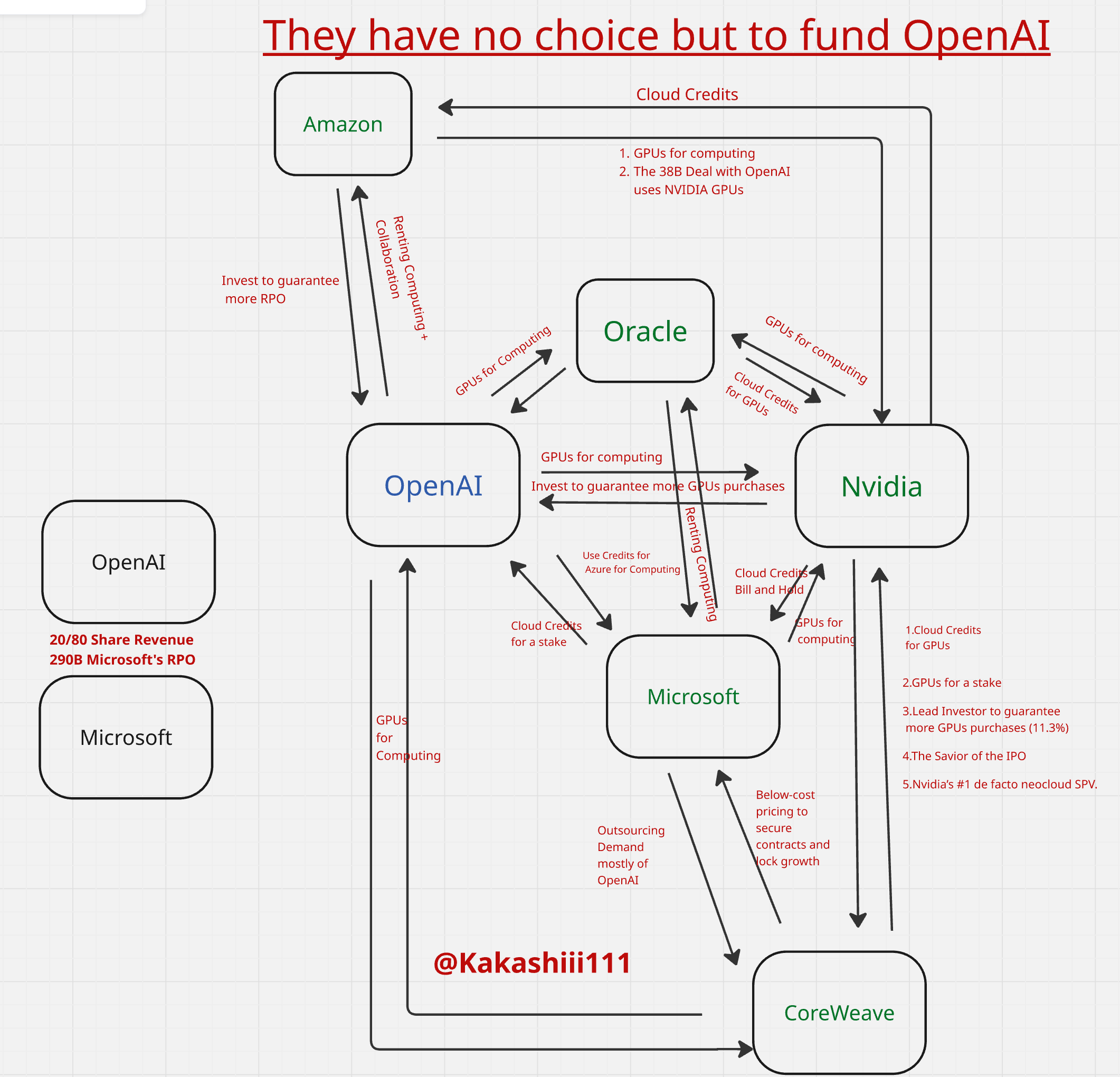
Well, he knew that hyperscalers need to show impressive RPO to investors to justify their capex estimates, and he knew that Nvidia needs the “Beat and Raise” cycle to keep going. So starting heavily in Q3 2025, he began throwing dozens of non-binding commitments to all these companies worth up to $1.4 trillion in total. They were all happy to take these commitments, not asking too many questions about where the money would actually come from, because it’s OpenAI. They will always get investors, right? And while it did not concern these companies at first, because they needed it, it started to concern public investors in Q4 when OpenAI did it a little too much. And now there is no going back. So what do you do? Everyone depends on OpenAI now, and they have to honor these commitments to show investors and Wall Street that these numbers are real.
Yep, Sam succeeded in the mission.
He knew these companies would have no choice but to keep the circle going and invest heavily in them. That is why Nvidia, Amazon and Microsoft are going to heavily participate in this upcoming round, estimated at an $800B-$850B valuation.
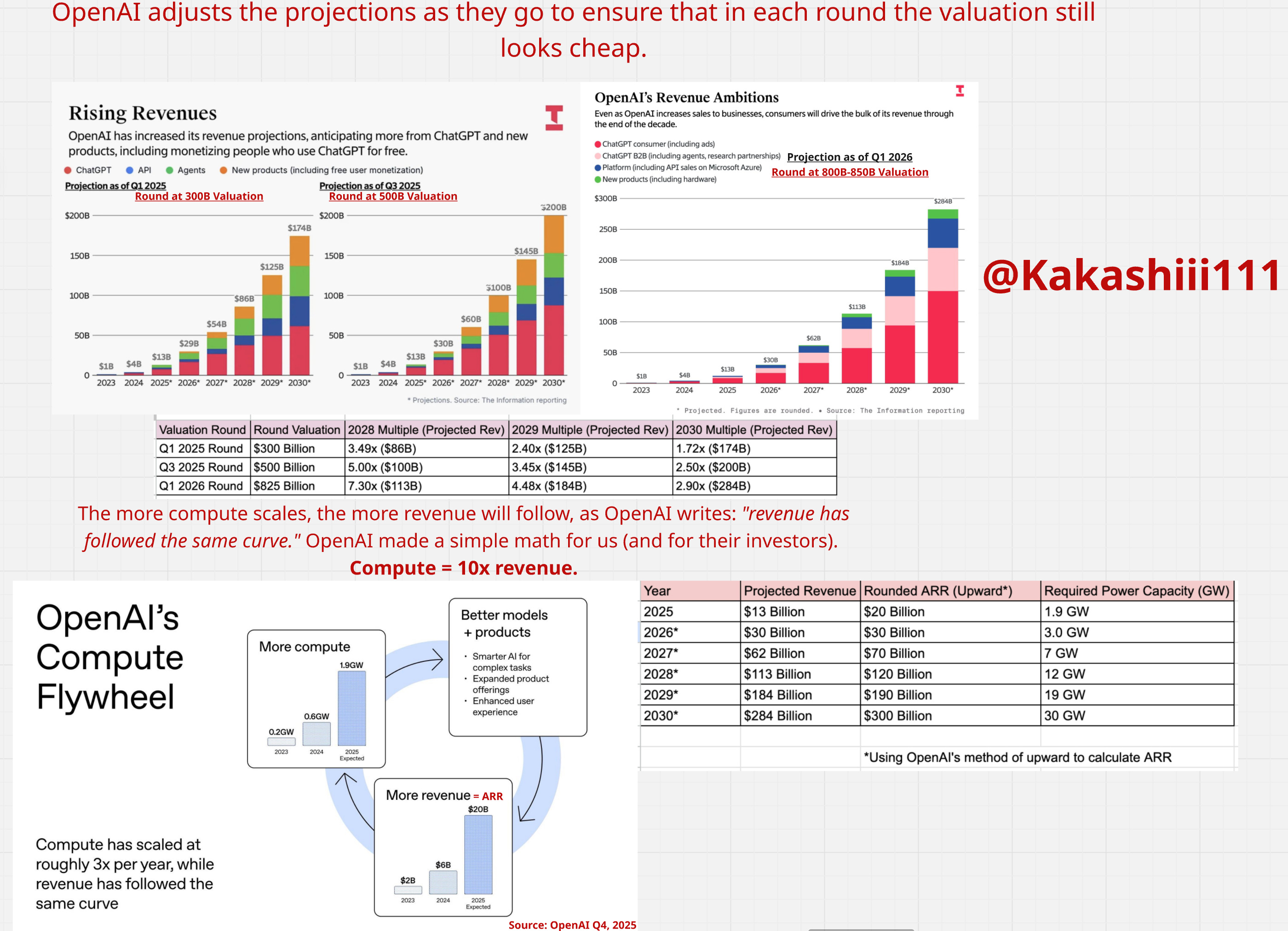
Now, look at OpenAI’s projections below and how they evolved from Q1 2025 to Q1 2026. First they estimated Agents and new products such as Sora, and now new products in hardware (a speaker?) and ads. It does not matter that none of these actually exist yet and it is all speculation.
The most important thing is to make sure the projections look cheap in each round, and therefore OpenAI make sure to adjust its revenue projections as it goes.
Finally, in Q4 2025, OpenAI posted a slide explaining to us, and to their investors, what they call “OpenAI’s Compute Flywheel.” This means the more compute scales, the more revenue will follow, as OpenAI writes: “revenue has followed the same curve.” OpenAI made a simple equation for us, and for their investors. Compute = 10x revenue.
2023: 0.2GW = $2B in revenue. 10 times.
2024: 0.6GW = $6B in revenue. 10 times.
2025 (expected): 1.9GW = $20B in revenue. 10 times.
Coincidentally, or not, GW = 10x revenue. Almost as if someone made sure it would be exactly that clean.
So if we apply OpenAI’s own formula:
2028 + 2029 = 30GW = $1.5 trillion in total datacenter costs
2030 = 30GW = $1.5 trillion in total datacenter costs
That is $3 trillion in datacenters between 2028 and 2030. Just for OpenAI.
I hope Satya “I’m good for my $80B” is ready for what is coming.