Hi there, and welcome to The Next - my take on health, wellness, and company building.
If you missed past episodes, I recommend checking out The Great American Poisoning, my manifesto on what’s going on with our chronic disease crisis.
A few months ago, my friend Lenny Rachitsky asked me to write a guest post for his fantastic newsletter, covering some of my favorite tools and products for living a healthy life. I thought all of you would enjoy, so am sharing part of it here. Enjoy!
***
In 2011, I was working for my first company while also taking a full college course load. As a committed Tim Ferriss acolyte, I read a blog post about polyphasic sleep. For a whole month, I slept 3.5 hours a night and took a 20-minute nap every four hours, even if that meant leaving class or coming late to a fraternity party.
This was insane. After a month of polyphasic sleep—and two crash-outs where I slept 18 hours in a row to recover—I realized it wasn’t for me. But what was for me, and what I’ve mostly stuck to in the 14 years since, is the paleo diet, which read about in the same blog post.
I went paleo for two weeks my junior year of college (yes, I was the weird kid who would pass on the pizza and beer). And during this two-week experiment, my acne disappeared, I got leaner, slept better, and just had more energy.
As it turns out, what you put in your body affects how you feel! If you’re not healthy, you’re not able to perform at your best, period. This is why so many in Silicon Valley are so obsessed with sleep tracking, diet, and other tools to help improve performance at work.
Unfortunately, the West is in the throes of a chronic disease crisis. Americans today are the sickest population of humans to ever exist. Nearly 50% of adults have prediabetes or diabetes, 73% are obese or overweight, and the richest American men live 15 years longer than the poorest, almost entirely due to chronic disease burden. Diabetes alone has an economic cost of around $106 billion.
In this post, I won’t cover traditional health tips (exercise, get eight hours of sleep, etc.), though they’re crucial. Instead, I want to cover some of the lesser-known health gotchas that consistently sap your health. I’ve spent the past decade of my career building companies in this world: first with Kettle & Fire (now a $100M+ annual revenue brand) and now with Truemed. And I’ve spent hundreds (thousands?) of hours searching for products that are the most effective both at driving real health outcomes and at avoiding many of the common toxins, microplastics, and other unhealthy compounds we encounter on a daily basis. Here are my most recommended products:
Getting good sleep is among the most critical things you can do to improve your health and set yourself up for peak work performance. There’s a ton of literature on why sleep is so important, but for the purposes of this post I’ll assume you’re already a believer.
In my view, the 80/20 of sleep health boils down to three things:
Exercise during the day
Get morning sunlight
Optimize your sleep setup (no external light, quiet, low CO2, cold) as much as possible
Beyond the basics, I’ve found a few products that really help me get my best sleep. I love my Eight Sleep, and have found their pod works incredibly well to help me both increase my deep sleep and avoid wake-ups. For those who have trouble falling and staying asleep, magnesium has been shown to radically improve sleep quality. I think the Momentous magnesium L-threonate supplement is the best out there. If you’re really, really struggling to get to sleep, I have a few friends who swear by the peptide Epitalon . . . though it’s technically a research chemical, so I can’t point you anywhere to get it. Ask your doctor. Or buy it illegally online, but beware of sourcing!
Studies have found that mattresses can be a source of harmful chemicals (especially foam ones), as they emit phthalates, benzophenones, and other compounds that have been linked to asthma, developmental issues, and reproductive harm. Sadly, many of these chemicals have not been thoroughly tested (thanks to the insane way we regulate chemicals in the U.S.), but the few studies we do have are concerning.
You may or may not know this, but our current approach to chemical regulation relies on industries to run their own tests and make their own assertions that the novel, never-before-seen chemicals they’re inventing and putting in our products are safe and sound.
When a pharma company invents a drug that humans take, it goes through a rigorous FDA approval process that takes a decade and is tested for safety. When a chemical company invents a compound that your body can’t break down and ends up in food, the water supply, and our bodies, regulators require . . . nearly nothing. How does this make sense?
It gets worse! That’s our approach to new chemicals. But for the chemicals there has been safety testing for—the thousands that we know are harmful at some dose but where the dose makes the poison—how are exposure limits determined?
To determine exposure limits, scientists follow a relatively simple process. First, they’ll expose a lab animal, often a rat, to small amounts of said chemical. They’ll then sit and watch for behavioral changes: Does the rat slow down, look like it’s in pain, or start wobbling a bit?
They then continue to increase the dosing of the suspected toxin until they observe behavioral changes in the rat. At that point, they take the dose they exposed the rat to and multiply it by a “safety factor” (usually 100) to account for the difference in weight between rats and humans. And that’s it. Anything below the dose number that’s spit out is now considered . . . safe!
To ensure you’re not inhaling toxic compounds that mattresses often off-gas (like VOCs, benzene, and formaldehyde) while sleeping, I highly recommend the Woolshire pillow, the Avocado mattress and pillows, and Coyuchi sheets. Besides Avocado, I have heard good things about Essentia and Naturepedic. And lastly, if you have $80,000 burning a hole in your pocket, I’m sure you can’t go wrong buying Hästens (though I wouldn’t know). Apparently, Drake bought eight of these mattresses for his Toronto home.
Your skin is the largest organ in your body, and it consistently absorbs compounds and chemicals that it’s exposed to. Yet we rarely think about what’s in the clothes we spend nearly all our time wearing.
Even though many clothes use dyes and chemicals known to be hazardous, there’s no such thing as a nutrition label, or even a disclaimer, as to what might be in the clothes you put on your body.
Turning fibers into clothing is a complicated and chemically intensive process. Thousands of chemicals are used to make clothing, some 10% of which have been shown to disrupt the immune system, increase cancer risk, mess with hormones, and create reproductive issues. Even worse, the fun, stretchy performance fabrics you love to wear probably have the highest level of chemical treatment, and heavily utilize PFAS (forever chemicals) and PBDEs (chemicals used as flame retardants). This could be one reason why PFAS are found in 97% of Americans’ blood.
It’s unfortunately not just the chemicals, dyes, and other additives that make your clothing choices important for your health. Extremely common materials like polyester can lower sperm count, yet it’s by far the most popular material used in underwear. These fabrics, and the dyes and chemicals on them, can fairly easily enter the body, especially in areas where your skin is most permeable: your nether regions, feet, and armpits.
I strongly recommend at minimum wearing toxin-free, organic cotton or linen socks and underwear. My favorite brands are Industry of All Nations and Pact for underwear (Nads as runner-up), and Pact for socks.
For shirts, I like Paka’s stuff, especially their T-shirts, as they use a blend of 85% organic cotton and 15% alpaca fibers. Faherty has a surprisingly good selection of organic tees that I’m into. And lastly—though I probably shouldn’t share my secrets—Wax London is my go-to fashionable brand that has tons of organic options.
This is the area I feel most passionate about. The Standard American Diet (SAD) is terrible. Right now, many Americans get 55% of their calories from ultraprocessed foods. The typical American diet is often bereft of nutrients, is riddled with toxins, and has created the sickest population of humans to ever exist on this planet 🇺🇲.
In large part, this is because we have a food system that is uniquely permissive in what it allows in our foods. Worse, international companies (like Mondelez) actually have American versions of the same product, where the American version is simply more processed!
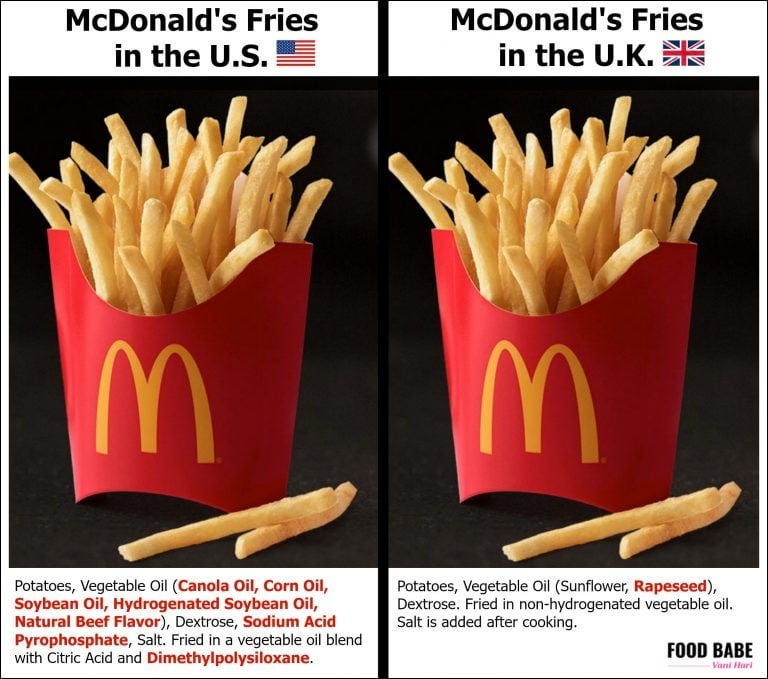
When it comes to sourcing foods, the biggest things to optimize for are (1) nutrient density and (2) toxin avoidance. The most nutrient-dense foods are sourced more locally, which inherently means eating seasonally. The farther your food travels, the less nutrient-dense it is. One study found that after nine days of travel, spinach was 90% less nutrient-dense than it was at harvest. Here in Austin, I am fortunate to live near an amazing grocery store (Radius), but many major cities have excellent farmers markets or grocery stores to buy local.
Beyond nutrient density, it’s important to mitigate common toxins like pesticides (glyphosate, atrazine), phthalates, microplastics (though it’s nearly impossible), and PFAS. That means buying organic where possible—especially the most-sprayed fruits and vegetables, called the “dirty dozen”—and, again, buying whole, unprocessed foods that require fewer chemicals to ensure some amount of shelf life. There are certifications (like glyphosate-free) that are fairly good signs that you’re buying from a brand that cares about sourcing, but these are few and far between.
Beyond those principles, there are a few foods from companies I feel comfortable recommending:
Protein bars/snacks: I absolutely love these Maui Nui meat sticks. Maui Nui has the best-sourced meat I am aware of, anywhere in the world. (We partnered with them at Kettle & Fire.) They actually hunt and harvest the animals they make the jerky from, and it shows in the taste and nutrient density of their meat sticks. It should be no surprise, but when animals live a longer time, forage, exercise, and are outside for their natural lifetimes, well, they tend to be more nutrient-dense and protein-rich: exactly what Maui Nui products are.
I prefer these sticks to a protein bar most of the time. But if I’m running low, I absolutely love the Jacob bar in a pinch. Just be sure to avoid David bar. 😉Bone broth: You probably knew I would say this, but I drink at least a carton of Kettle & Fire bone broth each day. We made the first wild-harvested bone broth (with Maui Nui), which is my go-to. But all our flavors are good!
Beef: People should be eating far more organ meats, because they’re such a great source of key amino acids and other nutrients. I love Force of Nature and their ancestral blend, which makes it easy to get organ meats in your diet while also buying some of the highest-quality regenerative beef out there. White Oak Pastures also does an incredible job from a sourcing standpoint.
Coffee: This is a tough one to source locally. I buy a lot of coffee from the Groundwork team, who have worked hard to build one of the only regenerative coffee supply chains in the world. Bonus points if you want to stir in some $400 manuka honey (which is apparently lightly psychoactive, though I haven’t personally tried it).
At this point in my life, there are very few national food brands that I support, as I tend to prefer buying locally and seasonally where possible. Scaling a food business while maintaining high standards is extremely difficult, and, to be frank, most companies out there don’t do a good job. Even Whole Foods’s beef has a high degree of phthalates!
Many supplements are a waste of time and money. Much (most?) of what you’ll find on Amazon is probably fake, overhyped, or doesn’t have enough effective ingredients to do anything. A recent consumer test found that 4 of 6 creatine gummy brands contained no creatine at all!
For almost everyone, getting core nutrients and amino acids from whole food sources is far superior to getting them from supplements. That said, many folks are still missing some of the building blocks the body requires to thrive. That’s where supplements can come in, to . . . supplement the diet. Some I like and recommend:
Protein powder: Protein is key, and most Americans don’t get anywhere close to the recommended 0.36 grams per pound of body weight. For those looking to increase protein intake, Equip is probably my favorite protein powder, with the Momentous whey a close second. I would recommend avoiding plant protein powders, as they (1) basically don’t work and are not bioavailable, and (2) are often made from pea or soybean protein, which is among the most pesticide-sprayed crops out there. For example, a Mamavation test found Orgain’s organic pea protein powder had glyphosate levels roughly 1,000 times higher than recommended.
Beyond protein for building muscle, Americans also criminally underconsume collagen and gelatin, both of which are key building blocks for healthy joints, skin, hair, and gut. I have four or five servings of collagen per week (on top of my daily bone broth) and recommend the collagen from Equip, Momentous, Lineage, and a company I started years ago, Perfect Keto (if you want the extra boost that comes with coconut fats).Creatine: Creatine is a naturally occurring amino acid stored in muscles and the brain that helps with energy creation. It’s been safely used by bodybuilders since time immemorial and is increasingly associated with a host of mental performance benefits. Pretty much the only creatine I would buy is Momentous, as they are one of the only non-Chinese-sourced brands out there.
Nattokinase: This is a new compound that I am very bullish on. Heart disease is the leading cause of death in the U.S., and 70% to 80% of heart attacks are caused by atherosclerotic plaque. Certain dosages of nattokinase (at least 10,000 fibrinolytic units) were found to be more effective than statins at reducing arterial plaque, a significant contributor to heart disease. For the many folks whose labs show high cholesterol or concerning ApoB/Lp(a) markers, I think taking nattokinase preventively is a good idea. I’ve been taking Toku, which has the clinically effective dose plus vitamin K2 (I also invested in the company). A friend found recently that his ApoB dropped 16% and his LDL came down 20% after 60 days of taking Toku. Josh (the founder of Levels) found similarly!
B vitamins and MTHFR: If you’re like me—and 30% of other people—you may have some variety of the MTHFR mutation. This mutation impairs the body’s ability to detox and can lead to higher levels of homocysteine, an amino acid in the blood that, at elevated levels, is linked to increased risks of heart disease, blood clots, strokes, and cognitive decline. I take this B complex from Thorne daily to help with methylation (basically, how your body clears toxins) and give my body support to detox and function the way it should.
Organ supplementation: As I’ve mentioned, organ meats and connective tissue contain key amino acids and nutrients that are not found in muscle meats like steak or chicken breast. Unfortunately, most Americans primarily eat cuts of muscle meats, and thus don’t get many key amino acids in their diets. I get it: eating straight kidney and liver can be gross! Many people (aka me) prefer supplementing with organs in capsule form. My favorite organ supplement is from Maui Nui (a partner of my company Kettle & Fire), which I believe sources the best and most ethical animal protein in the world.
Outside of those daily staples, I have a whole host of supplements I’ll take for specific life events, often from brands like Momentous or Thorne, which both have good sourcing practices. For example, when I’m sick, I follow the Huberman protocol and take 600 to 900 milligrams of N-acetylcysteine (NAC), along with 100 mg of zinc, per day for three to five days. I take AHCC and astaxanthin to help my body fight off the infection. I also mega-dose vitamin C and try to spend at least 30 minutes in the sauna.
Though this regimen seems to help, nothing is better than not getting sick at all. That’s why whenever I fly, I use Viraldine before getting on the plane to prevent catching anything.
To check out the rest of the post and see my thoughts on toxin mitigtation and everyday items, keep reading here!
Some of my favorite things since the last newsletter (note: I don’t get paid to recommend anything here):
📰 Article - I’ve long been a fan of Dominic Cummings and his writing on fixing/improving governance. His writing on the startup party and fixing the political rot that’s infected many western institutions is well worth reading in my view, even if you disagree with many of his specific beliefs.
At the least, I find him an interesting and coherent thinker, writing about one of the biggest opportunities of our time: reforming and improving our political institutions that seem wildly unresponsive to the will of their constituents.📚 Book rec - I’ve been on a real presidential biography kick. There’s something reassuring to reading about the trials and tribulations of our past presidents and founding fathers. Reading their biographies, I can’t help but feel like yes things are crazy now, but there have been many times before that it seemed like America just might not make it. I’m currently reading Team of Rivals about Lincoln and the heroics he went through to navigate the country through civil war, and bring it back together again afterwards - highly recommend!
⌚ Cool product - I’ve been reading more on the importance of training your grip. Grip strength decline is a leading indicator of aging: it’s seemingly neuroprotective and very good for you to train your grip strength and keep your neurons and grip muscles firing and engaged. I just purchased this grip strength trainer which I’m going to try for 2 months and see how my grip improves!
🎵 Music - This set is great: if you dig it, you’ll also likely enjoy this one from a festival I went to a few years back. It’s one of the few I still listen to on repeat years after!
🏀 Random - I have been eating way more sugar this summer, starting nearly every day with 1-2 glasses of orange juice and a bunch of fruit. And I feel great, have gained zero weight, and have no crash in the afternoon. I’ll soon be getting my bloodwork done, and will share more about any changes I’ve seen since adopting more of a high-sugar diet. Stay tuned!
🔥Hot take - I have an increasing thesis that much of the political polarization we see today is downstream of biological changes at the population level. Testosterone levels are down 30-50% in the last 20 years (depending who you ask), which makes men less active in finding mates. As men date less (and the number of sexless men reaches all time highs), the two sexes fail to pair up. Getting married and dating has a naturally moderating effect on both men and women: the lack of pairing could explain why single men and women are politically so far apart.
I realize I may be the proverbial man with a hammer here, but I strongly believe one of the highest leverage political interventions might just be cleaning up our food system and making the population healthy once again.
***
Thanks for tuning in for another episode. If you enjoyed this, please forward to a friend or colleague that might find it interesting. That’s (really) the only way that this little side project continues to grow!
Justin