Hello,
This is a retrospective of my game, Deep Space Exploitation, which I released 1 year ago on 2025-11-06. I find these retrospectives really useful for learning but also important contributions to the gamedev community, so I wanted to spend some time to write up a decent one. Before I get into it I'll say that the game was neither a flop nor a hit, and possibly only a success on my own terms.
I'll quickly say that I'm currently working on my next game, Terminal Reign, and it would be really cool if you took a look to see whether it's your thing. (Itch, Steam).
This is going to be quite a lengthy post with stats, thoughts, graphs, and a general documenting of the game's development and life after release. Here's the contents if you want to jump to anything in particular:
1. Development and Release
1.1 Inception
1.2 Development
1.3 Marketing and Events
1.4 Release
2. Finance
2.1 Expenses
2.2 Pricing the game
2.3 Revenue
2.4 Evaluation
3. Post Release
3.1 Reviews
3.2 Play Stats
3.3 Game and Content
3.4 Opportunities
3.5 Evaluation
4. Thoughts
1. Development and Release
1.1 Inception
I left my job as a software engineer in 2024 to have a go at living the dream of making my own games as a full time thing. My experience up to that point was 8 years of software engineering, a computer science degree in games programming (like a typical comp-sci degree but with graphics modules), a handful of game jams, and plenty of toy projects that never went anywhere. My motivation was to be able to work on my own ideas every day and just do that as a sustainable business, not necessarily to make it big.
The idea I decided on for my first game was a small and satisfying space mining game that combined arcade-like elements with 2D environment destruction and a short story to make it all hang together. I want to primarily make small games, but it seemed like a good idea anyway to stay small so I could more quickly see whether my plan was going to work out.
1.2 Development
The whole project took roughly 13 months, start to finish, including inception, development, marketing, and release. All work was done by me, except OST + SFX (by the fantastic JD Sherbert), and the capsule art (by a good friend). For the game's engine I used my own local forks of a monogame-like framework called Ultraviolet and a C# port of Box2D called Velcro, and then my own "engine" code that I'd written on top of that over the years while messing around with side projects. I didn't use any Generative AI at any point in development (that includes code), and don't intend to for any future projects.
Development went pretty smoothly, the core loop came together quickly, I found the gameplay engaging enough to encourage me to continue, and I was having fun working on the interesting parts of the game. There were a few times were I felt like I'd wasted weeks of development time on features that were either unnecessary or unused, and this caused me quite a bit of stress, but looking back I think this is just the nature of development. I think it was important that I got to do some things that I enjoyed that might be considered time wasters, like working on details that appeal to me, or writing devlogs, because ultimately I want to enjoy the whole process and not feel like I'm at work.
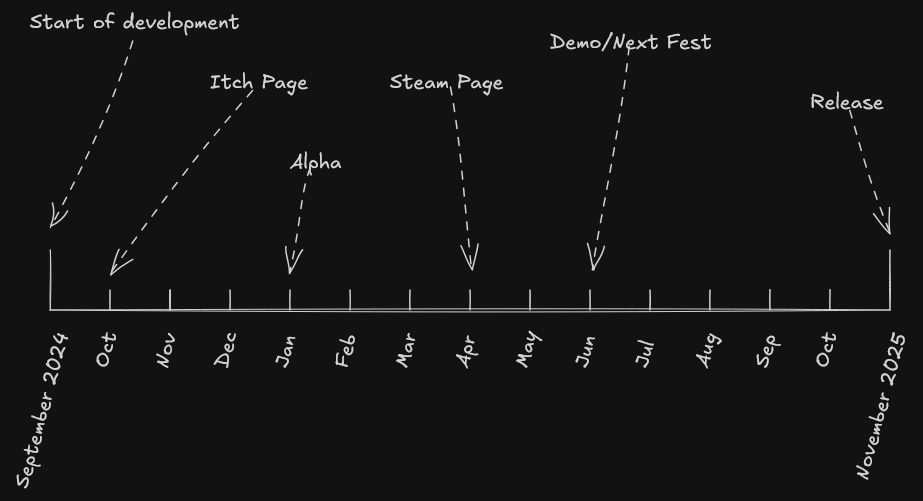
As a rough timeline, I started development in September 2024, made an Itch page in October 2024, released an alpha in Jan 2025, created the Steam page in April 2025, released a demo in June 2025 for Next Fest, then released the full game in November 2025. At each stage I felt like I was behind and running out of time and blowing the whole thing. For my current project I've realised that I don't need to feel like this, and can just take things at my pace.
1.3 Marketing and Events
Marketing went decently but was an uphill struggle, which is most devs' experience of it, I think. Throughout the project I was posting gifs to Reddit, some of which really popped off and got to the top of various subreddits, but most of which ended up with single digit upvotes. I was also posting to Bluesky and various Discords, which I think is important for connecting with people, but I wouldn't consider it serious marketing activity. I was pretty consistent with devlogs, and a proud moment for me was when my devlog about pathfinding made it to the front page of Hacker News. In the run up to release I ran ads on Reddit, which was worthwhile and drove a significant number of wishlists (more on that below). I also built up a spreadsheet of press and streamers' emails during development, which I think had a decent impact by getting a nice number of smaller streamers playing the game, but didn't land me anything with games websites.
One big mistake I made during development was neglecting events and festivals. I didn't quite understand how important they are for raising awareness, and to be honest it felt like an additional job that I didn't have mental capacity for at the time, so I let myself ignore it. This was obviously a silly thing to do, as the reality is that taking part in festivals is very low effort for how high a reward they offer.
I did take part in Next Fest June 2025, though. General advice is that you should only take part in the Next Fest directly before release, so the October one would have been better for me, but I wasn't sure exactly when I'd be releasing at that point, and I think I needed the validation boost of having more attention, feedback, and wishlists to keep my morale up.
1.4 Release
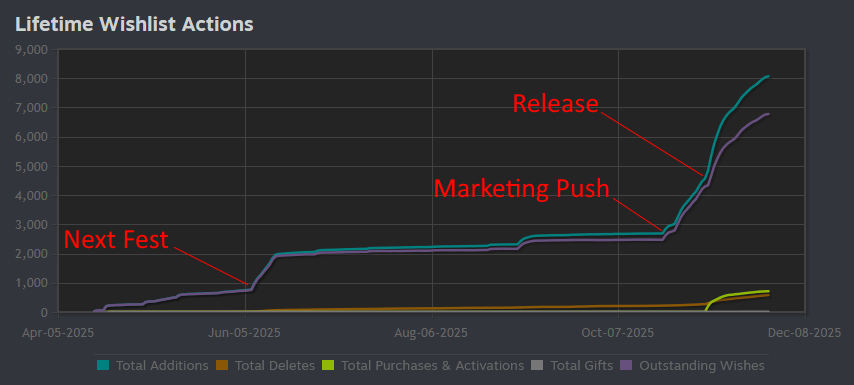
By October 2025 I was satisfied that the game was ready for release, but had only built up ~2,500 wishlists at that point (the advice at the time was to only release when you have around 7000). I decided to release soon, partly because I felt like no huge change in wishlists was going to happen, and partly because mentally I needed to finish the project and see whether it was all worthwhile. Marketing in the run up to release pushed up the wishlist numbers to ~4,300, which I was actually quite satisfied with. I only spent 2 weeks doing a serious marketing push before release, and looking at how well it went, I should have made it 4 weeks and started earlier, or just pushed the release date back (I'd already announced the release date and I like to keep my word). Overall, I think the release went well, but more on that in the next sections.
2. Finances
2.1 Expenses
Development costs included living expenses, capsule art, OST and SFX, and Reddit Ads. Living expenses were on the cheap end of things for the UK since I live in the north and have no car, kids, etc. I paid £375 for the capsule art, £337.50 for OST (2 excellent tracks), £10 for SFX packs, and £700 for Reddit Ads. So development expenses were £1,422.50 (excluding living expenses). Everything was funded from savings, I didn't pitch to any publishers (though I was encouraged to pitch by one publisher, which I just took as a positive sign).
2.2 Pricing the game
For the price of the game I decided on £7.49 ($8.99, 8,79€) based on estimated play time (~5 hours, plus replayability), genre and art, and feedback from testers and friends. I feel like I got this right, or at least didn't make too much of a mistake, since reviews only mentioned the game being great value. Still, when you run some numbers and see how much revenue is effected by upping the price by a few pounds, it does make you wish slightly higher prices were the norm.
2.3 Revenue
Here are the lifetime financial statistics for the game, taken from steamworks on 2026-11-04 (2 days short of a full year from release):
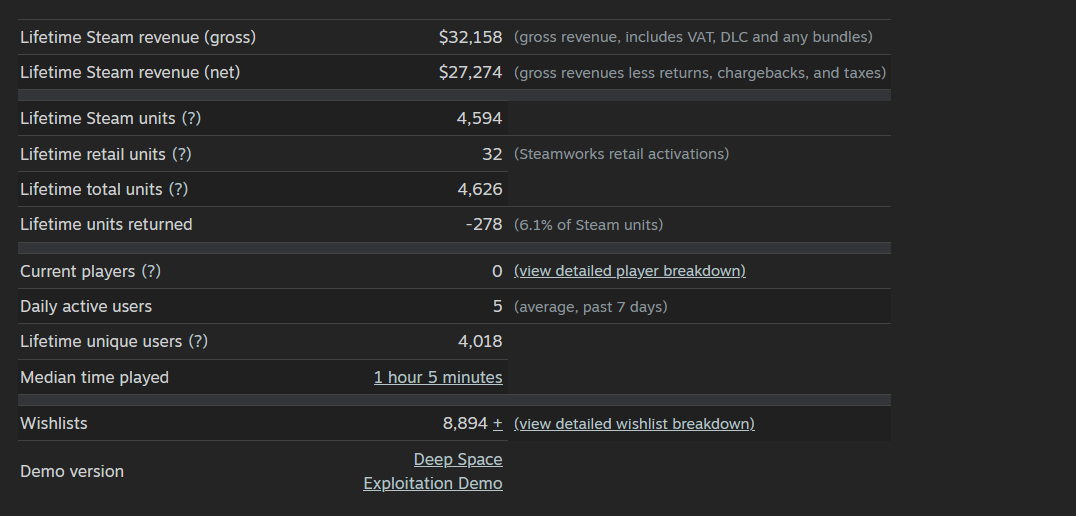
Revenue (Gross): $32,158
Revenue (Net): $27,274
Total Units: 4,626 (32 retail)
Units Returned: 278 (6.1%)
And now looking at after cuts and conversions:
Revenue (After Steam's Cut): $19,091.80 (Minus $8182.20)
Revenue (After FX): £14,204.29 (Roughly averaging the year at 0.744 USD/GBP)
Per Unit (Net): £3.26
I'll also mention that roughly 1/3 of the game's revenue came from two bundles, with games that are great matches. I'll talk more about bundles below in the Post Release section.
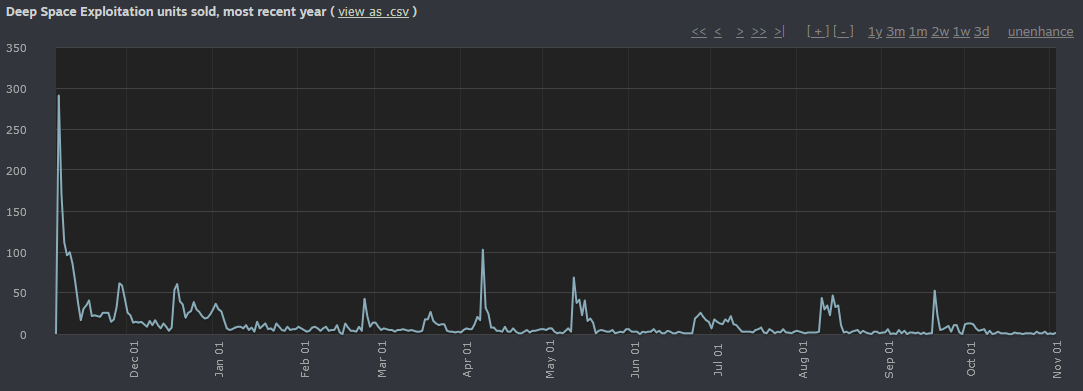
The above graph shows the unit sales over the last year and it gives a good indication of when sales actually happen. You can see that a huge portion of sales happen immediately after release, after which a kind of base line is settled on, then there are periodic spikes. These spikes are from sales and events, and they're where the majority of revenue comes from after the initial release period. Events and showcases perform better than the seasonal Steam sales, because the pool of games you're competing with is much smaller, so it shows quite clearly how important getting into these events are for revenue.
2.4 Evaluation
A few weeks after release I made a post about the release stats and in it I estimated, based on year 1 sales being 3 times that of week 1 sales, that the gross revenue at the end of year 1 would be $21k, so it's nice to have done 1.5 times that.
Judging whether this was a financial success is pretty straight forward: £14k for 1 year's work is not very much at all, especially when UK minimum wage is roughly £25k annually. The amount is low, but then if my goal is to make things that I want to make, on my own terms, and I only need to support myself, then that amount can still go a long way. The main question is whether I think I can improve on this with future projects, and my answer is that I don't know but I want to find out.
3. Post Release
3.1 Reviews
The game was well received and there was plenty of pleasant feedback. The reviews sat at 100% positive for a good few weeks, and right now it's at 97% from 136 reviews. I'm quite proud of this and really couldn't be happier. I do think there's an effect where the smaller and more indie your game is the nicer the reviews are, but I've also seen people be weirdly demanding of features and polish that AAA games don't have, so I'm unsure of how true that is.
Personally, I'm happy with how the game turned out. I tested it a lot throughout development and was surprised that I still found it fun even after spending all of that time with it. Gameplay-wise I think I made something that wasn't completely new, but at least fresh, interesting, and maybe even fun. From a technical point of view I believe I made something quite cool; the game features dynamic destruction in a 2D physics environment that wraps around the edges of the screen, with dynamic pathfinding for NPCs, too. For me, the whole thing works well, was built well, and was received well, so I'd count at least that as a success.
3.2 Play Stats
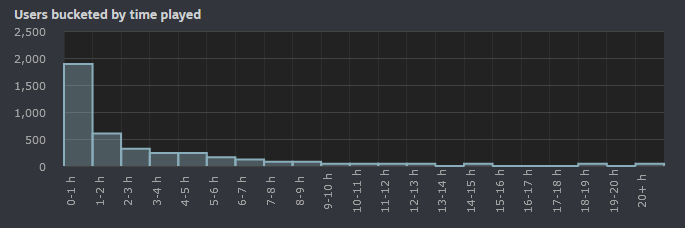
I'm a little unsure of how to interpret the play statistics, as it looks like almost everyone who bought the game played it, but not a huge amount. The current lifetime unique users (the number of users that actually launched the game) is 4,016 out of 4,346 (92%), the average play time is 2 hours 55 minutes, and the median play time is 1 hour 5 minutes. A single playthrough of the game is roughly 5 hours, and estimating from the play time graph above and achievement completion percentages, around 21% of players actually completed the game. These stats might be normal for a small game with limited content, so I've not really fixated on them.
3.3 Game and Content
I released the game in a complete state and as bug free as possible (throughout development I would fix issues as soon as I saw or heard about them. For me, this is the best way to approach things as it means you're always developing on the firmest ground.), so there weren't really any issues that needed firefighting. There was one puzzle element of the story that was badly explained in the game, and this lead to frustration and questions in the Steam discussions, and a negative review. I was slow to fix this because I was stupid and thought the explanation was fine, but when I did this problem went away entirely.
I made one small content update after release, which amounted to a few extra upgrades and a new gun, but apart from that I considered the game finished and was keen to start exploring other project ideas I had. One feature that a number of players requested was a free-play mode, but I wasn't confident I could do it justice (the proc-gen I'd experimented with for the game really wasn't very good), and I was convinced that the work needed for it wouldn't really shift the sales and would just eat into time I could be spending prototyping my next project. I was also possibly too hung up on the idea that the game would be short and would have an actual ending. I still don't feel great about this, but I'm making sure it's a serious consideration for my future (and current) projects.
3.4 Opportunities
Having a finished and released game is actually opens up a lot of opportunities. I'd neglected events and festivals during development, but now that the game is finished all I need to do is pay attention to up-coming ones and apply. This has been essential to actually making money from the game too, as you can see in the sales graph, the recurring spikes from festivals make up a good portion of the revenue. It's also really easy to talk with other developers about setting up bundles. I mentioned earlier that two bundles in particular were responsible for 1/3 of the revenue, and these are the bundles with Delta V and Astronomics. I reached out to the Delta V guys because quite a few players said that my game was like an arcade version of theirs, and they turned out to be super nice and were happy to set up a bundle. The Astronomics guys were also really cool and were generous with a lot of advice. I did try my luck approaching a few hit games about bundles, and I received an "unlikely" from since it was their publishers decision, and another said they were interested and we chatted a bit before they ghosted (that sounds harsh, but I honestly think they were just too busy and forgot).
3.5 Evaluation
Over all, post release was quite a pleasant time. Seeing people be excited and interested in something I made is really very nice, and that coupled with just how much I enjoy making games convinced me that I should stay at this, at least for another project. Many studios do not get the chance to make a second game after their first attempt is less than financially viable, but I'm fortunate enough to be able to stretch both savings and revenue, at least for the time being.
4. Thoughts
There's a lot of debate around the size of game projects and whether studios should start with a small game and then move on to larger projects afterwards. My game ideas tend to be pretty small scale anyway, so that question is already answered for me, but I do think that a 1 year project is a good starting size since it lets you experience the full process in a relatively short amount of time. I think what's more important than picking the size of the game is picking something you actually want to make. I sometimes see other devs making games that really don't seem to be their thing but are suspiciously on-trend, and I wouldn't want to be making my first game and making all these mistakes and learning difficult lessons all while having to work on something I don't care about.
On the whole, I really liked making this game and there wasn't really a part of it that I particularly disliked, so I'd like to keep doing this for as long as possible. Probably the worst part of the whole thing was dealing with my own morale, which wasn't something I'd put a lot of thought into beforehand. Working on a creative project with the goal of selling and making a living from it is quite the emotional roller coaster, and weathering the ups and downs was a serious part of the process because, looking back, there were definitely some decisions that I rushed (entering Next Fest early, for one) because I was feeling low and needed some external validation. If there's any advice I'd feel comfortable giving, it's that you should be take your time with things and try to understand why you feel a certain way or want to make certain decisions.
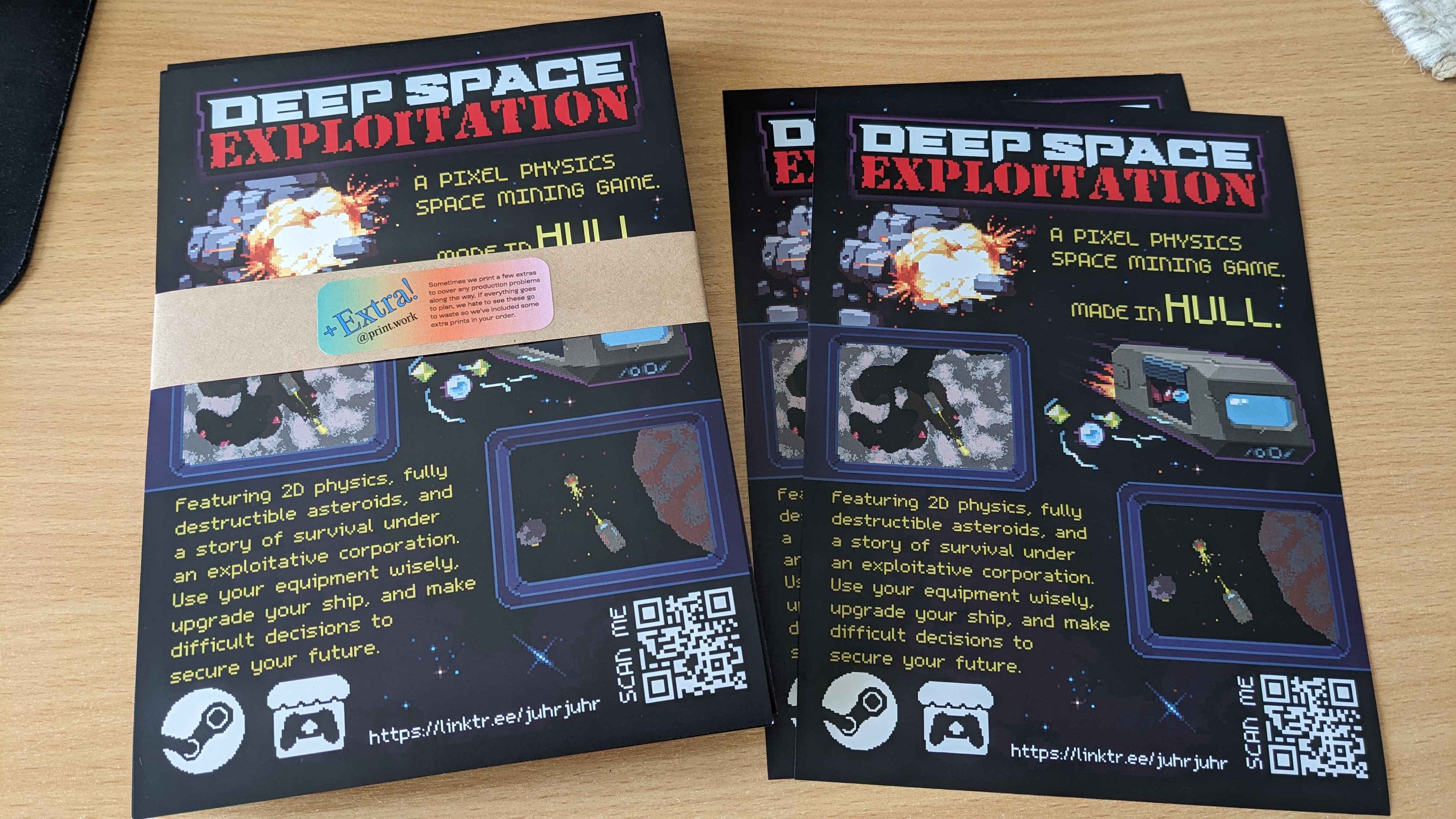
Thanks very much for reading what is quite a rambling stream of conscious post, I hope it's been of some use to you. You can put it all into context and take a look at Deep Space Exploitation on Steam or on Itch.
Since releasing DSE I also developed and released Directory Dungeon, also on Steam and Itch.
And I'm currently working on, Terminal Reign, which you can also find on Steam and Itch.