Author’s note: This essay is opinion and commentary based on publicly available sources on matters of public concern. It relies on publicly available sources, principally Brown, Lane & Martin (2024) and contemporaneous reporting (e.g., Reuters, Aug. 17, 2020). Scene‑setting passages are narrative framing, not claims about anyone’s private state of mind. All factual claims are intended to be supported by those sources. If you spot an error, please email me and I will correct promptly. The people and institutions named here are discussed in their public, professional capacities. Nothing herein alleges unlawful conduct. This is not legal, financial, accounting, or insurance advice. This essay is offered for public discussion and should not be taken as a definitive factual record. See also the Legal Notice & Editorial Standards at the end.
March 2020. Champaign, Illinois.
Jeff Brown looked out his office window, staring at the ghost town that was once the bustling heart of the University of Illinois. It was March 2020. The classrooms were empty, sidewalks deserted. No laughter, no chatter, no backpacks tossed carelessly aside as students sprawled on the grass. Just silence. Heavy, uneasy silence.
Across the globe, COVID-19 had closed borders overnight. Visa offices locked their doors, airports turned into ghost towns, and the vital stream of students from China, students who quietly accounted for more than twenty percent of the business school’s budget, slowed to a trickle. Panic spread through universities everywhere. Budgets tightened. Staff layoffs loomed. Hope faded.
In the eerie silence of that moment, Brown allowed himself a grim smile, feeling a profound, quiet gratitude.
Three years earlier, he'd placed a bet. A huge bet. An almost impossible bet, so innovative and untested that some had called it absurd. He'd fought skeptics, bureaucrats, and an intricate procurement system, even putting his reputation on the line. But now, it was about to save his university millions.
Yet Brown could not share this moment openly. He had to keep it private, like a secret letter tucked into his pocket.
It began in September 2015. After his first faculty meeting as the newly appointed Dean of the Business College, Jeff spoke about an invisible risk: too much revenue depended on Chinese students. Any disruption—a political conflict, a visa crisis, an epidemic—could collapse the university’s carefully constructed finances.
Afterward, as faculty shuffled papers and chairs scraped against the floor, Tim Johnson, a quietly brilliant finance professor with a neatly trimmed beard, thoughtful eyes, and the calm intensity of someone who’d once navigated the high-stakes world of hedge funds, approached Jeff:
“Dean Brown,” Tim said gently, “Have you ever thought about hedging the China risk?”
Brown, an MIT-trained economist who’d advised the White House and spent decades researching insurance markets, annuities, and long-term financial decision-making, felt intrigued but skeptical. "I'd love to, Tim," he admitted, “but the market does not exist.”
Johnson’s eyes sparkled like someone savoring a private joke. “Not yet,” he said, “but it could.”
Within days, Tim Johnson and Morton Lane, a professor who had managed money at the World Bank, run a derivatives brokerage firm in Chicago, and helped pioneer the market for insurance-linked securities, sat down for lunch. Their careers had already defied typical academic trajectories. Both had lectured at the prestigious London Business School, though in different decades, and both understood firsthand how finance could create something powerful from insight, courage, and imagination alone.
As Lane and Johnson sketched out their audacious plan, Jeff Brown lent his full support. They soon realized their best chance was Lloyd’s of London, a market willing to insure anything, even Taylor Swift’s engagement ring. They convinced Andrew Martin, a broker with Besso, a Lloyd’s brokerage, to join their quest. Martin was known for pioneering innovative insurance deals after Hurricane Katrina.
For two painstaking years, they built the case brick by brick: navigating skeptical administrators, persuading cautious underwriters at Lloyd’s of London, and confronting layers of bureaucrats whose careers thrived on caution, whose instinct was always to say no, and whose greatest fear was stepping into the unknown. They pushed through endless procurement requirements and marathon Zoom calls across time zones. Their families saw less of them. They faced relentless skepticism from colleagues who insisted universities simply didn't do deals like this. Yet they pressed on, driven by a quiet sense of duty and a vision they couldn’t yet fully articulate, but felt deep in their bones was necessary.
Finally, on May 1, 2017, after hundreds of calls and negotiations, Illinois placed a groundbreaking insurance policy with Lloyd’s of London: a three-year, $61 million hedge against the sudden collapse of Chinese student enrollment1. If tuition revenue dropped by more than 18.75% due to a covered event, such as a pandemic or government action, the policy would trigger, and Illinois would receive a payout.
It was the university’s ultimate tuition airbag.
Fast forward to March 2020.
COVID-19 did exactly what the policy anticipated. Revenue from China plunged. But just as Illinois filed the claim, the next crisis began, political rather than financial
The policy had a confidentiality2 clause, standard for the insurance world but explosive for a public institution subject to Illinois' FOIA transparency laws.
Illinois had compelling reasons to guard its policy’s secrecy. It was politically sensitive in the 2016 U.S. election year and early 2017, amid heightened debate over immigration and China policy; the university did not want disclosure misconstrued as “taking sides.”3
On campus, administrators likely panicked privately4, that’s my read of the moment, terrified that the crisis would expose their carefully maintained facades, the uncomfortable truth that beneath slogans of “shaping tomorrow’s leaders” and glossy brochures of smiling students engaged in intellectual exploration, their daily anxieties revolved around press releases, enrollment numbers, and image control. Internally, communications planning addressed how disclosure could be perceived and how to explain the policy’s student‑continuity purpose, while recognizing that FOIA can override contract confidentiality.5
Some probably wondered, with surreal sincerity, if the university was “betting against China,” as if they hadn’t long ago quietly conceded institutional values to financial pragmatism. Others likely worried donors, politicians, or students might think the university was prioritizing international students as sources of revenue at the expense of domestic applicants, as if money considerations hadn’t shaped admissions decisions.
The university knew exactly why this was dangerous: openly hedging a risk specifically tied to China could ignite fierce debates about fairness, privilege, and domestic opportunity.
Would American students and families accuse Illinois of putting lucrative international enrollments ahead of their own children?
How would donors react?
Would politicians accuse Illinois of betting against America’s global rival?
The political storm brewing behind closed doors was potentially more damaging than the financial risk they’d hedged against.
So intense was their fear of public backlash that Illinois communications officials quietly prepared talking points for difficult questions: Why single out China? Wouldn't recruiting elsewhere yield better returns? Exactly how many domestic students could replace lost enrollments from China? (per Brown, Lane & Martin, 2024).
Then came the FOIA request.
Reuters struck first, forcing some disclosure6.
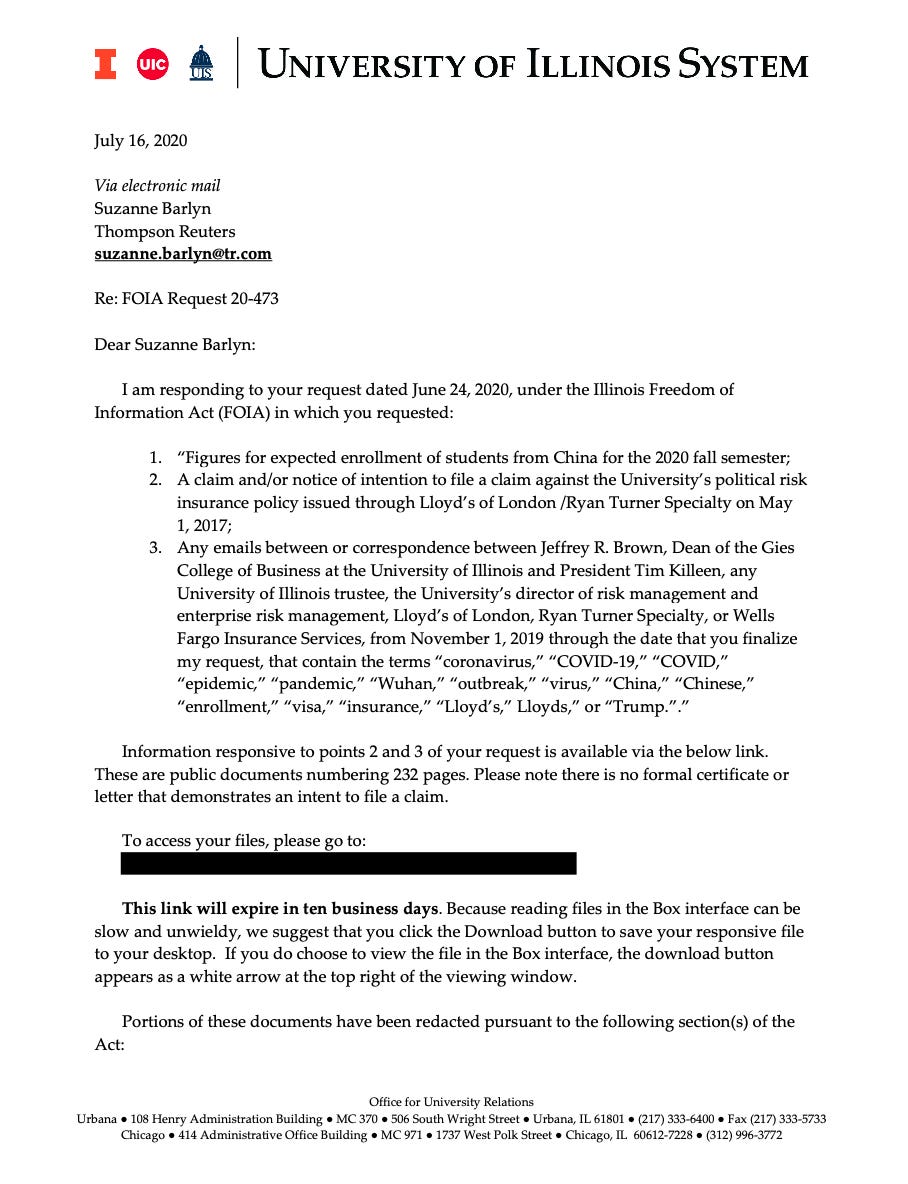
Yet the resulting article in August 2020 barely mentioned the policy’s success, glossing over how the university had averted a devastating financial loss. Instead, to Dean Brown’s deep frustration, it fixated on the difficulty of renewing coverage amid a global pandemic.
But administrators still held their breath. Reuters was challenging enough. What if the next request came from the Wall Street Journal, the New York Times, or the Financial Times? How would they weather that storm?
Just weeks later, another email arrived, precise and targeted, seeking internal correspondence about the policy and its renewal. Staff likely felt the pressure of the workload. Who was behind this meticulously crafted FOIA request? An investigative journalist? A political operative?
When they traced the sender, the fear likely turned into incredulous laughter, as I imagine it, because, per the SSRN account, it was a student from the Daily Illini7, the university's own student newspaper. The kid had zeroed in with remarkable precision, requesting internal emails and detailed correspondence related to the policy, its renewal, and the university's political calculations.
Then, just as suddenly, nothing happened.
One email from a student had come within inches of breaking open one of the most carefully guarded financial secrets in the university’s history. But suddenly, inexplicably, the student went silent. Perhaps homework piled up, exams overwhelmed him, or he mistakenly thought the story too trivial.
That silence cost him dearly. If that student had persisted, he would have exposed the heart of how a public institution navigates geopolitics, finances, admissions fairness, and bureaucratic risk. He could have secured a top-tier journalism career overnight.
He never realized his own power. He blinked, and the moment vanished.
A life-changing moment, abandoned for routine homework. Sometimes, the biggest mistake of your life isn’t obvious until years later.
For every student reading this: Never underestimate your own power.8
When an idea grips you, when something doesn't quite add up, when a thought becomes a quiet obsession: pay attention. Take it seriously. Drop everything if you must, even classes, and follow your curiosity without hesitation. Don’t buy into the myth adults sell about your inexperience, your smallness, your insignificance. But as you just saw, one carefully targeted email from a student nearly exposed one of the university’s deepest secrets.
You have more power than you realize. Don't underestimate yourself or get sidetracked by routine tasks, clubs, or classes. A single email, one bold action, can shake institutions, force uncomfortable conversations, and permanently alter the course of your life.
Hit send.
And then, the second tragedy struck, this time bureaucratic rather than biological.
As the policy neared renewal in late 2019, Andrew Martin, who had carefully arranged the original deal, secured even better terms. But the university’s newly appointed insurance director chose another broker, larger, more familiar, supposedly safer.
This decision significantly delayed the renewal process at the exact moment when swift action was crucial. Negotiations stalled. By the time the new broker initiated discussions, COVID-19 had already begun to spread worldwide, drastically shifting market conditions.
Consequently, renewal terms deteriorated dramatically: premiums jumped by 60%, coverage triggers became harsher, pandemic protections shrank, and COVID-19 was explicitly excluded. Eventually, even the diminished offer was withdrawn entirely, leaving Illinois financially exposed and potentially losing tens of millions in future protection.
A cautionary tale: in finance as in life, sometimes the safe choice is the most dangerous.
Amid the chaos of 2020, the University of Illinois quietly began filing paperwork for the insurance claim that had seemed impossible just years before.
It wasn’t easy.
Claim adjusters, skeptical, meticulous, cautious, began scrutinizing every figure, every contract clause, every nuance in the university's financial statements. Meetings grew tense, the air thick with unanswered questions and mutual suspicion.
At one point, the claims accountants floated an alarming misunderstanding: that perhaps the policy only covered calendar-year losses rather than the university’s fiscal year. This might sound minor, mere semantics, but it was potentially catastrophic, slicing millions from the claim. Mike Devocelle from Engineering later described it vividly: it was as if they'd bought flight insurance for an afternoon airplane ride, only to discover mid-flight that coverage ended at 3 PM, leaving passengers to fend for themselves. The university’s flight, he emphasized, began at the start of the semester, not midway through.9
An urgent meeting was convened.
Lane, Brown, Devocelle, and Johnson gathered in a conference room, tension etched on their faces. Lane had meticulously consulted Andrew Martin beforehand. After hours of careful review, the university’s interpretation (fiscal/academic‑year measurement) was accepted, and the claim advanced to mitigation and settlement discussions.
It was a crucial victory, though hardly their last obstacle.
Next, adjusters demanded proof of the university’s efforts to mitigate losses.
The response was remarkably creative: Master’s programs allowed students stranded in China to begin remotely. Deposits, typically lost if a student didn’t enroll, were now honored for the following year. The university even forged partnerships with institutions in China, enabling stranded freshmen to start their degrees abroad. The sheer scale of adaptation was staggering. Faculty and staff spent countless sleepless nights reconfiguring classes, bending established rules, and reinventing education itself, all while managing their own pandemic-induced anxieties.
After a meticulous, exhausting review, the insurers finally made their offer. Internal debates emerged. Should the university push for a slightly higher payout? After careful thought, the university concluded that the offer was fair.
It was time to accept.
On August 10, 2021, Jeff Brown received a quiet, understated email from the university’s insurance director:
We have received the $10 million advanced partial payment for the tuition loss claim.
The balance of the claim was received shortly thereafter, for a total, a few dollars shy of $24 million.
(per Brown, Lane & Martin, 2024)
The message seemed calm, almost mundane. But to Brown and his colleagues, it landed like thunder, a resounding confirmation of their courage, persistence, and foresight.
Those funds, compensating for the lost tuition of roughly 800 absent students10, meant staff could keep their jobs, classes could continue, and countless dreams could remain alive.
The airbag had deployed.
The impossible bet had paid off.
Today, looking back, we must admire the courage, brilliance, and sheer stubbornness of Jeff Brown, Tim Johnson, and Morton Lane. These three professors, with quiet determination, challenged bureaucracy, financial skeptics, and cautious insurers. They saw an invisible risk and built a financial fortress against it. They showed it is possible, even within rigid bureaucratic structures, to innovate boldly, patiently, and successfully.
Professor Johnson tragically passed away in 2023. Yet his legacy shines as brightly as the $24 million that saved the university when disaster struck.
But their story also leaves us haunted by questions such as:
How can public institutions balance innovative financial strategies that require confidentiality with public accountability?
How do we fairly balance opportunities for domestic students against universities’ increasing financial dependence on international enrollments?
How can brilliant professors and ambitious students escape from the suffocating grasp of institutional bureaucracy designed to crush the courage to innovate, take risks, and act boldly, within systems seemingly built precisely to suppress these very impulses?
These questions matter. Illinois must confront them, and so must every public institution and university in America.
But above all, remember this: courage matters. Innovation matters. Transparency matters. Your actions matter, far more than those in power would ever admit.
And that brings us back to the Daily Illini student. He came inches from exposing this powerful truth. But he blinked, distracted by routine, by classes, by life.
Life-changing moments rarely announce themselves. They are quiet, subtle, and easy to miss.
And yet, that is precisely the point. From a single decision, acted on or abandoned, whole institutions can be shaken, or left unchanged.
Because Illinois taught us something bigger than hedging tuition or navigating politics. It showed us that ordinary people, professors, students, dreamers, and innovators, can achieve the extraordinary, if only they dare to act.
Today, the campus quad lies quiet again, peaceful and serene. Yet beneath that silence lies this extraordinary story of innovation, of courage, of heroism, regret, bureaucracy, and, ultimately, hope.
Don’t forget it. Hold it tight. Keep it alive. Remember it.
Jeff Brown certainly will.
And perhaps Tim Johnson, wherever he may be, is smiling gently, knowing financial engineering11 did indeed work in practice.
Primary source
Brown, J. R., Lane, M., & Martin, A. (2024). Illinois’ Chinese Revenue Hedge: The Backstory of the University of Illinois’s Successful Insurance Program. SSRN / public PDF. (Policy structure; premium; triggers; confidentiality/FOIA; claim timeline; $10M advance; total “a few dollars shy of $24M”; renewal sequence.)
Selected further reading (as cataloged in the SSRN paper’s appendix)
Barlyn, S. (2020, Aug. 17). Reuters: Insight—U.S. university insured Chinese student tuition… then COVID‑19 hit. (Covers FOIA‑derived details and renewal difficulty.)
Inside Higher Ed; Times Higher Education; MarketWatch/WSJ; Insurance News; The PIE News; Yahoo Finance; PBS segment with Robert Frank (2018–2020 coverage of the policy’s existence and context). (See SSRN Appendix “Published News Articles and Additional Notes.”)
Legal Notice & Editorial Standards.
Nature of the Work. This publication is a work of narrative nonfiction on a matter of public concern. It contains the author’s opinions, value judgments, and interpretations based on disclosed and believed‑to‑be reliable sources, including public records, reporting contemporaneous to the events described, and the author’s own analysis. Certain scenes are reconstructed, and some dialogue is paraphrased for clarity; organizational details may be condensed for readability.
No Defamatory Meaning Intended. Nothing herein is intended to assert, and should not be read as asserting, provably false statements of fact about any identified person. Evaluative terms (e.g., “bet,” “airbag,” “bureaucracy”) are rhetorical hyperbole and protected opinion made in a public‑debate context. References to individuals are used for identification in an editorial context; no disparagement or accusation of unlawful, unethical, or incompetent conduct is intended.
Sources & Calculations. Figures, examples, and back‑of‑the‑envelope math (e.g., tuition equivalents, premium illustrations) are approximate and for explanatory purposes only; they are not audited financials and should not be relied upon for investment, legal, or accounting decisions.
No Confidential or Non‑Public Information. The author does not knowingly disclose confidential, proprietary, or trade‑secret information. Any contracts, claims, or negotiations referenced are discussed at a high level based on public‑interest reporting and analysis.
No Professional Advice. This publication is for commentary, education, and storytelling. It is not legal, investment, accounting, or risk‑management advice. Readers should consult qualified professionals for advice tailored to their circumstances.
Trademarks & Affiliation. All trademarks and service marks are the property of their respective owners. Mention of companies, institutions, or markets (e.g., Lloyd’s of London) does not imply endorsement, affiliation, or sponsorship.
Right of Reply & Corrections. The author welcomes documented corrections or clarifications. Please send substantiated requests to juandavidcampolargo@substack.com; verified material inaccuracies will be reviewed in good faith and, where appropriate, corrected or noted in a post‑publication update.
Public‑Interest & Opinion Context. The subject matter concerns public institutions, finance, and higher‑education governance. The statements herein are made in the context of ongoing public debate and are presented as fair comment and protected opinion on disclosed facts.
Reservation of Rights. © 2025 • Juan David Campolargo. All rights reserved. No part of this work may be reproduced without permission, except for fair‑use quotations with attribution.