When a dear friend read The Autobiography of Benjamin Franklin, he said it reminded him of me. When he read The Jailbroken Guide to the University, he told me I should definitely read the book.
So, I did.
Franklin figured out life, and that’s what his book is about.
There are many important lessons, but the most important ones for me are: (1) do not confute people, (2) present your ideas as public-spirited proposals, and (3) the fastest way for a poor or unknown person to rise is not talent or luck, but being so honest and reliable that powerful people trust you with their business.
Now, here are my notes:
Do not confute with other people. No one likes losing. This is a great way to make enemies.
To persuade, never use the words certainly, undoubtedly, or any other words that make you sound confident. Use in my opinion, it appears to me, I should think so, I imagine it to be so, if I am not mistaken, etc.
The purpose of conversation is “to inform or to be informed, to please or to persuade.”
You can be damn sure of what you’re talking about, but “speak with seeming diffidence.”
When Franklin was younger, he was really good at arguing. He would corner people with logic and win debates, but it made people annoyed and resistant. Over time, he realized that being right wasn’t actually helping him persuade anyone. So he changed his approach: he stopped using strong, certain language and instead spoke modestly (“I conceive or apprehend a thing to be so and so; it appears to me, or I should think it so or so, for such and such reasons; or, I imagine it to be so; or it is so, if I am not mistaken”). That shift made people less defensive, more willing to listen, and he became much more effective at getting his ideas accepted.
“Immodest words admit of no defense, For want of modesty is want of sense."
Present your opinions modestly so they can be better received with less contradiction.
If people are going to judge you based on who you are, take your name out of it and let the work prove itself first.
As a boy, Franklin knew his brother would probably reject his writing if it came openly from him, so he slipped anonymous pieces under the print-shop door at night. They were praised, guessed to be written by learned men, and only later revealed as his.
Let your work prove itself through results. Don’t waste time arguing, because real evidence will outlast criticism.
Franklin’s experiments on electricity were attacked by a well-known French scientist who wrote a whole book against him. Franklin started writing a response, but stopped. He realized his work was based on experiments anyone could repeat, so instead of arguing, he kept working. Over time, other scientists verified his results, his ideas spread across Europe, and the same institutions that had ignored him ended up honoring him. He won without ever engaging in the fight.
Narration and dialogue, as methods of writing, are very engaging to the reader.
Win arguments by asking questions instead of giving answers. Ask lots of questions so people find the answer themselves.
Franklin used the Socratic method on a guy who loved arguing, asking questions that slowly boxed him into contradictions. It worked so well that the guy started getting paranoid, refusing to answer even simple questions without asking what Franklin was trying to infer.
Learn to write.
If you can clearly explain a good idea at the right moment, you can move public opinion, beat wealthier opponents, and create opportunities for yourself.
There was a fight in Pennsylvania over issuing more paper money: ordinary people wanted it because it would increase trade and jobs, while wealthy creditors opposed it because they feared depreciation. Franklin took the pro-currency side, wrote an anonymous pamphlet arguing for it, and it was so persuasive that the opposition weakened, the measure passed, and he was rewarded with the profitable job of printing the new money, showing him that being able to write clearly could translate directly into influence and income.
Never contradict the sentiment of others.
“Disputing, contradicting, and confuting people are generally unfortunate in their affairs. They get victory sometimes, but they never get good will, which would be of more use to them.”
Present your idea as a public-spirited proposal already supported by others and open to improvement, so people can adopt it without feeling they’re advancing your ego.
Franklin was trying to start a shared library where people would pool money to buy books together. He noticed people resisted when it looked like his idea, because supporting it might raise his reputation above theirs. So he stepped back and presented it as a plan from “a number of friends.”1 Once he did that, support came easily, and the project took off. Let the project move forward smoothly while the credit finds its way back to you later.
In Proposals Relating to the Education of Youth in Pensilvania (1747), he presents the academy plan not as his own scheme, but as a civic proposal already approved by others and offered for public input, making it far easier to gain support and eventual adoption.
Removes personal ownership → avoids ego resistance
Adds social proof (“publick-spirited Gentlemen”2) → lowers risk
Opens it for advice → invites participation
Positions himself as facilitator (“Printer”) → builds trust
Anchors it in public good → makes support morally easy
Frame your idea as something already endorsed, collectively owned, and open to advice, so others can support, refine, and eventually carry it forward as their own.
A personal example.3
Reputation = Reality + Visible Signals.
Be actually industrious and frugal and avoid all appearances to the contrary.
When Franklin started his printing business, he worked hard, but he also made sure everyone could see it. He dressed simply, avoided idle entertainment, stayed visibly busy, and even pushed a wheelbarrow through the streets himself. Because of that, merchants trusted him, gave him credit, and helped him grow while his competitor collapsed.
People will always want to help young, humble, hard-working people.
Get away from the Samuel Michels of the world. They think they’re smart because they always find a reason for things to fail. Be around yes people who give you energy.
When Franklin started his printing business, an older, respected man named Samuel Mickle warned him that Philadelphia was collapsing, and the whole thing would fail. The warning almost discouraged him, but the city grew, his business succeeded, and Mickle, who had been predicting ruin the whole time, later paid far more for a house than he could have earlier.
Be humble and control your pride.
You will never kill your pride4, but at least give the appearance of doing so. Learn to manage it and disguise it. After all, Franklin was proud of his humility.
Franklin realized pride was his biggest flaw after a friend told him he came off as overbearing in arguments. He added humility to his list of virtues and tried to control it.
A life shaped by good habits—industry, frugality, sincerity, and good temper—naturally earns trust, reputation, and a kind of happiness that others are drawn to.
“Vicious actions are not hurtful because they are forbidden, but forbidden because they are hurtful.”
Virtue is practically useful, not just morally good. Franklin says that harmful actions aren’t forbidden arbitrarily. They’re forbidden because they actually damage your life and chances of happiness. In a world where merchants, governments, and powerful people constantly need trustworthy individuals to manage their affairs—and where such people are rare—those who develop probity and integrity are far more likely to rise, gain responsibility, and build their fortunes.
Being honest and trustworthy is one of the most reliable ways to have a good life5 because people with money and power are always looking for someone to rely on.
What looks like “luck” (getting opportunities, rising fast, and being trusted is often simple: being the kind of person others can trust when the stakes are high).
In other words, your “luck” increases when people feel safe putting responsibilities in your hands.
The fastest way for a poor or unknown person to rise is not talent or luck, but being so honest and reliable that powerful people trust you with their business.
This is one of the most important ideas from the book.
“He that has once done you a kindness will be more ready to do you another, than he whom you yourself have obliged.”
Franklin had a political rival in the Assembly. Instead of trying to win him over directly or fight back, Franklin asked to borrow a rare book from his library. The guy agreed, Franklin returned it with a thank-you, and from that point on, the man became friendly and helpful toward him. That one small favor flipped the relationship.6
This reminded me of something people used to say in high school: If you like someone, ask to borrow a pencil. Franklin figured this out centuries ago.
On partnerships:
Often finish in quarrels.
Avoid that by “explicitly settled, in our articles, every thing to be done by or expected from each partner, so that there was nothing to dispute.”
Introduce your ideas to your group of friends, let it circulate through them, and as they gain influence, they gradually annex it as their own.
Franklin noticed problems in Philadelphia. The night watch was ineffective, and fires were common. He brought these ideas to his small group, the Junto. From there, the ideas spread to other clubs, often presented as if they came from each group. They weren’t adopted right away, but over time, as those members gained influence, the ideas turned into actual laws and institutions. For instance, his fire protection idea eventually led to Philadelphia’s first volunteer fire companies.
Never ask, never refuse, nor ever resign a public office.
In matters of credit, it’s often wiser to let others believe they led the success than to insist on recognition and create conflict.
You can be in conflict with someone and still work with them if you treat the disagreement as roles, not as personal enmity.
Your reputation is shaped by the system you’re in, not just your intentions.
In systems where most people act for personal gain, even honest actions are assumed to be self-interested.
Franklin helped supply the army and didn’t take a commission, but the officer he dealt with didn’t believe him because, in that system, most people did make money that way. Franklin later admits he learned that large fortunes were commonly made in those roles, so the suspicion was not irrational. It was the norm.
If you don’t tell people about your ideas, they won’t know about them.
For every project, Franklin would write something, a newspaper article or a pamphlet.
Share your ideas. Learn from Tyler, The Creator.
On fundraising:
“In the first place, I advise you to apply to all those whom you know will give something; next, to those whom you are uncertain whether they will give any thing or not, and show them the list of those who have given; and, lastly, do not neglect those who you are sure will give nothing, for in some of them you may be mistaken.”
On management:
Keep people productively engaged (cough cough busy) because when there’s nothing to do, energy turns into complaints, conflict, and disorder.
Always call people by their made-up societal titles, such as Doctor, Professor, Captain, Director, etc.7 If you’re not sure, still call them by such. Otherwise, you give them an excuse to ignore you.
Franklin was pressing a complaint against the Pennsylvania proprietors over taxation, arguing their estates should be taxed like everyone else’s. Instead of engaging the substance, their side seized on a technicality: he hadn’t addressed them with their full formal titles (“True and Absolute Proprietaries”). They used that breach of etiquette to label him disrespectful and stall the issue, delaying the case and sidestepping his argument
Don’t use your work to bring other people down. Focus on creating something useful and worthwhile instead, even if negativity would get more attention or money.8
Read one or two hours every day.
Franklin used reading to make up for the formal education he didn’t get while building his business.
Reading was also Franklin’s only amusement. No bars, games, or “frolicks.”
Spend all your money on books.
Industry + Frugality = Wealth.
“After getting the first hundred pound, it is more easy to get the second.”
“It is hard for an empty sack to stand up-right.”
Be parsimonious.
If you don’t spend money, you don’t need to make money.9
Don’t drink alcohol.
You’ll work harder, save money, and have a healthier life.
If you’re interesting and provide interesting conversations, your company will always be sought after.
How do you make yourself interesting? According to Franklin, reading.
To be an interesting conversationalist, read a lot.
When you work hard, provide interesting conversations, and are a good influence, people will want themselves and their offspring around you. You’ll be offered good opportunities, invited into their homes, businesses, and inner circles.10
The only real competition in the long run is yourself.
In the printing business, people lived beyond their means, did not keep focused, and sooner or later, would go out of business.
Have good friends and mentors.
Arrange your conduct to suit your whole life.
“Seest thou a man diligent in his business? he shall stand before kings; he shall not stand before mean men.”
Franklin’s father used to repeat this proverb to him growing up, so he saw hard work as the path to wealth and distinction. He took it seriously, but never literally. Decades later, he stood before five kings and had dinner with one.
Find a hardworking and frugal partner.
Franklin said he was lucky to find a hardworking and frugal partner. Together, they worked on their businesses and lived simple lives.
“He that would thrive must ask his wife.”
“The most acceptable service of God was the doing good to man.”
Franklin wanted to arrive at “moral perfection.”
He created a list of virtues, focused on mastering one at a time, and conducted daily examinations.
1. TEMPERANCE. Eat not to dullness; drink not to elevation.
2. SILENCE. Speak not but what may benefit others or yourself; avoid trifling conversation.
3. ORDER. Let all your things have their places; let each part of your business have its time.
4. RESOLUTION. Resolve to perform what you ought; perform without fail what you resolve.
5. FRUGALITY. Make no expense but to do good to others or yourself; i.e., waste nothing.
6. INDUSTRY. Lose no time; be always employ'd in something useful; cut off all unnecessary actions.
7. SINCERITY. Use no hurtful deceit; think innocently and justly, and, if you speak, speak accordingly.
8. JUSTICE. Wrong none by doing injuries, or omitting the benefits that are your duty.
9. MODERATION. Avoid extreams; forbear resenting injuries so much as you think they deserve.
10. CLEANLINESS. Tolerate no uncleanliness in body, cloaths, or habitation.
11. TRANQUILLITY. Be not disturbed at trifles, or at accidents common or unavoidable.
12. CHASTITY. Rarely use venery but for health or offspring, never to dulness, weakness, or the injury of your own or another's peace or reputation.
Franklin thought God was the “fountain of wisdom” and thought it was “right and necessary to solicit his assistance for obtaining it.” So he created this prayer:
"O powerful Goodness! bountiful Father! merciful Guide! increase in me that wisdom which discovers my truest interest. strengthen my resolutions to perform what that wisdom dictates. Accept my kind offices to thy other children as the only return in my power for thy continual favors to me."
Better to aim at perfection and fall short than to settle for mediocrity. The effort itself makes you far better than you would have been otherwise.
“Every part of my business should have its allotted time.”11
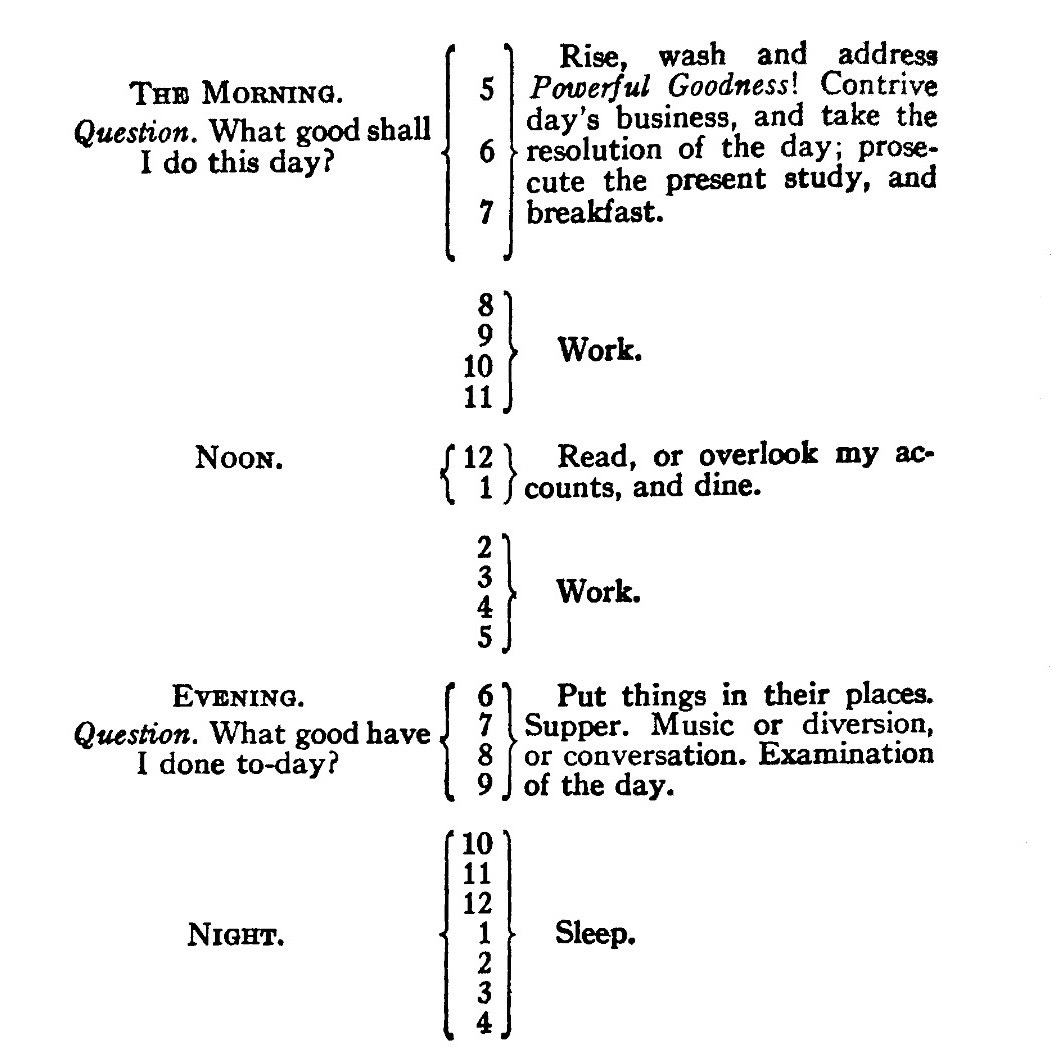
A person of ordinary ability can accomplish great things by making a plan and cutting off every distraction to focus entirely on executing it.
You are not truly disciplined until the right behavior becomes a habit. Before that, your impulses will keep pulling you off track.
Learn French, Italian, or Spanish before Latin, as it will make learning Latin easier.
You may never forgive yourself for not acting, so don’t decide based on fear or imagined regret. Decide based on what actually makes sense.
Franklin’s four-year-old son died of smallpox. There was a safer option at the time, inoculation, but Franklin avoided it because of the risk. Afterward, he realized the mistake. People avoid certain actions because they think they could not live with themselves if something goes wrong, but the regret of doing nothing can be just as real. His point was simple. Do not decide based on which outcome feels less painful to imagine. Decide based on what actually gives you the better odds.
“Truth, sincerity and integrity in dealings between man and man were of the utmost importance to the felicity of life.”
“That, as we enjoy great advantages from the inventions of others, we should be glad of an opportunity to serve others by any invention of ours; and this we should do freely and generously.”
“Human felicity is produc’d not so much by great pieces of good fortune that seldom happen, as by little advantages that occur every day.”
Mic drop.
Franklin wrote this book before the American Revolution, before the United States of America, and before most of the things you probably remember him for.
He was a printer’s kid from Boston with no money, no connections, and no formal education. And yet, by the time he died, he had helped birth a nation, charmed a monarchy into funding a revolution, figured out that lightning was electricity, and built the civic infrastructure of a city: a library, a fire company, a university, a hospital, a learned society, a mutual insurance company, paved and lit streets, and a postal system that became the information infrastructure of a democracy.
My friend told me this book reminded him of me. I’m still not sure if that’s a compliment or a challenge. Probably both.
What I do know is that Franklin figured out how humans work and wrote it for us as a manual. The best books are conversations, and this book was a conversation I needed to have. I needed the reminders, I needed to learn from his stories and experiences so I don’t repeat the same mistakes, and I’m glad I finally read it.
Read the book. Take notes. Then go be useful.
Until next time, Benny,
Juan David Campolargo
I read the book and made a few projects, which I think you might enjoy:

FranklinRPG


