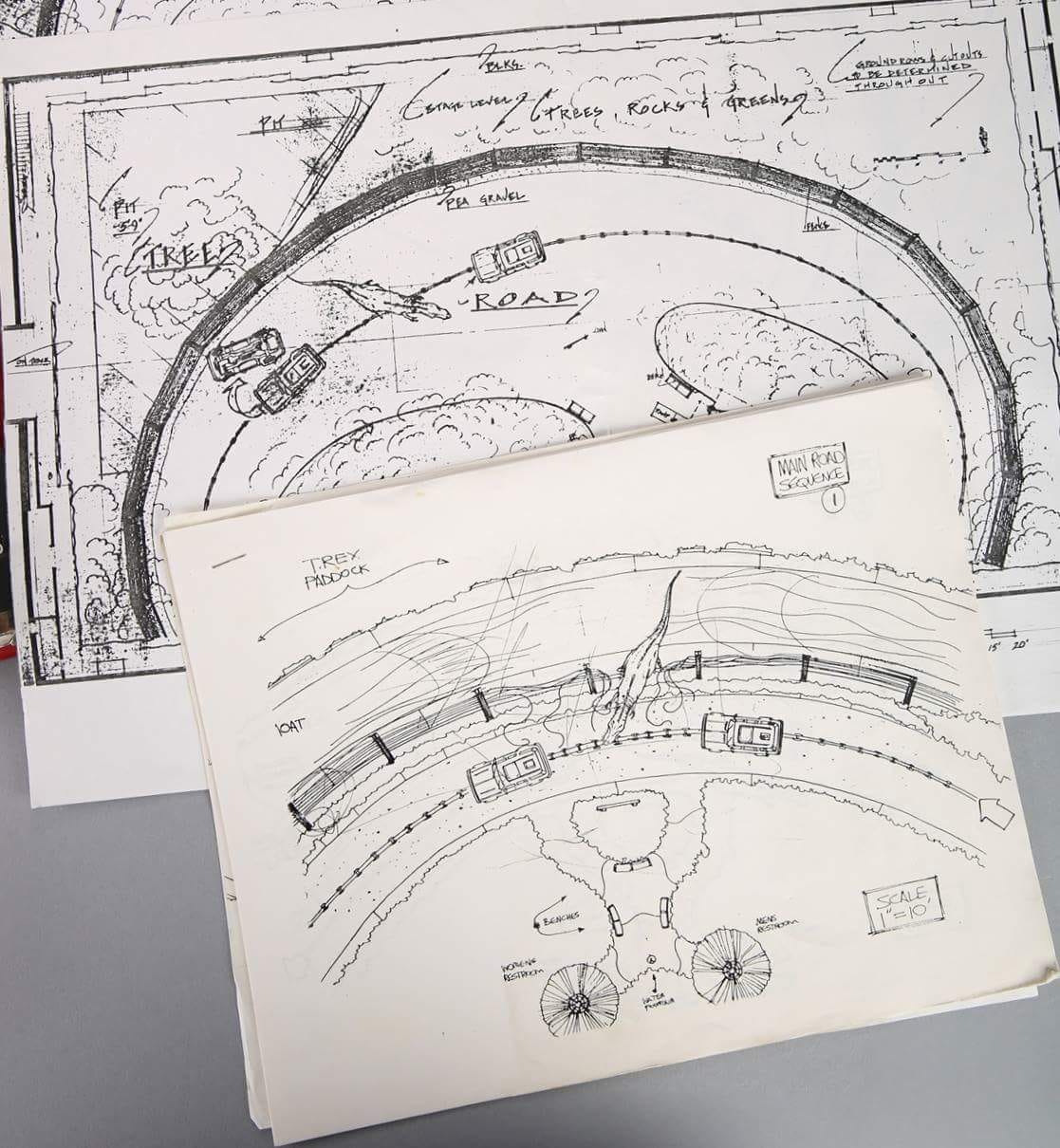
Recently I’ve been contemplating how to use Tactical Decision Games (TDGs) to train expertise in new domains. For the uninitiated, TDGs are a type of scenario training game revived and refined in the Marines by John Schmitt1 to teach the new tactical doctrine that was being established in the wake of the failures of the Vietnam war. While principally used to train officers in tactics, TDGs have a premise simple enough that they likely have a history as old as Homo Sapiens, with applications extending far beyond military tactics.
Because the traditional domains for which we do TDGs in my work (military, law enforcement, firefighting) require background knowledge I don’t have, I decided to make one in a domain that was a little more tractable and familiar - at least to a nerd like me - to better wrap my head around various conceptual issues I have been wrestling with. Here is what I came up with.
You are Dr. Alan Grant, a paleontologist brought to Jurassic Park to assess the park and help reassure its investors.
Dr. Ian Malcolm and yourself are riding in an autonomous SUV that follows an electric guided track embedded in the road. About 40 feet in front of you is an identical vehicle also following the tracks. Inside that second vehicle are the two grandchildren of the park’s founder, Lex and Tim. You’re not good with kids, but you think they are 10-ish (plus or minus a couple years). Also in the car with the children is Martin Ferrero, the
bloodsuckinglawyer.The vehicles are now heading back to the visitor center due to an incoming hurricane which has cut the tour short. The rain is coming down hard, and thunder booms around you. Unexpectedly, the car slows down and comes to a complete stop. You try to turn the vehicle on, but nothing happens - it seems the power has gone out, and the electric vehicle is now stuck. Damn technology. You run out into the storm and visit the other car to quickly confirm that the plan is to stay put in the cars until the power comes back.
“Are the kids OK?” Malcolm asks once you are back in the car, drenched from the rain.
“I didn’t ask. Why wouldn’t they be?”
“Kids get scared.” he tells you.
“What’s there to be scared about? It’s just a little hiccup with the power.”
“I didn’t say I was scared.”
As you wait, you begin to understand Ian’s worry. The sounds of the storm, and the shadows moving in the forest, barely glimpsed through sheets of water running down the window, cannot help but remind you of the creatures you were brought here to see.
Something catches your eye, and you see Martin running to a nearby restroom, leaving the kids alone in the forward car. “When you gotta go, you gotta go,” Malcolm remarks.
You hear something, and turn towards the other side of the vehicle. You watch as the wires of the electric fence snap, the twang echoing over the pounding rain.
And then you see it. Or rather, you see her.
You know the facts better than anyone here. Over 40 feet long and weighing over 8 tons, you watch as she bites through the thick steel cables of the electric fence, which like the rest of the park must have lost their power. She steps onto the roadway with heavy steps that cause the car to shake.
The Tyrannosaurus Rex looks at you, and roars.
With two massive steps, she approaches your car and circles it curiously. She nudges it with her massive snout, and the vehicle rocks violently.
Then, through the rain, you see a flashlight switch on inside the other vehicle. The Tyrannosaurus stops, turns toward the light, and heads towards the children.
What do you do?
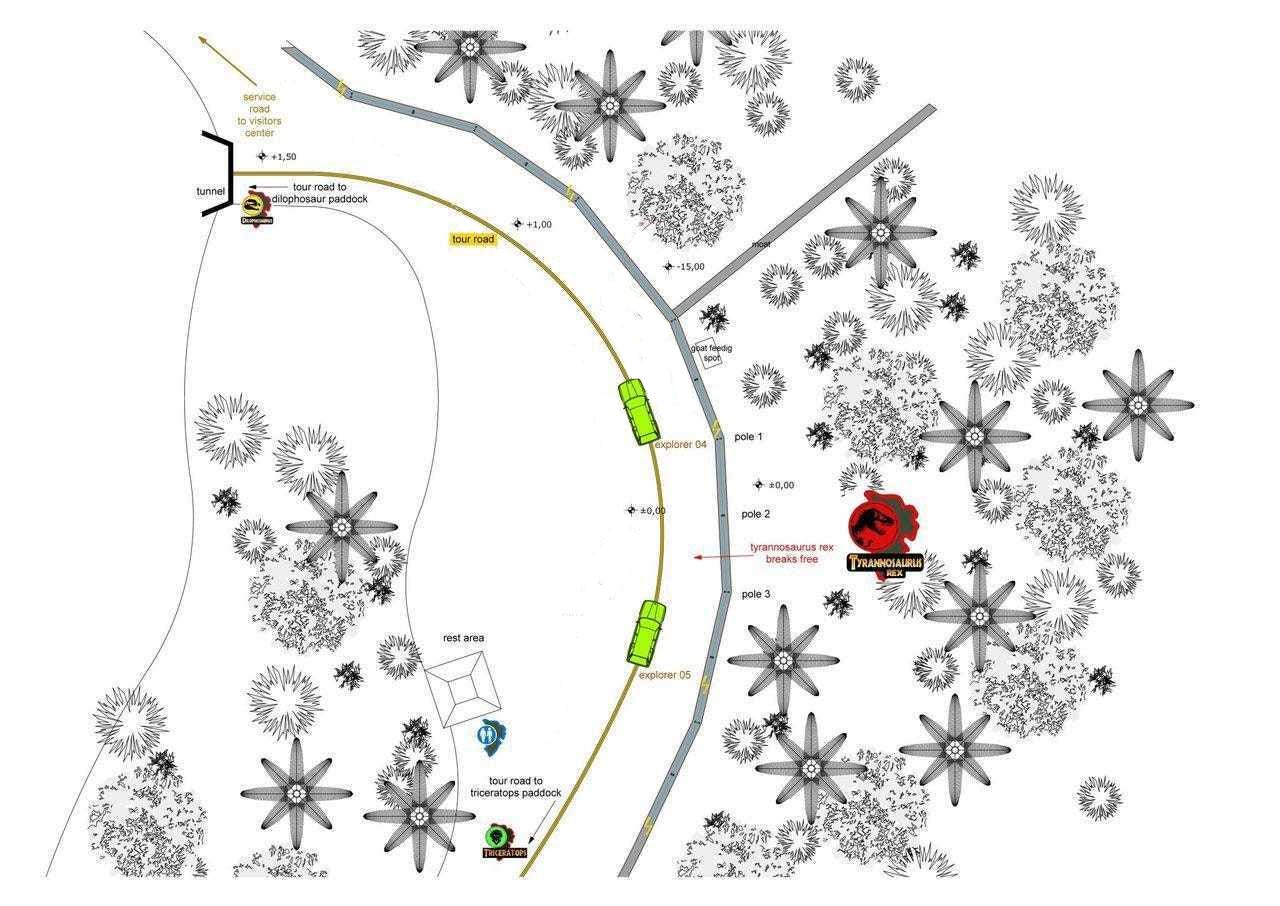
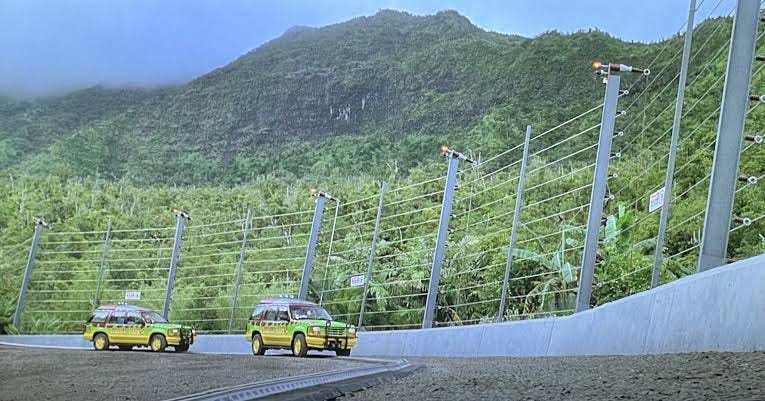
During a live TDG, you would have 2 minutes before a facilitator asks for your orders. What follows is an intense hour of discussion, pushback and questioning as the room collectively comes to two realizations, (1) the situation is even more complex than they initially realized, and (2) the situation is more tractable than their initial impression led them to believe.
If you haven’t already, try out the scenario above and post your response in the comments. I will post mine as well (no peeking!). Instructions in this footnote.2
As I have contemplated how to adapt TDGs, I have been thinking about the role of the map, as it is so central to the experience. So central that even if a domain does not happen in a specific geography, we still try to find a proxy for the map.
But why exactly? What makes this particular training technique so dependent on maps when other training techniques (e.g., Deliberate Practice) do not require them? And what is a map anyways? These are important questions if we want to train expertise in new domains.
As I was pondering these things, I happened to be in a meeting where Gary Klein3 mentioned something offhand that I should have known, but hadn’t truly internalized. Gary’s offhand remark was this: there is no general decision-making skill, nor a general situational awareness skill. There is no way to train your general ability to make decisions or become situationally aware.
That may sound extreme to some, but as I dug into that claim I realized that Gary’s claim was actually far too narrow. The literature is pretty clear that there is also no critical thinking skill, no creative thinking skill, and no problem solving skill. None of these are skills.
This line of reasoning led to a cascade of insights that started with ‘adaptive expertise is not a skill, it is an uncommon common sense’ and ended with ‘and that is why you need a map’.
Let me take you on that journey.

When I did my first TDG, I was overwhelmed. I had no military background, and the entire scenario felt like a loose collection of facts that didn’t fit together. The scenario felt utterly hopeless, and I didn’t know where to begin.
But over the course of an hour, the scenario started to cohere into something I could imagine. Or said differently, I started to have a mental model of the problem, with all its constraints and affordances. I started to understand the enemy’s motivations, how my units would respond to my own orders, and how the enemy might react. It was no longer just a map, but a meaningful problem space that I could mentally simulate.4
The map didn't do that on its own. Rather, it was the pushback from the facilitator as I explained my (terrible) plan, and the orders and reasoning from the other participants (with their own brilliances and failures) that provided a feedback loop which led to insight after insight, until I could see the affordances and constraints which were previously invisible due to my ignorance.
The transition from an objective map to a subjective problem space, facilitated by the feedback loop, is the key pedagogical experience of the TDG. It is a transition from staring blankly at the map and having no idea where to start, all the way to having a bit of common sense.
Common sense is a strong phrase, and I want to be careful about how I use it. I am still terrible at military tactics and often feel lost when doing TDGs. I am certainly not arguing that tactics ever become simple. I also think the feeling of common sense can be incredibly misleading, and you should be wary of it.5
Instead, what I am arguing is that just as I immediately understand why screaming ‘na-na-na, bet you can’t catch me’ at a T. rex is not a full-proof plan, I now also understand why taking the high ground is important in military situations. I know this fact not as some unexplainable intuition, or some protocol I have memorized, but as a rather trivial fact about reality.
Each TDG is like that. Each one makes the problem space so concrete that previously abstract principles and doctrine, as well as the immediate threats in the scenario itself, become immediately obvious. So obvious that it seems impossible that I hadn’t always understood. You might call this hindsight bias, but as Ellis Morlock and I have argued elsewhere, “hindsight isn’t always a bias. Sometimes, the obviousness that comes with hindsight just means you did the work to look at the problem in a way that surfaced the most appropriate solution.”
This principle is so important that over the years I have collected a mountain of people saying the same thing. The previously mentioned John Schmitt says that, “problem formulation and problem solving are not merely linked cognitive processes. They are the same cognitive process.” Mathematician Matt Parker says that, "any sufficiently well explained problem is indistinguishable from being obvious." And Nobel Prize winner Herbert Simon notes that, “solving a problem simply means representing it so as to make the solution transparent.”
Joseph Borders and myself call this the Situation Shaping Hypothesis. The hypothesis is that what matters for decision-making isn’t computational power, better memory, or a particular skill, but knowing how to frame a messy situation into an actionable problem.
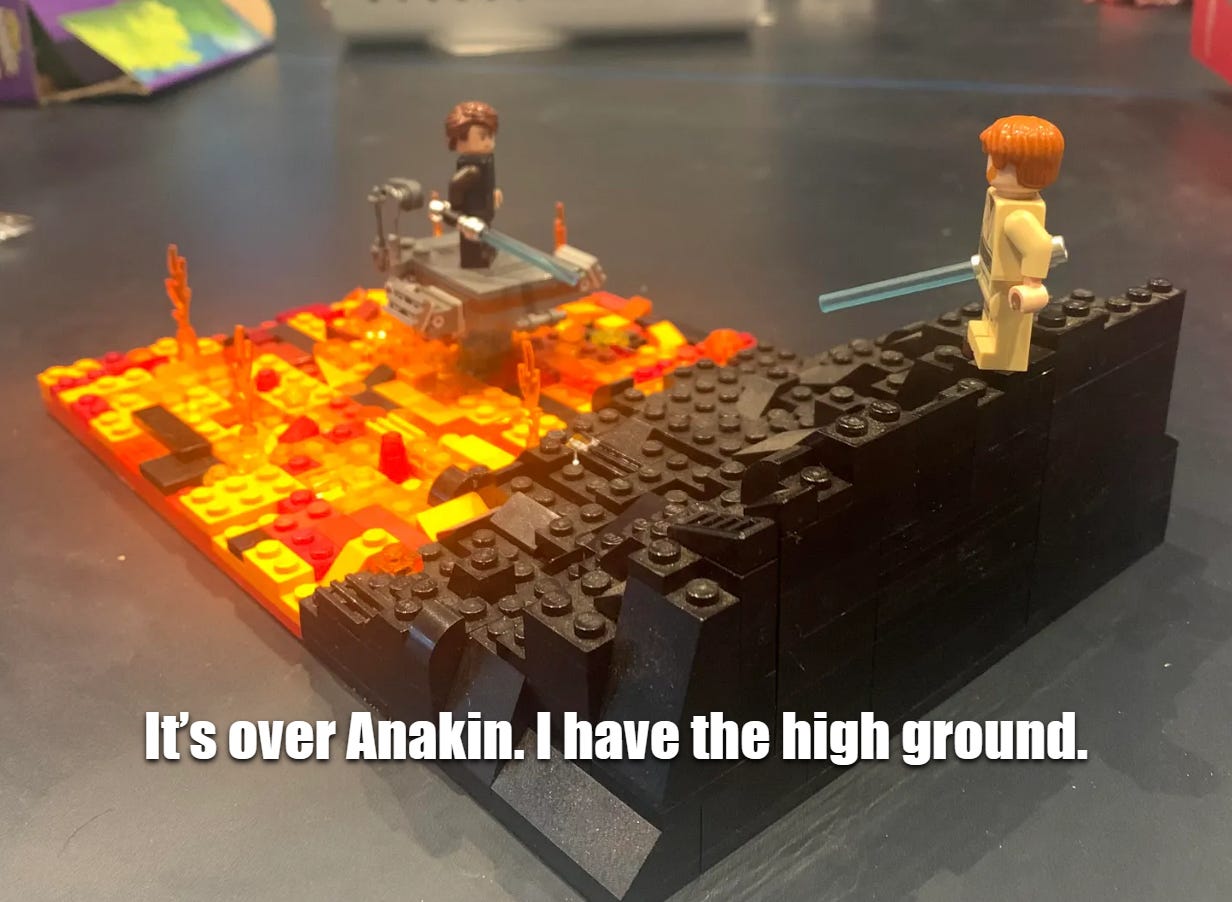
Is this the same thing as a skill? Ultimately this question depends on how you define the term, but the immediate obviousness of knowing that a T. rex won’t roll over to allow you to rub its belly - even if you ask nicely - doesn’t seem like a skill to me, and neither does understanding the tactical advantages of taking the high ground. Some things are so apparent on their face that it would feel weird to describe them as a skill.
When talking about expertise, we often use terms like intuition, patterns, prototypes, and affordances. But these scientific concepts can obscure the actual experience of expertise, which is that of common sense and like you just know how things will play out if you take one action or another. Not because of some magical gut instinct, but because you have seen similar situations so many times that you understand what is happening just by looking.
This is why I believe expertise, and in particular adaptive expertise,6 is better described as an uncommon common sense as opposed to a skill - enough experience with the specific features, constraints, and goals of a domain will make things intuitive for you, even when they do not immediately click for others.
Skills still exist, and you need to do drills if you want to obtain high levels of expertise. Maybe even do Deliberate Practice if it doesn’t kill the fun. Skills are absolutely essential for high levels of competency as they change the underlying problem space by opening new possibilities. I am not arguing against skills.
What I am arguing is that if you want adaptive expertise in complex domains, you need to learn to read the problem space inherent in a map so that you have a mental model. Learn what it is like to develop common sense. Because, and as I argued in my review of David Bessis’ Mathematica,
[T]he psychology of expertise isn’t exceptional. Expertise isn’t rare. Rather, it is how we navigate, walk, talk, breathe, do math, or even sense that we are no longer hungry. Expertise only feels so unobtainable because we think of it as something relative that places humans in a hierarchy, when instead we should think of it in terms of basic human development, and the ordinary human faculties of intuition, pattern matching, and imagination. Expertise is the natural development of human capacity.
Military tactics are a little distant from most people’s everyday experience, so let’s bring this to a more mundane domain. Marketing.
If you want to become an expert marketer, what do you need to do? What things do you need to learn? What skills do you need to practice?
Well, if LinkedIn is anything to go by, you need to learn positioning, segmentation, personas, funnels, advertising, SEO, A/B testing, pricing tactics. Once you master these skills - you are promised by the masses of AI generated profile pictures - you will become an expert marketer. In this view, marketing expertise is something you bootstrap into by learning the various subskills.
But as Cedric Chin of Commoncog notes in his series on understanding customer demand,
Good marketers think in terms of tactics. Great marketers go further: they know all the tactics that the good marketers know, but they also have an ability to uncover and understand the latent demand that is separate from their product.
And later in the same essay,
Most folks talk about ‘getting good at marketing’ in terms of learning marketing skill, not in terms of learning demand. It takes awhile before you learn that ‘understanding demand’ is a related skill that underpins the skill of marketing (and sales, and product).
I would change that last sentence to “It takes awhile before you learn that ‘understanding demand’ is the expertise that underpins the skill of marketing (and sales, and product).”
Expertise is what gives context to skills. Even if you are technically skilled at writing positioning statements, it will serve you nothing if you don’t understand the demand, as it is the demand which contextualizes the skill and makes it adaptive. But even more than that, expertise is a sort of common sense which has competence as a byproduct.
Often what happens in life and business is that we see someone express some level of competence - they make good decisions, have situational awareness, think critically or creatively, solve hard problems - and then we conclude these must be distinct skills. Or if not skills themselves, perhaps they consist of a series of sub-skills which can be learned separately and then combined back together.
But I am denying that. These are not skills, nor are they merely an assembly of sub-skills. These are not domain-general competencies. There is no general ability to check your assumptions, consider alternatives, notice changing circumstances, or mentally simulate outcomes that can be trained independently of understanding the particular assumptions, alternatives, stabilities and causal factors of a given domain.
This is not radical, but a mainstream position in Cognitive Science.7 As Daniel Willingham has argued with regard to critical thinking,
People who have sought to teach critical thinking have assumed that it is a skill, like riding a bicycle, and that, like other skills, once you learn it, you can apply it in any situation. Research from cognitive science shows that thinking is not that sort of skill. The processes of thinking are intertwined with the content of thought (that is, domain knowledge)…[Critical thinking] is a type of thought that even 3-year-olds can engage in—and even trained scientists can fail in. And it is very much dependent on domain knowledge and practice.8
This is why in NDM we never explicitly teach the Recognition Primed Decision-Making (RPD) model when training decision-making. What would be the point? It is not a general decision-making skill you need to learn, nor do you need to know RPD to recognize that an overly curious predator many times larger than your car might be able to kill those inside. Recognizing the meaning of things in the world is just the natural progression of increasingly familiarity. i.e., RPD is just the natural progression of common sense.

So why are maps important for TDGs? And what even is a map for our purposes?
Maps are any interface used in a domain to understand the problem space, and therefore they are the principal way that people learn how to create mental models and gain common sense over situations.
Maps do not have to be literal maps. They can be a set of financial statement, a brief, a transcript, a video, a song, a picture, or even a dance position. Even the scenario description itself is a type of map.
The important thing isn’t the particular representation (or even whether it is a representation) but that the ‘map’ you are using captures and then communicates the cues that people in your domain must interpret when trying to make sense of the latent problem space with all its various affordances, constraints, and causal factors.
Why? Because at the end of the day, adaptive expertise is about learning how to read the problem space. It is about developing the common sense of being able to look at (or hear, or feel…) a situation, and understand how things will play out if you take one action or another.
But this is not a skill.
Even if you manage to come up with a perfect solution to the TDG I introduced at the beginning, you will not have improved your decision-making skills in marketing. Nor will your skills in marketing make you adept at figuring out how to manage a predator the size of a school bus.
Heck, Chase and Simon (1973) famously found that experienced players could memorize a chessboard better than novices, but only if the pieces were in realistic positions, whereas if the pieces were placed randomly there was little to no advantage. Even memory is downstream of your understanding of a particular domain as opposed to a distinct general capacity.
The various expressions of expertise I have discussed in this essay - decision-making, situational awareness, critical thinking, creative thinking, problem solving, and to some extent even memory and communication9 - are specific to your experience base, and so are domain specific competencies. They do not transfer to new domains.
But note that what counts as a domain is not entirely set in stone.
The boundaries of a domain are not set by the gods of expertise, but by your experience base. There is not unlimited flexibility, but the boundaries can certainly be pushed outwards to more and more unfamiliar situations so that you can learn to adapt to novel situations you have never seen before.
But such adaptivity needs to be trained explicitly.
If you want mere routine expertise, you do not need to understand the importance of the hill, and so you don’t need a map. Instead, just practice taking the hill.
But if you want to train someone to adapt to new situations (such as situations where taking the hill would be a mistake), then they need to understand the deep structure - the role the various features serve in the problem space - so that they can recognize their relevance (or irrelevance) in novel situations. This happens not through memorization and practicing recall, but through practicing recognition in varied scenarios.
This is why maps are essential to training adaptive expertise but are not necessary for training regimes such as Deliberate Practice which are about routine expertise. Maps turn what would be a simulation exercise of what-to-do into an exercise in making sense of a problem space, thereby training a common sense understanding, and an ability to notice opportunities and threats, and imagine the future, resulting in an ability to adapt.
All of that to say that TDGs do not train skills, because adaptive expertise is not a skill. It is an uncommon common sense developed by making sense of relevant problem spaces. And in the context of TDGs that is done with maps and effective feedback loops provided by a facilitator and a peer group trying to make sense of the same things you are.
That is why TDGs work. That is how they train adaptive expertise.
Which bring us back to Alan Grant. A trained paleontologist who, for the first time in his life, is face-to-face with the subject of his study. For all I care, he could have the sum total of all human knowledge about dinosaurs, as none of it will prepare him for this moment, sitting in a car in the pounding rain, watching as two children wave down a hungry Tyrannosaurus rex with a flashlight.
You have two minutes. What do you do?
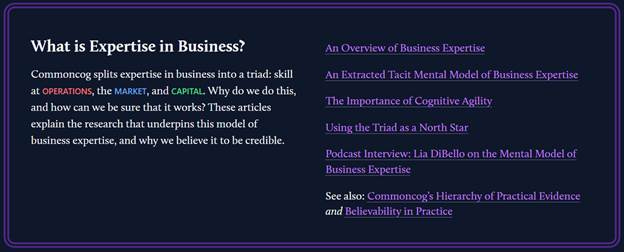
Announcement: If you’d like to design your own TDGs, John Schmitt and our team at ShadowBox, and in collaboration with Commoncog, will be hosting a workshop on TDG development. The focus will be on using TDGs to develop business expertise.
Slots will be limited and priced accordingly. We’ll open registration first to members of Commoncog before making any remaining spots available publicly. For context, our recent Commoncog-sponsored TDG filled every available slot within two minutes. If you want a shot at one of the remaining spots, subscribe here so you don’t miss the announcement.