Could you steal the gold from Poseidon’s teeth? I found out how, and it’s harder than it looks.
I’m referring, of course, to tidal energy, in which I received a thorough blooding a decade ago, having joined a startup with the Very Good Idea of harvesting the raw power of tidal races to generate stable, predictable green energy. It’s a fine idea and you can immediately see the appeal: Unlike solar, which goes out with a bit of cloud, or wind turbines, on which you might as well flip a coin, tidal energy is as dependable as the orbit of the moon. It’s predictable 3,000 years in advance, you can set your watch by it, and it’s powered by the greenest energy of all; the kinetic energy of our big ol’ orbiting rock.
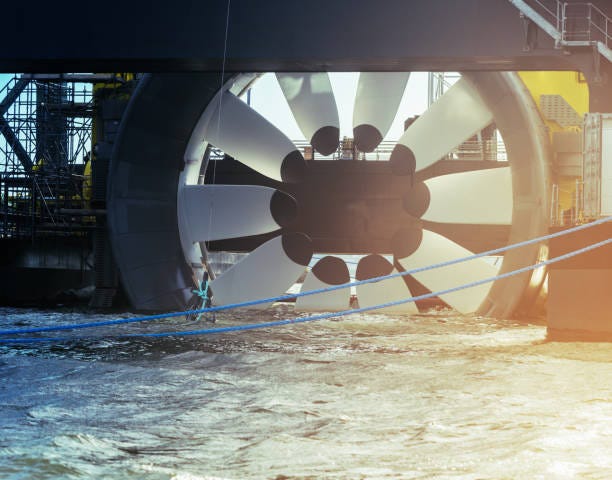
It is also, unfortunately, very, very difficult to achieve. It relies on fine engineering, at great expense, deployed into an environment that wants to kill everything in it.
So how do we do it?
Read on, and discover the secrets of generating green energy… the hard way!
Across the world there are areas where natural geography creates channels or pinch-points in natural tidal flows, concentrating them and greatly increasing both their vertical range and velocity. One example of such a ‘tidal race’ is the Bay Of Fundy in Nova Scotia, where every six hours moves a water flow equivalent to three times all the rivers in the world combined. Other tidal races include the waters around the tangled archipelago of the Orkney Islands near Scotland, or the waters near the island of Alderney in the English channel, close to France. These tidal races worldwide, if peppered with tidal turbines, could potentially provide 1,000 TeraWatt-Hours of electricity a year, or a thousand-thousand-thousand-thousand kilowatt-hours. Or 20% of the electricity use of the United States.
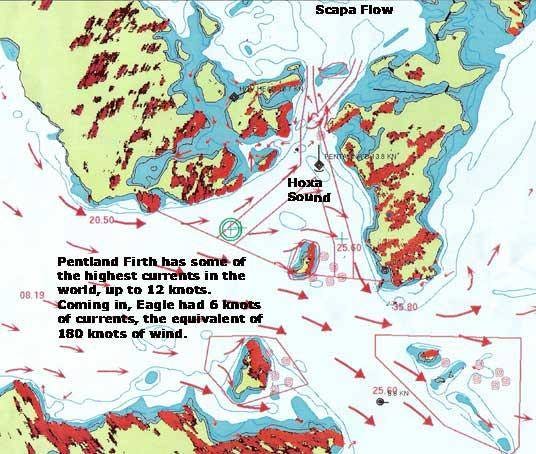
And a tidal race is brutal. Almost un-dive-able in many areas, they are challenging for surface vessels too, with current flows of up to 4 metres per second at their peak. Lest it be forgotten, because water is a thousand times more dense than air, a tidal flow of 4m/s exerts a force on fixed subsea structures equivalent to a 400km/h tornado wind on land. This is not engineering for the faint-hearted!
But first things first: How do we generate power from it, anyway?
There are two fundamental ways of generating tidal power: Barrage and freestream turbine. A barrage is functionally similar to a dam, in that it features a barrier between a captive body of water (a tidal lagoon) and the open sea, in an area with a high tidal range. The barrier has a series of channels containing turbines, and sluice gates that can control the flow of water. When the incoming or outgoing tidal flow has created a high enough vertical range, the gates open and power generation commences.
A freestream tidal turbine, by contrast, is more subtle: It is a turbine, usually mounted subsea but occasionally floating or moored, which sits in the open water region of a tidal race and generates power directly from the flow in the same manner as the wind turbines we all know.
Each method has its own strengths & weaknesses. This week we'll look at the method I have personal experience in, the freestream tidal turbine…
More intuitive than a tidal barrage, the tidal turbine simply stands or floats moored in the path of a tidal race and absorbs the full brunt of it, which spins a series of rotors and powers a generator. The generator outputs electricity, of course, but this is not the end of the story, for the energy produced by the turbine is rough & raw, completely incompatible for a national grid and needs stabilizing and frequency matching to a level of quality that can be safely exported. This is done through a current convertor & turbine control unit which can be co-located, located on a tower or on shore.
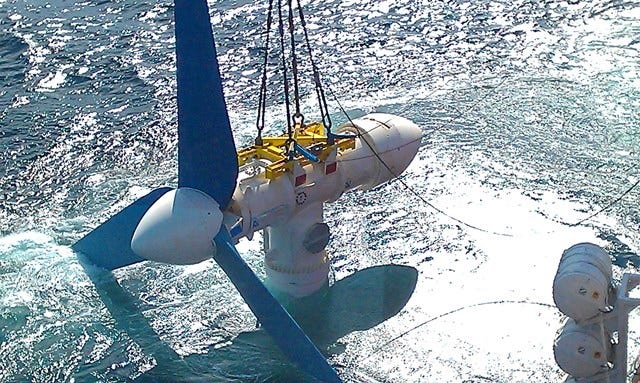
So far, so simple, but despite this apparent simplicity this is by far the least popular way of generating tidal energy: The big tidal plants are all barrages so far. This may of course change, but as of now the design maturity of free-mounted tidal turbines is limited, and many approaches are still being tried out.
There are still design forks to be navigated, from assembly & deployment to rotor design, types of generator, maintenance access & location of the turbine control centre. Let’s navigate all of these, and give some kind of explanation as to why this form of power generation is so damned difficult to pull off.
Two clear forks in turbine design relate directly to electricity generation. Namely, how many blades the rotor should have, and what kind of generator to use; podded geared generators versus direct drive permanent magnet turbines.
Beginning with the blades: Most tidal turbines have either two or three blades, and the trade-off here is between pure hydrodynamic efficiency and structural loading. Essentially, the pressure difference between the up-flow and down-flow directions on a blade, as well as moving the rotor, also creates flow swirl around the tip of each rotor blade, which affects the incoming current and the blade angle of attack, generating induced drag much as on an aircraft’s wing. Because co-located blades interact with each other, you would therefore expect that optimal hydrodynamic efficiency is achieved with a minimum number of blades: Two.
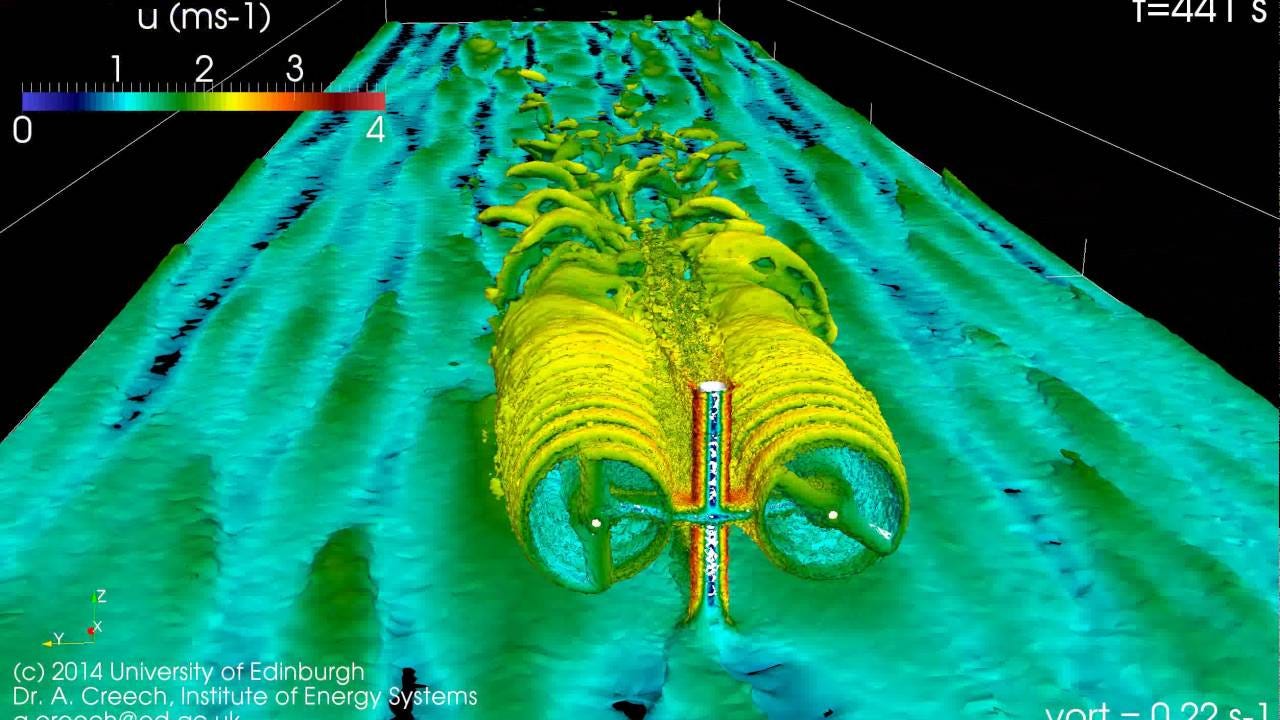
And while that is true, there are other factors. For one, it’s not all about hydrodynamic efficiency; once you’ve committed to sinking a thousand tons or more of tidal turbine structure, you might as well squeeze out as much power from that installation as you can, even if adding a blade brings some declining returns. To pull as much power out of two bladed installations as possible you’d need to rotate them fast, which makes cavitation a risk for larger installations.
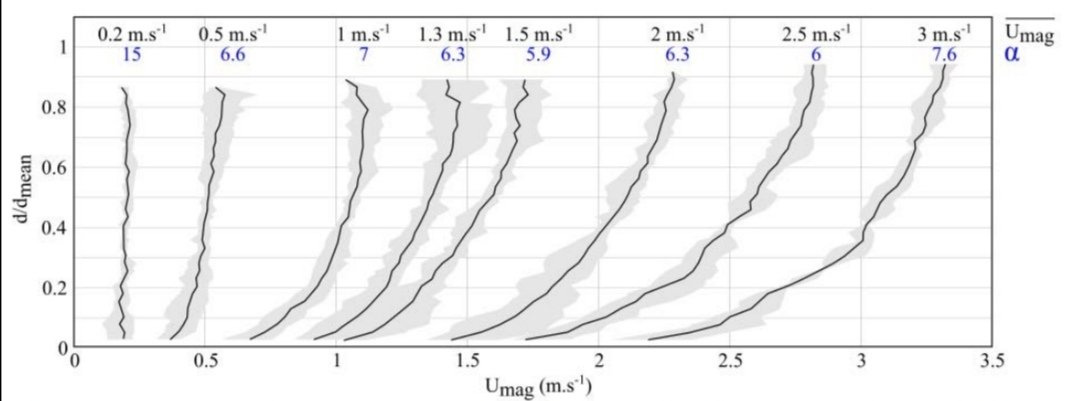
Secondly there’s the factor of twist and resonance: With a wind turbine, if the wind direction suddenly changes then the differences between upwind and downwind lift from the blades creates a twisting moment on the support structure, which becomes dangerous with two-bladed designs due to the potential for dynamic resonance. Three blades avoids some resonance modes for wind turbines, and while tidal turbines don’t twist they can create pitching moments very easily due to large velocity gradients near the sea floor.
As ever, it’s all compromise. Smaller installations and floating turbines get on well with two blades. Large seabed mounted ones tend towards three.
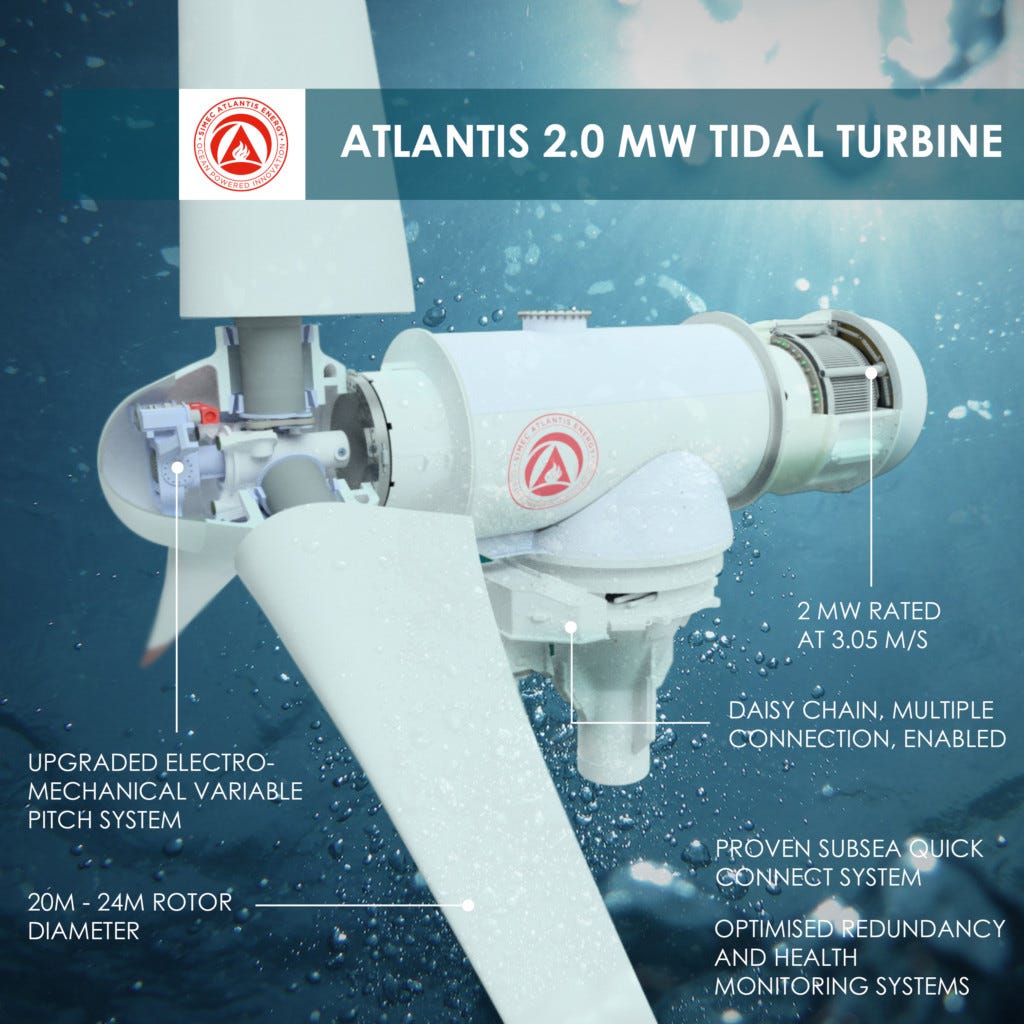
For generation, the mainstay is a traditional geared, podded generator: A multi-wound rotor & stator combo connected to a gearbox that spins the rotor up close to grid generation frequencies. The downside of such a thing is the need for foolproof multi-year waterproofing and corrosion resistance, generally by a pressurized oil/ grease reservoir that prevents water ingress. The alternative less, common, generator type is a direct drive permanent magnet system, which is what we used in my time in OpenHydro: It’s a flooded design, so doesn’t concern itself with water ingress, and eschews a gearbox, relying on the raw speed of the rotor moving past the coils to generate. Theoretically simpler, the DDPM approach tends to be much harder to build and asks for exacting build tolerances on very wide diameter assemblies. In practice, it’s not an ideal solution.
But we didn’t know that at the time, and it does make for a very cool looking design.
We shall, just for a moment, take a close look at the OpenHydro turbine that I worked on, which conveys the very special challenges of a flooded DDPM generator approach.
Basically, OpenHydro had a clear design philosophy, which was to minimize the amount of moving parts underwater. This makes sense, since the sea is a violent, corrosive brute that kills machinery, and of course the smallest number of moving parts in a turbine is one.
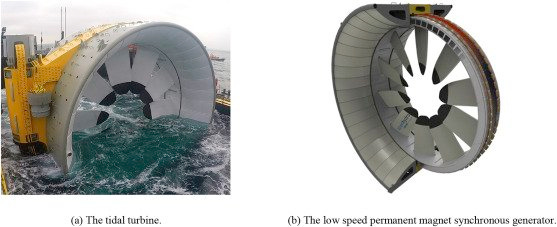
To achieve this meant a DDPM design with no gearbox, so the permanent magnets, mounted on the outside of a rotor, would run straight past a series of epoxy-secured coils and thereby generate electricity. Both magnets and coils were mounted in water proof, cathodically protected, corrosion resistant housings, but the DDPM approach drove three design features which were an absolute pain to deal with:
Firstly, the magnets had to be on the outside of a giant ring structure, because efficiently generating the current required the magnets moving past the coils with great velocity. This meant a giant toothy doughnut design, with rotor blades facing inwards on a neutrally-buoyant O-shaped rotor with bearings and magnets on the outside!
Secondly, the rotor and stator had to be huge, to maximize magnet-coil passing speed: A 14m diameter rotor on our 2 megawatt turbine design.
Thirdly, the distance between magnet and coil, where they passed, had to be minimised. A water gap of just over half an inch, and a bearing gap of much less, on a 14 metre diameter centre-less assembly is no mean feat. Mounting tolerances were controlled to within +/- 0.5mm radial position with a virtual centre located by regular laser positioning surveys throughout assembly. This was, understandably, a right royal pain in the arse to manage, especially when our prototypes were being put together in environments without temperature control. Plus the stator & rotor were assembled in different facilities entirely, and expected to be transported to meet, and fit, together.
We made it work, but it wasn’t easy. At all!