I stood up a working social network for eight mates last weekend. Profile pages, a shared feed, a photo wall, a jukebox bolted onto a spare domain. It took me a Saturday, about forty bucks in Claude credits, and exactly zero product-market-fit meetings.
The same weekend, Meta earned about six bucks off me. Google made ten. LinkedIn, YouTube, TikTok, X — all quietly billing in the background, none of them sending a receipt. If you add them all up for the average American, the annual total is north of $1,000. You just never see it, because no money changes hands and no invoice arrives.
The clever thing about "free" on the internet isn't that the trade doesn't exist. It's that it's been designed so you can't see it. No money moves. No invoice lands. No app shows you the meter ticking as you scroll. The exchange is real — your attention and your data in, Instagram and Google and LinkedIn out — but by the time the numbers get tallied, they live in a quarterly earnings report you'll never read. So the trade feels weightless.
It isn't. You just can't see the price tag.
The strange thing is the price tag has been public the whole time. Every platform listed on a stock exchange tells you, four times a year, exactly what you're worth to them. You've just never been shown how to read it — and until recently, the only practical alternative to reading it was "live in a cabin." That part has changed, and it's the part almost nobody is talking about.
The invisibility isn't an accident either. If Meta had to send you a cheque every month for the money they made off you, you'd treat the relationship very differently. You'd notice when the amount went up. You'd notice that the teenager version of the payment looks nothing like the adult version. You'd wonder why the Auckland cheque was ten times the Jakarta one for the exact same hour of scrolling. The whole edifice of "free" rests on keeping the accounting one-sided — they measure you in basis points to three decimal places, you experience the trade as a vague sense of having lost your afternoon.
The price tag they're legally required to print
The number you want is called ARPU — average revenue per user. Every public platform reports it, because investors demand it. The maths is blunt: take the company's annual revenue, divide by monthly active users. What comes out is what the platform earns off the average human who shows up, per year.
For Meta last year the global figure was about $52 per user. For YouTube's ad-supported side, around $24. For LinkedIn it's $15 averaged across all 1.2B members, but much higher once you strip out the dormant accounts.
These aren't guesses from a watchdog group. They're from the companies themselves, in the part of the earnings release where the whole purpose is to convince shareholders each user is worth more than last quarter. The incentive is to talk the number up, not down.
Whatever ARPU says, the reality on the ground probably isn't lower. If anything, it's a floor.
Your annual bill, itemised
Rough figures, from the companies' own filings:
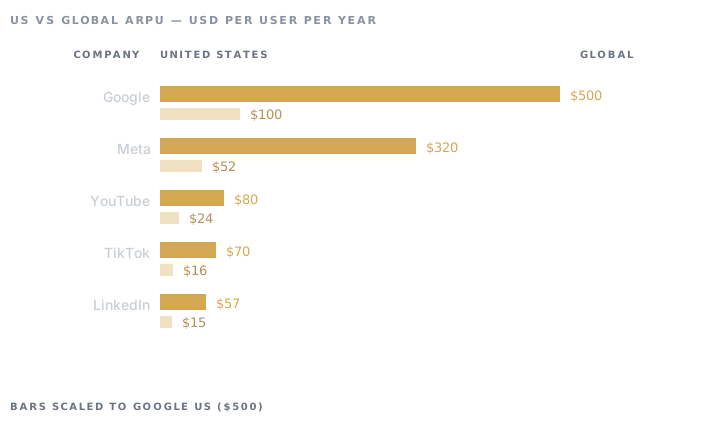
- Meta: ~$52/yr global, ~$320 in the US
- Google (all products): ~$100/yr globally, ~$500 US — $400B in revenue across ~4B users spanning Search, Android, YouTube, Cloud and Workspace combined
- YouTube ads alone: ~$24/yr global, ~$80 US
- LinkedIn: $15/yr averaged across all 1.2B members, but ~$57/yr across the 310M monthly active ones
- TikTok: ~$16 global, ~$70 US — doubled in two years
- Snapchat, Reddit, Pinterest, X: all in the $10–30/user/yr range
The geographic skew is the part most people miss. Meta's figure in the US is roughly ten times what it is in Asia-Pacific. Europe sits in the middle at about $92. Same product, same features, same algorithm — different rate card, because ad buyers pay more to reach wealthier audiences. You are literally worth more in Auckland than you are in Jakarta, and your feed is tuned accordingly.
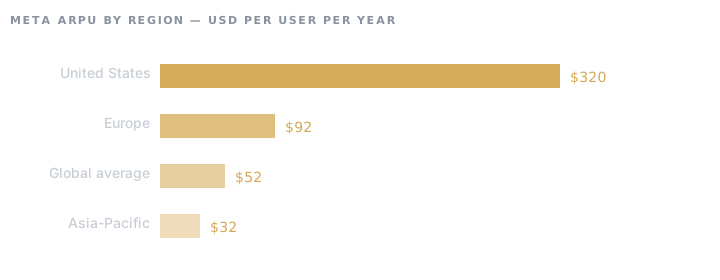
The same skew shows up across every ad-funded platform. The US rate card is the one the rest of the world gets compared to:
Marketplaces don't fit ARPU cleanly, but the extraction is still there if you look for it. Uber and Lyft take around 20% of each fare. Airbnb combines host and guest fees for about 14–16%. DoorDash and Uber Eats take closer to 25%. Shopify's card take is 2.9% plus 30 cents per transaction. Different mechanism, same game — a percentage of every transaction, quietly skimmed, never itemised.
The meter, in dollars per hour
ARPU is annual. Attention isn't spent in years though — it's spent in hours, in the little windows between other things. So the honest conversion is to divide.
The average US Meta user burns about 200 hours a year across Facebook and Instagram. $320 ÷ 200 = roughly $1.60 per hour of your attention. YouTube works out to about $0.27/hour. TikTok $0.22. Snapchat cheaper still. Do the same sum on global averages and Meta drops to around 26 cents an hour, YouTube to 8.
Those rates are only what the platform earns this year, mind. They aren't what your data is ultimately worth. Everything you click and hover and pause on feeds ad targeting across the wider web, plus — now — AI training corpora. ARPU is the rent. The equity is bigger, and the equity compounds.
The AI-training bit is genuinely new and worth pausing on. For fifteen years the data you generated on these platforms powered one thing: better ad targeting on those same platforms. It was a closed loop. You scrolled, they learned, they sold the targeting back to advertisers, the advertisers bought your attention again. Bounded. Weird, but bounded.
That loop isn't bounded anymore. Your posts and comments and DMs are now training data for models that will be sold, resold, and embedded into every piece of software you touch for the next decade. The $320 Meta earned off you in the US last year is a rounding error next to what the underlying corpus is worth to the next generation of AI products. ARPU doesn't capture any of that. It's literally last quarter's ad rent, with none of the capital gains on the asset.
Even the rent, laid out per hour, makes one thing obvious: you can see exactly why every platform is obsessed with "time spent" as a north-star metric. If one extra hour a week on Facebook is worth ~$83 a year per US user, multiplied across three billion users, the maths for why the feed never stops scrolling is not mysterious. The feed is a meter. Keeping it running is the business. Every "new feature" that shows up in your settings — reels, shorts, a nudge to open the app on your commute — is a hand on that meter.
Once you see it that way, a lot of product decisions stop looking like product decisions.
Run your own numbers
The point of making the numbers this concrete is that you can plug in your own usage and see what you personally throw into the machine each year. Drag the sliders for how much time goes into each platform and watch the ledger tally up. Rates are global averages.
The Ledger
global averages · per year
Notes on the method
ARPU is rent, not equity. What a platform earns this year isn't what the underlying data is worth across the wider web and AI training corpora.
Averages hide heavy users. Freemium smears free and paying users into one figure. If you're all-in, you're worth more than average.
Multi-product companies cheat the top line. Google's per-user number isn't all Search — it's Search plus Android plus YouTube plus Cloud.
The rates come from the earnings-report maths above — global ARPU divided by average annual hours on the platform.
The weekend social network
Once the number has somewhere to sit, it's much harder to ignore.
Most people look at a total over $1,000/yr and go quiet for a second. Not because any one platform is egregious — on a per-hour basis they really aren't — but because the aggregate is real, and it's been invisible until now. That's the first useful thing the exercise does. It makes a choice possible.
The obvious next move is to look at alternatives. Signal instead of WhatsApp. Kagi or Brave Search instead of Google. Paid Spotify instead of ad-supported Spotify. Bluesky or Mastodon instead of X. Fastmail instead of Gmail. None are perfect, and some cost actual money — but once you can price what you're currently "not paying", the paid alternative often looks less expensive than it did five minutes ago. Fastmail at $5/month stops being a luxury when the honest comparison is "$60/yr vs being the product for an ad network that paid $500 for me last year."
That's the defensive move. It's the one everyone talks about, every time one of these pieces gets written. You switch to the more honest vendor, you feel slightly better, and the fundamental shape of the market doesn't move.
The more interesting move is what's happened on the build side, and it's the part almost nobody has internalised yet.
Standing up a social app used to take a small team months. You needed a backend engineer, a frontend engineer, a designer, probably a DevOps person, and a spare three months. That was the real moat — not the network effects, not the algorithm, but the sheer human-hours required to put a working thing on the internet. That's why the only viable answer for twenty years was to build something big enough to run ads against. Small social didn't exist because small social couldn't pay the salaries.
With Claude Code, Cursor, v0, and Lovable, that equation has quietly inverted. A profile page, a shared feed, a wall for photos, maybe a jukebox, a chat wall — a MySpace-sized thing for you and a dozen friends, on a domain you own, with none of it feeding anyone's ad platform — is a weekend. I know because I just did it. Not as some Silicon Valley startup trying to replace Facebook. As a Saturday project for eight mates, on a domain that cost twelve bucks, running on a box that costs ten a month.
The bill of materials is embarrassingly short. A boring Postgres. A boring Next.js app. Auth via magic link. Storage for photos. An LLM for the fiddly bits nobody wants to write from scratch. All of it plumbed together in an afternoon of prompting, an evening of cleanup, and a Sunday of adding the jukebox because my mate Hamish wouldn't stop asking.
It is not good software. It is good enough software for eight humans who know each other.
That qualifier is the whole thing. Facebook has to be good software at planet scale because Facebook is selling ad impressions at planet scale. A group of eight doesn't need p99 latency and a content moderation policy. A group of eight needs a place to put photos from the weekend where the photos don't end up training someone's image model in twelve months' time. Those are very different engineering problems, and the second one is much, much easier than the first.
A lot of things genuinely don't work on the weekend version. There's no recommendation algorithm. There's no real search. The feed is reverse-chronological and that's it. When someone posts something at 3am nobody sees it until the morning. There's no cleverness about which photos get surfaced or which memories get resurrected. If you go on holiday for two weeks, you come back to a feed that's exactly what your eight mates posted, in the order they posted it.
That sounds like a limitation until you notice the thing it is not doing is optimising for your engagement. Reverse-chronological across eight friends is not a meter. It's a wall. You check it, you see what's there, you leave. There's no reason for the software to try to keep you around because there's nobody paying the software to keep you around. That inversion — from meter to wall — is the entire point.
The thing that would have been a VC round in 2015 is now a side quest you finish before the roast is in the oven. The tools genuinely got that much better in the last eighteen months. We just haven't updated our intuitions yet about what that means.
What it means, specifically, is that the ad-supported social network is no longer the only technically viable answer. For twenty years it was. That was the constraint the whole "free web" was built around. The constraint is gone, and nobody has sent the memo.
The cheapest social network in 2026 is the one you and six mates build on a Saturday afternoon. It doesn't scale. It doesn't need to. It costs less than a month of Netflix, produces no ad revenue for anyone, and feeds no one's training set. You own the domain. You own the data. You own the product decisions — which in practice means there are no product decisions, because nobody is trying to squeeze another hour out of anyone's week.
None of this replaces the platforms, to be clear. You still need Gmail for the recruiter, LinkedIn for the job hunt, YouTube for the tutorial, WhatsApp for the group chat your family refuses to leave. The ad-supported internet isn't going anywhere and I'm not pretending it is. What's changed is that it's no longer the only game in town. For the circle of people you actually care about — the eight mates, the cousins, the old uni flat — you don't have to hand them over to the ad machine anymore. You can build them a room of their own, and the tools to build that room have become trivial in a way we haven't fully absorbed yet.
The meter's been running your whole life. You just got the tools to turn it off.