One of the most consequential misunderstandings in the history of literary criticism turns on a single Greek word. In Aristotle’s Poetics, that word is hamartia. It is usually rendered, in classrooms and handbooks, as “tragic flaw,” and on that translation an entire tradition of reading tragedy has been erected. Yet if we return to Aristotle’s Greek and trace the word’s history with some philological care, it becomes clear that this familiar formula rests on a slow but decisive mistranslation—less an error at a single moment than a long cultural drift in which a term meaning “mistake” gradually hardened into a doctrine of moral defect.
In classical Greek, hamartia belongs to the language of action rather than character. Its root sense is concrete and kinetic: to miss one’s mark, as an archer misses the target. By extension, it denotes an error, a misjudgment, a false step—often one made in ignorance of some crucial fact. Aristotle uses the term this way throughout his works, ethical and otherwise. In the Poetics, when he says that the tragic hero falls into misfortune “because of hamartia,” he is careful to exclude two alternatives. The hero does not fall because he is wicked, nor because he is exceptionally virtuous. Tragedy, for Aristotle, does not punish vice or reward goodness; it stages the vulnerability of human action to error within an intelligible but unstable world. The downfall comes about δι’ ἁμαρτίαν—because of an error, not because the hero is “flawed” in a modern psychological or ethical sense.
This emphasis is consistent with Aristotle’s broader priorities. Tragedy, he insists, is a representation not of character but of action (praxis). Character matters only insofar as it shapes decision-making in particular circumstances. What drives the tragic plot is not an inner defect slowly working itself out, but a sequence of actions taken under pressure, in partial ignorance, with consequences that only become fully visible after the fact. Oedipus does not fall because he is proud; he falls because he acts decisively and intelligently on the basis of false assumptions while attempting to do the right thing. That is hamartia in its original Aristotelian sense.
The trouble begins not with Aristotle, but with his afterlife. As Greek philosophy passed into the Hellenistic and Roman worlds, the semantic field of hamartia began to shift. Latin offered no exact equivalent. Translators oscillated between error, which preserved some of the original neutrality, and morally freighted terms such as culpa (fault) and peccatum (sin). At the same time, Stoic ethics, with its emphasis on rational self-mastery and moral responsibility, encouraged readers to see error less as a situational miscalculation than as a failure of inner disposition. A word that had once named a missed shot began to suggest a weakness in the archer.
The decisive transformation, however, came with Christianity. In the Septuagint and the New Testament, hamartia is the standard Greek word for sin. It now names not an unfortunate mistake, but a condition of guilt rooted in a corrupted will. By late antiquity, any educated reader encountering the term would instinctively hear moral failure rather than epistemic error. When Aristotle was read—often indirectly, through summaries or commentaries—his language was absorbed into this theological atmosphere. Suffering was expected to follow fault; misfortune implied desert. The tragic fall began to look like punishment, however refined.
During the Middle Ages, this moralization deepened. The Poetics itself circulated unevenly and was often known only in fragments or through Arabic and Latin intermediaries. Tragedy as a living dramatic form had largely disappeared from Western Europe, and literature was commonly approached as moral instruction. In such a context, hamartia could hardly retain its original neutrality. It was read as a weakness, a lapse, a moral shortcoming that explained why calamity was justly inflicted. Aristotle’s insistence that the tragic hero be neither villain nor saint quietly receded from view.
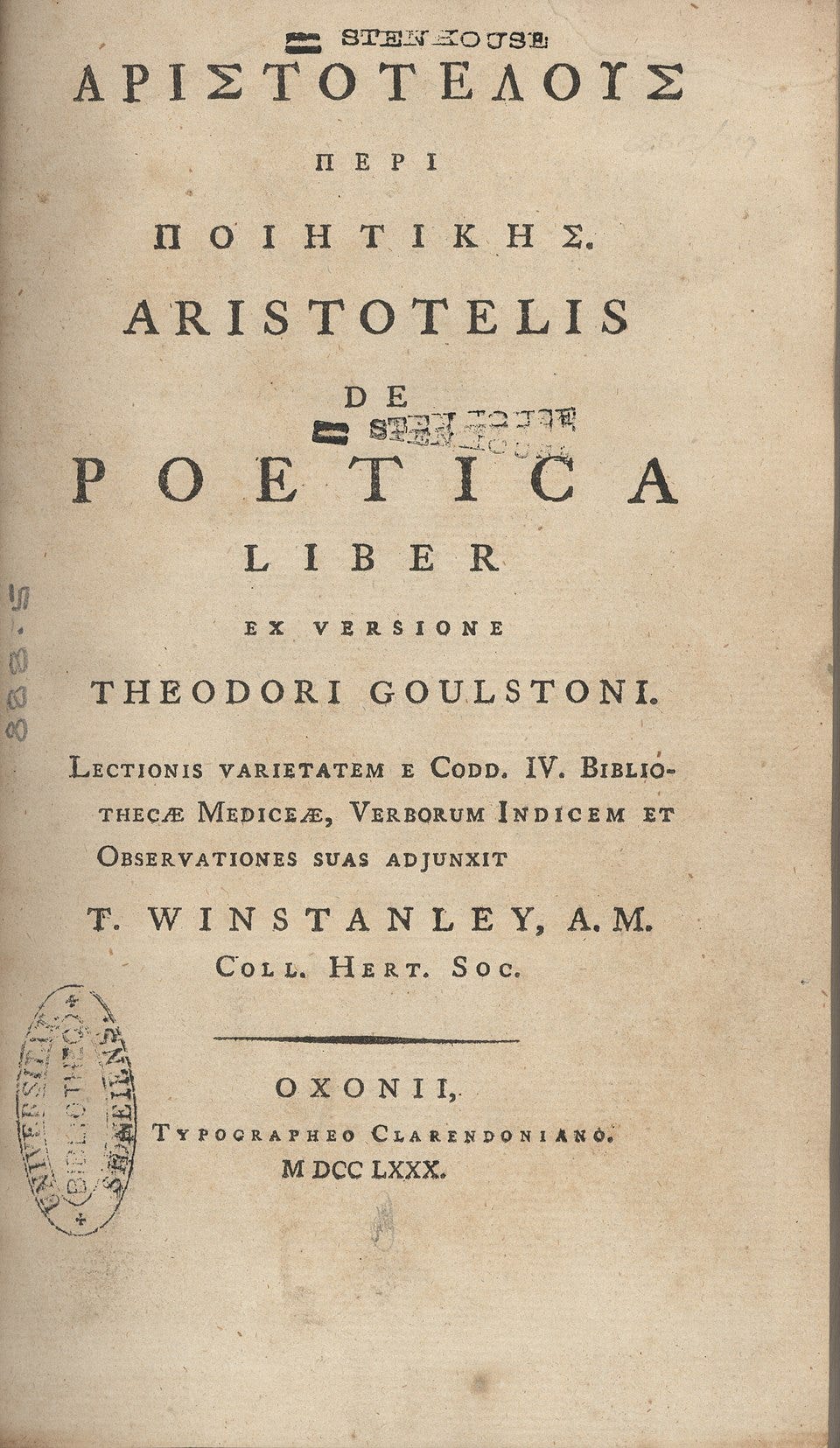
The Renaissance rediscovery of the Poetics did not reverse this tendency; it redirected it. Humanist critics were fascinated by character, inwardness, and ethical exempla. They read tragedy as a study of the soul under pressure. Italian commentators such as Castelvetro, followed by English critics, increasingly interpreted hamartia as a dominant trait or habitual tendency—a personal excess that leads the hero astray. This interpretation proved especially congenial to Shakespeare, whose plays teem with inward conflict and psychological nuance. The language of “flaw” felt not only plausible but illuminating, and so it took hold.
By the nineteenth century, the transformation was complete. German Idealism (notably Hegel) reframed tragedy as the collision of ethical forces embodied in individuals, and then the Victorian critic A. C. Bradley systematized the idea. In Shakespearean Tragedy, he argued that each of Shakespeare’s great tragic heroes is marked by a central defect of character which, while inseparable from his greatness, ultimately brings about his ruin. Hamlet’s tragedy lies in his habitual indecision, his tendency to think rather than act; Lear’s in his pride and blindness to genuine love; Macbeth’s in an overvaulting ambition that outruns moral restraint; Othello’s in a susceptibility to jealousy rooted in trustfulness and insecurity. These flaws are not crude vices but subtle distortions of otherwise admirable qualities, and Bradley’s readings are often extraordinarily sensitive to Shakespeare’s language. Yet the conceptual framework is clear: tragedy unfolds as the working-out of an inner imbalance. Action is the expression of character; catastrophe is the revelation of defect.
Nowhere has this model been more influential—or more contested—than in readings of Hamlet. From Goethe onward, Hamlet was imagined as the archetypal “man of thought, not action,” a consciousness too reflective for the brutal necessities of the world. Coleridge famously described him as paralysed by “the overbalance of the contemplative faculty.” Critics seeking textual warrant for this interpretation have often fastened on a passage in Act 1, Scene 4, in which Hamlet reflects on what he calls the “vicious mole of nature”—some innate defect or habit which can corrupt an otherwise noble character. The immediate context is Hamlet’s disgust at the Danish custom of heavy drinking, but the passage has repeatedly been taken as a moment of self-diagnosis, a tacit acknowledgement of Hamlet’s own fatal flaw.
Yet this reading rests on surprisingly fragile foundations. The “vicious mole” passage appears in the Second Quarto but was cut from the Folio text, the version of the play most closely associated with theatrical performance. Its absence suggests that Shakespeare, or the acting company, did not regard it as structurally or thematically indispensable. If the play truly turned on Hamlet’s recognition of his own tragic flaw, it is hard to see why such a passage would be dispensable. The cut reminds us that what later critics seized upon as a key to Hamlet’s psychology may have been, for Shakespeare himself, an excisable reflection rather than a governing principle.
By the time Bradley’s synthesis was absorbed into university curricula, however, such doubts scarcely registered. The tragic-flaw model offered an elegant, teachable way of organizing Shakespeare’s plays, and Aristotle was repeatedly invoked as its classical authority—even though the Aristotle thus cited had been filtered through centuries of moral and psychological reinterpretation.
Only in the twentieth century did scholars begin to dismantle this inheritance. Classicists and philosophers returned to the Greek text and found no tragic flaw lurking there. Critics such as Gerald Else, Martha Nussbaum, and Bernard Williams showed that Aristotle read Greek tragedies not as morality plays about defective personalities, but as explorations of the fragility of human agency. Error, not vice, is their motor. The world of tragedy is one in which good reasons can lead to disastrous outcomes, and in which understanding comes too late to undo what has been done.
Seen in this light, the history of hamartia traces a remarkable arc: from error in action, to moral fault, to sin, to vice, to psychological flaw. Each step made sense within its own intellectual climate, yet the cumulative effect was to impose on Aristotle a conception of tragedy he would scarcely have recognized. What began as a missed mark became a stain on the soul. And with that shift, tragedy itself was subtly transformed—from a meditation on human fallibility into a lesson on personal failure.