My name is Jon Stevens. I am CEO of Hot Aisle, a two year old company that operates at the center of the AI compute supply chain, the same supply chain that research firms like SemiAnalysis claim to analyze objectively.
I spend my days working directly with the public, hardware vendors, data centers, cloud operators, and developers building the next generation of AI utility. I see firsthand the pricing dynamics, the real performance and stability characteristics, the role of confidential NDAs, and the intense pressure that comes with navigating the modern semiconductor ecosystem that is growing faster than ever.
The semiconductor information economy has become a new form of power.
Opinions, especially from well-followed analysts, move markets.
Narratives shape trillion-dollar technology roadmaps.
A single sensational report can elevate a startup or bury an incumbent.
And yet, unlike traditional equity research (where I’m also a paid consultant), this relatively new class of analysts is mostly unregulated, opaque, and often financially entangled with the very companies they evaluate. That is a fundamental threat to fair markets, to technological progress, and to those building real infrastructure in an industry that actually has continuously thinning margins (Burry depreciation) and massive existential risk.
In this industry, silence isn’t accidental, it’s engineered. There’s an unspoken rule that you don’t challenge the people who control the narrative, especially those who can shape perception with a single post or newsletter blast. Careers, partnerships, and access to hardware can vanish overnight if you step out of line.
Everyone feels the pressure:
Don’t ask uncomfortable questions
Don’t challenge popular opinions
Don’t expose inconvenient truths
Just play the game. Be a good little boy or girl. Nod along. Wait your turn.
The result is a quiet, simmering fear and intimidation. Companies produce and ignore inaccuracies because correcting them risks retaliation. Founders smile through the shade because they can’t afford to lose their seat at the table. Analysts grow more powerful not through accuracy, but through the absence of anyone willing to call them out. And then that silence becomes the culture. The culture becomes the norm. And the norm becomes the problem.
I’m choosing to break that cycle, because influence without accountability corrodes everything around it. And AI, the technology that is already shaping economies, redefining jobs, and governing critical decision-making, is far too important to be steered by unchecked power and self-interested narratives.
We are not talking about some niche hobbyist market anymore. We’re talking about the infrastructure of the future:
Who gets access to compute
Who gets to innovate
Who falls behind
Whose voices get heard
Even global national security
When a small group, with little formal training or backgrounds in the industry, can bend perception to their financial advantage, entire industries can be misdirected.
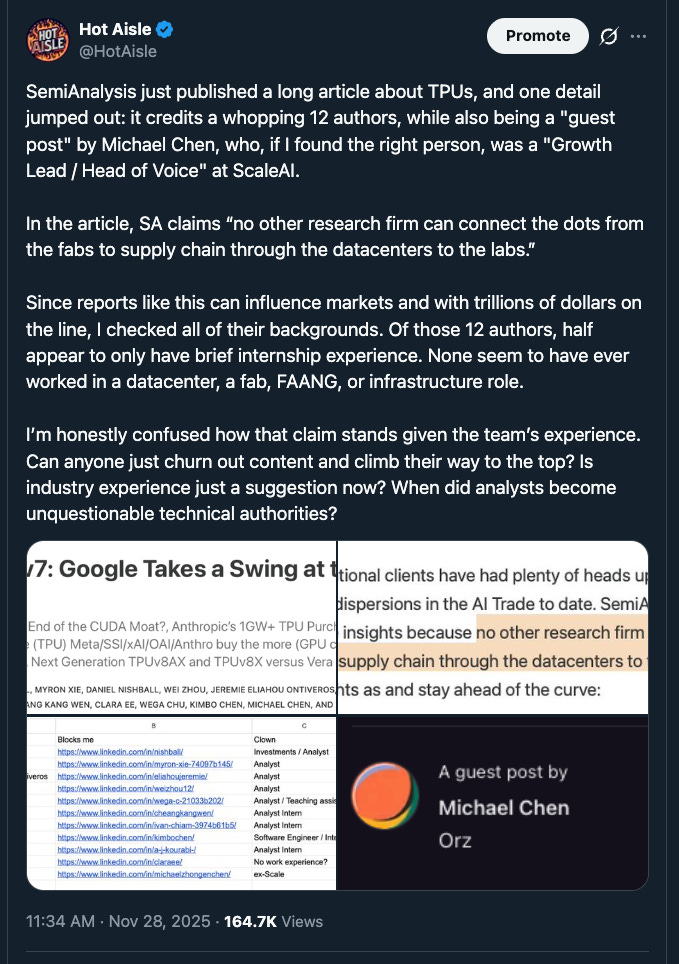
https://x.com/HotAisle/status/1994489979486310866
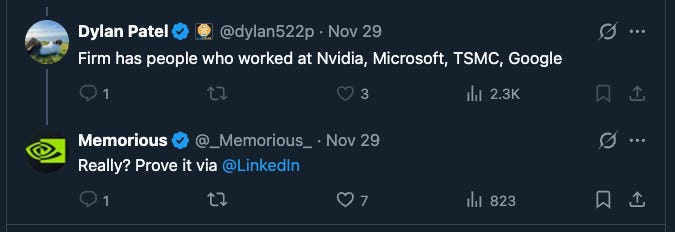
https://x.com/_Memorious_/status/1994840110689599856
Investment decisions shift. Startups die prematurely. Researchers build on bad assumptions. And the future becomes something shaped in private, rather than earned in public. AI must not inherit the worst behaviors of the old guard, secrecy, back-room deals, and information gatekeepers who profit from fear. It deserves a sovereign foundation of transparency, technical honesty, and shared progress.
This is a long-overdue due-diligence audit of a powerful multi-national firm whose influence has grown far beyond its accountability. A look at how commercial incentives, personal relationships, and methodological shortcuts can turn “analysis” into a potential weapon for unregulated ideological market manipulation.
For those who have followed the online discourse, none of this is new. The difference now is that it’s being consolidated into a single, coherent story that can be linked to every time someone is lost in a twitter thread. And before anyone misinterprets what follows, let’s establish a few principles:
I believe in a competitive multi-vendor AI future.
That future requires independent, transparent, honest voices.
It requires ethical interactions and research.
It requires asking fair questions and getting fair answers.
It expects influence and respect to be earned, not gamed or purchased.
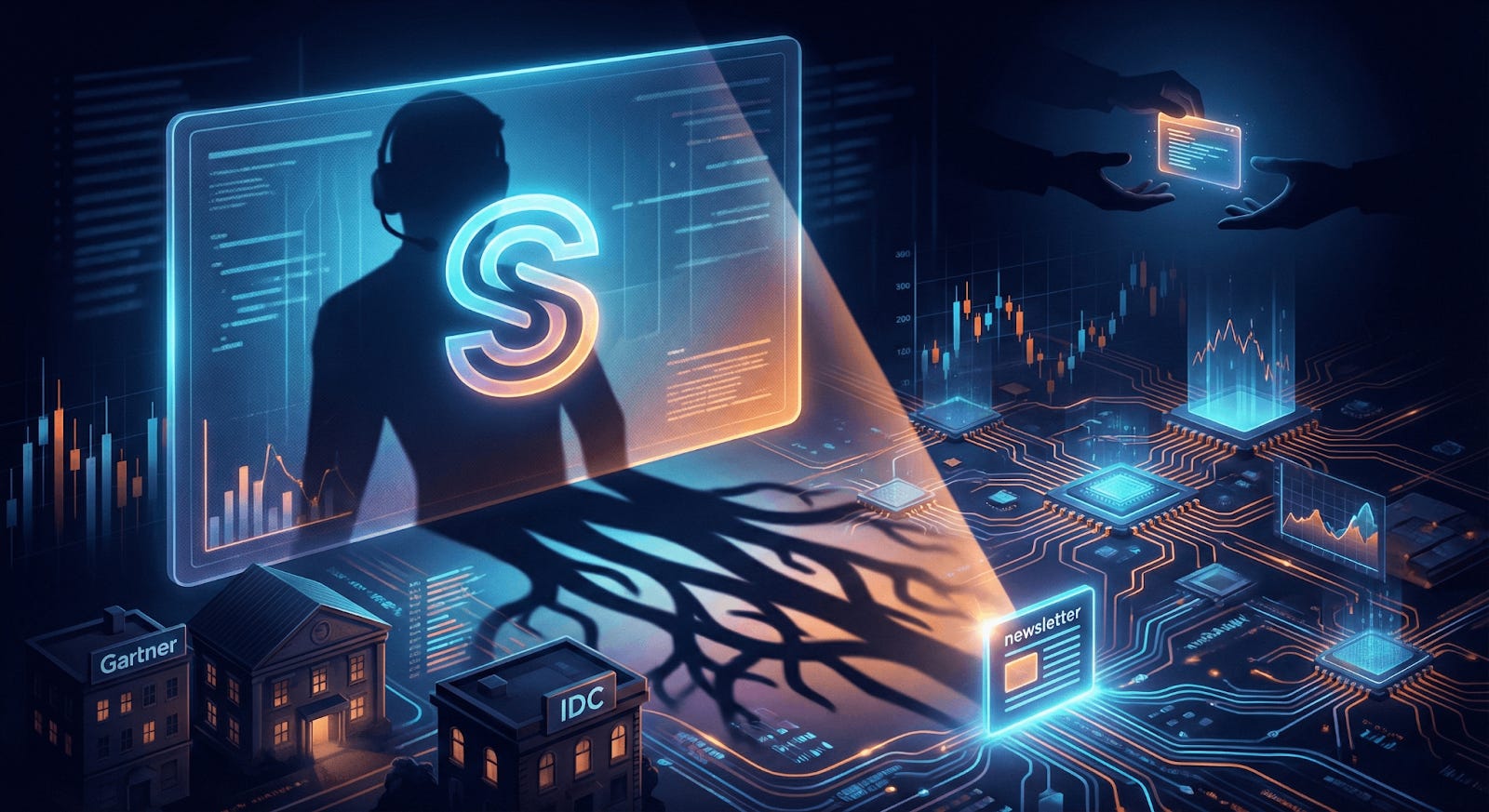
The modern semiconductor landscape is no longer defined solely by the physical realities of lithography, yield rates, and packaging technologies. It is increasingly shaped by an information ecosystem that dictates capital allocation, stock valuations, and strategic corporate roadmaps. Within this ecosystem, boutique research firms have emerged as critical nodes of influence, bypassing traditional institutional gatekeepers to deliver high-velocity, technical intelligence directly to investors and industry insiders.
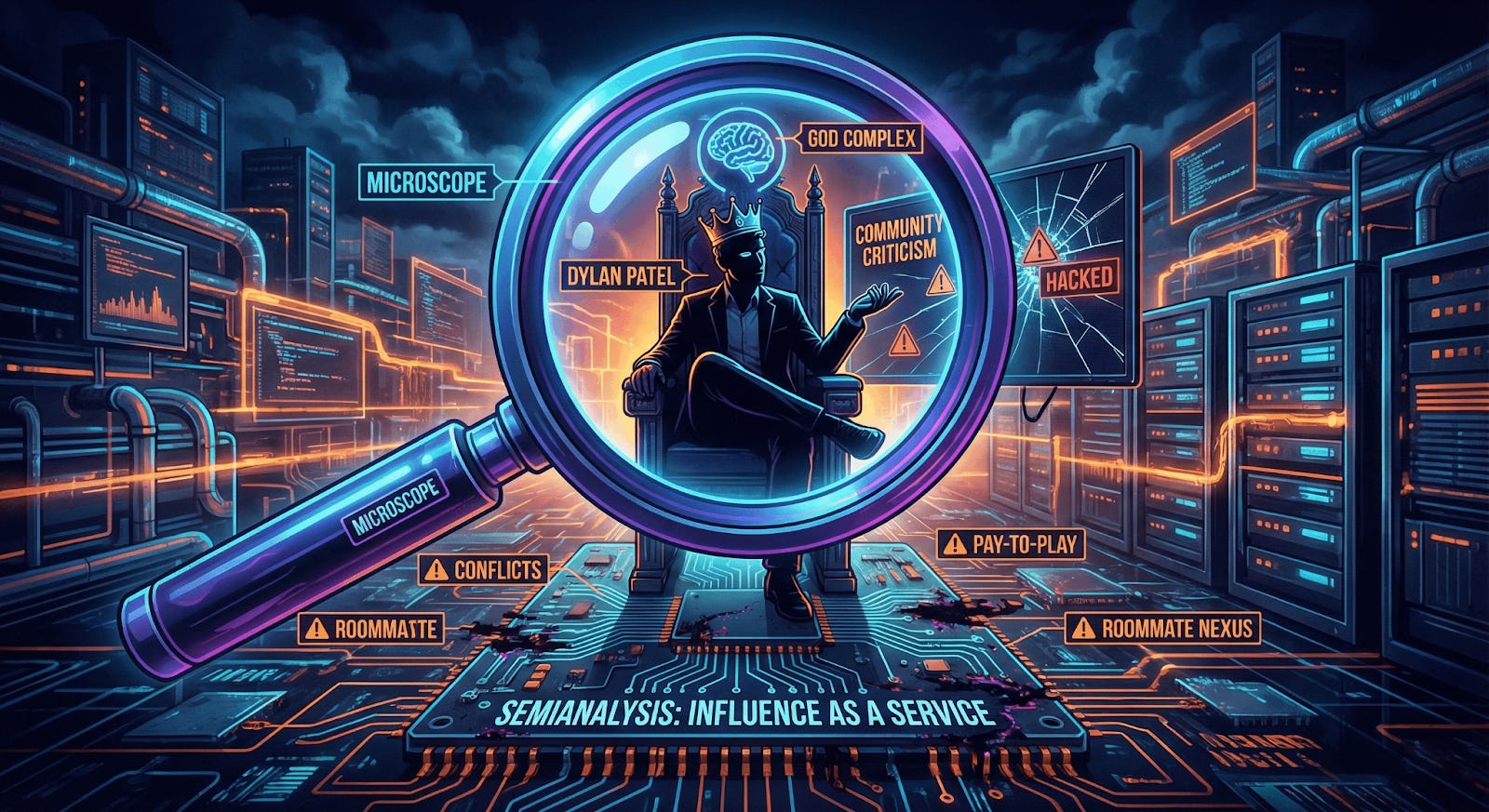
Among these, SemiAnalysis, led by Aiaf Dylan Patel, has ascended to a position of prominent authority. A long examination of the firm’s operational conduct, revenue mechanisms, and leadership psychology reveals a complex web of structural conflicts, security vulnerabilities, and methodological irregularities. This report serves as a due diligence external audit, deconstructing the façade of objective analysis to expose the commercial and behavioral mechanics that potentially compromise the integrity of SemiAnalysis’s (and potentially other analyst) output.
To understand the gravity of the scrutiny surrounding SemiAnalysis, one must first contextualize the vacuum it fills. Traditional analyst firms like Gartner or IDC operate on quarterly cycles with broad, often lagging, market surveys. In contrast, the artificial intelligence (AI) hardware boom, driven by the ascendancy of Large Language Models (LLMs), created a demand for real-time, granular supply chain intelligence.
SemiAnalysis capitalized on this shift with a newsletter-model: publishing technical deep dives that promise “alpha,” proprietary insights marketed as capable of delivering outsized returns for anyone willing to pay $500 a year, rather than just buying a couple shares of the companies they write about.
This business model relies heavily on the perceived independence and technical acuity of the analyst. When that independence is eroded by undisclosed commercial entanglements, or when the technical acuity is marred by bias and operational negligence, the risk transfers directly to the consumers of that intelligence, the investors and corporate strategists managing billions (or trillions) in capital.1
SemiAnalysis’s core power lies in its ability to move markets with a single publication, or these days, a tweet. A report declaring a specific GPU architecture “dead on arrival”, a software stack “unusable”, a business as “Not Recommended”, can instantly erase hundreds of millions of dollars in market capitalization for the targeted company. “Not Recommended” was an addition over ClusterMAX 1.0 as a way to push their influence even further. A, kinder, alternative approach would have been to end the list at the Bronze category. Just like the Olympics, there is no fourth place.

Instead, this power has the potential to create a perverse incentive structure where CEO’s are publicly shamed into improving their low rankings on his report.
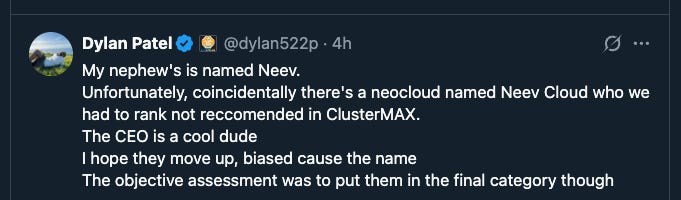
https://x.com/dylan522p/status/1986563022794403919
Attention is currency, the threat of negative coverage is leverage. Self-realized analysts are in lightly regulated positions where normally journalism standards should apply. SemiAnalysis has not only recognized this leverage but has institutionalized it, creating a perceived business model where public criticism could act as the top-of-funnel lead generation for private, lucrative consulting arrangements and access to proprietary information. Streisand Effect v2.0.

https://www.reddit.com/r/AMD_Stock/comments/1p8vdlq/comment/nr83e12/
This perceived “pay-to-play” dynamic, often obfuscated by the guise of “constructive feedback,” represents the single most significant threat to the firm’s credibility and the integrity of the data it provides to its subscriber base. From the outside, it’s often impossible to know whether that happens in specific cases, but the overall incentives are troubling.
The fundamental ethical breach alleged against SemiAnalysis stems from the dual nature of its operations. On one front, it presents itself as an independent media outlet and research house, publishing “facts” and “analysis” for public and subscriber consumption.
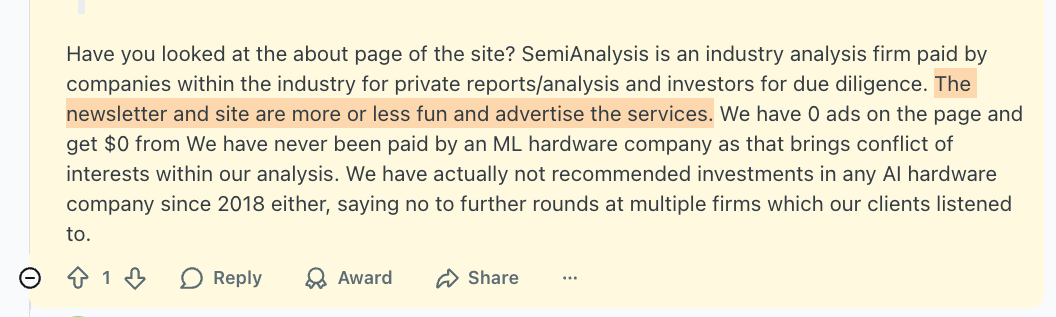
https://www.reddit.com/r/NVDA_Stock/comments/10dglom/comment/j59yrmc/?context=3
On the other end, it operates as a private consultancy, offering paid advice to the very companies it covers. In the absence of strict, transparent firewalls, of which there is little oversight and evidence, this duality creates an inescapable conflict of interest.
When you provide consulting services to analysts, especially those who publish market-moving opinions, the expectations around transparency are significantly higher. Consultants and thus analysts often have access to confidential business information, roadmap insights, and competitive positioning. That means any paid relationship isn’t just a business arrangement, it’s a potential conflict of interest.
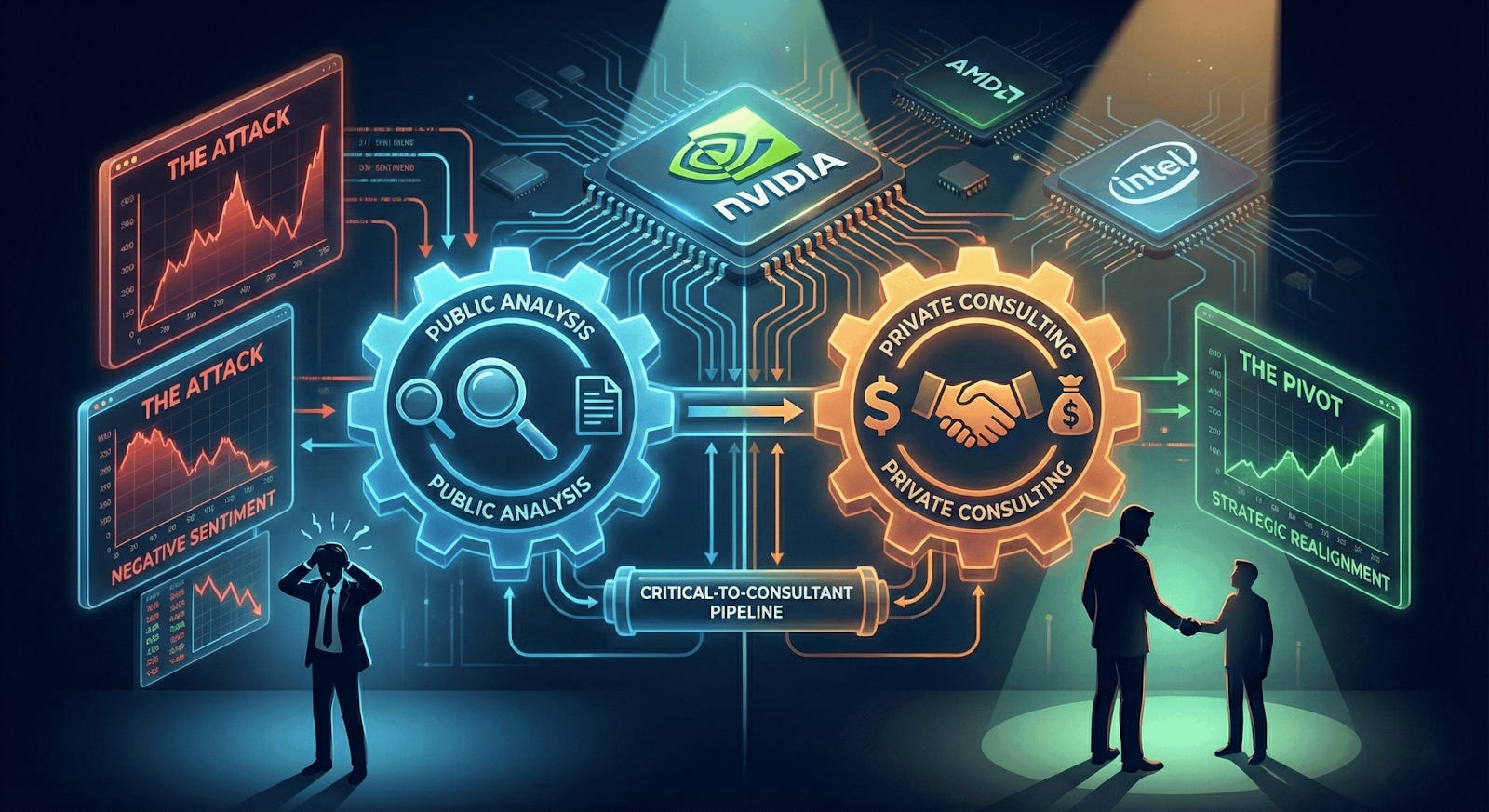
The global industry standard for navigating this conflict is rigorous disclosure. When an analyst writes about a company they consult for, that relationship must be explicitly stated to allow the reader to adjust for potential bias. The investigation into SemiAnalysis reveals a pattern of acute opacity. Critics argue that this may be a deliberate strategy to leverage this conflict. This is most visibly manifested in what industry observers term the “Critical-to-Consultant” pipeline. This mechanism operates on a predictable cycle:
The Attack: The firm publishes a highly critical, often sensationalized report regarding a vendor’s technology, citing anonymous sources or specific technical failures.
The Squeeze: The negative sentiment impacts the vendor’s stock price or customer confidence, creating urgent pressure on the vendor’s leadership to “correct the narrative.”
The Engagement: The vendor engages the analyst firm for “advisory services” or “strategic consulting” to address the critiques.
The Pivot: Subsequent coverage of the vendor softens, emphasizing “rapid improvements,” “responsiveness to feedback,” or “strategic realignments,” effectively neutralizing the initial negativity.
This forces technical leadership at the target companies to engage directly, as seen in the interactions with major semiconductor CEOs. The “due diligence” performed during these consulting engagements is alleged to be “tailored to the one paying the bills”.1 This implies that the “facts” presented to investors in private reports are curated to support the client’s pre-determined narrative, rather than reflecting the objective reality of the hardware’s capability.
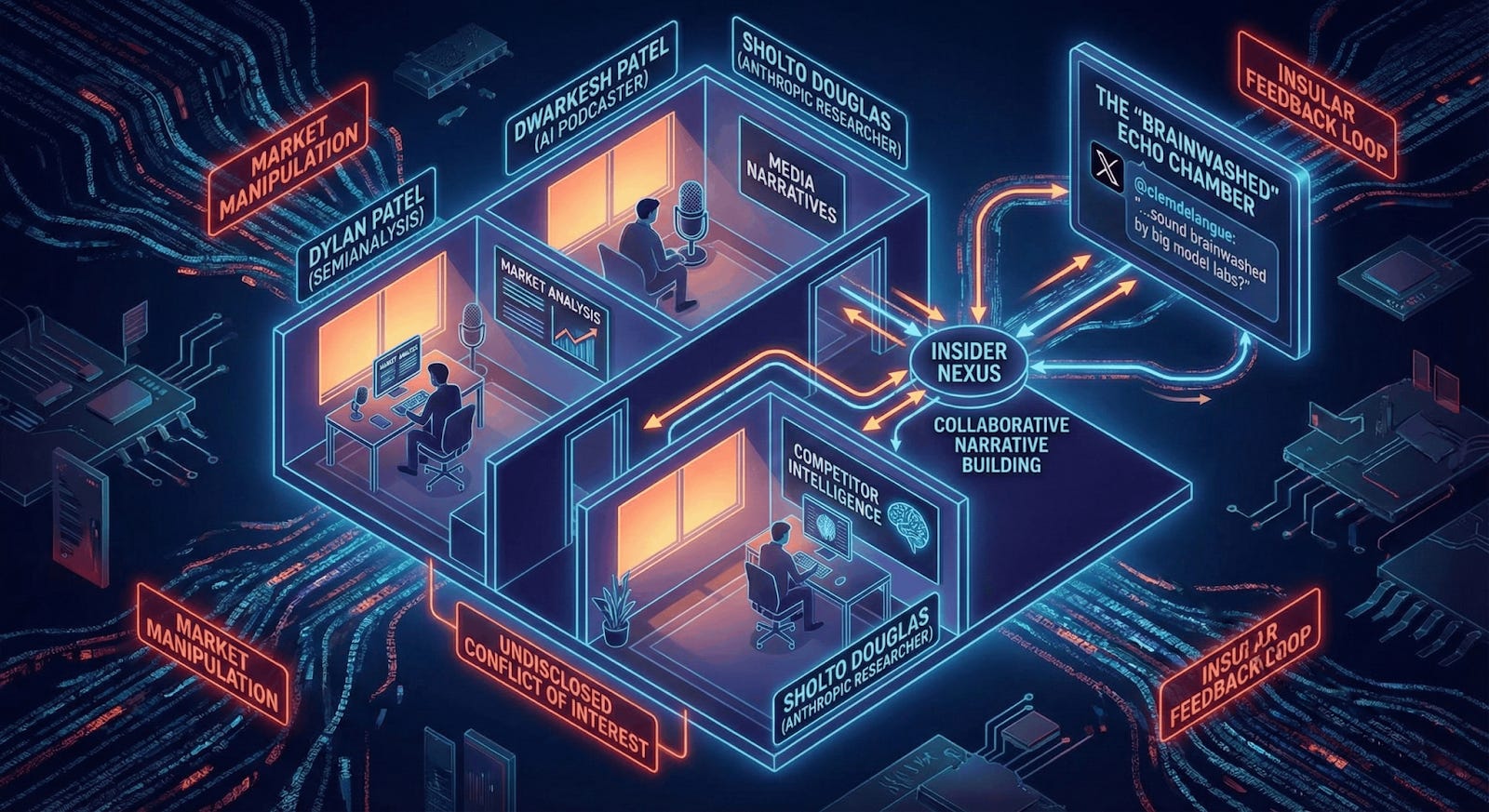
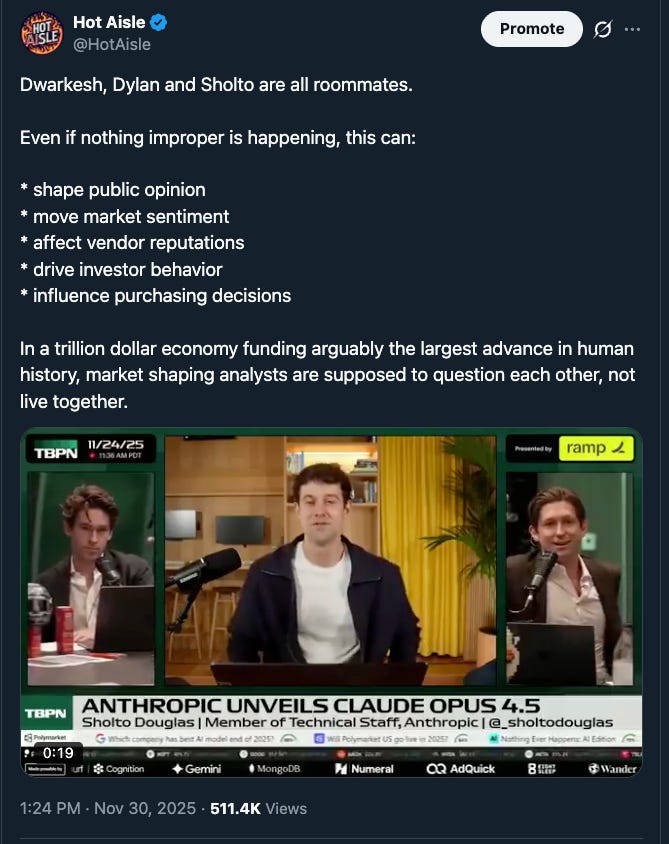
Perhaps the most alarming revelation regarding the firm’s lack of independence is the recent confirmation of a “Roommate Nexus” involving key industry players. Dylan Patel (SemiAnalysis) lives with Dwarkesh Patel (a prominent AI podcaster) and Sholto Douglas (a researcher at Anthropic, a primary competitor to OpenAI and Microsoft), as well as possibly others. Clearly my post hit a nerve, with 511k views. 7, 8
https://x.com/HotAisle/status/1995242558117847404
This “roommate nexus” absolutely creates the appearance of a tightly-coupled influence loop. Optics in this industry are intensely important. Market analysis (Dylan), podcast-driven narrative shaping (Dwarkesh), and technical perspective from a leading AI lab (Sholto) are all intertwined in a private, domestic setting. Even without any outright illegal behavior, it risks distorting objectivity: analysis, media narratives, and research viewpoints can end up reinforcing one another inside the same social circle.

Dec 14th, 2025
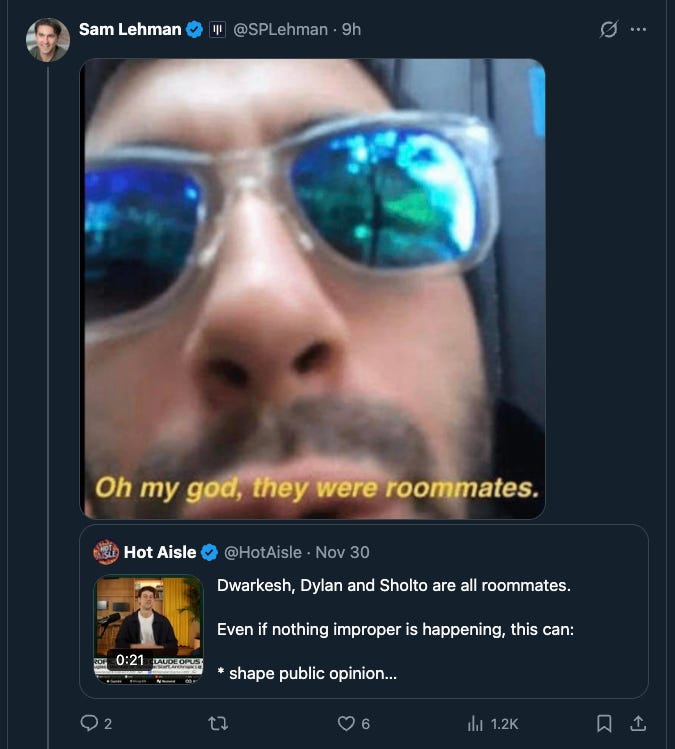
The blatant conflict of interest is now a political meme
Industries have always operated on social circles, favors, and “who you know.” Of course people can spend time with whomever they choose, that’s the most superficial counterpoint.
https://x.com/HotAisle/status/1995585910210220204
Dylan has gone on a high visibility talk show, while sitting outside, performing full damage control, attempting to blow it off, as if that was the issue at hand. “Oh, I thought I should live with friends, its more fun. Giggle.” Nobody disagrees with you.

A subtly different and professional analyst approach from someone who is trying to repair their reputation in the industry. Which was not done. Would have been to go on record saying simply: “There is absolutely no conflict of interest between roommates, beyond ordering too much pizza together.” You had your chance to legitimize your business, lined up perfectly, why did you choose to go the superficial route?
Problems arise when personal ties are hidden while those same people are influencing markets and shaping narratives. It’s like learning that Dr. Lisa Su is Jensen’s first cousin once removed, interesting trivia, but only problematic if no one bothers to mention it until after key decisions are already made.
Observers like Singularity Research, have pointed to this nexus dynamic as evidence of an insular feedback loop that could distort objective analysis. We can assume that if an analyst is living with a researcher from a major AI lab, their “neutral” assessments of that lab’s competitors (e.g., OpenAI or Google) should be viewed with extreme skepticism.
The line between “independent research” and “collaborative narrative building” is blurred, creating a possible environment for opinionated “market manipulation” through socially engineered narratives. The fact that the CEO of an “independent” research firm shares a roof with a key employee of a company he covers (and whose competitors he critiques) represents a staggering, previously undisclosed, conflict of interest.
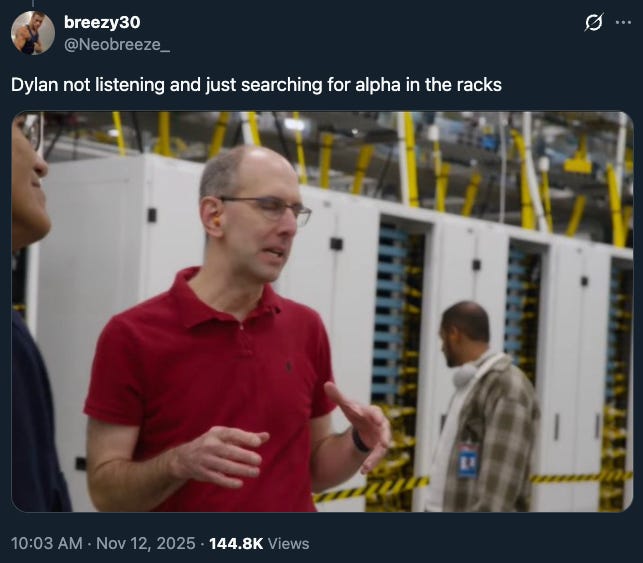
Especially when two of them participated in a widely publicized meeting with Microsoft’s CEO and none of these relationships are disclosed, raising legitimate concerns about transparency, and SemiAnalysis’s role in the meeting.
https://x.com/Neobreeze_/status/1988668924175814824
Quantifying the Bias: The “Nvidia-Centric” Lens
A recurring theme in the analysis of SemiAnalysis’s output is (until recently) a persistent, structural bias in favor of Nvidia, the dominant incumbent in the AI hardware space. While Nvidia’s market leadership is an objective fact, the methodology used by SemiAnalysis to reinforce this narrative has drawn sharp criticism for being intellectually dishonest and commercially motivated. This criticism is often used to farm more engagement by directing people to “read the post.”
Critics point to the firm’s reliance on “NeoCloud” rental pricing as a proxy for hardware value and performance. NeoCloud, third-party GPU rental services, often price instances based on competition, scarcity and brand demand rather than raw compute efficiency. By using these rental rates to calculate “cost per token” or “inference economics,” SemiAnalysis produces benchmarks that inherently favor Nvidia’s ecosystem, which commands a premium due to software lock-in (CUDA), while disadvantaging competitors like AMD or Intel, whose hardware might offer better raw performance-per-dollar but lack the first mover advantage, rental demand or market liquidity.
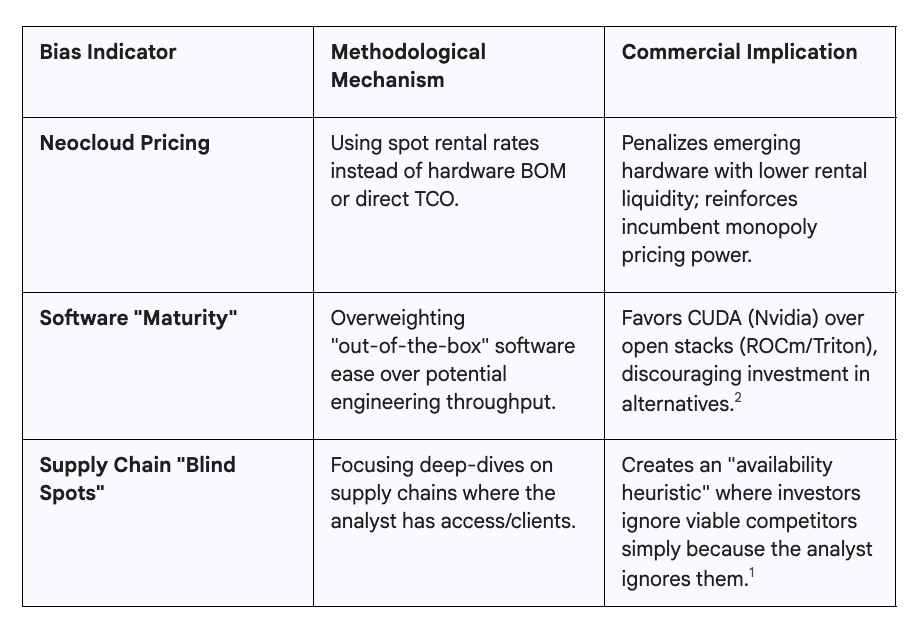
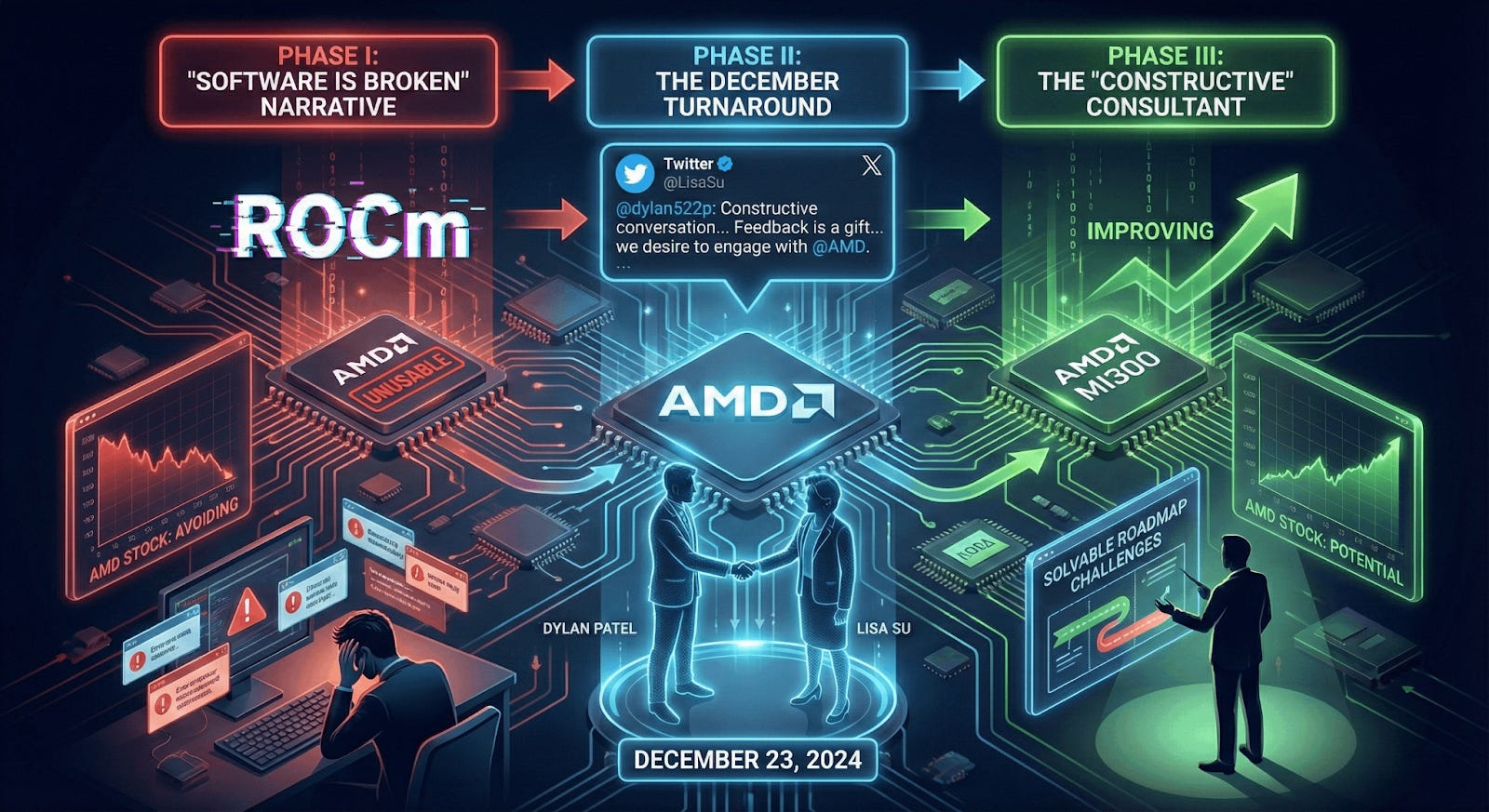
The most compelling evidentiary thread supporting the perception of “pay-to-play” is the chronological evolution of SemiAnalysis’s coverage of Advanced Micro Devices (AMD) and its MI300 accelerator. This sequence of events offers a rare, visible glimpse into the mechanism of narrative capture described above. The purpose of this is not to cast a negative light on AMD in any way, but to show the larger picture of how SemiAnalysis could potentially manipulate things, with any company, into their favor.
Full transparency: as one of only two AMD-exclusive NeoCloud providers, meaning we exclusively deploy and rent AMD Instinct GPUs, speaking publicly about this could invite speculation about my alignment with AMD. To eliminate any ambiguity, my position on that is already clearly outlined in this longer post, which also details my personal views on transparency and ethics: https://x.com/HotAisle/status/1990330662348374104
Throughout late 2023 and the majority of 2024, SemiAnalysis (and others, such as George Hotz) maintained a combined bearish and often derisive stance regarding AMD’s AI ambitions. The primary vector of attack was their obviously weak links which are the ROCm software stack and developer ecosystem. Reports detailed extensive bugs, poor developer experience, and a lack of optimization for leading-edge models, effectively labeling the hardware as “unusable” for serious enterprise deployments, despite its impressive raw specifications. This narrative was widely disseminated and cited by investors as a primary reason for avoiding AMD stock or shorting it relative to Nvidia.2
The pivot point can be isolated to a specific interaction in December 2024. Following the publication of an AMD training article, “MI300X vs H100 vs H200 Benchmark Part 1: Training - CUDA Moat Still Alive”, which presumably contained deep, critical analysis of the hardware’s training capabilities. This resulted in a high-visibility public interaction between Dylan Patel and AMD CEO Lisa Su. On December 23, 2024, Lisa Su publicly thanked Patel for a “constructive conversation,” stating, “Feedback is a gift even when it’s critical... I appreciate all the feedback and desire to engage with @AMD”.
This public acknowledgment from a Fortune 500 CEO to a newsletter writer is highly irregular and signals a significant escalation in the relationship. It implies a direct, high-level channel of communication had been established. In the world of high-stakes corporate strategy, CEOs do not typically spend time having “constructive conversations” with independent bloggers, unless those bloggers possess significant industry leverage, or are being brought into the fold as paid advisors. Without direct inside knowledge, it would be difficult to prove, but from the outside looking in, it is worth noting that this is not a common occurrence.
Following this engagement, market observers noted a tangible shift in the tone of SemiAnalysis’s coverage. While not becoming an outright cheerleader, the criticism shifted from “fundamental disqualification” to “solvable roadmap challenges.” The narrative began to emphasize AMD’s “improving” position and the potential for the MI300 GPU to capture meaningful market share, provided they executed on the feedback, feedback that presumably mirrored the advice given in the consulting sessions.
The community reaction was swift and cynical. “I would be very, very surprised if AMD did not pay SemiAnalysis for the 12/23/2024 consulting meeting,” remarked one observer, encapsulating the consensus that the meeting represented a commercial transaction. The implication is that the “constructive conversation” was the commencement of a consulting retainer. By paying for the “due diligence,” AMD effectively neutralized a vocal critic, transforming him into a “critical friend.”
Of course, it must be noted that the lack of transparency in this industry leaves the door open for all sorts of speculation, good and bad.
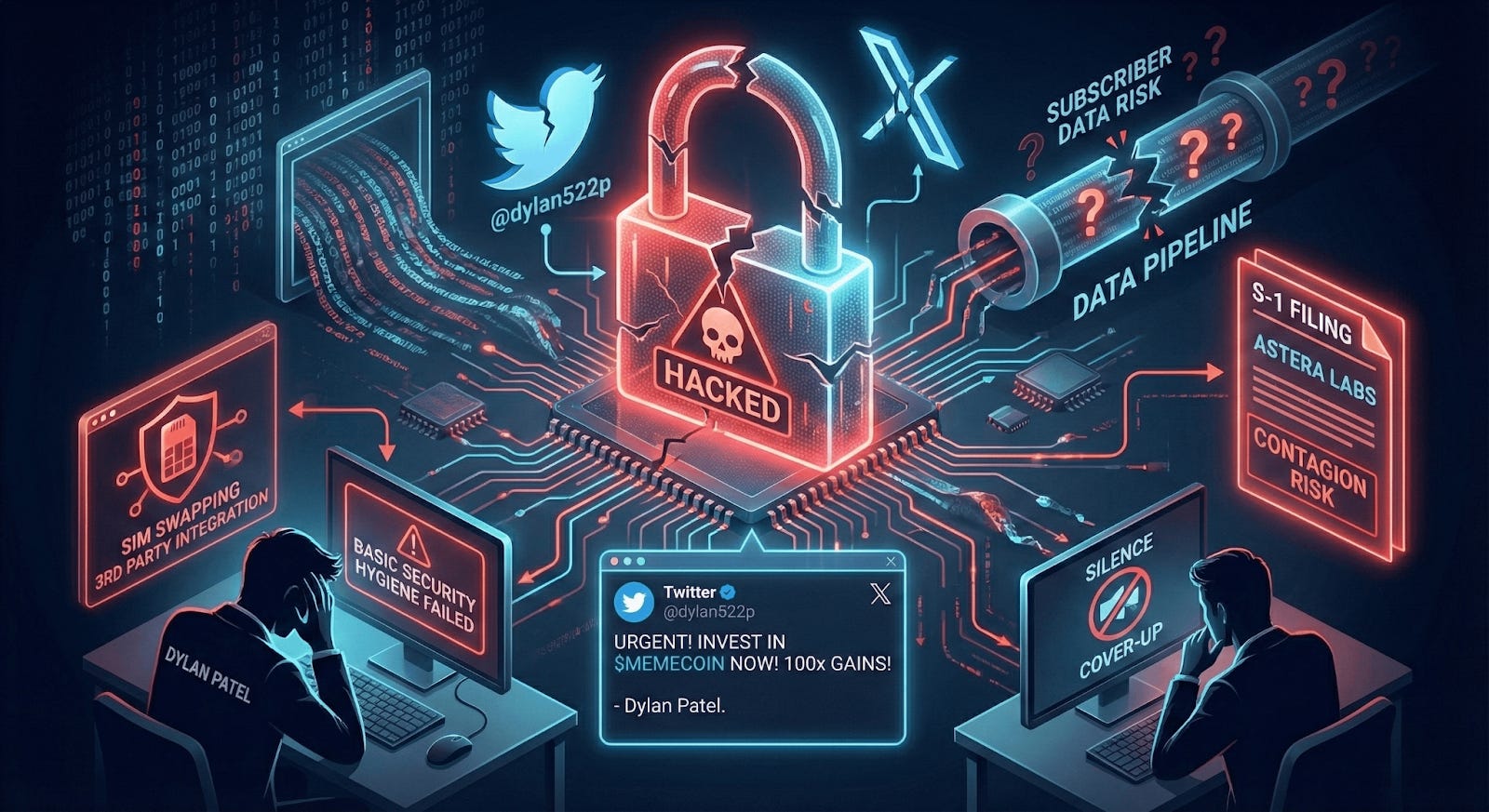
For an organization that sells “Deep Due Diligence” and acts as an arbiter of competence for trillion-dollar hardware companies, the operational security (OpSec) of SemiAnalysis is alarmingly fragile. The most damning evidence of this is verified by Dylan’s own admission, a security breach that targeted the @SemiAnalysis_ X (Twitter) account.
Records confirm that their account was compromised and used to promote a cryptocurrency scam. Specifically, the account was hijacked, multiple times, to push a “meme coin,” leveraging the analyst’s credibility to solicit funds from followers. For a few days following the attack and subsequent regaining of control of the account, in a major oversight, the attackers post remained visible. It is unclear if this resulted in any loss of funds due to phishing, but it speaks to a general lack standard policy for dealing with the aftermath of an attack.
This wasn’t a sophisticated breach of a secure system; it was a basic social media takeover that standard security hygiene (like 2FA not stored in a shared password manager) would have prevented. And that’s where the private DMs become critical.
Analysts occupy a position of trust and regularly exchange confidential information outside of approved channels: embargoed product details, pricing intelligence, unpublished roadmaps, private conversations with executives, investor discussions, the kinds of messages that should never end up in a stranger’s hands. When your DMs are compromised, it’s not just embarrassment, it’s a potential leak of sensitive market-moving intelligence.
An arguably unprofessional followup along with blaming “the intern” isn’t a valid excuse. Not when you’re responsible for safeguarding conversations that affect billions of dollars in industry decisions.
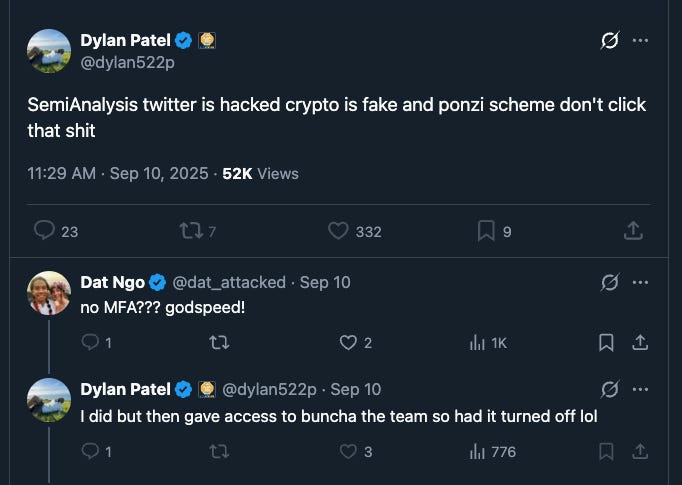
https://x.com/dylan522p/status/1965845179929407679
It wasn’t the first time he’s thrown his own people under the bus while rushing to do something.
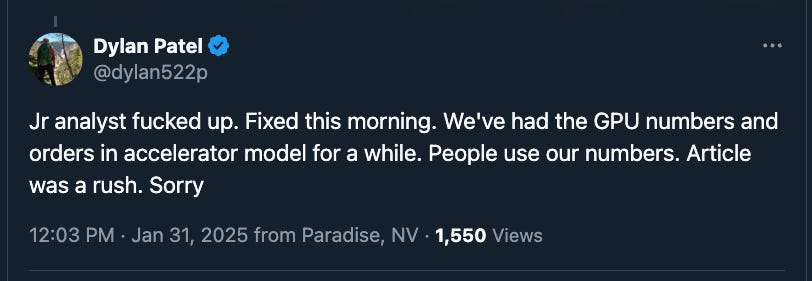
The optics of this breach are catastrophic to an analyst. A firm that postures as an authority on the security and robustness of data center infrastructure, even going so far as to require NeoClouds to obtain SOC2 to avoid being labeled “underperforming” in ClusterMAX and comparing it to FAA certification, couldn’t secure its own digital identity. For an analyst who claims deep insight into the hardware security of Nvidia and Google, falling for the most generic “Twitter crypto hack” imaginable doesn’t just raise questions, it erases credibility on technical competence entirely.
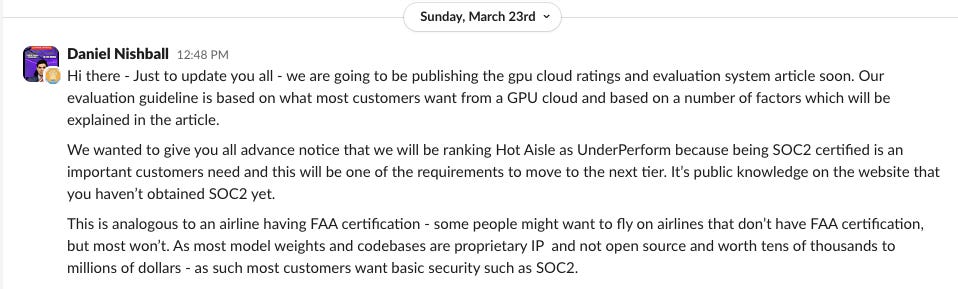
Interestingly, the hacker even unblocked and followed my own account, clearly aware of the ongoing feud between us over our ranking, and openly mocking SemiAnalysis for leaving the door wide open. My own replies to their posts quietly disappeared long before the hackers own posts did, showing their concern over what I said, was greater than their own users.
The available public record supports this characterization of a “soft cover-up.” There is no evidence of a formal post-mortem, a transparency report, or a detailed explanation to subscribers regarding how the breach occurred or what data might have been exposed.
Was subscriber data exposed? The firm collects emails and potentially payment details for its high-priced institutional subscriptions.3 Without a transparent audit, subscribers cannot know if their identities were part of the compromise.
The “Narcissist” Defense: The refusal to admit fault aligns with the behavioral profile of a narcissist. Acknowledging a hack certainly requires humility and an admission of vulnerability. Although, by pretending it never happened, the leadership preserves the illusion of invulnerability, but leaves stakeholders in the dark regarding their actual risk exposure.
Risks of this lax security extend beyond the firm itself. SemiAnalysis is cited in S-1 filings (IPO registration documents) for companies like Astera Labs as a source of market data.4 If SemiAnalysis itself is a compromised node, it introduces a contagion risk. A public company relying on compromised market data from a hacked analyst firm could make material misstatements to the SEC. The “unbelievable” nature of a big tech analysis firm ignoring a hack is not just poor PR, it is a potential liability for every public company that cites them as an authority.
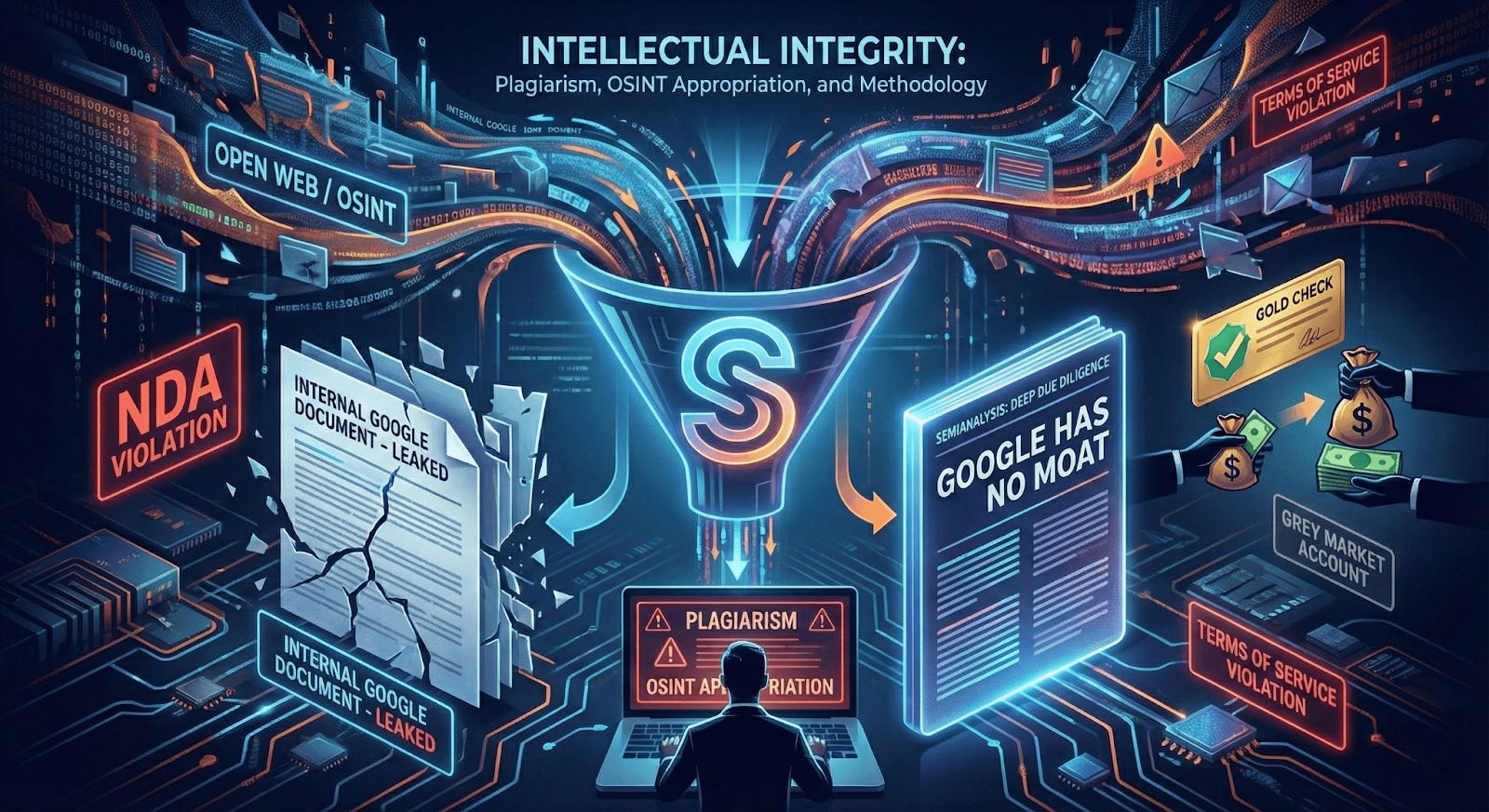
A deep dive into the methodology of SemiAnalysis reveals a practice that borders on intellectual arbitrage, harvesting insights from the open web and repackaging them as proprietary “deep due diligence.” In a secretive world where everything is locked behind NDAs, the only route to real breaking news is privileged access. Otherwise? Just remix someone else’s work and pretend you were “inspired” by it after the fact. Going so far as to delete your tweet to hide your malfeasance.
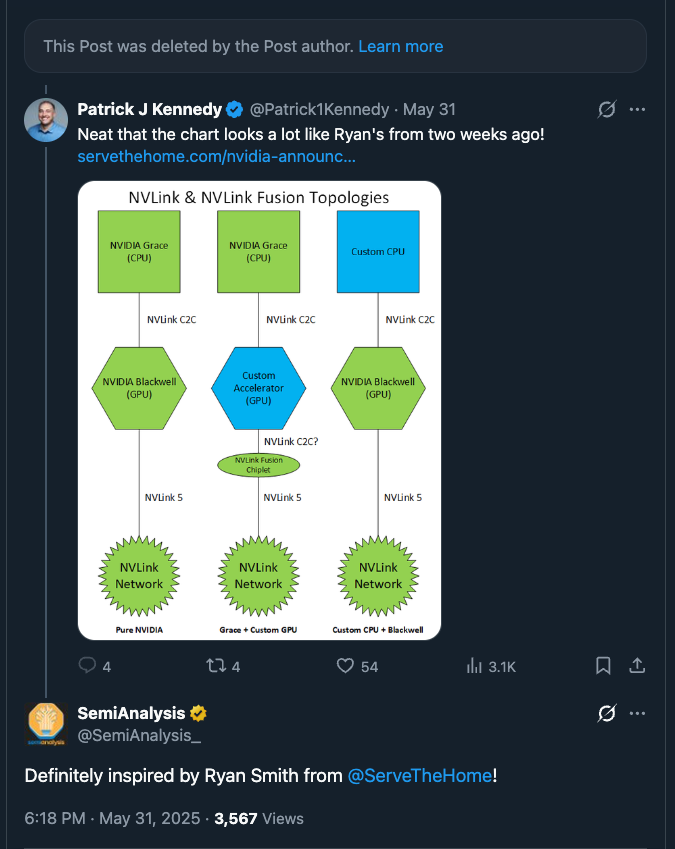
https://x.com/SemiAnalysis_/status/1928984590279909789

https://x.com/SemiAnalysis_/status/1928984590279909789
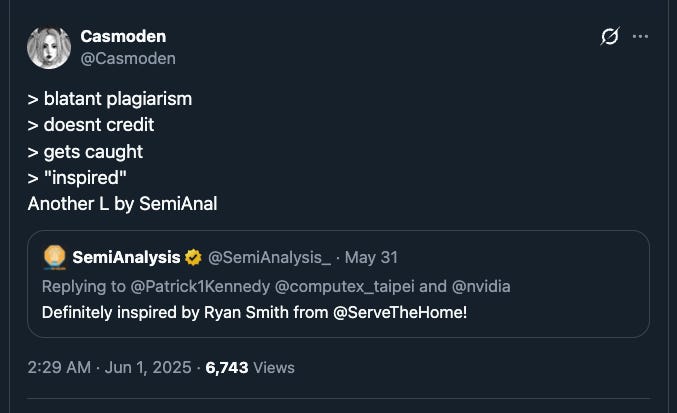
https://x.com/Casmoden/status/1929108073446051906
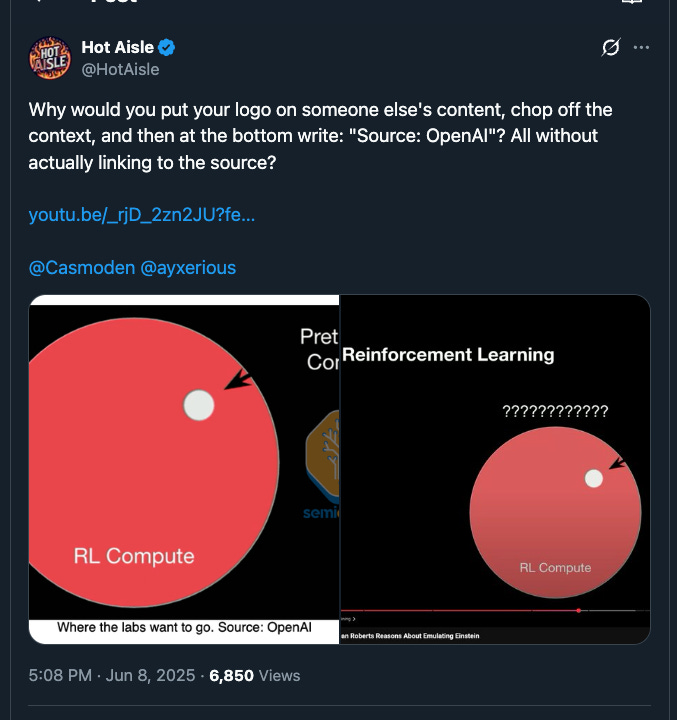
https://x.com/HotAisle/status/1931865964179828897
We assumed they had learned their lesson, but in July, Michael Luo tweeted frustration over a lack of citation.
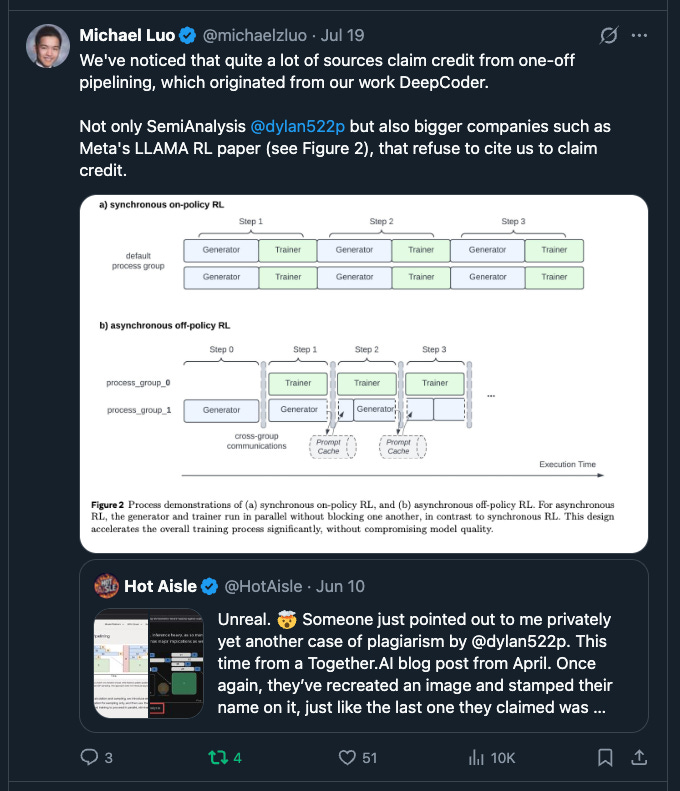
https://x.com/michaelzluo/status/1946640127369089520
To their credit, it appears they’ve taken some lessons to heart, and only minor issues have emerged since then. However, they continue to publish third-party screenshots in their reports with their own branding prominently overlaid, a practice rarely seen among established analyst firms. The need to rely so heavily on engagement farming implies that perhaps their content doesn’t stand on its own.

A critical inflection point in the firm’s fame (2023) was the publication of the document titled “Google We Have No Moat, And Neither Does OpenAI.” While widely attributed to SemiAnalysis, forensic analysis confirms this was a leaked internal Google document written by a Google researcher, not an original analysis by SemiAnalysis itself.
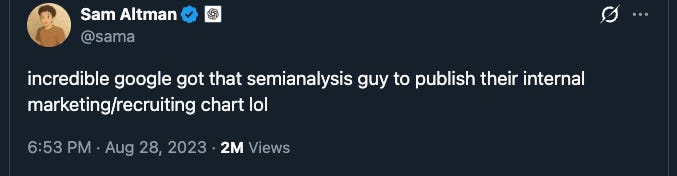
https://x.com/sama/status/1696340377098453440
The Misrepresentation: While the firm eventually added disclaimers, the initial distribution often conflated the “messenger” with the “author.” Headlines and social media chatter frequently credited Dylan Patel with the insight, a confusion the firm did little to aggressively correct until pressed.
The “Leak” Business Model: Publishing leaked trade secrets is a legally precarious business model that differs fundamentally from equity research. It relies on the violation of NDAs by sources rather than independent analytical derivation. This confirms the suspicion that the firm is “not clean”, it trades in the grey market of misappropriated corporate data.
Clearly, there is a fundamental lack of oversight if professional analysts aren’t even ensuring that their “inspiration” is properly attributed. When major publications that elevate a firm’s reputation turn out to be leaked internal documents produced by others, yet are circulated in a way that blurs the line between messenger and author, it raises questions about editorial rigor and ethical guardrails. If a firm’s credibility hinges on leaks and repackaged insights rather than transparent sourcing and original research, the trustworthiness of the entire operation becomes suspect.
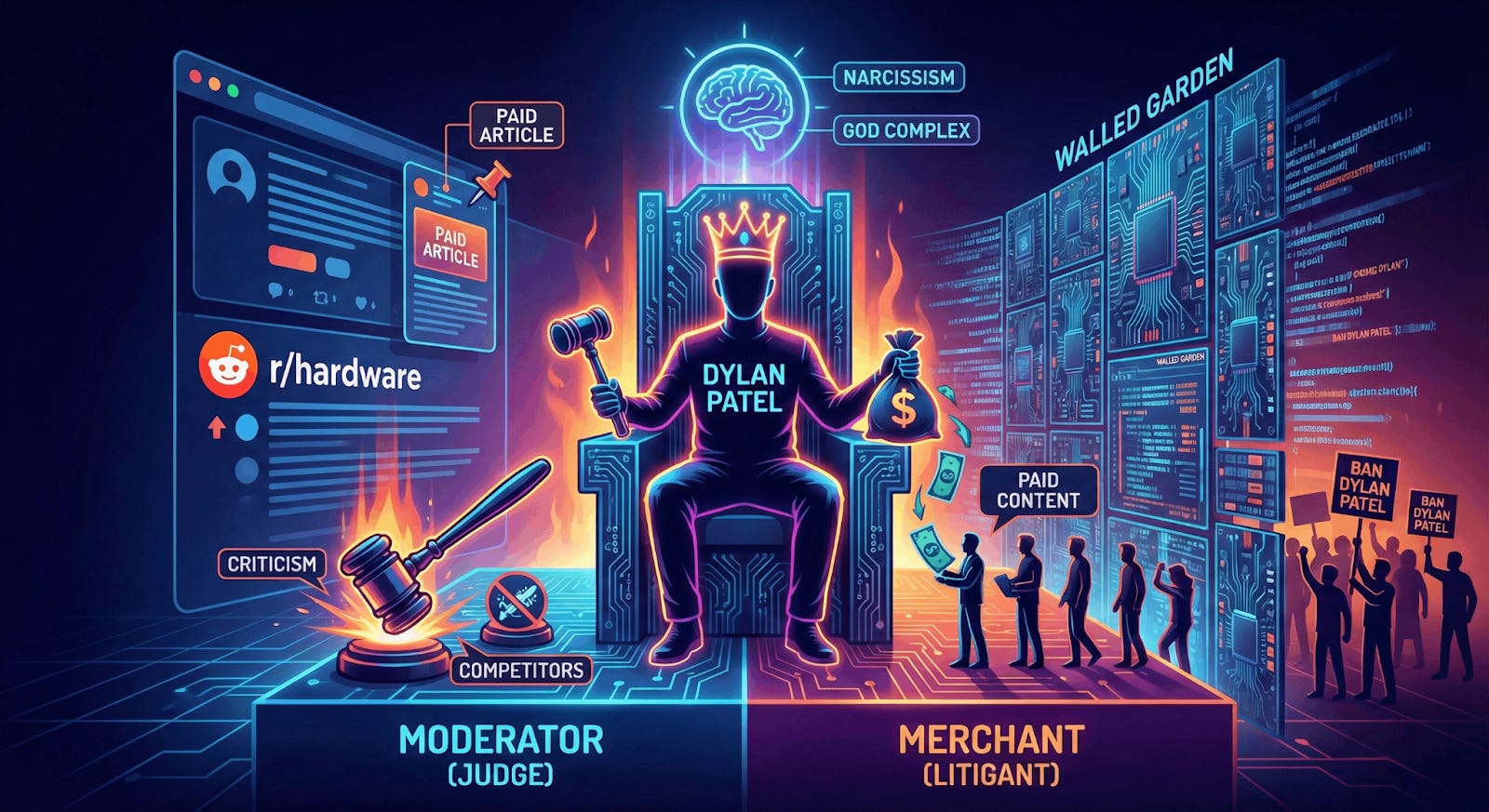
Dylan Patel’s interactions with the broader community are characterized by a high degree of combativeness and a lack of professional detachment. He frequently defaults to the dismissive response of, “You didn’t read it,” a tactic clearly designed to provoke frustration and keep the engagement metrics climbing.
It’s less about correcting misunderstandings and more about stoking conflict to juice visibility. Once the reaction is triggered and the attention captured, any hope of meaningful dialogue disappears, follow-up questions or attempts at genuine discourse are almost always met with silence.
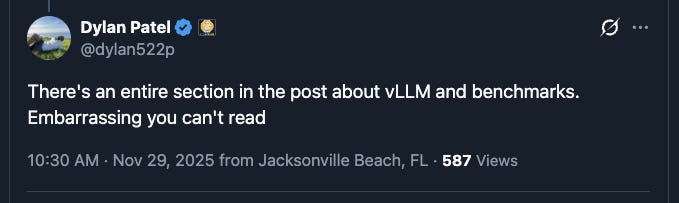
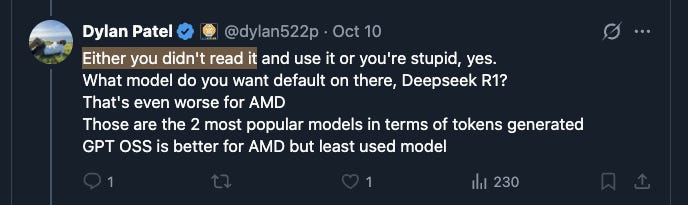
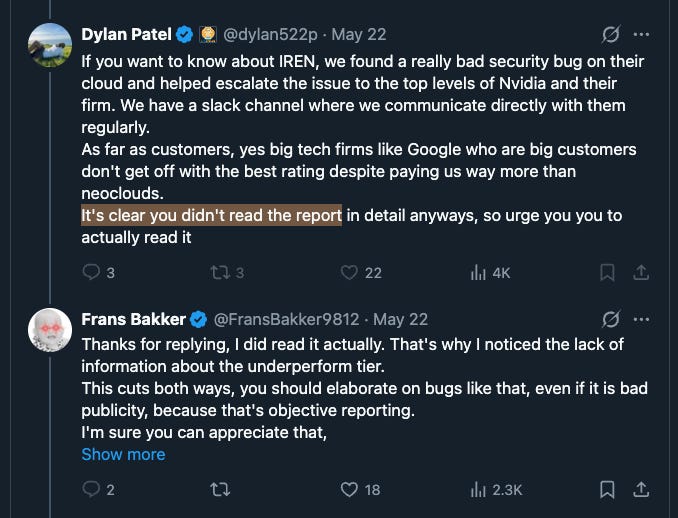
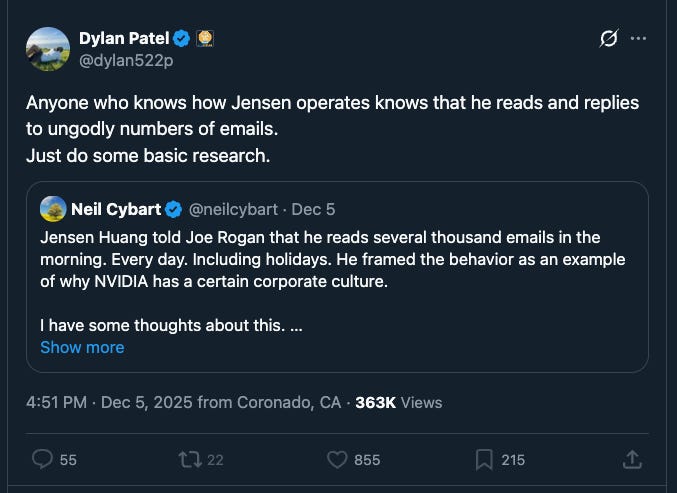
‘Anyone who knows how Jensen operates’ is just a flex to imply he’s above everyone else. And ‘just do some basic research’ feeds straight into the god-complex vibe.
Zero Humility: When challenged on technical points or bias accusations, the response is rarely a data-driven rebuttal but often a dismissal of the critic’s credentials or intelligence. “I think the guy has... absolutely 0 humility,” notes one observer.1 This trait is dangerous in an analyst. Markets are complex and humble; an analyst who believes they are infallible is prone to confirmation bias.
The Moderator-Merchant Conflict: Perhaps the most egregious governance failure is the allegation that Dylan Patel acts (or acted) as a moderator for key discussion hubs like r/hardware while simultaneously using them to promote his paid content. This is a textbook conflict of interest. A moderator is a judge; a content creator is a litigant. Using judicial power to ban competitors, suppress criticism, or pin one’s own articles to the top of the feed is a corruption of the community discourse. It creates a “walled garden” where the only “truth” allowed is the one that SemiAnalysis sells. The calls to “Ban Dylan Patel” from these communities highlight the depth of the resentment toward this manipulation.
It is worth noting that Dylan’s 13-year history of participation on Reddit has now dropped off significantly, and his last few comments were all combative. https://www.reddit.com/user/dylan522p/comments/
In his recent, and somewhat curiously timed, piece on “Getting off Twitter,” Dwarkesh Patel highlights a familiar tendency: stepping away from a community when the environment shifts against you.
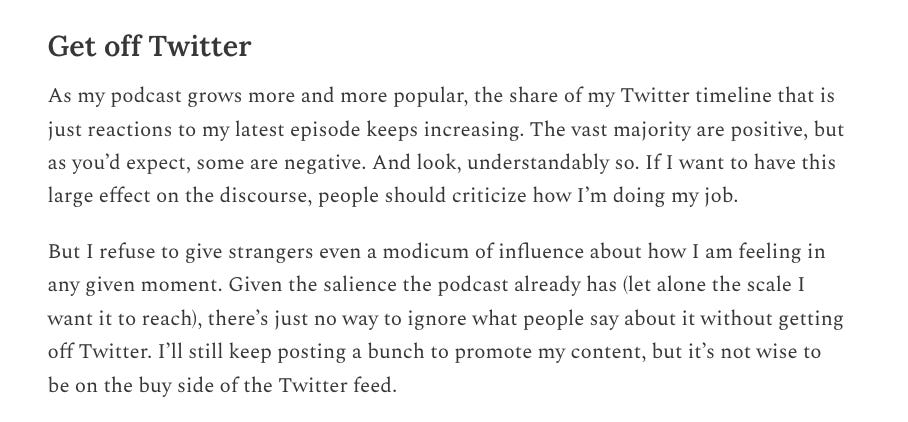
https://www.dwarkesh.com/p/dec-strategy-doc
The “Roommate Nexus” and the firm’s increasing alignment with large labs have led to accusations that the firm has lost its objective edge entirely. Following the recent joint interview with Microsoft CEO Satya Nadella (conducted by roommates Dylan and Dwarkesh), Clem Delangue, CEO of Hugging Face, publicly skewered the group’s stance. Delangue stated on X: “Great interview but am I the only one who feels like @dwarkesh_sp and @dylan522p sound brainwashed by big model labs?”
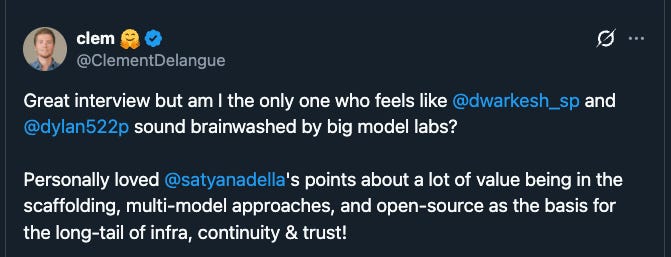
https://x.com/ClementDelangue/status/1988712755126292952
This “brainwashed” allegation from a major industry CEO reinforces the view that SemiAnalysis has been “bought” by the very ecosystem it claims to analyze. Instead of offering critical, independent due diligence, the firm is seen as regurgitating the talking points of the “Big Model” incumbents, a behavior that could be explained by the “Roommate Nexus” with Anthropic and the consulting contracts with major players.
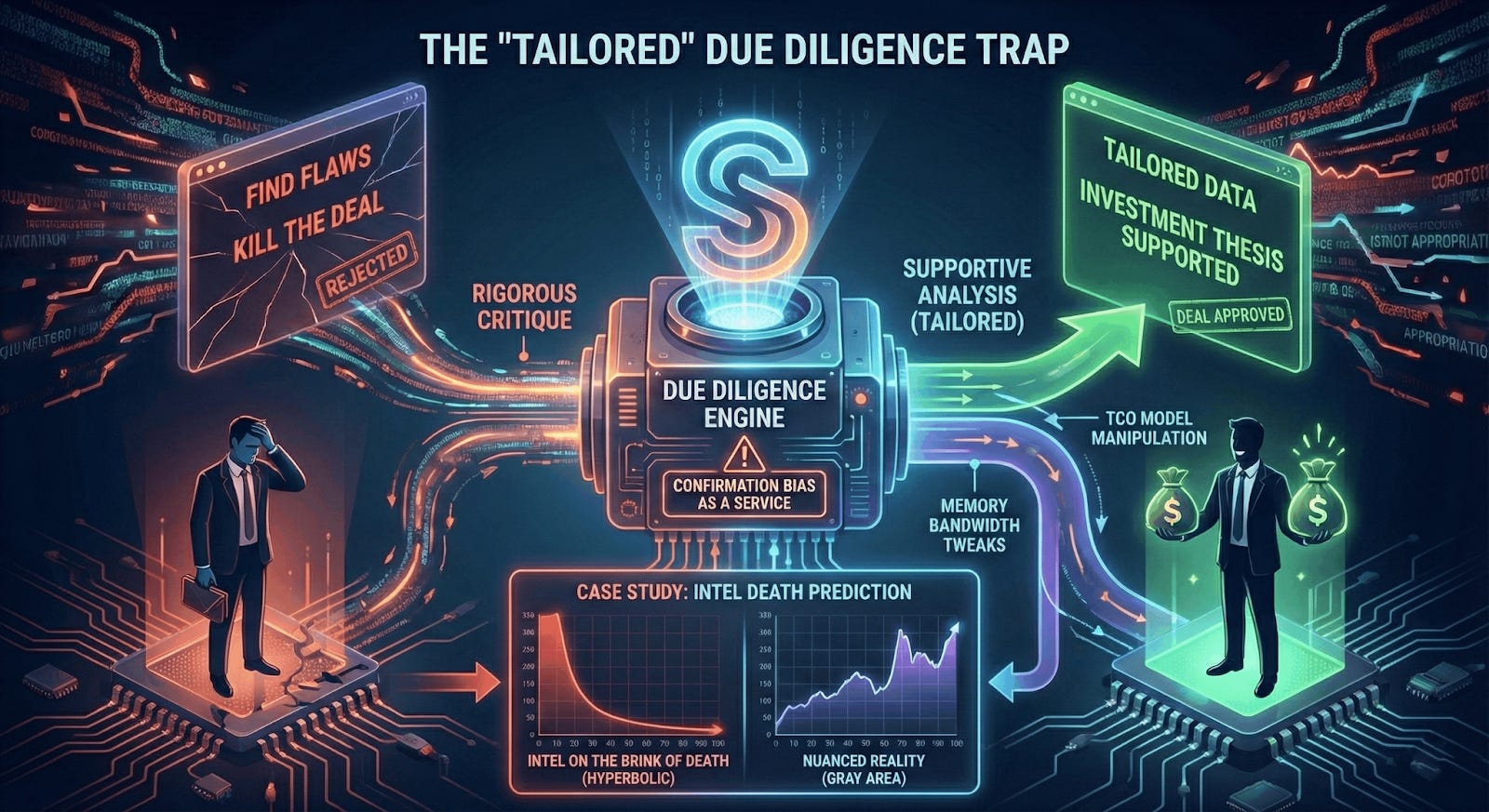
“Tailored” due diligence is a euphemism for “confirmation bias as a service.” When an investor engages SemiAnalysis to vet a potential investment (e.g., a new AI chip startup), the firm has two options:
Rigorous Critique: Find the flaws, potentially killing the deal.
Supportive Analysis: Find data that supports the investment thesis, ensuring the deal goes through and the investor (the client) is happy.
Because SemiAnalysis sells both public research and private technical diligence, there’s always a risk that complex TCO models end up telling busy paying clients what they want to hear. From the outside, it’s impossible to verify how neutral those assumptions are, which should make investors cautious about treating any single model as gospel.
Operating a NeoCloud and being privy to confidential NDA-restricted pricing for compute, I can say with absolute certainty that real-world pricing dynamics are vastly more complex than the sanitized “TCO models” pushed by SemiAnalysis.
Every major deal is wrapped in secrecy, with vendors insisting that everyone receives the same pricing, a claim that can never be independently verified without someone breaching confidentiality. And the consequences for breaking that trust are not theoretical, they are existential.

Lose access to GPUs or supporting infrastructure, and your entire business collapses overnight. This opacity creates fertile ground for selective narratives, where analysts can present oversimplified models as objective truth while ignoring the hidden variability and high-stakes leverage that actually determine who succeeds and who gets priced out of the market.
The firm has frequently predicted the demise of Intel, publishing articles with titles like “Intel on the Brink of Death | Culture Rot, Product Focus Flawed, Foundry Must Survive”. While Intel has certainly struggled, the hyperbolic nature of these reports suggests a “tailored” narrative that benefits short-sellers or competitors. When Intel fails to die and instead secures new funding or government grants, the “due diligence” looks less like analysis and more like a hit piece. The firm’s predictions are often binary and extreme, “Crush,” “Death,” “Moat”, which sells subscriptions but fails to capture the nuanced, gray reality of corporate turnarounds.
In this final section, I’ll just keep updating it with the absurdity.
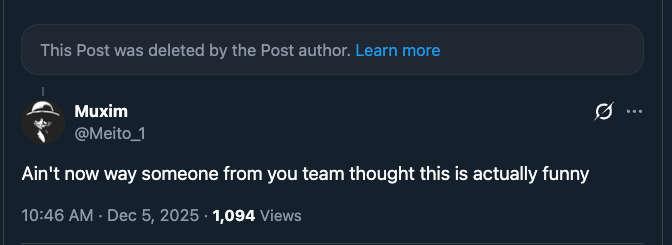
Dec 5th
I spoke up, and I wasn’t the only one. They deleted their posts on Twitter and LinkedIn. If no one pushed back, just like with this article, they’d keep believing this kind of behavior is acceptable.
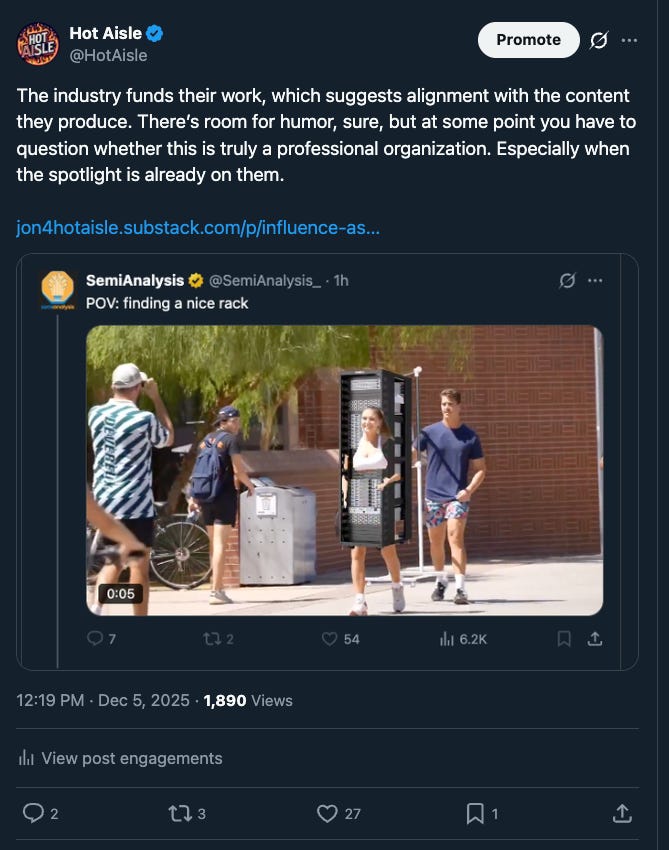
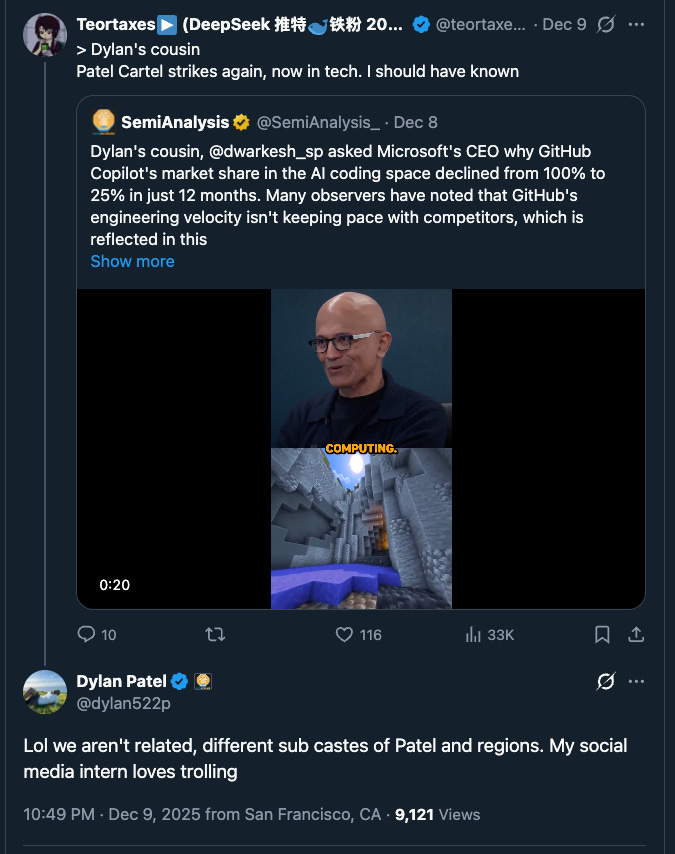
Dec 9th
Trolling, blaming the caste system, blaming the intern.
Dec 13, 2025

China is realizing they are being played by SemiAnalysis, going so far as to use my own “clown” characterization.
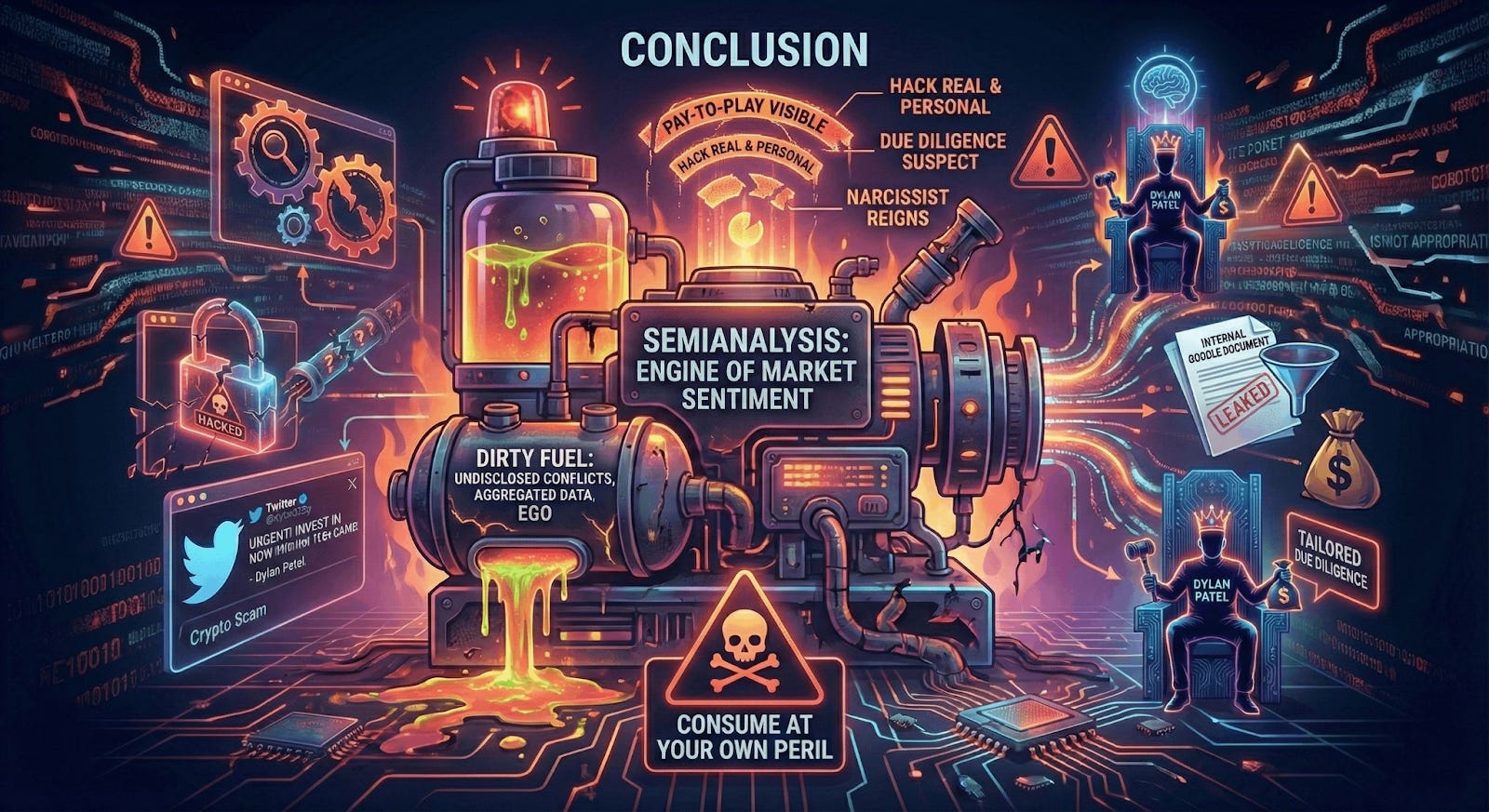
The investigation into SemiAnalysis reveals a firm that operates at the bleeding edge of the information economy, but does so with a cavalier disregard for the ethical and operational safeguards that define professional equity research. The firm is “not clean.” It is stained by a business model that incentivizes conflict of interest, an operational culture that ignores security breaches, and a leadership style defined by narcissism and hostility.
The presented information is clear:
The “Pay-to-Play” pattern is visible: The AMD case study provides a chronological smoking gun of how criticism could transform into consulting revenue.
The “Roommates” Conflict is Real: The confirmed co-habitation of the analyst (Dylan), the media host (Dwarkesh), and the competitor (Anthropic’s Sholto Douglas) creates a questionable “Insider Nexus” that distorts independent analysis.7
The “Hack” was real: SemiAnalysis’ account was hijacked to peddle a crypto scam, a humiliation that was swept under the rug rather than transparently addressed.5
The “Due Diligence” is suspect: Methodologies like “neocloud pricing” 2 and the “no moat” leak demonstrate a preference for sensationalism and easy data over rigorous, original engineering validation.
The “Narcissist” reigns: The CEO’s digital footprint confirms a “God Complex” that alienates the community and biases the analysis.1
The “Brainwashed” Allegation: Industry peers like Hugging Face’s CEO have publicly called out the firm’s alignment with big model labs, further eroding trust in their impartiality.
Consulting conflicts, security lapses, leak-driven scoops, and online hostility. SemiAnalysis comes across, in my view, as an influence business with serious governance and optics problems. Readers of their content should apply a heavy bias-adjustment before treating their output as neutral analysis.
When I first engaged with SemiAnalysis, I genuinely believed they were a respected voice in the industry. I went out of my way to accommodate them, providing early, free access to our servers and engaging in open, candid discussions with their team.
The relationship soured March 2025, after they labeled us “underperforming,” a move that felt like a punch to the gut. It dismissed not only the work my team had poured into our business, but the accomplishments of others on that list as well.
If Dylan had demonstrated even a bit of emotional intelligence, reached out privately, acknowledged the situation, or recognized that we met their SOC 2 requirement just three months later, in record time, I would have gladly accepted any gesture of goodwill.
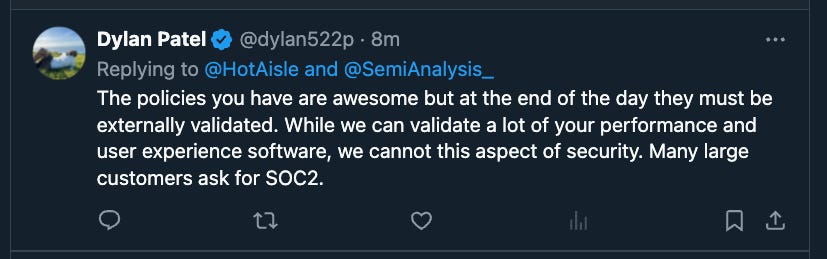
He chose to double down, and at that point, I felt I had no choice but to respond. I began paying closer attention to his history, his business practices, and the influence he wielded. That’s when it became clear that some of the behaviors shaping the analysis ecosystem carried real risk. I also learned I wasn’t alone. Many others shared similar concerns, but voiced concerns about retaliation behind closed doors.
I genuinely believe none of this is irreversible. The firm clearly has talent, reach, and a genuine opportunity to contribute positively to the industry. Stronger security practices, clear disclosure of business and financial relationships, more rigorous methodology, and a shift toward collaborative rather than adversarial (or dismissive) engagement would go a long way.
This critique is feedback from someone who truly wants to see more trustworthy analysis in a field that directly shapes the future of AI. If Dylan and SemiAnalysis take this moment to evolve, add transparency, work to restore confidence, and commit to higher standards, everyone in the ecosystem benefits. Because when you’re in a position to influence billions of dollars in decisions, accountability isn’t a burden, it’s part of the job.
End of Report.
There are many people I would thank by name for helping me prepare this report, but I won’t, out of respect for the risk they would take in doing so publicly. You know who you are, and I’m grateful.
The silence in this industry isn’t because people agree with the status quo, it’s because they’re afraid of the consequences. The support I’ve felt behind the scenes makes one thing very clear: I am not alone in believing this needs to change.