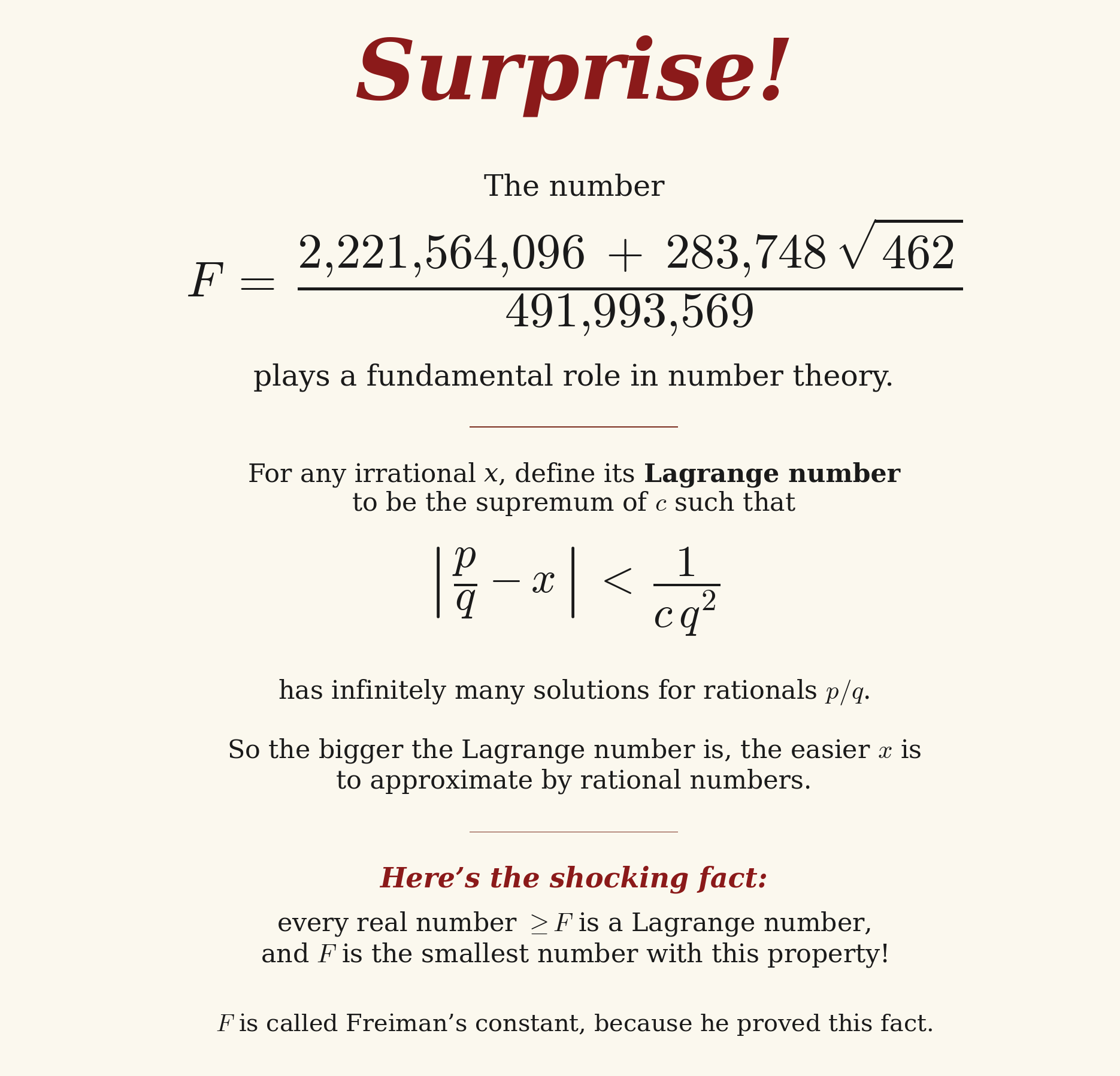
I recently asked people on Mastodon “What’s the most surprising fact you’ve learned in the last couple of weeks?” It was a nice way to learn a lot of interesting things. My own biggest recent surprise was this: the number

plays a fundamental role in number theory!
For any irrational 


has infinitely many solutions for rationals 

Quite famously, the golden ratio has the smallest possible Lagrange number, namely √5. This means it’s as hard as possible to approximate using rational numbers.
The set of all Lagrange numbers is very complicated, and very interesting. But here’s the shocking fact: if
then every real number 

• G. A. Freiman, Diophantine Approximations and the Geometry of Numbers (Markov’s Problem) [in Russian]. Kalinin State University Press, Kalinin, 1975.
There’s a lot more crazy stuff known about the set of all Lagrange numbers, which is called the Lagrange spectrum. As mentioned, the smallest number in the Lagrange spectrum is 


3 is the Lagrange number of every number whose continued fraction expansion eventually consists only of 1’s and 2’s and is not eventually periodic. Above 3 the Lagrange spectrum becomes much richer. It’s a fractal: it has infinitely many gaps, but positive Hausdorff dimension, with the dimension increasing as we move up.
Moreira showed that when we reach 

the Lagrange spectrum is a half-line. Directly below Freiman’s constant, Freiman showed there is a gap of width roughly

Here is the classic reference in English on this subject:
• Thomas W. Cusick and Mary E. Flahive, The Markov and Lagrange Spectra, AMS Mathematical Surveys and Monographs 30, AMS, Providence, Rhode Island, 1989.
The Markov spectrum is another set, containing the Lagrange spectrum, and their relationship is very interesting. Here’s a free online reference that reviews all the basics before doing more:
• Carlos Gustavo Moreira, Geometric properties of the Markov and Lagrange spectra, Annals of Mathematics 188, 145–170.
For a stripped-down account, go here:
• Wikipedia, Markov spectrum.
This entry was posted on Thursday, May 7th, 2026 at 10:27 pm and is filed under mathematics. You can follow any responses to this entry through the RSS 2.0 feed. You can leave a response, or trackback from your own site.