
As an undergrad I learned a lot about partial derivatives in physics classes. But they told us rules as needed, without proving them. This rule completely freaked me out. If derivatives are kinda like fractions, shouldn’t this equal 1?
Let me show you why it’s -1.
First, consider an example:
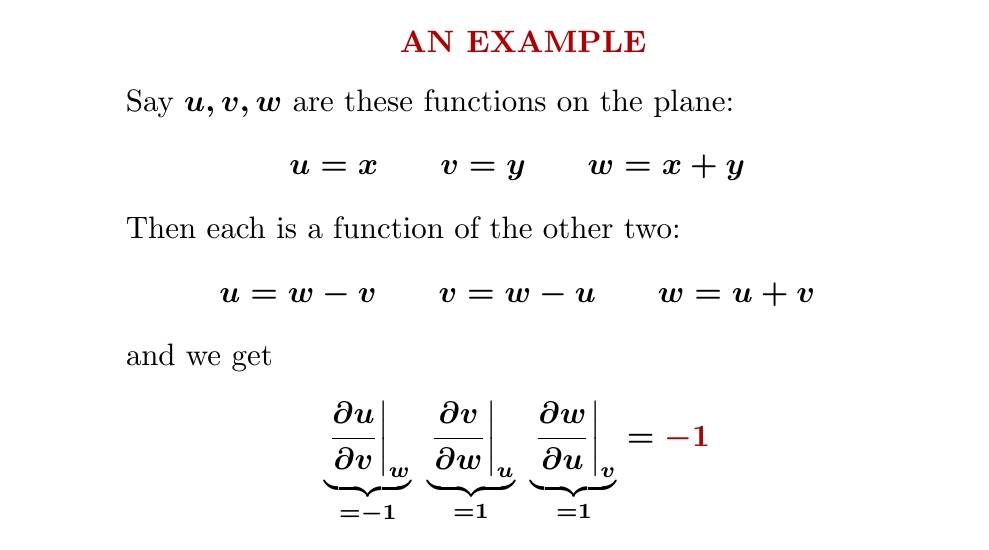
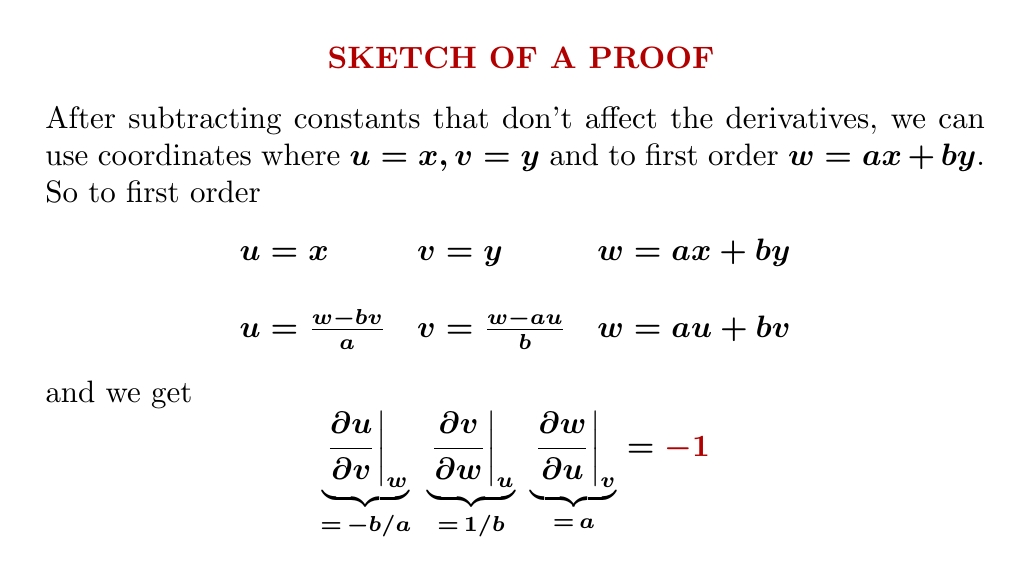
This example shows that the identity is not crazy. But in fact it
holds the key to the general proof! Since 


Then just compute!
There’s also a proof using differential forms that you might like
better. You can see it here, along with an application to
thermodynamics:
But this still leaves us yearning for more intuition — and for me, at least, a more symmetrical, conceptual proof. Over on Twitter, someone named
Postdoc/cake provided some intuition using the same example from thermodynamics:
Using physics intuition to get the minus sign:
- increasing temperature at const volume = more pressure (gas pushes out more)
- increasing temperature at const pressure = increasing volume (ditto)
- increasing pressure at const temperature = decreasing volume (you push in more)

Jules Jacobs gave the symmetrical, conceptual proof that I was dreaming of:

This proof is more sophisticated than my simple argument, but it’s very pretty, and it generalizes to higher dimensions in ways that’d be hard to guess otherwise.
He uses some tricks that deserve explanation. As I’d hoped, the minus signs come from the anticommutativity of the wedge product of 1-forms, e.g.

But what lets us divide quantities like this? Remember, 

For Jacobs’ argument, we also need that these ratios obey rules like

But this is easy to check: whenever 
• John Baez, Torsors made easy.
Finally, Jules used this sort of fact:
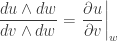
Actually he forgot to write down this particular equation at the top of his short proof—but he wrote down three others of the same form, and they all work the same way. Why are they true?
I claim this equation is true at some point of the plane whenever 
First of all, by the inverse function theorem, if 


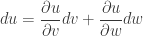
or more precisely
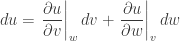
Thus
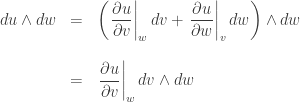
so
as desired!
This entry was posted on Monday, September 13th, 2021 at 4:21 pm and is filed under mathematics, physics. You can follow any responses to this entry through the RSS 2.0 feed. You can leave a response, or trackback from your own site.