While I often use this newsletter to explore new ideas, today I’m gonna be reflecting on some old ones. Consider this the official redux to “The Commercial Satellite Imagery Business Model is Broken,” the blog post that changed my career, and more candidly, my life. Today, I get to share an update that I’ve been looking forward to every day since I wrote it in 2020.
Today at Umbra we released sample data for the first time through the Registry of Open Data on AWS.1

Umbra@umbraspace
Our SAR open data program is now available! 10 diverse sites around the world updated multiple times a week.
umbra.space
Illuminate the World - Umbra

We’re starting small with 10 sites around the world updated multiple times a week. And we threw in a bunch of other stuff for fun including everything we’ve posted online to date (if we missed something, let me know).
All of the data is licensed the same way our paid data is licensed - openly. No login required to download. No talkin’ to sales people. No baloney (besides my tweets promoting it). All samples include detected data and most also include complex data and even phase history.2
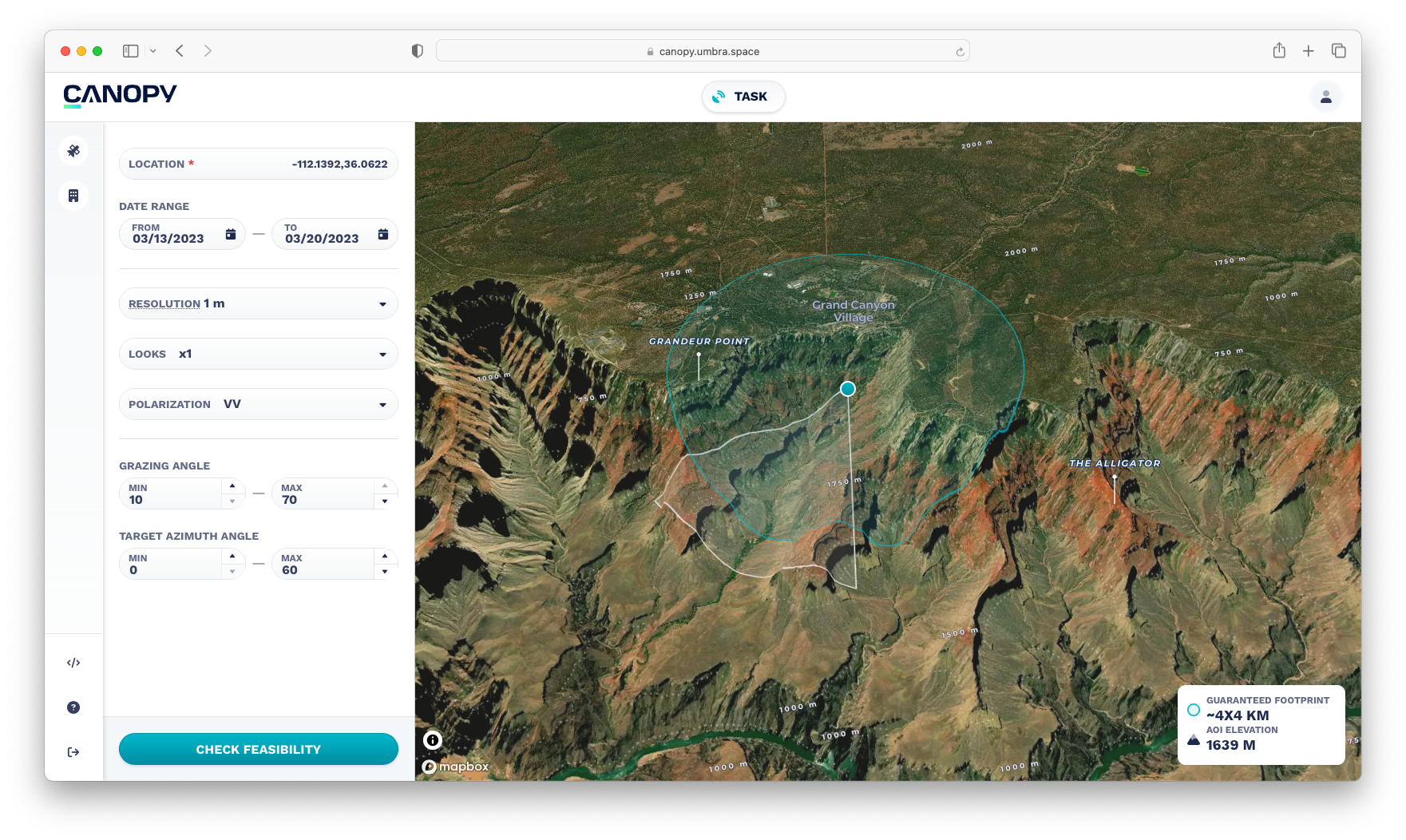
If you play around with the data and decide you want to task some fresh stuff, you can sign up to get on the waitlist for early access to our tasking platform, Canopy, here.
Oh, and did I mention the pricing is listed on the website?
To summarize:
Open data (I’ll)…
Open licensing (be)…
Self-service tasking (gosh)…
Transparent pricing (durned!)
The last few weeks of teasing our stuff on social media has led to a huge wave of interest from around the world, so please be a patient with us if you can. I promise we’re working as fast as possible to get people set up on Canopy.
If you simply must get your hands on some fresh microwave energy from Umbra, but you can’t stand waiting for direct access, then you’re in luck. Yesterday, SkyFi announced support for tasking our satellites at SXSW, so you’re actually only one swipe of a credit card away from tasking your first SAR collection: app.skyfi.com/explore/task
SkyFi@SkyfiApp
Starting today, you can purchase @umbraspace synthetic aperture radar (SAR) images on your SkyFi app! Clouds? Nighttime? Fog? See through it all.
5:22 PM · Mar 14, 2023
16 Reposts · 43 Likes
If you don’t work in the satellite imagery industry you might read these opening paragraphs and wonder what the big deal is, because honestly, transparent pricing and open licensing are pretty boring topics. It’s all so obviously where the world is headed, and therefore, where this industry is headed. And yet…somebody’s gotta take the plunge. Might as well be us.3
I honestly, unabashedly, cringe-worthily believe Umbra is going to change the world. Half of that equation is our technology prowess, and to be fair, that’s a really impressive competitive moat.
However, in my opinion, the bigger deal is our courage to approach the market in a novel way. Some have called us unsavory names for taking this approach. I’ve personally been called naive and idealistic more times than I can count. I was only called an idiot once, that I can remember, but it left an impression. If you aren’t pissing off the old guard, what are you even doing?
The truth is that satellite imagery is invaluable for some of the most dire challenges that arise in the world, but it’s under-delivering on its potential. And fixing the business model is the first step toward reaching that potential.
Joe Morrison@mouthofmorrison
Insights derived from Earth observation data is already a fundamental part of most peoples’ lives and yet we’ve still only unlocked maybe 1% of its potential

Eric Jorgenson @EricJorgenson
What one idea are you building your entire career around?
2:39 PM · Feb 23, 2023
2 Reposts · 46 Likes
Our strategy, in a nutshell, is to simply not jerk people around. And I think that in the coming years, if we can demonstrate that this strategy not only works but works splendidly, customers will demand better of our competitors and the contagion will spread. The result, I believe, will be a dramatic increase in the productivity of our small sector of the economy and a heck of a lot more benefit to society.
Today is an inflection point, but we are only just barely getting started. We aren’t out to become the best SAR provider - we are hellbent on permanently and irrevocably changing this entire industry for the better.
Exactly three years ago, I made the difficult decision that I needed to leave the satellite imagery industry. I was fed up. I realized that I was wasting my time. My head was black and blue from banging it against the same wall so many times.
For the prior three years, I had been pouring myself into Raster Foundry and Raster Vision, the open source satellite image processing and analytics tools we were building at Azavea.4 Unfortunately, they never took off the way we'd all hoped.
The biggest problem wasn’t a technical one - it was a cultural one. Satellite imagery providers were not equipped to support small clients; they refused to quote standard pricing, often tried to steal our customers, and occasionally even hired us to unwittingly help them steal customers from our competitors! That was especially messed up!5
When I thought I had found my next opportunity outside of the satellite imagery industry, I wrote an open letter of sorts—a breakup letter in my mind—called “The Commercial Satellite Imagery Business Model is Broken.” I figured it might help some of the suckers I was leaving behind.
The response was immediate and profound.
I was saying the quiet part out loud - repeating cliched observations that industry insiders had been lamenting privately for years. It was the first thing I ever wrote that more than a dozen people read, and the response to it changed my life.
Of the hundreds of people who reached out to me after that blog post, one of them was particularly persistent. Gabe Dominocielo, the founder of Umbra. He had to follow up with me multiple times, because I was so jaded by previous bad experiences that the first time I went to the website and watched the hype video, I got the wrong impression that it was all vaporware…6
I’ll be honest - even after I met Gabe, I was skeptical. What he was proposing sounded too good to be true (even for “naive” and “idealistic” me). Transparent pricing. Open licensing. API-first development. Essentially, every box on my wish list checked off - and he was even more adamant about it than I was.
I’ll never forget one of my first strategy meetings after joining Umbra. We were debating our licensing approach - I didn’t think they’d go for CC BY 4.0, so I suggested a custom, but very permissive license. And Gabe got so offended. He was furious that we’d even consider a half measure - were we going to flip this industry upside down or was I too chicken??
After that call that I realized I’d found my home. And I haven’t looked back a day since.
Nothing you see today is the result of any one person. It’s a heroic effort that many dozens of people have worked on tirelessly - in at least a couple cases for almost eight years solid. A healthy portion of the people who built the software at Umbra were also contributors to Raster Vision and Raster Foundry - for a handful of us, this is a second act. And I’m grateful to work with those folks (and the many new close friends I’ve met since joining) every day.
Looking back, the last two years have been kind of incredible:
Built, tested, and launched five satellites with a sixth set to launch in less than a month.
Built an automated ground system
Built Canopy, our self-service tasking and data delivery platform, on top of that ground system
Built a set of internal tools for controlling the satellites, QA’ing the data coming off of them, and ensuring timely delivery to customers
Rebranded the company (twice)
Tripled in size from 30 to 90+
Recruited and hired half of the C-Suite
Onboarded our first customers, many of whom had been waiting patiently for years
Signed a major partnership with Maxar, the leading satellite imagery provider in the world
And as of today…released sample data for the first time. Pretty dang cool.
I honestly think this team is building a generational business…the kind of thing that I may only ever get one shot at in my career, as much as I hope to do this over and over again.
There’s quite a lot of work still to do, and I’m not counting my chickens just yet. But, I can see the path ahead of us stretching many years into the future, and I’ll savor every moment of the journey while I can.
It’s all next.
Step 1 was fix the business model. Step 2 is grow the market together with customers using our data to build products that their customers don’t even need to know involves SAR.
Sure, the data we released is exciting to the tiny group of people that follow the commercial SAR industry. Internally, we call them the “First 100,” the most innovative remote sensing analytics firms on the planet. That’s our target audience.

And I hope those 100 organizations are excited. After all, the data is conspicuously high resolution compared to what people are used to, and it’s affordable compared to what others charge.
But for the rest of us, what we are announcing today are just necessary preconditions. We need a movement - a wave of entrepreneurs able to turn this raw material into finished products and services that normal people can get value from.7
It turns out the old hype video I watched when Gabe was first recruiting was real. We really can produce a ridiculous amount of high resolution data per satellite per day. What you see in the sample data folder is not some concerted effort - that’s mostly just what our marketing director does in his (extremely limited) spare time. There is a lot more to come.
They say a rising tide lifts all boats. Prepare for the flood. Other SAR providers, optical satellite imagery companies, analytics firms, world governments, non-profits, Fortune 500 companies, academic researchers, anyone excited about applying remote sensing data to solve problems - we need all the help we can get to make the most of this new step function change in available, affordable, high resolution SAR. And there’s about to be a ton more of it available this year.
Depending on which category you fall into: